 EN
EN
Meta title: Launch an Inositol Brand Without Expensive Mistakes
Meta description: Turn an inositol idea into a sellable supplement with the right customer, form, dose, format, MOQ, testing, packaging, claims and reorder plan.
Buying inositol powder is easy.
Building an inositol product that customers understand, retailers accept, factories can manufacture and your cash flow can survive is much harder.
Most startup mistakes begin with a supplier asking, “How many bottles do you want?” before anyone has answered a more important question:
What exactly are you selling, to whom, and why should they choose it again next month?
If those answers are missing, a low-MOQ private-label offer can lock you into a generic formula, an unrealistic capsule count, weak claims and packaging that looks identical to every other listing.
This launch blueprint turns the process around.
Step 1: choose one customer before choosing one formula
“Women who want wellness support” is not a customer definition. It is an audience too broad to guide a product.
A clearer target could be:
- first-time buyers comparing 40:1 products;
- customers who dislike swallowing multiple capsules;
- practitioner-recommended users who expect technical transparency;
- subscription customers who want a 30-day routine;
- premium DTC customers who want a clean single-ingredient powder; or
- retail buyers who need a documented and shelf-ready product.
Each customer changes the formula, format, bottle, label, content and price.
A powder may suit a customer comfortable with scooping gram-level servings. Capsules may suit convenience but require several units. A complex formula may create a stronger story but also increases testing, claim and stability questions.
Start with our custom inositol product-development brief.
Step 2: define the ingredient before discussing the dose
Do not approve “inositol” as a generic line item.
Decide whether the product uses:
- Myo-Inositol;
- D-Chiro-Inositol;
- a defined Myo/DCI combination;
- another specifically identified inositol form; or
- a multi-ingredient blend.
Then define the manufacturer, source, specification, test methods and market position.
This decision controls the research you may discuss and the label language you may use. It also prevents a supplier from selecting the cheapest product hidden behind a broad name.
Step 3: stop treating 40:1 as a complete formula
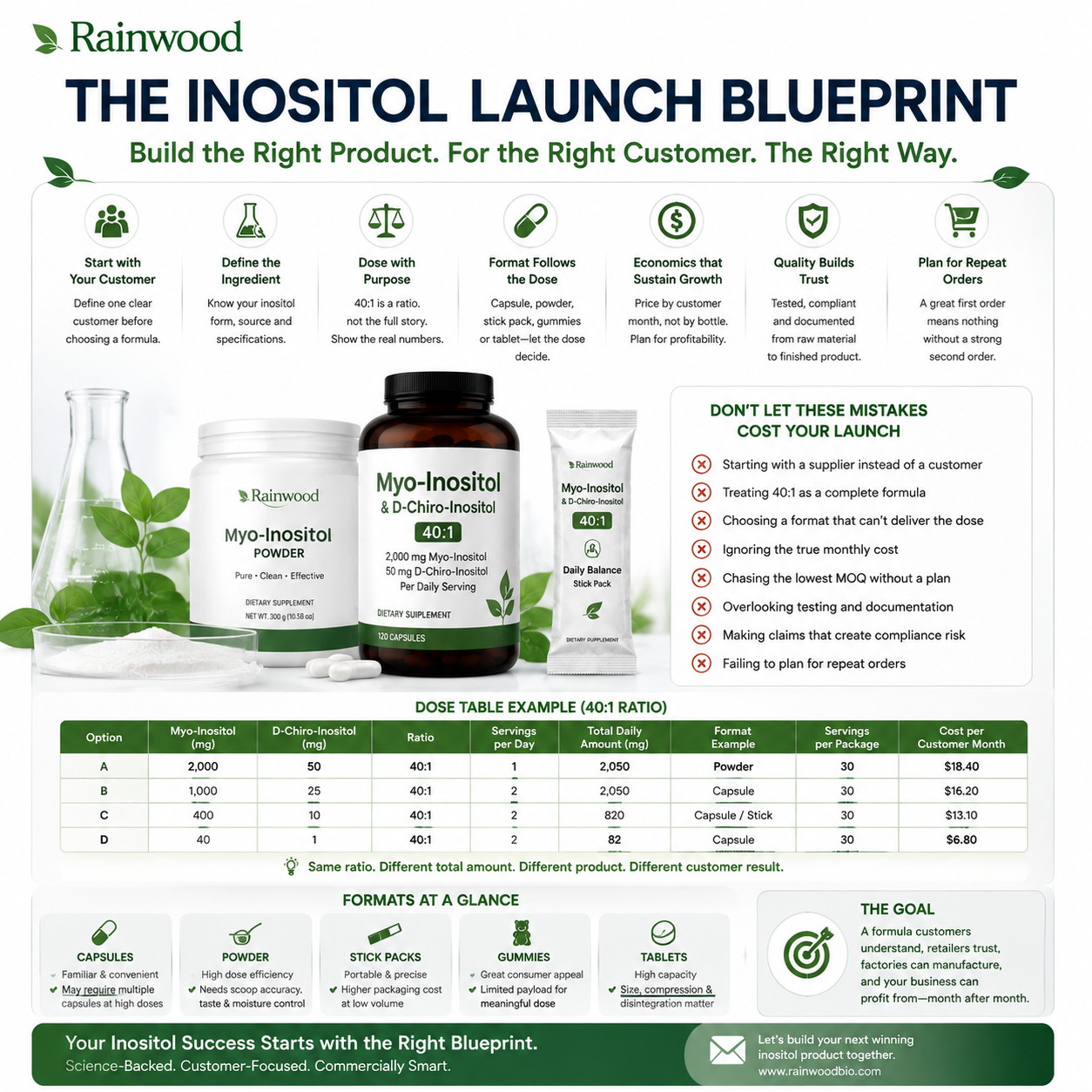
The ratio is only a relationship. It does not tell you the total daily amount.
These are all 40:1:
- 2,000 mg Myo-Inositol plus 50 mg DCI;
- 1,000 mg plus 25 mg;
- 400 mg plus 10 mg; and
- 40 mg plus 1 mg.
A startup can therefore copy the market’s favourite ratio and still launch a formula that looks weak under basic comparison.
Build a dose table containing:
- amount of each ingredient per serving;
- servings per day;
- total daily amount;
- evidence or commercial rationale;
- capsule, scoop or sachet count;
- servings per package; and
- cost per consumer month.
Do not let a large “40:1” graphic replace those numbers.
Step 4: make the format obey the dose
The dose must choose the format—not the other way around.
Capsules
Capsules are familiar and easy to merchandise, but gram-level Myo-Inositol products may require multiple capsules per day. That changes shell cost, filling time, bottle size and consumer routine.
Powder
Powder carries a higher dose efficiently and can create a clean formula. It requires scoop or sachet accuracy, moisture control, dissolution expectations, taste positioning and honest servings-per-container communication.
Stick packs
Stick packs improve convenience and portion control. They add film, printing, packing, carton and machine setup costs. Low initial volume can make them more expensive than a bottle of powder.
Gummies
Gummies attract consumers but have limited payload. A commercially meaningful inositol amount may require too many gummies or a lower-dose positioning. Sweeteners, flavours, stability and texture add development work.
Tablets
Tablets may increase capacity but can become large and need suitable compression behaviour, binders and disintegration controls.
Step 5: build the economics around a customer month
A cheap bottle can be an expensive product.
Suppose one bottle contains 60 capsules but the daily serving is four. That is only 15 days. The customer needs two bottles per month, and your advertised unit price no longer describes the actual routine.
Calculate:
1. raw-material cost per daily serving;
2. dosage-form cost per daily serving;
3. package cost;
4. testing and release;
5. compliance and artwork;
6. freight and fulfilment;
7. platform or wholesale margin;
8. expected discounts and returns; and
9. customer cost per 30 days.
That final number determines whether the product can earn repeat purchases.
Step 6: use MOQ as a cash-flow tool, not the main strategy
A practical first order should test the business assumptions without producing an unprofessional placeholder.
Separate:
- formula MOQ;
- raw-material MOQ;
- production MOQ;
- bottle or pouch MOQ;
- printed-label MOQ;
- carton MOQ;
- stick-pack film MOQ; and
- third-party testing quantity.
A supplier advertising “100 bottles MOQ” may be quoting a stock formula with a simple label. That can be useful for market testing, but it is not the same as a custom formula, unique packaging or fully developed evidence position.
Ask what can and cannot change at each volume.
Step 7: design the proof before designing the front label
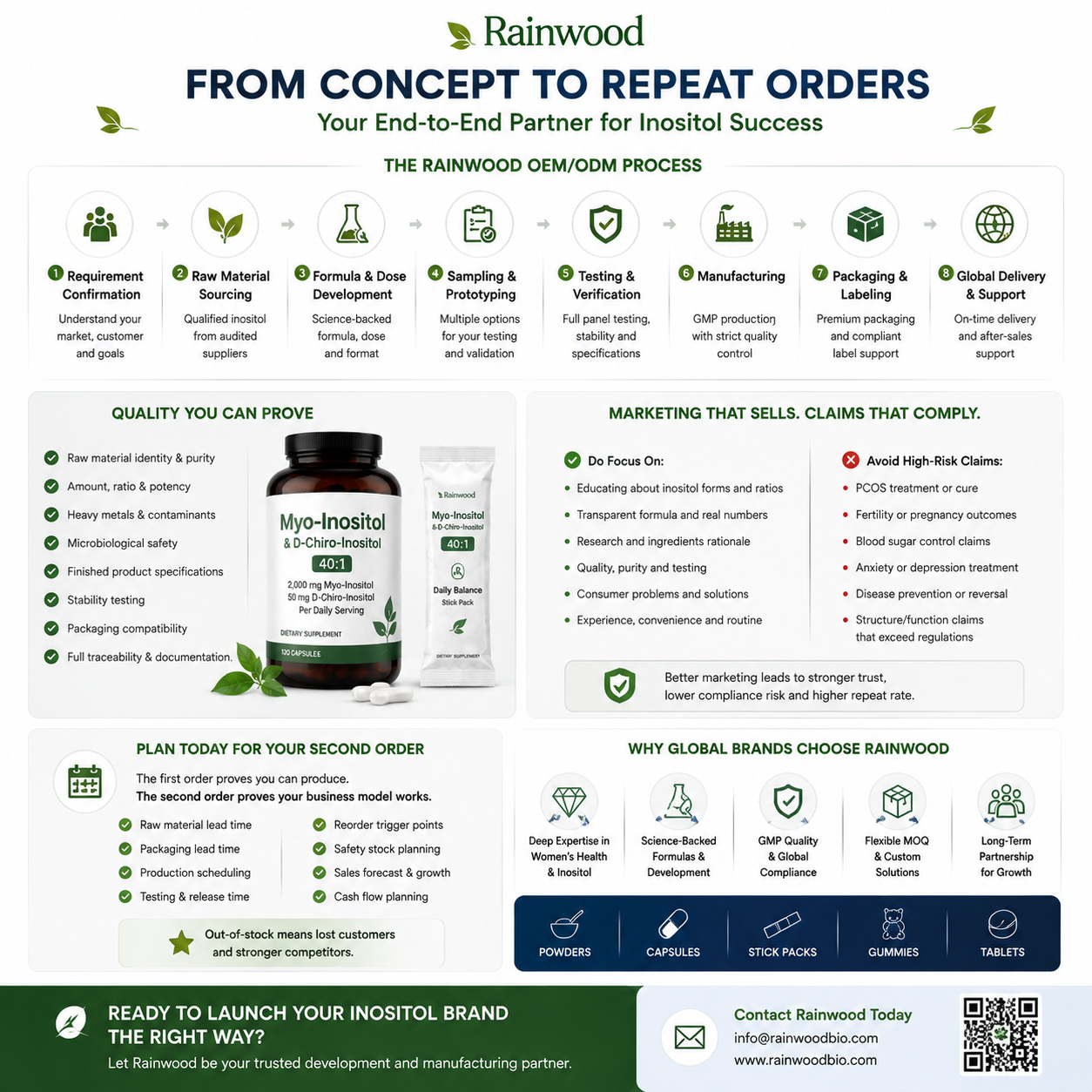
The product should have a proof plan covering:
- ingredient identity;
- potency or composition;
- ratio where applicable;
- heavy metals;
- microbiology;
- relevant residuals or contaminants;
- finished-product conformance;
- stability or shelf-life support;
- packaging suitability; and
- traceability.
Testing must match the promise. If the label states specific Myo and D-Chiro amounts, a total non-specific inositol result may not answer the right question.
Use our inositol quality and batch-release checklist before placing the first commercial order.
Step 8: sell the desire without printing a regulatory grenade
The inositol market is powered by emotionally strong customer needs. That makes the copy valuable—and dangerous.
FDA has cited an inositol seller for claims involving PCOS fertility, blood sugar, anxiety and depression. The problem was not that the words were persuasive. The problem was that they presented the supplement as treating disease.
Your content strategy can still be aggressive:
- expose confusing ratios;
- compare transparent and hidden formulas;
- discuss the category and consumer questions;
- explain ingredient and research differences;
- highlight routine, format and quality;
- use responsible structure/function territory where supported; and
- create urgency around choosing a documented product.
The best marketing does not need to promise a cure. It makes the customer feel that every competing label suddenly looks incomplete.
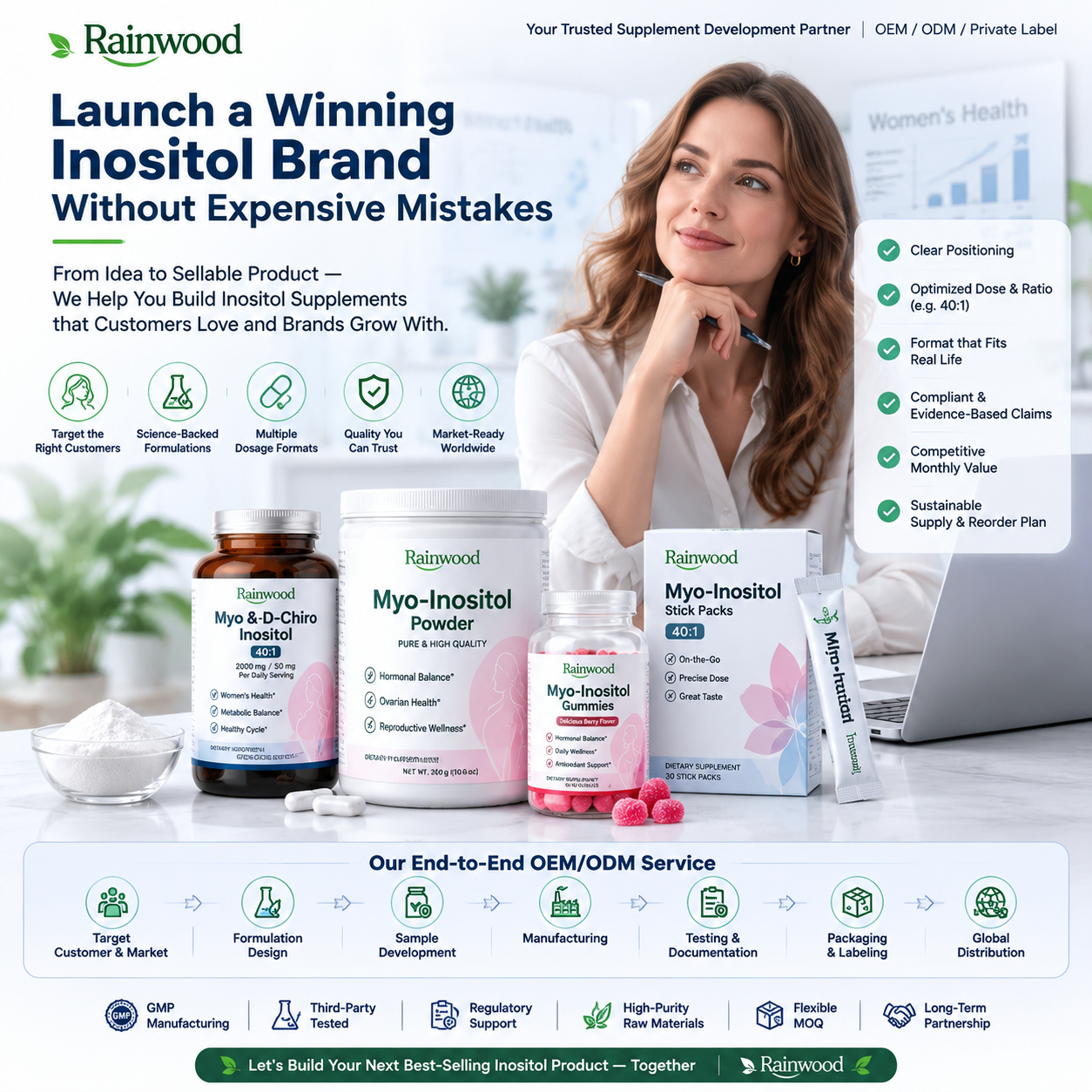
Step 9: make RainwoodBio part of the solution, not a logo at the end
RainwoodBio’s website presents the company as a Xi’an-based supplement and ingredient business established in 2006, with capabilities across raw materials, hard capsules, gummies, powders and sachets, tablets and other private-label formats.
For a startup inositol project, the most relevant strengths are the workflow:
1. requirement confirmation and compliance assessment;
2. raw-material procurement and supplier management;
3. production and process control;
4. quality testing and release;
5. compliance documentation; and
6. logistics and traceability.
That sequence can turn a vague idea into a quotation suppliers can execute consistently.
Learn more about RainwoodBio’s private-label supplement capabilities.
Step 10: plan the second order before launching the first
The first order proves feasibility. The second proves the business.
Before production, establish:
- ingredient lead time;
- packaging lead time;
- normal production window;
- laboratory release time;
- freight and customs assumptions;
- reorder trigger;
- safety stock;
- forecast scenarios; and
- change-notification rules.
A viral launch followed by eight weeks out of stock can donate your newly educated customers to a competitor.
Ask the supplier what becomes constrained when volume triples. If the answer is “nothing,” keep asking.
The startup launch brief
Send every potential manufacturer the same information:
- target customer;
- destination market;
- precise ingredient and source preference;
- exact daily formula;
- preferred format;
- units or servings per package;
- packaging requirements;
- claim territory;
- testing requirements;
- first-order quantity;
- six-month forecast;
- desired launch date;
- target retail price; and
- shipping destination.
Without this brief, the lowest quotation often wins by assuming the least.
Frequently asked questions
1.What is the best format for a low-MOQ inositol launch?
It depends on dose and positioning. Stock capsules or bottled powder may reduce component MOQs, while custom stick packs and gummies usually require more development and packaging commitment.
2.Should a startup launch Myo-Inositol alone or a 40:1 blend?
The decision should follow the target customer, market, dose, evidence strategy, differentiation and manufacturing feasibility. A popular ratio is not automatically the right brand.
3.How much testing should the first batch receive?
Use a risk-based plan that establishes identity, composition and relevant safety or quality criteria for the raw material and finished product. The exact scope depends on formula, source and market.
4.Can RainwoodBio help with packaging?
RainwoodBio publishes private-label capabilities covering multiple dosage forms, labels and packaging. The available options and MOQ should be confirmed for the selected formula and market.
Do not ask for “best price” until you have a sellable brief
Send RainwoodBio your target customer, country, formula idea, format, quantity and target retail price.
We can help organise the questions that determine whether the product fits the dose, package, evidence position and budget before you invest in artwork or inventory.
Request an inositol OEM launch feasibility review.
References
- US Food and Drug Administration, *Warning Letter to FDC Nutrition Inc. concerning claims for an Inositol 100% Pure Free Form product* (2021).
- US Food and Drug Administration, GRAS Notice No. 1198, *Inositol (Myo-Inositol)*.
- NIH Dietary Supplement Label Database, *Inositol labels and serving formats*.
- Fitz et al., *Inositol for Polycystic Ovary Syndrome: A Systematic Review and Meta-analysis* (2024).
- RainwoodBio, *About Us and OEM capabilities*.
*This article provides general product-development information and is not medical or legal advice. Formula, claims, testing and market access require product-specific review.*