 EN
EN

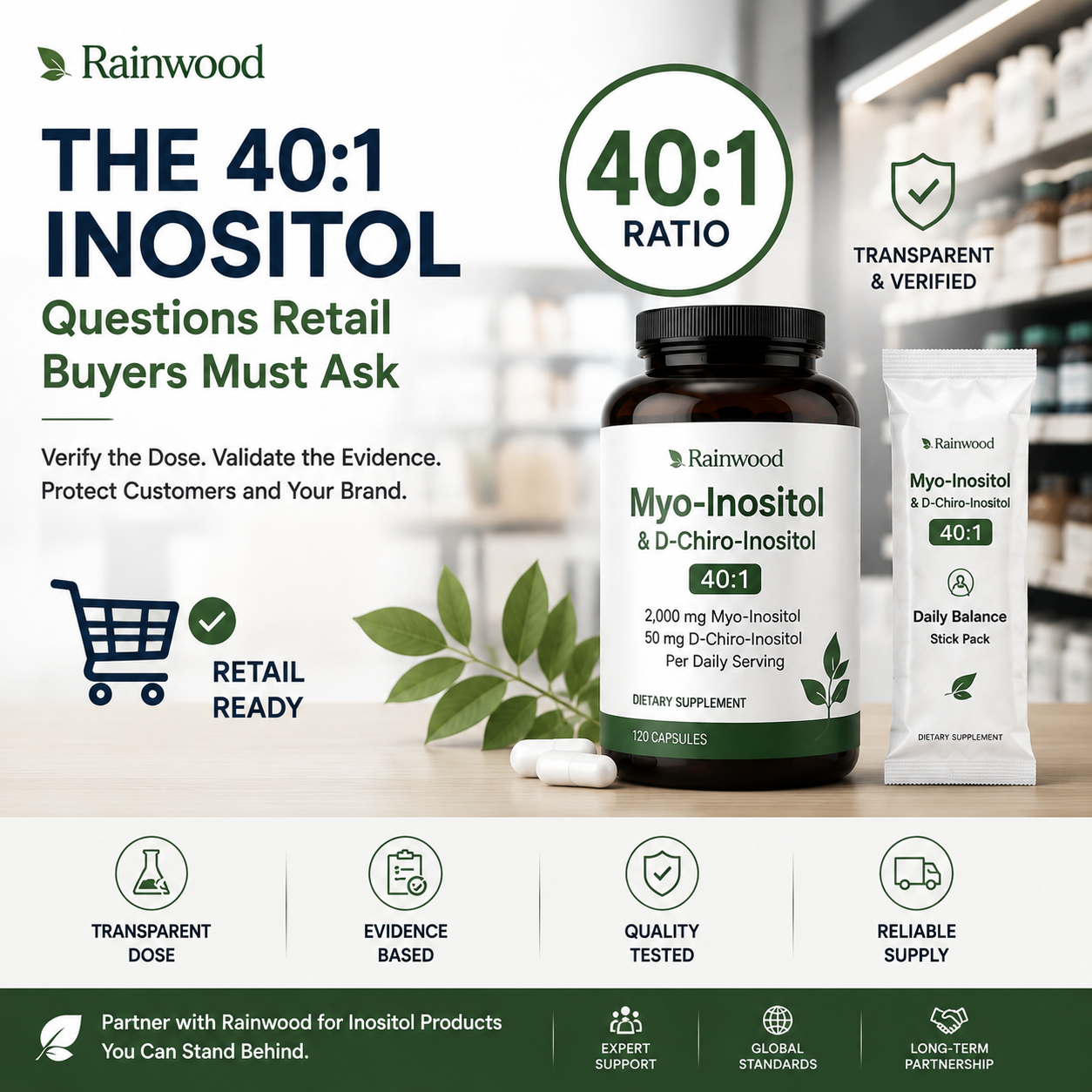
Meta title: The 40:1 Inositol Questions Retail Buyers Must Ask
Meta description: Before listing a 40:1 inositol product, retail buyers should verify exact amounts, identity, evidence, claims, testing, bottle days and supply.
“40:1 Golden Ratio” looks excellent on a shelf card.
It gives staff an easy talking point, customers an easy comparison and the brand an instant science story.
It can also hide an underdosed formula, an undisclosed blend or a ratio that exists only in the manufacturer’s spreadsheet.
Retail buyers should not reject 40:1. They should make suppliers prove what the badge means.
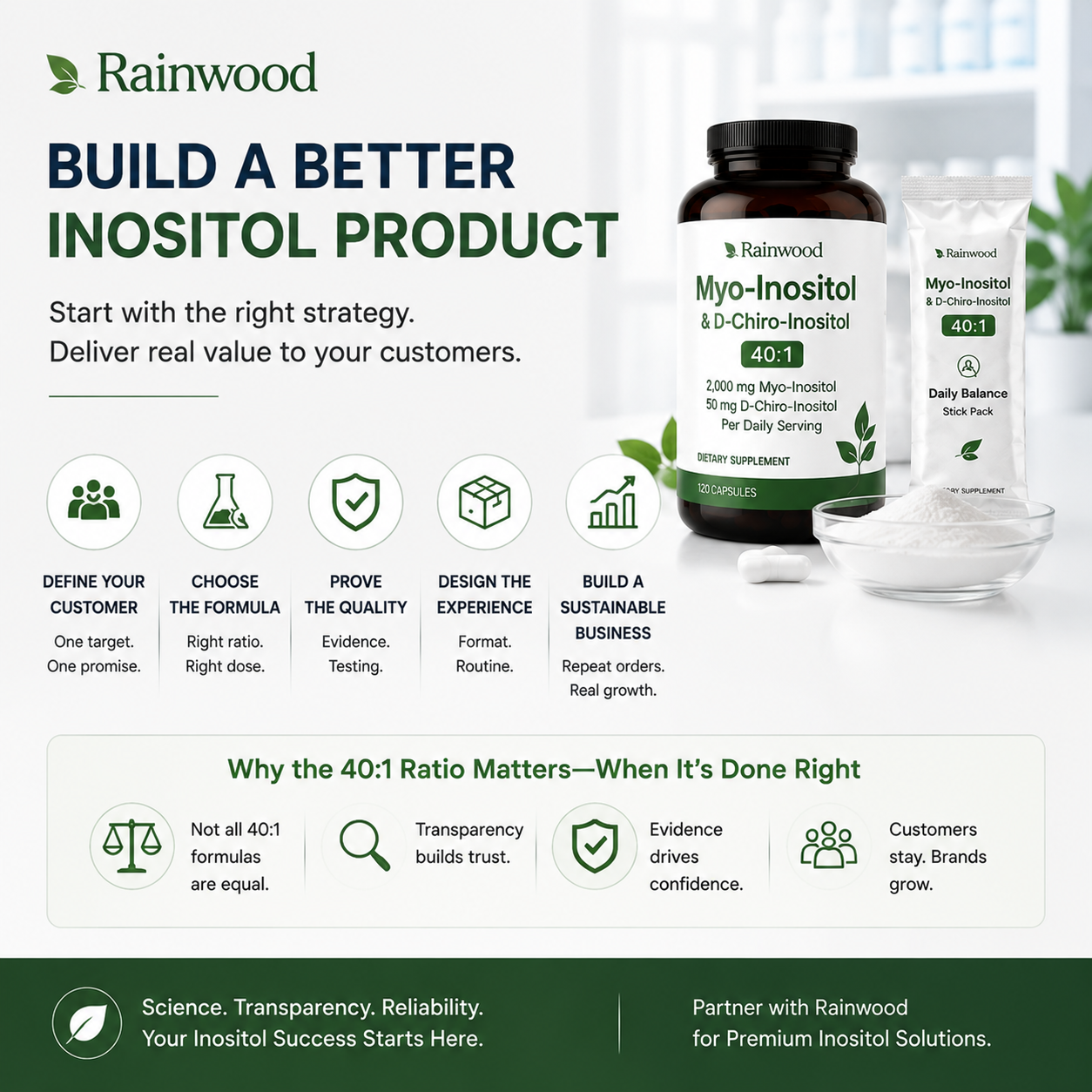
Question 1: what are the actual daily amounts?
Require:
- Myo-Inositol per serving;
- D-Chiro-Inositol per serving;
- servings per day;
- total daily amount; and
- days per package.
These formulas are all 40:1:
- 2,000 mg + 50 mg;
- 400 mg + 10 mg;
- 40 mg + 1 mg.
The shelf ticket should not compare them as equivalent.
Question 2: can the customer calculate the ratio?
If component amounts are hidden inside a proprietary blend, the retailer must rely entirely on confidential supplier information.
Ask for:
- full quantitative formula under confidentiality;
- ratio calculation;
- finished-product controls; and
- explanation of public label transparency.
The “golden ratio” should not be a black box.
Question 3: are both ingredients specifically identified?
The product file should distinguish Myo-Inositol, D-Chiro-Inositol and related materials.
Check:
- exact names;
- CAS numbers;
- original manufacturers;
- reference standards;
- identity methods;
- assay methods; and
- lot traceability.
A total inositol result may not prove both forms.
Question 4: does the evidence match the product?
The 2024 systematic review informing the PCOS guideline described the evidence as limited and inconclusive overall.
Ask the brand to map its formula and claims to:
- studied form;
- dose;
- ratio;
- population;
- duration;
- outcomes;
- limitations; and
- conflicts or uncertainty.
Do not accept “40:1 is the physiological ratio” as the complete evidence file.
Question 5: is the product page making disease claims?
Review:
- physical label;
- retailer description;
- brand website;
- Amazon page;
- images;
- FAQ;
- staff training;
- influencer content; and
- testimonials the retailer republishes.
FDA has cited disease claims for an inositol product involving PCOS fertility, blood sugar, anxiety and depression.
A retailer can inherit reputational and operational risk from supplier copy.
Question 6: can customers follow the routine?
Check:
- capsule count;
- scoop size;
- mixing instructions;
- taste;
- servings;
- bottle days;
- subscription frequency; and
- warning information.
A 120-capsule bottle requiring four capsules daily lasts 30 days—not 120.
Make sure shelf staff and e-commerce pages communicate the same routine.
Question 7: is the ratio controlled in production?
Request evidence for:
- source approval;
- dispensing;
- preblending;
- mixing;
- sampling;
- finished composition;
- batch release;
- retention; and
- change control.
Two raw-material COAs do not prove one finished ratio.
Question 8: what happens when the source changes?
A backup ingredient may change:
- identity method;
- physical behaviour;
- source claim;
- allergen position;
- finished test;
- label;
- evidence relevance; and
- cost.
Require written notification and retailer approval before material changes.
Question 9: is the “golden ratio” consistent across every channel?
Retail buyers should compare the physical label with:
- brand website;
- marketplace listing;
- distributor catalogue;
- social advertising;
- influencer scripts;
- product training;
- shelf talkers; and
- customer-service FAQ.
One channel may state exact amounts while another implies a much larger daily dose. One may use careful wellness language while another promises PCOS treatment or fertility results.
The retailer needs one controlled claim and formula source. Otherwise the same SKU carries different risks depending on where customers discover it.
Question 10: does the margin depend on customer confusion?
Calculate the real value:
- landed cost;
- wholesale price;
- retail price;
- daily serving;
- days per package;
- consumer cost per 30 days;
- expected promotion;
- return allowance; and
- retailer margin.
A high-margin bottle that creates angry reviews because it lasts 15 days is not a strong listing.
Ask the supplier to show the monthly routine, not only the unit price.
Compare the ratio at the customer’s real daily use
Some listings display the ingredient amounts per capsule, others per serving, and others per two servings. A retailer comparing only the highlighted ratio can miss that customers must multiply, divide or take the product several times per day to reach the promoted amount.
Rebuild every candidate into one standardized table: milligrams of Myo-Inositol per day, milligrams of DCI per day, units per day, days per pack and retail cost per 30 days. Then compare that table with the directions, evidence story and product-page headline.
This normalization often exposes the real differentiator. Two products can both advertise 40:1 while one delivers transparent daily amounts and the other relies on a small serving, oversized “per container” number or inconvenient routine. The ratio badge is identical; the customer experience is not.
Retailers should merchandise the product they can explain in one honest shelf conversation. Complexity that hides the daily reality will eventually return as poor reviews, staff confusion and avoidable refund pressure.
What to request in the confidential technical pack
At minimum:
- full quantitative formula;
- ratio calculation;
- ingredient specifications;
- source identities;
- representative COAs;
- finished-product specification;
- label substantiation;
- stability support;
- allergen and GMO information;
- packaging details;
- complaint contacts; and
- change-notification commitment.
The supplier does not need to publish every confidential detail. The retailer still needs enough evidence to own the listing decision.
How RainwoodBio can support a retail-ready file
RainwoodBio’s published workflow connects requirements, supplier management, production control, testing, compliance documents, logistics and traceability.
For retailers, the useful output is a structured package:
- formula and ratio table;
- ingredient specifications;
- lot COAs;
- finished release documents;
- label and package information;
- shelf-life support;
- supply plan; and
- change-control commitment.
Explore RainwoodBio’s retail and private-label supplement service.
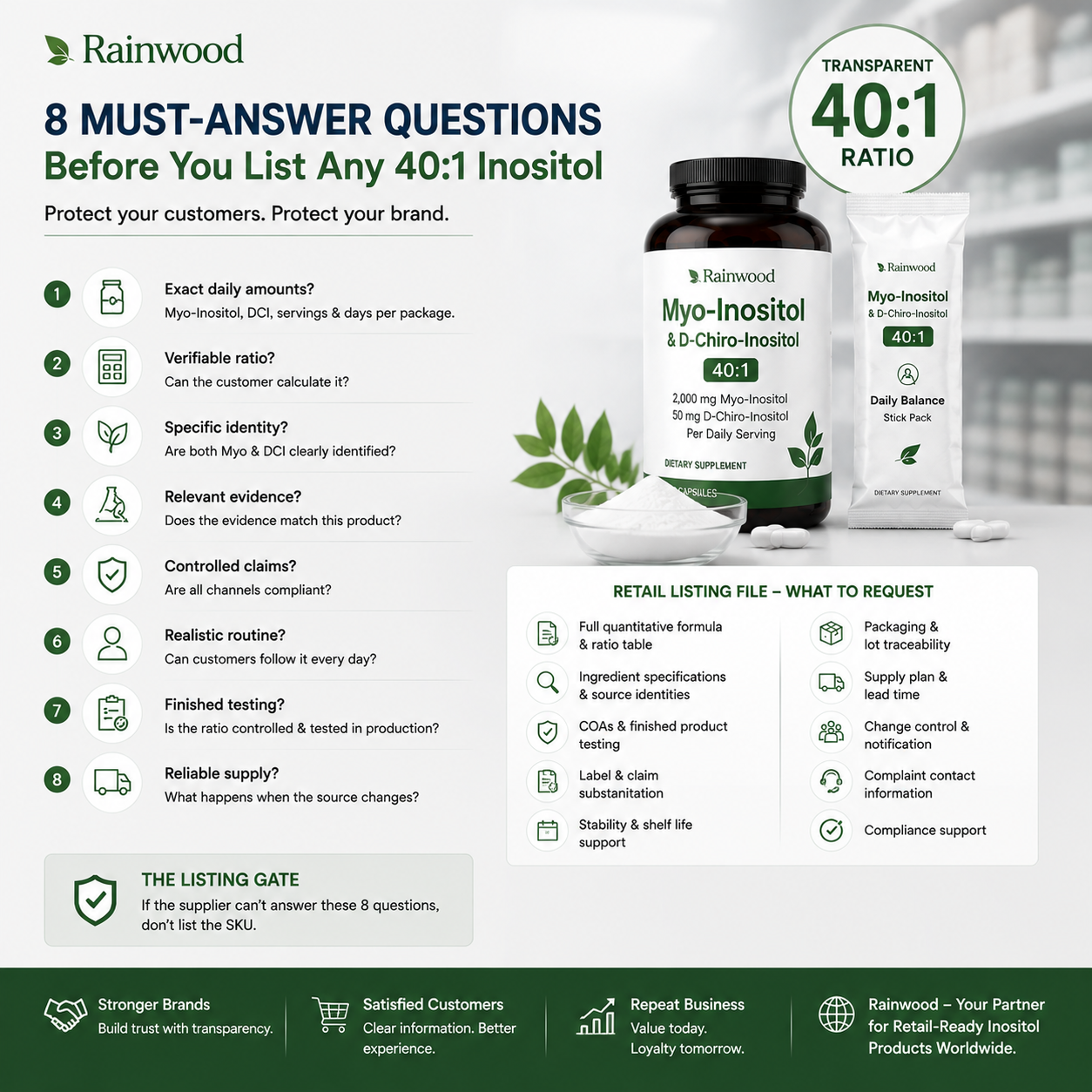
The listing gate
Do not approve the SKU until the supplier answers:
1. Exact daily amounts?
2. Verifiable ratio?
3. Specific identity?
4. Relevant evidence?
5. Controlled claims?
6. Realistic routine?
7. Finished testing?
8. Reliable supply?
If the sales deck has 40 slides but cannot answer these eight questions, it is marketing theatre.
Frequently asked questions
1.Is 40:1 a recognised legal quality standard?
It is a formulation ratio used in research and marketing, not a standalone certificate of identity, purity, safety or compliance.
2.Can a retailer request the full formula?
Commercial arrangements vary, but retailers commonly request sufficient confidential information to assess product suitability.
3.Should every retail market use the same label?
No. Ingredient status, mandatory information, warnings and claims can differ by country.
Make the ratio earn its shelf space
Send RainwoodBio the target market, retail requirements, formula, label and annual forecast.
Request a retail inositol listing-file review.
References
- Fitz et al., *Inositol for Polycystic Ovary Syndrome: A Systematic Review and Meta-analysis* (2024).
- NIH Dietary Supplement Label Database, *Inositol product labels*.
- US Food and Drug Administration, *Warning Letter to FDC Nutrition Inc.* (2021).
*This article provides general retail and product information and is not legal advice.*