 EN
EN

Meta title: Lock the Myo-to-DCI Ratio Before Production
Meta description: Control a Myo-Inositol and D-Chiro-Inositol formula through specifications, weighing, preblending, sampling, finished testing and change control.
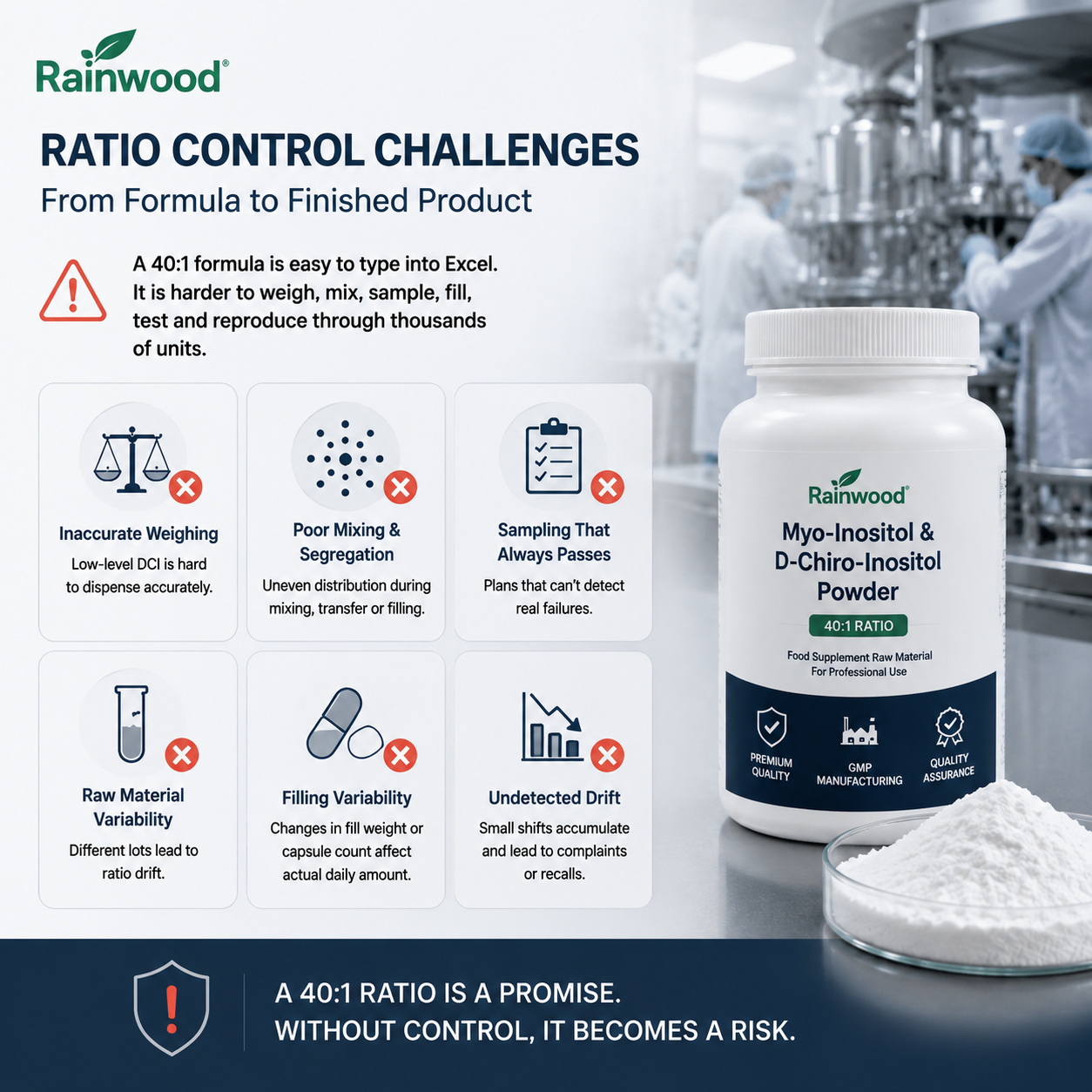
A 40:1 formula is easy to type into Excel.
It is harder to weigh, mix, sample, fill, test and reproduce through thousands of units.
If your manufacturer treats the ratio as a marketing line rather than a critical formula attribute, the finished product can drift while every raw-material COA still passes.
This is the production-control blueprint OEM buyers should demand before the first commercial batch.
Control point 1: define both ingredients independently
Approve a controlled specification for Myo-Inositol and another for D-Chiro-Inositol.
Each should identify:
- exact name and form;
- original manufacturer and code;
- CAS or other identifier;
- identity method;
- assay;
- moisture;
- relevant impurities;
- physical properties;
- storage;
- shelf life or retest period; and
- change-notification obligations.
Do not purchase a generic “40:1 premix” without knowing who manufactured and verified it.
Start with our Myo-Inositol and D-Chiro-Inositol specification review.
Control point 2: write milligrams before writing the ratio
The master formula must state:
- Myo-Inositol per unit;
- D-Chiro-Inositol per unit;
- units per serving;
- servings per day;
- daily amount;
- target ratio;
- acceptable composition range; and
- theoretical batch quantity.
“40:1 complex” is not a master formula.
Any overage must have a documented technical basis. It should not be used to hide weak process control.
Control point 3: verify scales and dispensing
The scale used for the smaller DCI quantity must be suitable for that quantity and required accuracy.
Records should capture:
- scale ID and calibration status;
- minimum and maximum operating range;
- target and actual weight;
- material and lot;
- operator;
- independent check;
- time; and
- reconciliation.
If the commercial batch is too small for reliable direct dispensing, consider an appropriately controlled preblend.
Control point 4: qualify the preblend
Geometric dilution or another justified preblending approach can help distribute a low-level component through a larger carrier quantity.
Define:
- carrier material;
- addition sequence;
- sieve or de-lumping step;
- mixer type;
- load;
- speed;
- time;
- hold time;
- transfer conditions; and
- sampling plan.
The process must be demonstrated, not described with “mix until uniform.”
Control point 5: manage segregation
A blend can be uniform in the mixer and separate during discharge, transport or hopper feeding.
Evaluate differences in:
- particle size;
- density;
- shape;
- moisture;
- flow; and
- electrostatic tendency.
Reduce unnecessary transfer and vibration. Monitor beginning, middle and end of the filling run where appropriate.
Control point 6: choose a sampling plan that can fail
A sampling plan designed only to produce a passing composite is not control.
Define:
- sampling locations;
- number of samples;
- timing;
- individual or composite analysis;
- acceptance criteria;
- investigation triggers; and
- rework or rejection rules.
The plan should detect the failure mode you are trying to prevent.
Control point 7: verify the finished product
The finished release plan may need to confirm:
- identity;
- composition of each inositol;
- ratio or calculated relationship;
- fill or net-content control;
- dosage-unit performance;
- relevant contaminants;
- microbiology;
- packaging integrity; and
- label reconciliation.
The exact tests depend on the product and market. The principle does not: the final claim needs final-product evidence.
Use our inositol batch-release and testing framework.
Control point 8: connect the ratio to capsule or sachet reality
A correct bulk blend can still produce the wrong daily serving if:
- fill weight changes;
- capsule count changes;
- powder scoop size changes;
- sachet net weight drifts; or
- label directions do not match the formula.
Reconcile formulation, actual yield, average fill, serving size and label amount before release.
Control point 9: retain samples and trend results
Do not review each lot in isolation.
Trend:
- raw-material assay;
- moisture;
- particle size or density where relevant;
- blend results;
- fill variation;
- finished composition;
- yield;
- deviations;
- complaints; and
- stability observations.
Small shifts may expose a source or process change before a batch fails.
Control point 10: prohibit silent changes
Require prior written approval for changes involving:
- supplier;
- manufacturer;
- ingredient form;
- specification;
- method;
- batch size;
- mixer;
- production site;
- excipient;
- capsule;
- package; or
- label.
The cheapest emergency replacement can become the most expensive recall discussion.
Make the first commercial batch a verification batch
Do not treat a successful development sample as permission to reduce scrutiny. The first full-scale batch introduces different equipment loads, transfer distances, hold times and packaging speeds. Those changes can expose segregation that a benchtop trial never showed.
Pre-agree the sampling locations, individual-component assay targets, investigation trigger and release authority before production begins. Ask for results from the beginning, middle and end of the run, not only one convenient composite. If a result fails, the answer cannot be “the average ratio still looks right.” The investigation should trace dispensing, preblending, transfer, compression or filling, and retained samples.
This verification batch becomes the baseline for future trend review. Without it, every later COA is an isolated number. With it, the buyer can see whether the process is remaining stable or slowly drifting toward a future complaint.
How RainwoodBio can build the control file
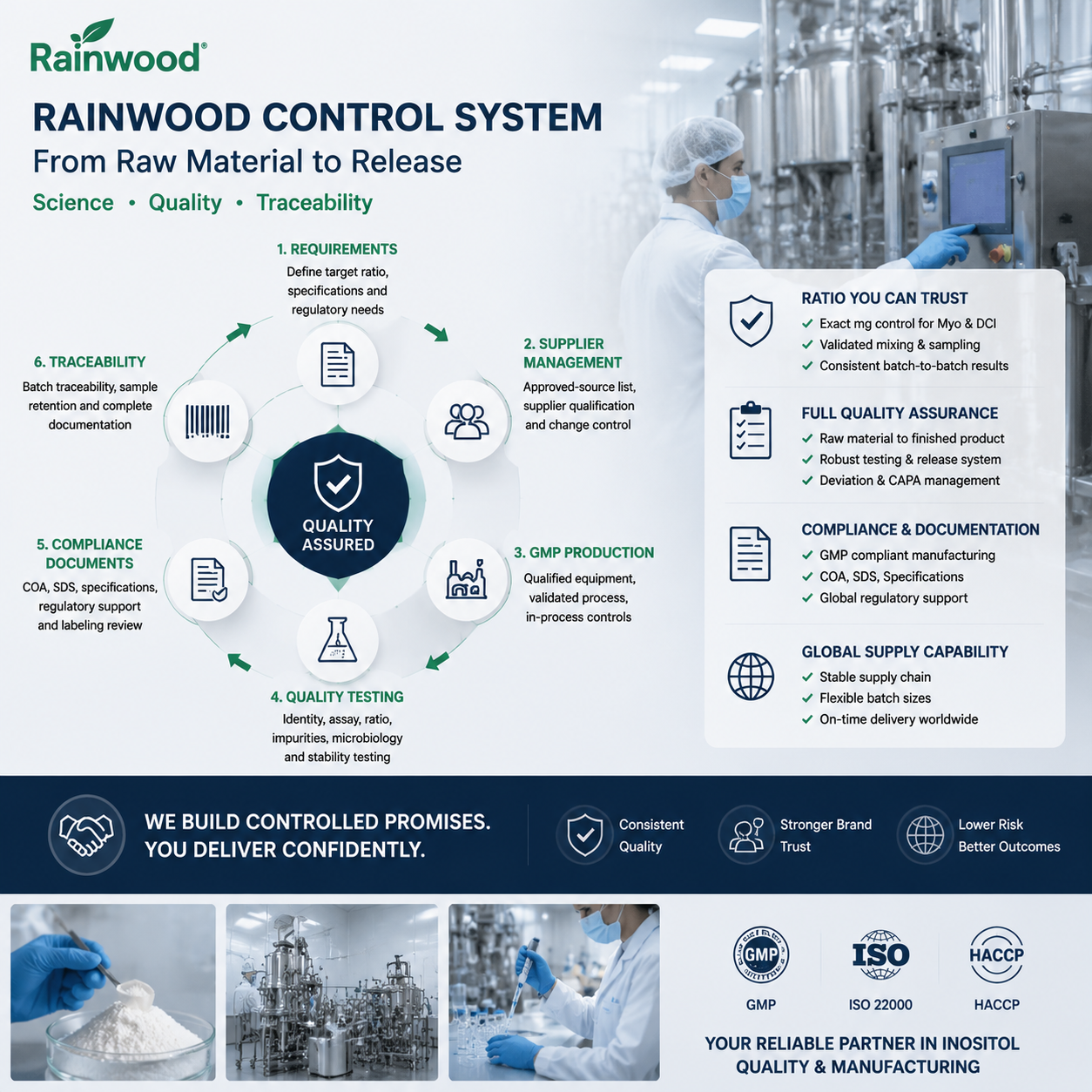
RainwoodBio publishes a six-stage workflow covering requirements, supplier management, GMP production, quality testing, compliance documents and traceability.
For custom inositol products, that structure can be used to develop:
- an approved-source list;
- controlled specifications;
- master formula;
- manufacturing instructions;
- in-process controls;
- finished release requirements;
- retention and traceability; and
- customer change approval.
Learn more about RainwoodBio’s OEM production and quality workflow.
The buyer’s pre-production gate
Do not release production until you have:
- approved both ingredient sources;
- confirmed exact milligrams;
- tested physical feasibility;
- approved mixing parameters;
- accepted the sampling plan;
- defined finished specifications;
- approved packaging and label;
- signed change control; and
- agreed deviation handling.
Frequently asked questions
1.Is the 40:1 ratio tested directly?
It may be calculated from separately determined component amounts or evaluated through another justified approach. Method selection depends on the formula and laboratory capability.
2.Can a premixed 40:1 raw material simplify production?
Potentially, but the premix itself must have traceable manufacturing, specifications, uniformity and stability evidence.
3.How tight should the ratio tolerance be?
It should be scientifically and practically justified based on ingredient specifications, process capability, analytical variation, label requirements and intended use.
4.What happens if DCI is out of range?
The quality unit should investigate the material, dispensing, mixing, sampling and method before deciding whether the batch can be reworked, rejected or otherwise handled.
Turn the ratio from a badge into a controlled promise
Send RainwoodBio your target amounts, batch size, dosage form, package and market.
Request a Myo-to-DCI production-control assessment.
References
- US Food and Drug Administration, *Current Good Manufacturing Practice for Dietary Supplements*, 21 CFR Part 111.
- NIH Dietary Supplement Label Database, *Myo-Inositol and D-Chiro-Inositol labels*.
- Pustotina et al., *Effects of Myo-Inositol and D-Chiro-Inositol in a Ratio 40:1* (2024).
*This article provides general manufacturing information. Specifications, sampling and analytical controls should be approved for the exact product and market.*