 EN
EN
Meta title: Myo vs D-Chiro vs D-Pinitol: Avoid the Inositol Trap
Meta description: Inositol is not one interchangeable ingredient. Learn how Myo-Inositol, D-Chiro-Inositol and D-Pinitol mix-ups can derail your formula, label and launch.
Your supplier writes “Inositol 99%” on a quotation, attaches a polished COA and waits for your deposit.
It looks simple. It is not.
“Inositol” can describe a family of related compounds, while the supplement market commonly deals with Myo-Inositol, D-Chiro-Inositol and products that mention D-Pinitol. They can share familiar language and still be different materials with different identities, sources, doses, evidence and commercial uses.
If your formula brief says only “inositol,” your supplier may quote the cheapest interpretation—not the ingredient your brand story, research or target customer requires.
That mistake can survive sampling, artwork and even the first production run. It may only become visible when a laboratory questions the identity, a retail buyer asks for the exact form, or customers realise that the product does not deliver the formula they thought they purchased.
The first dirty secret: “inositol” is often used as if it were a complete specification
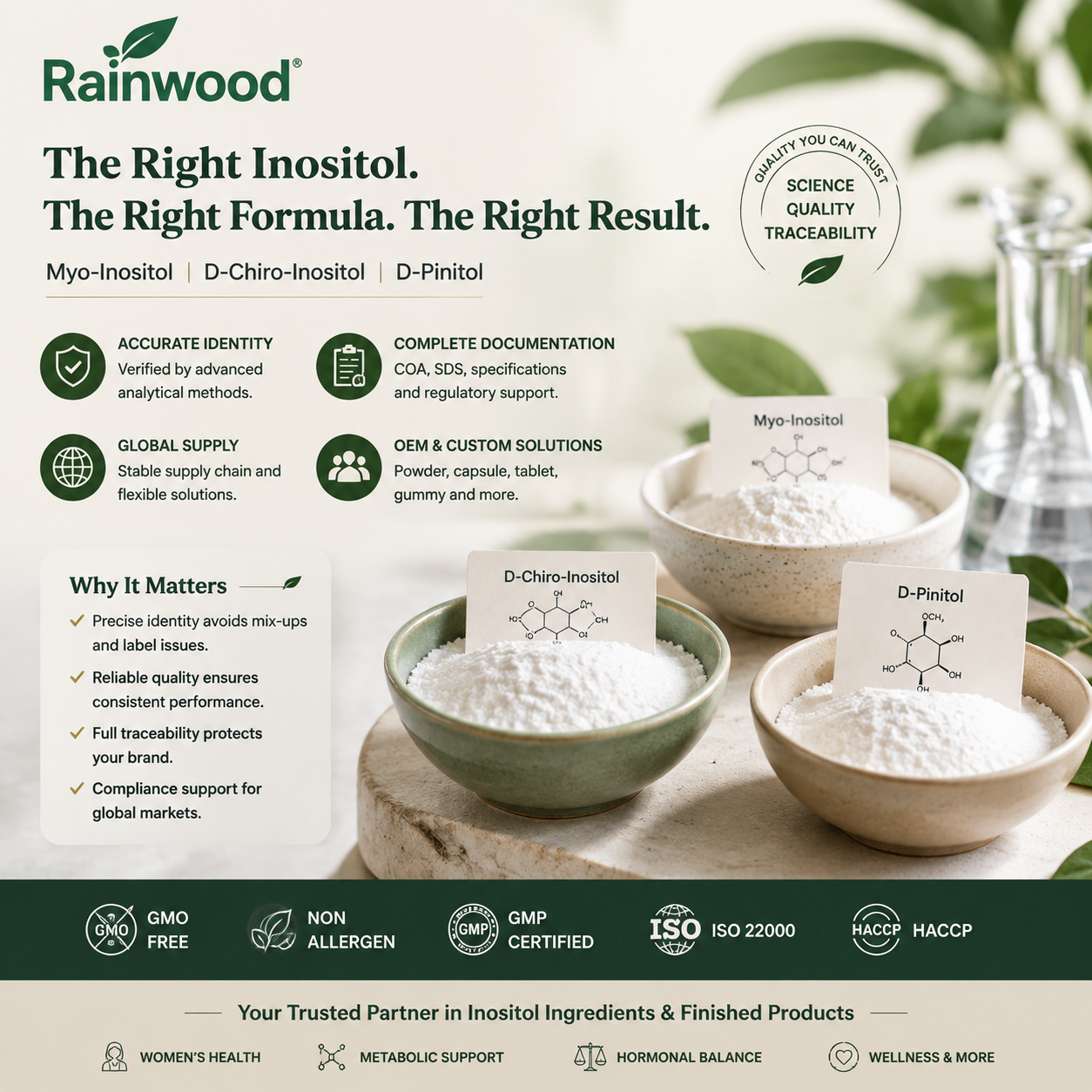
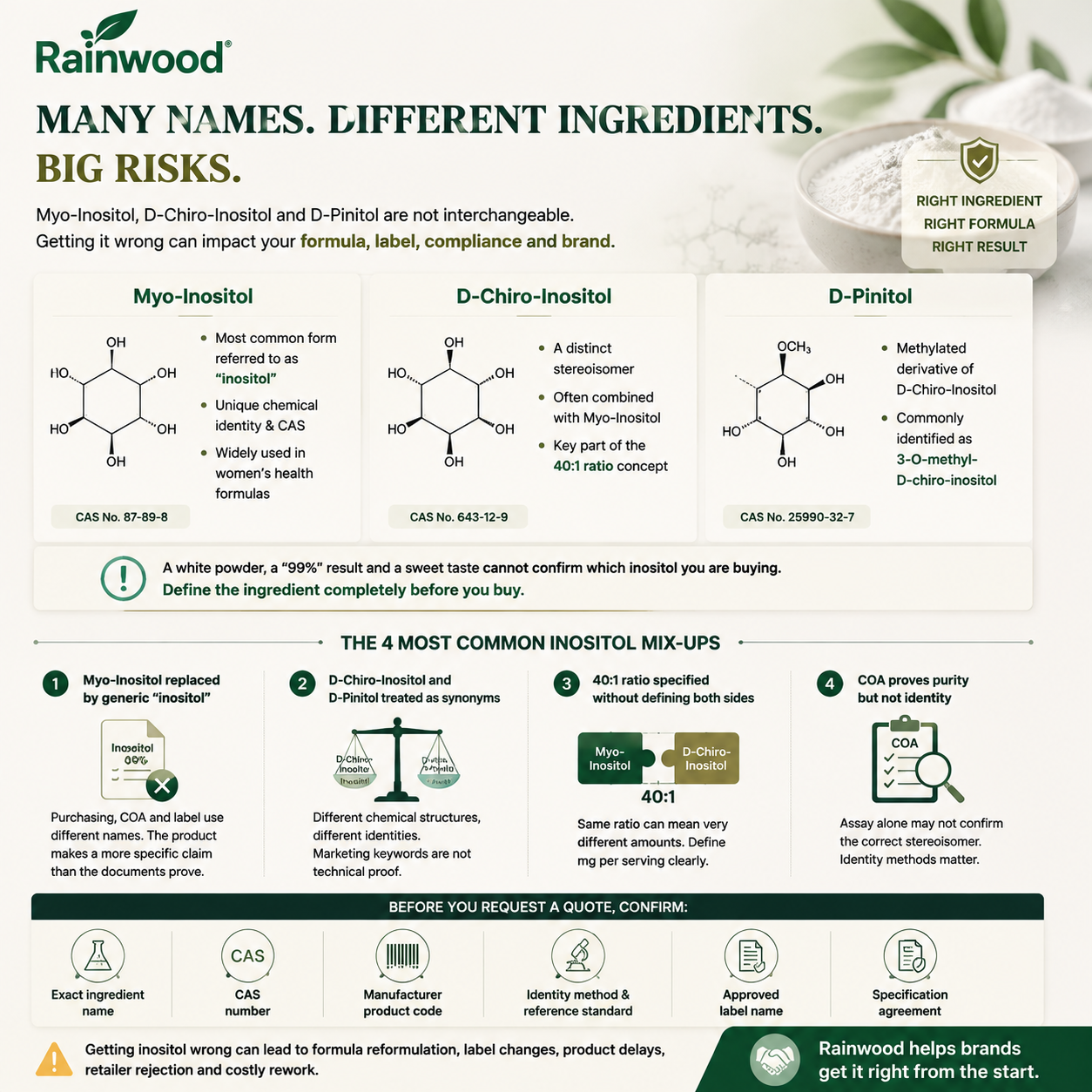
Myo-Inositol is the form most commonly meant when a product simply says “inositol.” It has its own chemical identity and CAS number. D-Chiro-Inositol is a distinct stereoisomer. D-Pinitol is not merely another spelling for D-Chiro-Inositol; it is a methylated derivative, commonly described as 3-O-methyl-D-chiro-inositol.
These distinctions are not academic decoration. They determine:
- which reference standard the laboratory should use;
- which analytical method is suitable;
- which clinical or technical literature may be relevant;
- how the ingredient appears on the label;
- what amount belongs in the formula;
- whether a 40:1 story is even applicable; and
- what the buyer should pay.
A white powder, a sweet taste and a “99%” result cannot, by themselves, settle these questions.
Before requesting a price, define the material through a complete inositol ingredient specification.
Mix-up #1: Myo-Inositol is silently replaced by generic “inositol”
This is the most common naming shortcut. It may be harmless when both parties clearly understand the material, but it becomes dangerous when a quotation, contract, COA and label use different names.
Imagine this chain:
1. Your marketing team develops a Myo-Inositol concept.
2. Your purchasing request asks for “inositol powder.”
3. A trader quotes a product named “Inositol 99%.”
4. The COA shows assay but no isomer-specific identity.
5. Your label later says Myo-Inositol.
The commercial product now makes a more specific statement than the purchasing file proves.
Stop that chain at the beginning. Require the exact chemical name, CAS number, manufacturer product code, analytical identity method and approved label name to agree.
Mix-up #2: D-Chiro-Inositol and D-Pinitol are treated as synonyms
D-Pinitol is related to D-Chiro-Inositol, and the body may metabolically connect the two. That does not make the drum labels interchangeable.
A supplier may describe a carob- or soy-derived material as “Chiro-Inositol (D-Pinitol)” because the combined language attracts more searches. A product page may use “Myo D-Chiro Inositol” in the title, “Chiro-Inositol” in the specification and “D-Pinitol” in the description. That is a warning that marketing keywords have overtaken technical identity.
Ask four direct questions:
1. What is the exact analyte?
2. Which reference standard is used?
3. What chromatographic or stereochemical evidence distinguishes it?
4. Which name will appear on the commercial invoice, COA and label?
If the supplier cannot answer all four consistently, do not approve the artwork.
Mix-up #3: a 40:1 formula is specified without defining both sides
The popular 40:1 concept refers to a relationship between Myo-Inositol and D-Chiro-Inositol. A true 40:1 mass ratio could be built from 2,000 mg Myo-Inositol and 50 mg D-Chiro-Inositol.
But the words “40:1 inositol complex” do not prove those amounts.
The formula may contain:
- 2,000 mg plus 50 mg;
- 1,000 mg plus 25 mg;
- 200 mg plus 5 mg;
- an undisclosed proprietary blend; or
- the correct ratio on paper but the wrong ingredient identity.
Every example is mathematically 40:1. They are not commercially equivalent.
Mix-up #4: the COA proves purity but not identity
An assay answers only the question the method was designed to answer. A non-specific chemical assay may estimate total inositol-like content without proving that the material is the intended stereoisomer.
A stronger review may consider:
- specific identity against a suitable reference standard;
- chromatographic profile;
- optical rotation or another justified stereochemical control;
- assay method and calculation basis;
- water or loss on drying;
- related substances;
- residual solvents where relevant;
- heavy metals;
- microbiological criteria;
- source and manufacturing-process information; and
- lot-to-lot traceability.
The test plan should follow the exact material and process. Myo-Inositol from a fermentation route and D-Pinitol isolated from a botanical source do not automatically present the same verification questions.
Use our inositol COA and identity review framework to turn a one-line assay into a meaningful qualification file.
Mix-up #5: “natural,” “fermented” and “plant-derived” become identity claims
Origin language sells. It also distracts.
“Corn-derived,” “fermented,” “carob-derived,” “soy-derived” and “natural” describe source or process stories; they do not replace the chemical identity. A buyer must still know the final analyte, purity, process, allergens, GMO position, residual controls and traceability.
The source story should also survive documentation. If a product is marketed as soy-free but the upstream material is isolated from soy, a generic non-GMO statement may not answer the allergen or customer-expectation question. If a material is sold as fermented, ask for the production organism, processing overview and relevant residual or GMO documentation.
Do not pay a premium for an origin adjective that disappears from the technical file.
What this mistake costs a new brand
The wrong identity can trigger far more than a laboratory retest:
- reformulation;
- rejected labels or marketplace content;
- destroyed packaging;
- delayed launch inventory;
- inability to support a 40:1 claim;
- retailer questions the sales team cannot answer;
- supplier disputes;
- lost trademark or evidence positioning;
- consumer complaints; and
- a second purchase made under time pressure.
The cheapest time to discover the mix-up is before the first sample. The most expensive time is after the product becomes successful.
The seven-line purchase specification that prevents most confusion
Your purchase order should not say only “Inositol 99%.” At minimum, state:
1. exact ingredient name and form;
2. CAS number or other agreed identifier;
3. original manufacturer and product code;
4. identity and assay methods;
5. purity, moisture and relevant impurity limits;
6. source or process claims that must be supported; and
7. approved label name and intended market.
For a blend, add exact milligrams of Myo-Inositol and D-Chiro-Inositol per serving, ratio tolerance, blending controls and finished-product verification.
How RainwoodBio helps prevent an identity mistake
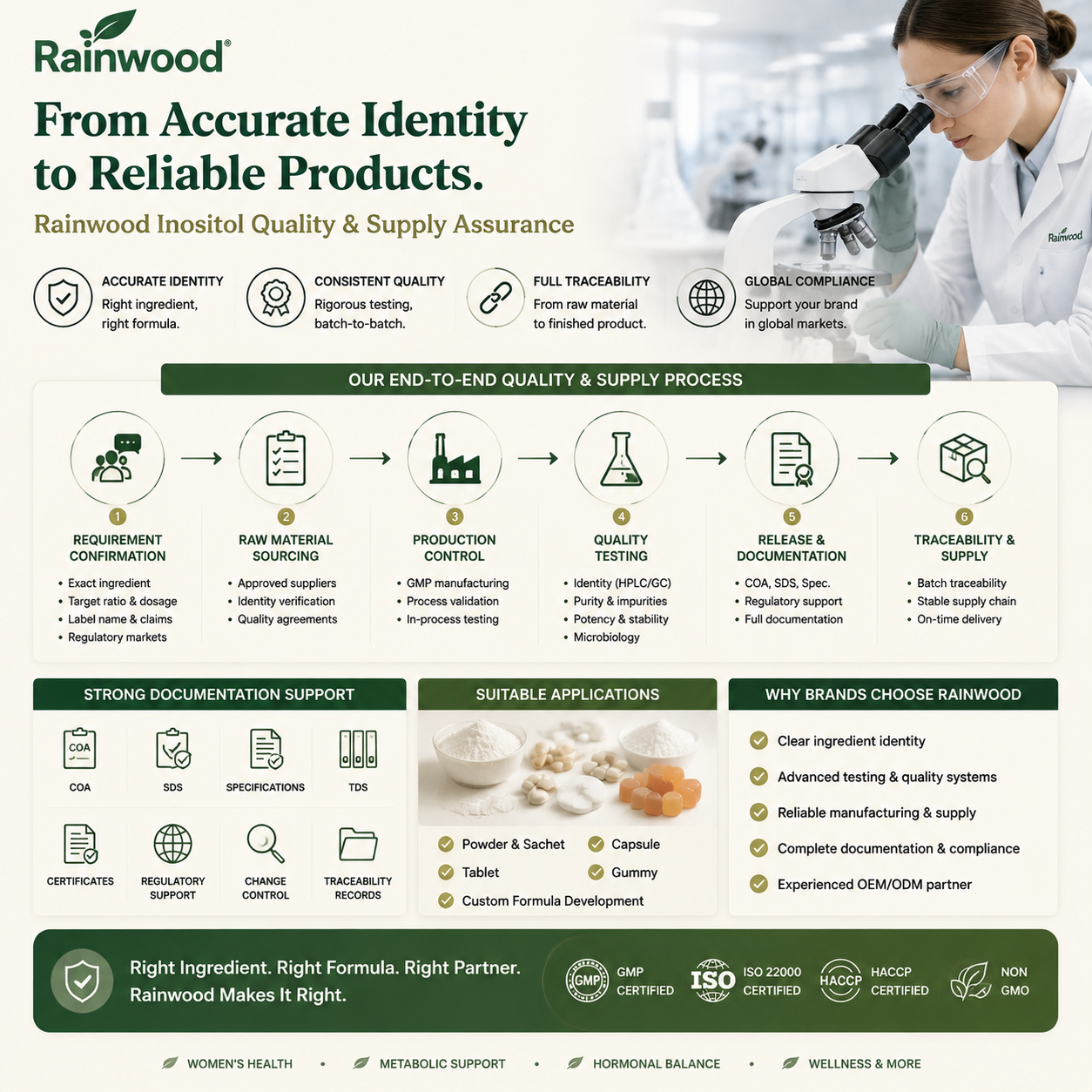
RainwoodBio’s published workflow covers requirement confirmation, raw-material procurement and supplier management, production control, quality testing and release, compliance documents, logistics and traceability. For an inositol project, that workflow should begin with the exact ingredient identity—not with a generic product-page keyword.
Our team can use your target market, intended label, formula and supplier documents to create a clearer technical brief before sampling. Depending on the project, RainwoodBio can also support raw powder, capsules, tablets, powders or sachets through its broader supplement and private-label capabilities.
Learn more about RainwoodBio’s manufacturing and quality capabilities.
The practical promise is simple: every commercial claim should trace back to a defined material, an approved formula and evidence that belongs to that product.
Buyer checklist: do not place the order until these match
- Quotation name
- Purchase-order name
- Specification name
- CAS number
- COA identity
- Reference standard
- Formula name
- Label name
- Research material
- Source claim
If one document says Myo-Inositol, another says Chiro-Inositol and a third describes D-Pinitol, stop. Do not let the supplier “explain it later” after your packaging is printed.
Frequently asked questions
1.Is ordinary “inositol” always Myo-Inositol?
It is commonly used that way in the market, but purchasing and quality documents should state the exact intended form rather than rely on assumption.
2.Is D-Pinitol the same as D-Chiro-Inositol?
No. D-Pinitol is commonly identified as 3-O-methyl-D-chiro-inositol. The materials are related but should not be treated as identical purchase specifications.
3.Does a 99% assay prove the correct isomer?
Only if the method is suitably specific and the identity evidence supports that conclusion. Ask what the method actually measures.
4.Can RainwoodBio develop a finished inositol product?
RainwoodBio publishes capabilities across hard capsules, powders and sachets, tablets, gummies and other private-label formats. Feasibility depends on the exact ingredient, daily amount, market, formula and packaging.
Send us the document your supplier hopes you will not question
Do not wait until a laboratory or retailer discovers that your “inositol” documents describe three different materials.
Send RainwoodBio your current quotation, COA, intended label and target market. We will help organise the identity questions and identify the gaps that should be closed before formula approval.
Send your inositol COA for an identity gap review.
References
- US National Library of Medicine, PubChem, *Myo-Inositol*.
- US National Library of Medicine, PubChem, *D-Pinitol / 3-O-Methyl-D-chiro-inositol*.
- NIH Dietary Supplement Label Database, *Inositol ingredient and label terminology*.
- US Food and Drug Administration, GRAS Notice No. 1198, *Inositol (Myo-Inositol)*.
- Fitz et al., *Inositol for Polycystic Ovary Syndrome: A Systematic Review and Meta-analysis to Inform the 2023 International Evidence-based PCOS Guideline* (2024).
*This article provides general product-development and sourcing information. Ingredient identity, claims and market requirements should be confirmed for the specific material and destination.*