 EN
EN

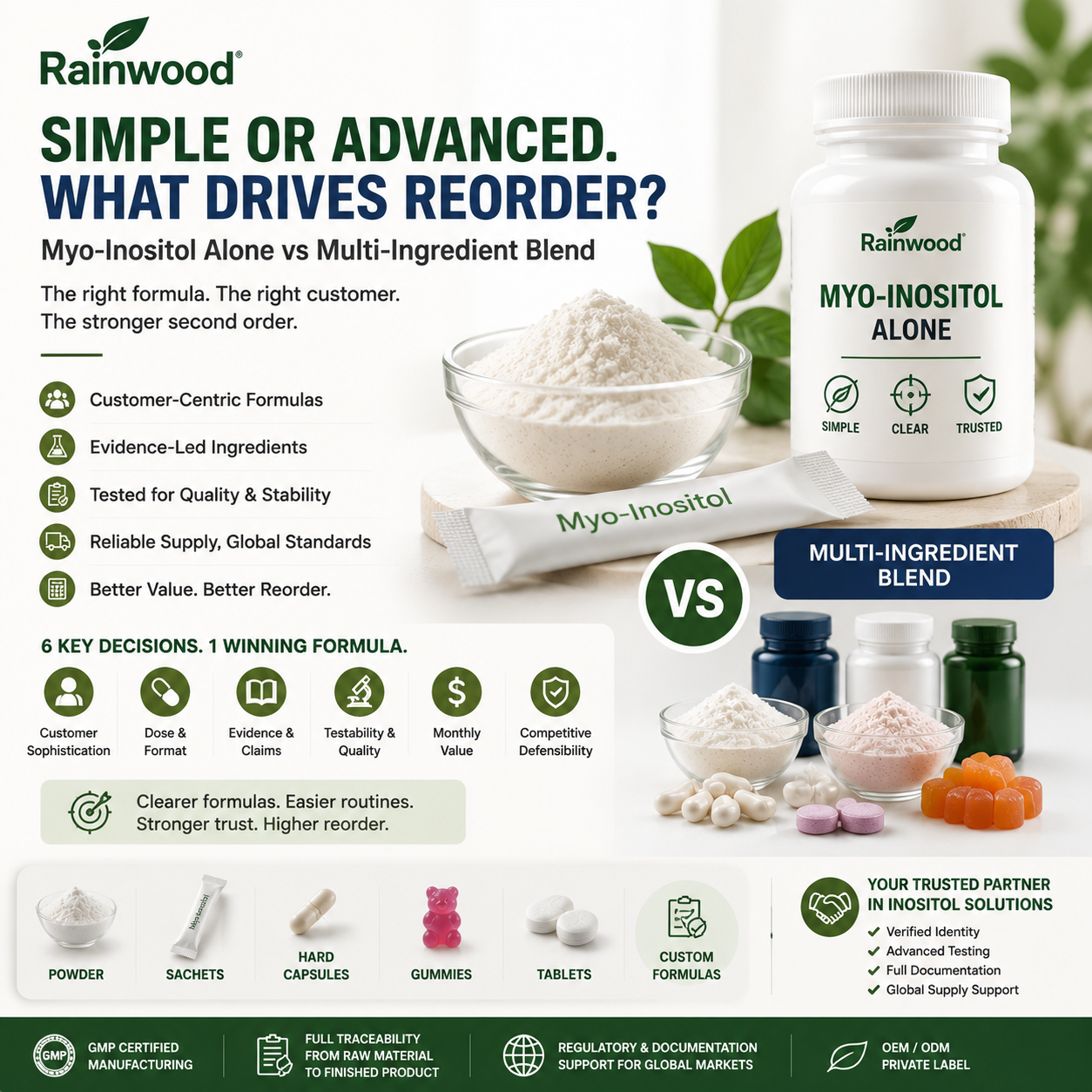
Meta title: Myo-Inositol Alone vs a Multi-Ingredient Blend
Meta description: Compare single-ingredient Myo-Inositol with complex blends by clarity, dose, evidence, format, cost, testing and customer reorder potential.
A complex formula wins the first click.
A product customers understand and use consistently wins the second order.
That is the real contest between a simple Myo-Inositol product and a multi-ingredient blend. The answer is not “more ingredients are better” or “clean label always wins.” The right product depends on customer, dose, format, evidence and price.
When Myo-Inositol alone can be stronger
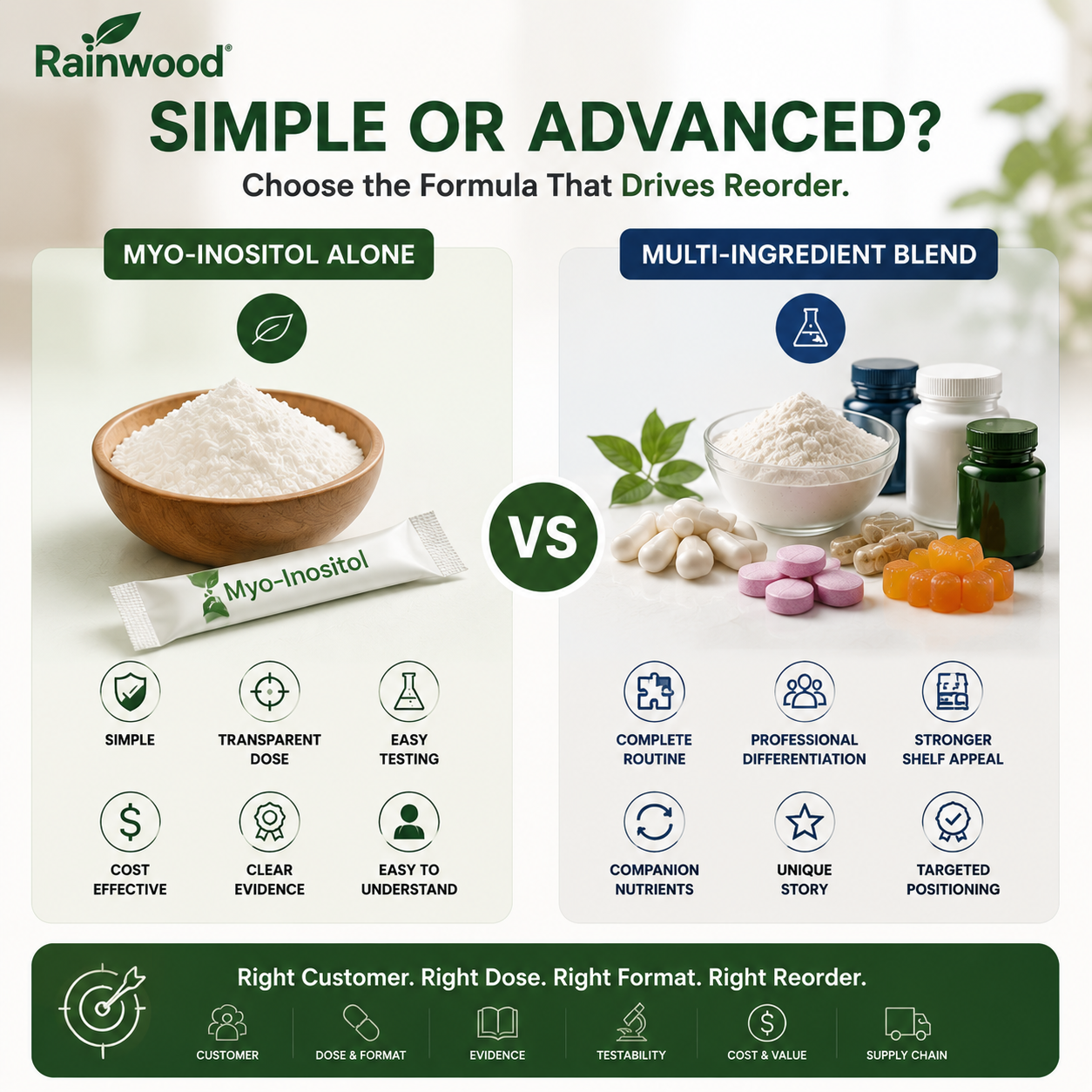
A single-ingredient product offers:
- simple identity;
- transparent daily amount;
- easier evidence discussion;
- fewer interactions;
- cleaner taste and formulation;
- simpler testing;
- easier supplier change control; and
- clear cost comparison.
It works especially well for educated customers who already know what they want.
Explore RainwoodBio’s bulk Myo-Inositol and private-label options.
When a blend can create more value
A blend may serve customers who want:
- Myo/DCI positioning;
- a complete routine;
- fewer separate bottles;
- professional-channel differentiation;
- companion nutrients;
- stronger shelf communication; or
- a unique formulation story.
The blend creates value only when each ingredient has a reason and meaningful amount.
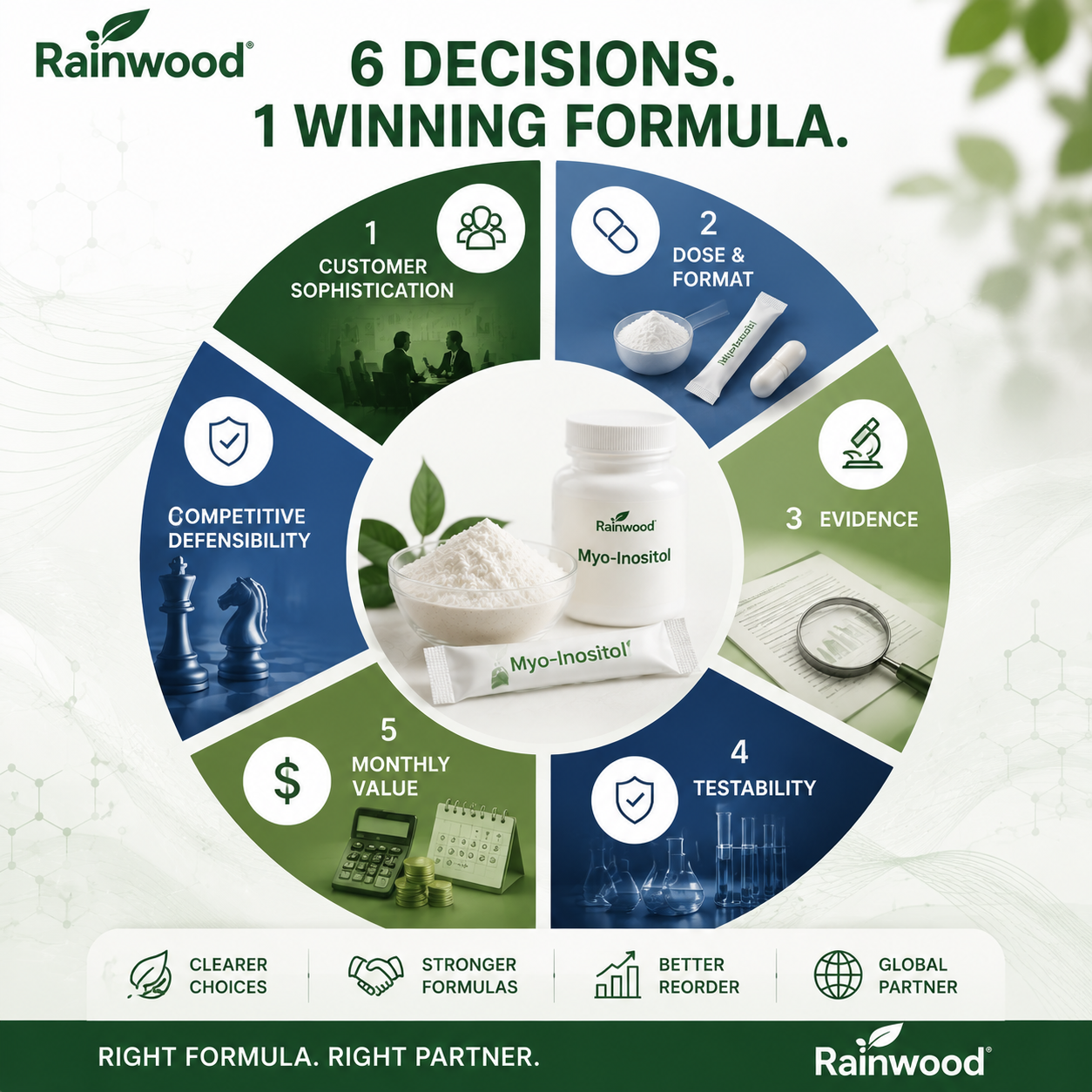
Decision 1: customer sophistication
A knowledgeable buyer may distrust a proprietary complex. A mainstream customer may find a single white powder too generic.
Choose whether your brand wins through:
- radical transparency;
- convenience;
- professional recommendation;
- premium formula story; or
- price.
Do not design for every customer.
Decision 2: dose and physical format
Myo-Inositol at gram-level amounts can work naturally as powder or sachets. Adding multiple ingredients may increase capsule burden or complicate flavour and stability.
Run a physical feasibility test before choosing:
- capsules;
- powder;
- stick packs;
- tablets; or
- gummies.
Decision 3: evidence
A single-ingredient formula can map more directly to single-ingredient evidence. A combination may have synergy or convenience logic, but it should not borrow every claim from studies on each component.
Build one evidence table for the finished formula.
If the brand needs five separate papers to explain five underdosed ingredients, the formula may be built for marketing rather than use.
Decision 4: testability
A complex blend can make it harder to:
- distinguish components;
- quantify low-level ingredients;
- avoid analytical interference;
- validate methods;
- investigate failures; and
- maintain stability.
Testing cost belongs in the formula decision, not after the quotation.
Decision 5: monthly value
Compare:
- daily dose;
- daily units;
- days per package;
- manufacturing cost;
- testing cost;
- retail price;
- customer monthly cost; and
- reorder interval.
A simple product with excellent experience can outperform a complex formula that customers abandon.
Decision 6: competitive defensibility
A generic single-ingredient product can be copied easily unless the brand differentiates through:
- source;
- quality transparency;
- format;
- packaging;
- education;
- subscription;
- testing; and
- service.
A complex formula is not automatically defensible either. If it is merely the same twelve trending ingredients, competitors can copy the label faster than you can print it.
The two-SKU strategy
Some brands separate:
1. a transparent Myo-Inositol foundation product; and
2. a more targeted Myo/DCI or companion-ingredient formula.
This can improve customer choice and content architecture while reducing pressure on one product to serve everyone.
The strategy requires clear differentiation to avoid internal cannibalisation.
The customer-service test
Give the proposed label to the person who will answer customer emails. Ask them to explain:
- why this form was selected;
- how much is taken daily;
- why the ratio matters;
- what each companion ingredient does;
- how long one package lasts;
- when customers should take it;
- what the product does not promise; and
- who should seek professional advice.
If the explanation requires a ten-minute scientific lecture, the formula may be too complicated for the intended channel.
Customer confusion becomes:
- abandoned carts;
- incorrect use;
- refund requests;
- contradictory support answers;
- poor reviews; and
- weak repeat purchase.
Clarity is not simplistic. It is conversion engineering.
The supply-chain test
A single-ingredient product may have one critical raw-material source. A complex blend may have ten. More sources increase:
- lead-time variability;
- documentation work;
- minimum quantities;
- incoming tests;
- shortage exposure;
- change-control events;
- expiry coordination; and
- working capital.
Map every active ingredient to supplier, lead time, MOQ and backup status. A formulation that looks premium can become commercially fragile when one decorative ingredient delays the entire batch.
The content-cluster advantage
A simple product can support deep education around source, quality, dose, format and use. A blend can support ingredient comparisons, formulation logic and professional content.
Choose the formula that gives the brand enough honest material for months of useful content—without inventing claims to keep the story alive.
Measure reorder risk before choosing the prettier label
Score both concepts against five behaviours: how quickly customers understand the product, how easily they follow the routine, whether they can identify what they are paying for, how confidently customer service can answer questions, and whether the product can remain consistent when one input becomes scarce.
A complicated blend may win the first click because the label looks abundant. It can still lose the second order if the serving is inconvenient, the effect story is vague or customers cannot tell which ingredient matters. A focused formula may look less dramatic while creating clearer expectations and a simpler routine.
Use a small pilot to test the decision. Track sample completion, questions, taste or swallowing complaints, reasons for discontinuation and willingness to buy a full month. Do not ask only whether participants “liked” the product. Ask whether they understood it and whether they actually completed the intended daily use.
Reorder is where formula logic becomes commercial truth.
How RainwoodBio can compare both routes
RainwoodBio publishes capabilities covering raw ingredients, hard capsules, powders and sachets, gummies, tablets and custom formulas.
A useful development project can compare two prototypes using the same criteria:
- customer;
- daily amount;
- format;
- ingredient cost;
- testing;
- packaging;
- MOQ;
- claims;
- monthly value; and
- supply.
Explore RainwoodBio’s custom inositol formulation and sampling service.
Learn more about RainwoodBio’s dosage-form capabilities.
The reorder test
Ask:
- Can customers understand the product in ten seconds?
- Can they follow the routine?
- Does the bottle last as expected?
- Is the monthly cost clear?
- Is the formula meaningfully different?
- Can customer service explain every ingredient?
- Can manufacturing reproduce it?
The product with more “yes” answers has the stronger reorder case.
Frequently asked questions
1.Is single-ingredient Myo-Inositol too commoditised?
It can be, but source transparency, quality evidence, format, packaging and brand education can create differentiation.
2.Does a 40:1 blend always sell better?
No. It may improve comparison appeal in some segments, while simplicity or higher disclosed Myo-Inositol may win elsewhere.
3.Can RainwoodBio produce both powder and capsules?
RainwoodBio publishes capabilities for both formats. Feasibility depends on dose, formula, packaging and MOQ.
Choose the formula customers will finish
Send RainwoodBio your customer profile, single-ingredient idea, blend concept, format and price.
Request a single-versus-blend inositol development comparison.
References
- NIH Dietary Supplement Label Database, *Inositol single-ingredient and combination labels*.
- Fitz et al., *Inositol for Polycystic Ovary Syndrome: A Systematic Review and Meta-analysis* (2024).
- RainwoodBio, *Published OEM capabilities*.
*This article provides general product-development information and is not medical advice.*