 EN
EN

Meta title: The PCOS Inositol Claim Trap Brands Cannot Ignore
Meta description: PCOS and fertility claims drive inositol sales, but one disease promise can create FDA, platform and retailer risk. Learn how to market aggressively without crossing the line.
PCOS is one of the strongest commercial magnets in the inositol category.
It is also where brands become reckless.
A seller discovers that “supports women’s wellness” converts slowly, while “improves fertility in women with PCOS” attracts immediate attention. The copy grows stronger. Amazon images promise hormone balance. Influencer scripts mention insulin resistance. Customer testimonials are reposted with pregnancy stories.
Then the brand learns an expensive lesson: a supplement disclaimer does not erase a disease claim.
This is not a theoretical risk
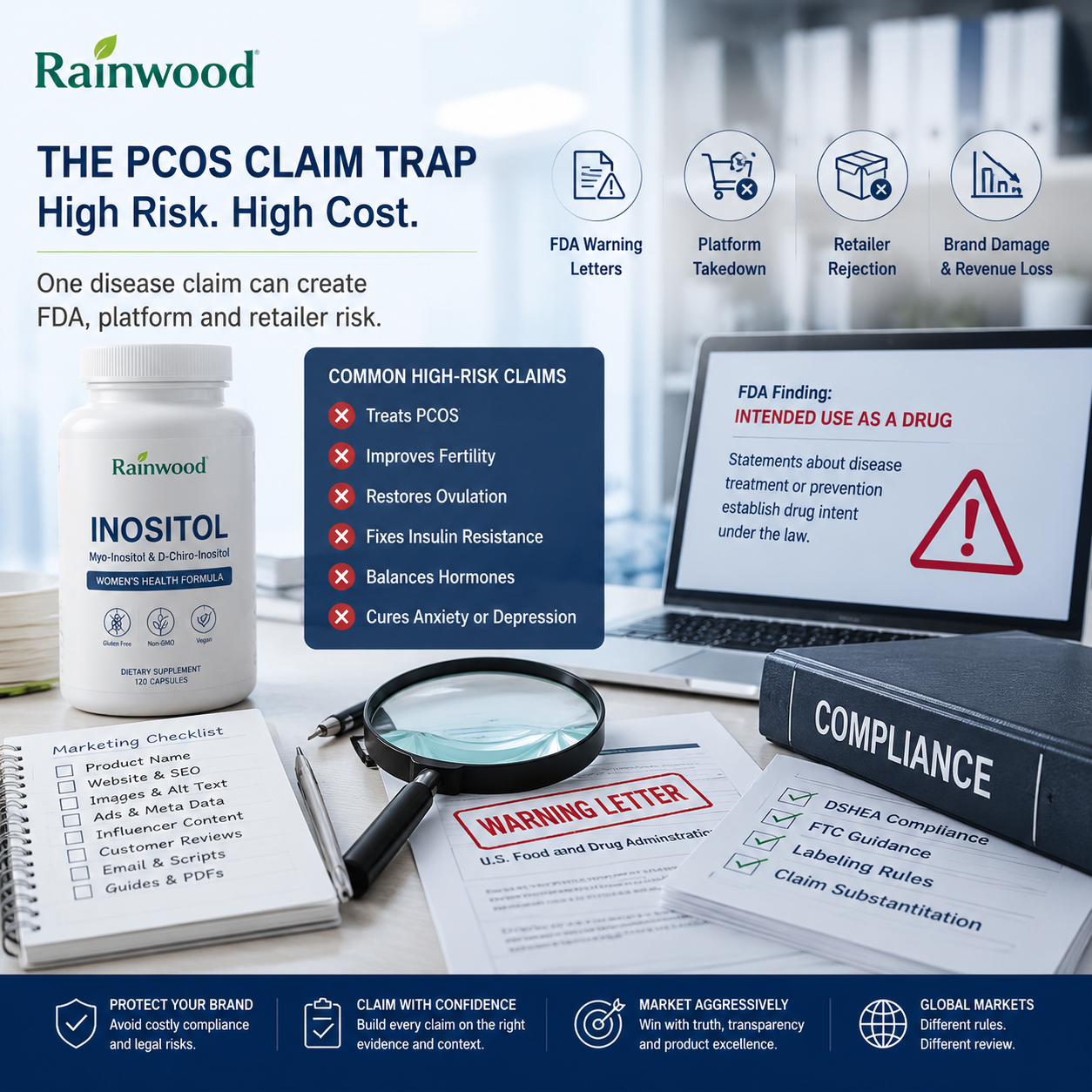
FDA issued a warning letter to a company selling an “Inositol 100% Pure Free Form” product. Cited statements included claims about blood sugar control, insulin sensitivity, fertility in women with PCOS, anxiety and depression.
FDA concluded that the claims established intended use as a drug.
The lesson is brutally simple: if your copy tells customers that the product will treat, mitigate or prevent a disease, the most persuasive sentence on your page may become the sentence a regulator quotes back to you.
Review our market-specific inositol claim framework.
Trap 1: putting PCOS in the product name
A product named “PCOS Treatment Inositol” communicates disease intent before the customer reads anything else.
Risk can also arise through:
- page title;
- URL;
- image alt text;
- metadata;
- Amazon backend terms;
- comparison charts;
- downloadable guides;
- practitioner handouts; and
- paid-search ads.
The label is not the only regulated message.
Trap 2: turning a mechanism into a promised outcome
Marketing often follows this chain:
1. inositols participate in cellular signalling;
2. studies investigate metabolic or reproductive outcomes;
3. therefore this product “fixes insulin resistance”;
4. therefore it “restores ovulation”;
5. therefore it “treats infertility.”
Every arrow adds certainty the evidence and regulatory framework may not support.
Mechanistic language can educate. It cannot automatically prove a clinical result for your finished bottle.
Trap 3: using “clinically proven” without naming the clinical match
Ask:
- Was the studied material Myo-Inositol, DCI or a combination?
- What ratio and daily amount?
- Which other ingredients were present?
- Who participated?
- How long was the study?
- Which outcomes improved?
- Which did not?
- Was the finished commercial product studied?
The 2024 systematic review informing the international PCOS guideline concluded that evidence for inositol was limited and inconclusive overall. Some outcomes appeared promising; others did not show benefit.
“Clinically studied” may be accurate. “Clinically proven to reverse PCOS” is a very different message.
Read Clinically Proven Inositol or a Selected Headline?.
Trap 4: customer testimonials become your claims
Testimonials can communicate:
- “I got pregnant.”
- “My PCOS disappeared.”
- “It cured my anxiety.”
- “I stopped my medication.”
When a brand selects, edits, highlights or republishes the testimonial, the message can become part of its advertising.
Do not assume that adding “results may vary” solves the problem.
Create a moderation policy for reviews, influencers, affiliates and customer-service responses. Train the team not to confirm disease claims in public comments.
Trap 5: the disclaimer becomes a decorative footer
The standard US dietary supplement disclaimer does not neutralise an otherwise clear disease promise.
Consumers read the dominant message. Regulators and platforms do too.
If the headline says “Treat PCOS Naturally,” a small footer stating that the product is not intended to diagnose, treat, cure or prevent disease creates contradiction—not protection.
Aggressive inositol marketing can still win
You do not need weak copy. You need a stronger angle.
Use:
- formula transparency;
- exact amounts;
- ratio education;
- ingredient-source story;
- testing and traceability;
- routine convenience;
- comparison with hidden proprietary blends;
- customer-specific lifestyle positioning;
- quality questions competitors cannot answer; and
- evidence-literate education.
Instead of promising to cure PCOS, make the customer ask why competing products hide their DCI amount or provide only 15 days per bottle.
That is aggressive marketing built on product truth.
Build a claim-to-evidence matrix
For every material claim, document:
| Proposed statement | Type of claim | Evidence | Product match | Market review | Approved version |
|---|---|---|---|---|---|
| | | | | | |
Review express and implied meaning. “For women with PCOS” may communicate more than “supports a healthy menstrual cycle,” depending on context.
Include:
- label;
- website;
- marketplace;
- ads;
- email;
- influencer brief;
- FAQ;
- chatbot;
- sales scripts; and
- downloadable content.
Your affiliates can create the claim you refused to print
A cautious label does not protect a brand whose affiliates, influencers or distributors promise that the product treats PCOS, restores ovulation or replaces medical care. Screenshots travel quickly, and regulators or platforms can examine the full commercial ecosystem—not only the bottle.
Create a channel-control pack before launch. It should contain approved phrases, prohibited disease language, required disclosures, evidence-linked talking points and examples of unacceptable before-and-after promises. Require approval for high-risk campaigns and keep dated records of the material supplied to partners.
Monitor live content after publication. If a partner crosses the line, document the correction and remove repeated offenders. This is not timid marketing. It protects the asset that aggressive marketing is supposed to build: a product page, ad account and distribution network that can keep selling.
The strongest claim is not the loudest sentence you can publish today. It is the sharpest promise you can defend consistently across every channel tomorrow.
How RainwoodBio can support a more defensible launch
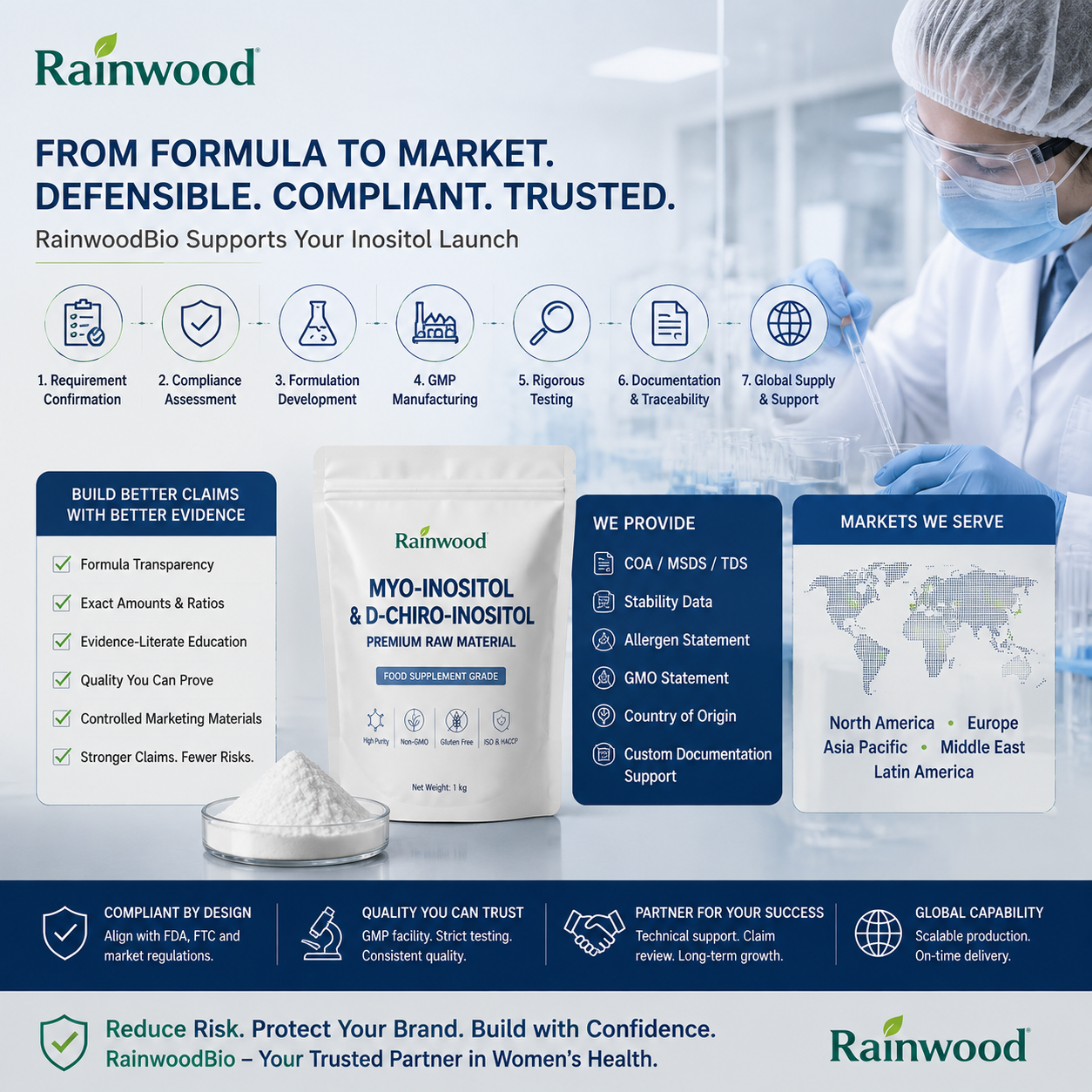
RainwoodBio’s published workflow begins with requirement confirmation and compliance assessment, then connects formulation, production, testing, documents and traceability.
For a women’s-health inositol project, that allows the product team to align:
- exact formula;
- source and ratio;
- dosage form;
- target market;
- label information;
- test plan;
- evidence territory; and
- controlled sales materials.
Explore RainwoodBio’s women’s-health supplement OEM service.
The pre-launch claim test
Ask five people to read the page and answer:
1. What condition does this product appear to treat?
2. What outcome does it promise?
3. How quickly does it imply results?
4. Is the finished formula actually supported?
5. Would the message change without the disclaimer?
If the first answer is a disease, escalate the copy for qualified review.
Frequently asked questions
1.Can an inositol Blog discuss PCOS research?
Educational discussion may be possible, but context, product linkage, claims and target-market rules matter. Avoid turning scientific discussion into a treatment promise.
2.Can a product use fertility language?
Fertility-related messages can create strong implied claims. They require careful market-specific review and substantiation.
3.Are influencer claims the influencer’s responsibility?
Brands can be responsible for advertising made by endorsers and affiliates, especially when they direct, pay for or republish the content.
4.Can RainwoodBio write the final legal claim approval?
RainwoodBio can help organise formula and technical information. Final regulatory and legal approval should be completed by qualified professionals for the destination market.
Send the claim before it becomes printed inventory
Send RainwoodBio your formula, target market, draft label and top five marketing statements.
Request an inositol claim and label gap review.
References
- US Food and Drug Administration, *Warning Letter to FDC Nutrition Inc.* (2021).
- US Food and Drug Administration, *Notifications for Structure/Function and Related Claims*.
- US Federal Trade Commission, *Health Products Compliance Guidance*.
- Fitz et al., *Inositol for Polycystic Ovary Syndrome: A Systematic Review and Meta-analysis* (2024).
*This article provides general marketing and regulatory information and is not legal advice.*