 EN
EN

Meta title: Perfect 40:1 Sample, Wrong Inositol Bulk Blend
Meta description: A perfect inositol sample can hide source changes, ratio drift and poor blend uniformity. Learn how OEM buyers protect Myo-to-DCI production.
The sample is perfect.
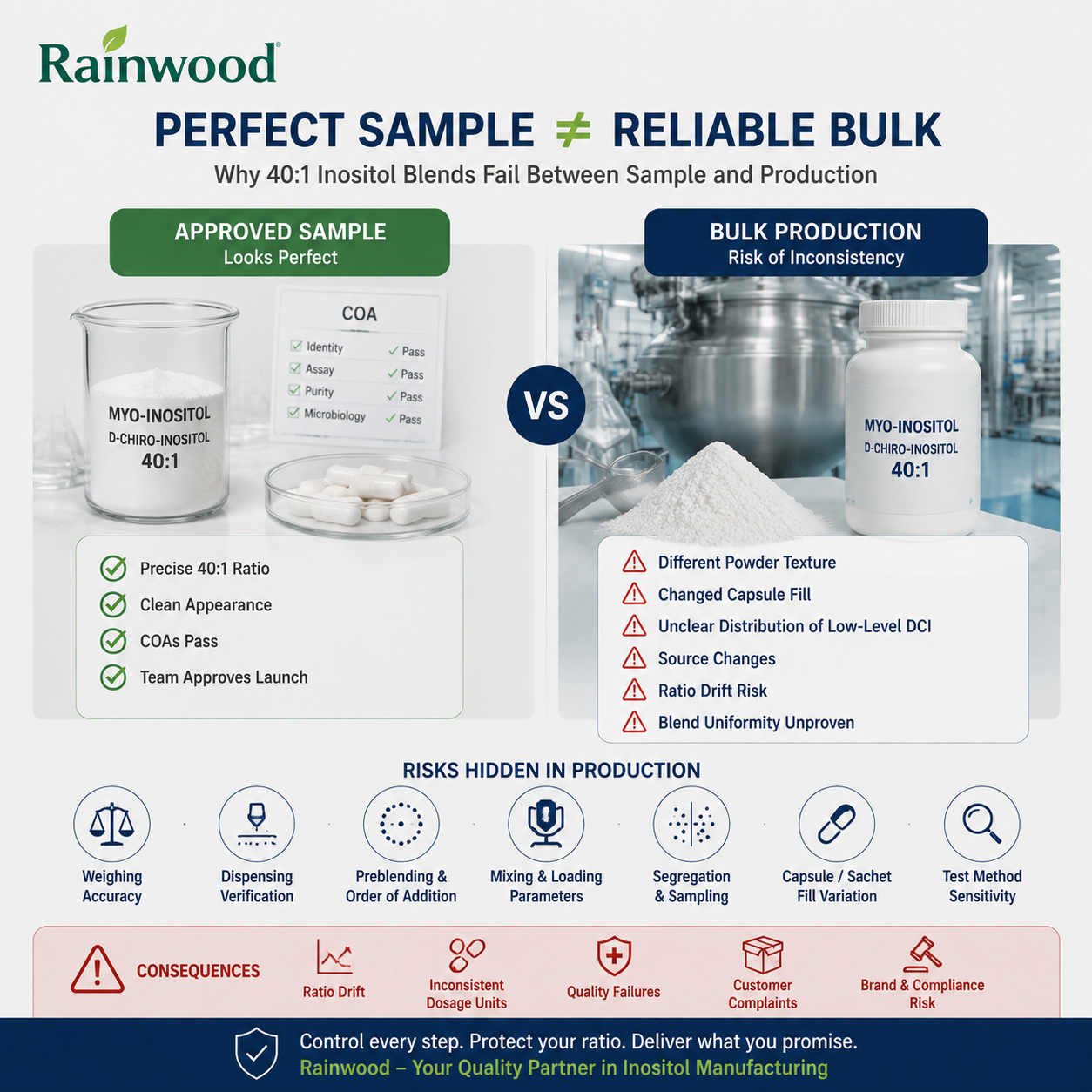
The label says 2,000 mg Myo-Inositol plus 50 mg D-Chiro-Inositol. The capsules look clean. The COAs pass. Your team approves the launch.
Then the bulk order arrives with a different powder texture, changed capsule fill and no clear proof that the low-level D-Chiro component is distributed as intended.
The supplier says, “Same formula.”
Your batch record may tell a different story.
Why a 40:1 blend is easy to approve and harder to reproduce
The two components may be used at very different quantities. That creates risks around:
- weighing accuracy;
- dispensing verification;
- preblending;
- order of addition;
- mixer loading;
- segregation;
- sampling;
- capsule or sachet fill; and
- test-method sensitivity.
A laboratory sample may be hand-mixed in a small container. Commercial production may involve a large blender, longer transfer paths and thousands of dosage units.
Visual similarity proves almost nothing.
Use our inositol sample-to-production control brief.
The bait-and-switch scenario buyers rarely design against
Not every difference is deliberate. But every quality agreement should make deliberate substitution difficult.
A sample may use:
- a branded or better-documented source;
- a higher-purity lot;
- a denser powder;
- a different particle size;
- hand-selected capsules;
- manual filling; or
- an excipient level that changes later.
The bulk batch may then use another source because the original is expensive, unavailable or never approved for scale.
Lock the original manufacturer, product code, specification and change-notification requirement before approving the sample.
Ratio drift begins at the weighing room
For a 2,000 mg to 50 mg formula, the smaller component requires tighter attention. A dispensing error that looks minor compared with the Myo-Inositol quantity can materially shift the ratio.
The batch record should show:
- theoretical quantity;
- actual dispensed quantity;
- scale identification and suitability;
- second-person verification;
- material and lot identity;
- reconciliation;
- deviation handling; and
- authorised release.
Do not accept “added according to formula” as the complete record.
Mixing can create a perfect average and inconsistent units
A composite sample may meet the average target while individual locations or dosage units vary.
Factors include:
- particle-size differences;
- density differences;
- electrostatic behaviour;
- transfer vibration;
- excessive mixing;
- insufficient mixing;
- blend discharge order; and
- hopper segregation.
The manufacturer should justify mixing parameters and sampling locations. Where blend or dosage-unit uniformity is a critical risk, the qualification plan should test it appropriately.
The sample may not use production equipment
Ask how the sample was made:
- hand-filled;
- benchtop mixer;
- pilot equipment;
- commercial line;
- production-representative raw materials; or
- leftover development stock.
Then record which characteristics the sample actually proves.
A hand-filled sample can demonstrate colour, capsule shell, label and approximate serving concept. It cannot prove commercial machine speed, long-run fill variation or bulk blending performance.
Source changes can alter more than chemistry
Two lots may both pass an identity and assay specification while differing in:
- bulk density;
- particle size;
- flow;
- moisture;
- taste;
- colour;
- compaction; and
- compatibility with other ingredients.
These differences can change capsule capacity, excipient need, yield and package size.
The finished product needs its own release logic
Raw-material COAs do not prove that:
- the correct quantities entered the batch;
- the ratio survived blending;
- the fill weight supports the label;
- each daily serving is consistent;
- the package protects the product; or
- the batch remains suitable through shelf life.
Define finished-product specifications and release records before production.
The plan may include appearance, identity or composition, dosage-unit controls, microbiology, contaminants, disintegration where relevant, net contents and packaging checks.
Retain the evidence before the dispute
Keep:
- approved development sample;
- raw-material retention samples;
- commercial blend or finished-product retention;
- original manufacturer COAs;
- batch record;
- in-process results;
- finished release report;
- packaging records; and
- shipment traceability.
Without retained evidence, “the bulk looks different” becomes an argument based on memory.
How RainwoodBio can make the approved sample reproducible
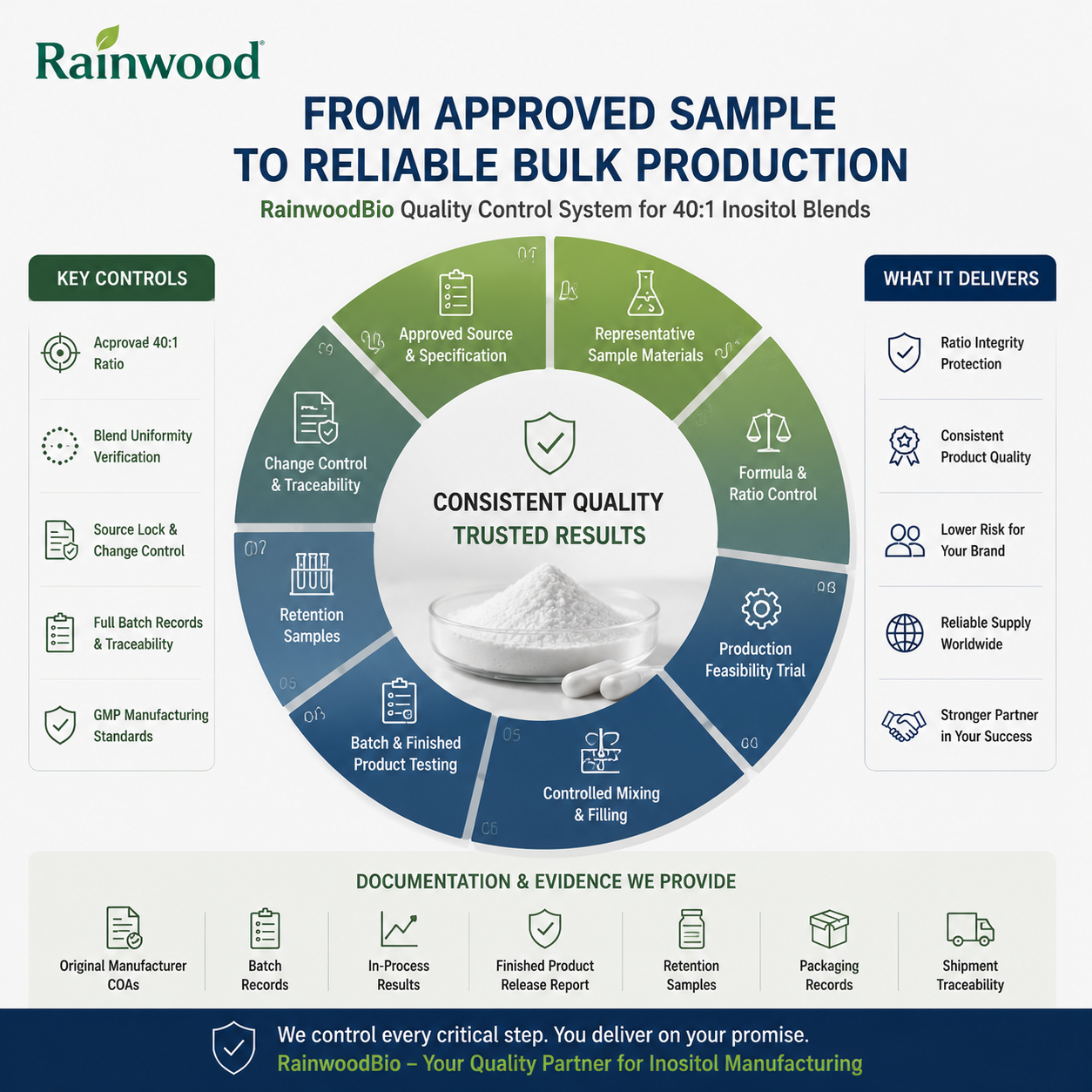
RainwoodBio’s published process includes requirement confirmation, supplier management, GMP production and process control, quality testing and traceability.
For a Myo/DCI project, the useful controls include:
1. approved source and specification;
2. representative sample materials;
3. formula and ratio tolerance;
4. production-feasibility trial;
5. documented mixing and filling parameters;
6. batch and finished-product checks;
7. retained samples; and
8. written change control.
Explore RainwoodBio’s custom inositol manufacturing process.
The contract sentence that matters
Your agreement should prohibit unapproved changes to:
- raw-material manufacturer;
- ingredient form;
- product code;
- specification;
- test method;
- formula;
- excipient;
- dosage form;
- packaging; and
- manufacturing site.
Require written notice and brand approval before implementation.
Audit the first ten minutes of production
Many important differences appear before the line reaches steady state.
Observe or document:
- line clearance;
- material verification;
- first dispensing;
- first mixer charge;
- preblend preparation;
- discharge;
- hopper loading;
- first units;
- adjustment decisions; and
- rejected material.
Then compare beginning, middle and end of the run.
A manufacturer may show a polished line video while the real control failure happens at weighing or transfer.
Investigate a ratio failure without guessing
Review in sequence:
1. raw-material identity and results;
2. dispensing records;
3. scale suitability;
4. yield and reconciliation;
5. mixing parameters;
6. sample locations;
7. laboratory preparation;
8. method suitability; and
9. retained-sample retest where justified.
Do not immediately add more DCI to the next batch. A sampling or analytical problem can look like a formulation problem.
Frequently asked questions
1.Does a passing finished assay prove uniformity?
An average composite result may not establish distribution across individual units. Sampling and acceptance criteria should match the identified risk.
2.Can the bulk batch use a different lot?
Yes, if the lot is from the approved source and meets the agreed specification and controls. An unapproved source change is different.
3.Is a pilot run necessary?
It is valuable when dose load, blend uniformity, flow, capsule capacity or packaging creates meaningful uncertainty.
4.How can buyers detect substitution?
Combine contractual source control, traceability, original manufacturer documents, incoming identity verification and retained-sample comparison.
Do not approve a beautiful sample without an ugly level of detail
Send RainwoodBio the approved sample specification, formula, ratio, source documents and intended batch size.
Request a sample-to-bulk inositol risk review.
References
- US Food and Drug Administration, *Current Good Manufacturing Practice for Dietary Supplements*, 21 CFR Part 111.
- US Food and Drug Administration, *Dietary Supplement Labeling Guide*.
- NIH Dietary Supplement Label Database, *Myo-Inositol and D-Chiro-Inositol labels*.
*This article provides general manufacturing and quality information. Product-specific controls should be designed by qualified technical and quality professionals.*