 EN
EN

Meta title: Best Inositol Format: Powder, Capsules, Gummies or Sticks
Meta description: Compare inositol powder, capsules, gummies and stick packs by dose capacity, customer routine, manufacturing, packaging, testing and landed cost.
The wrong format can destroy a good inositol formula.
A brand chooses gummies because they convert. Then it discovers the intended dose would require a handful per day. Another chooses capsules and learns that the bottle lasts 15 days. A third chooses powder and ignores clumping, scoop accuracy and travel use.
Format is not decoration. It is the delivery system for your promise.
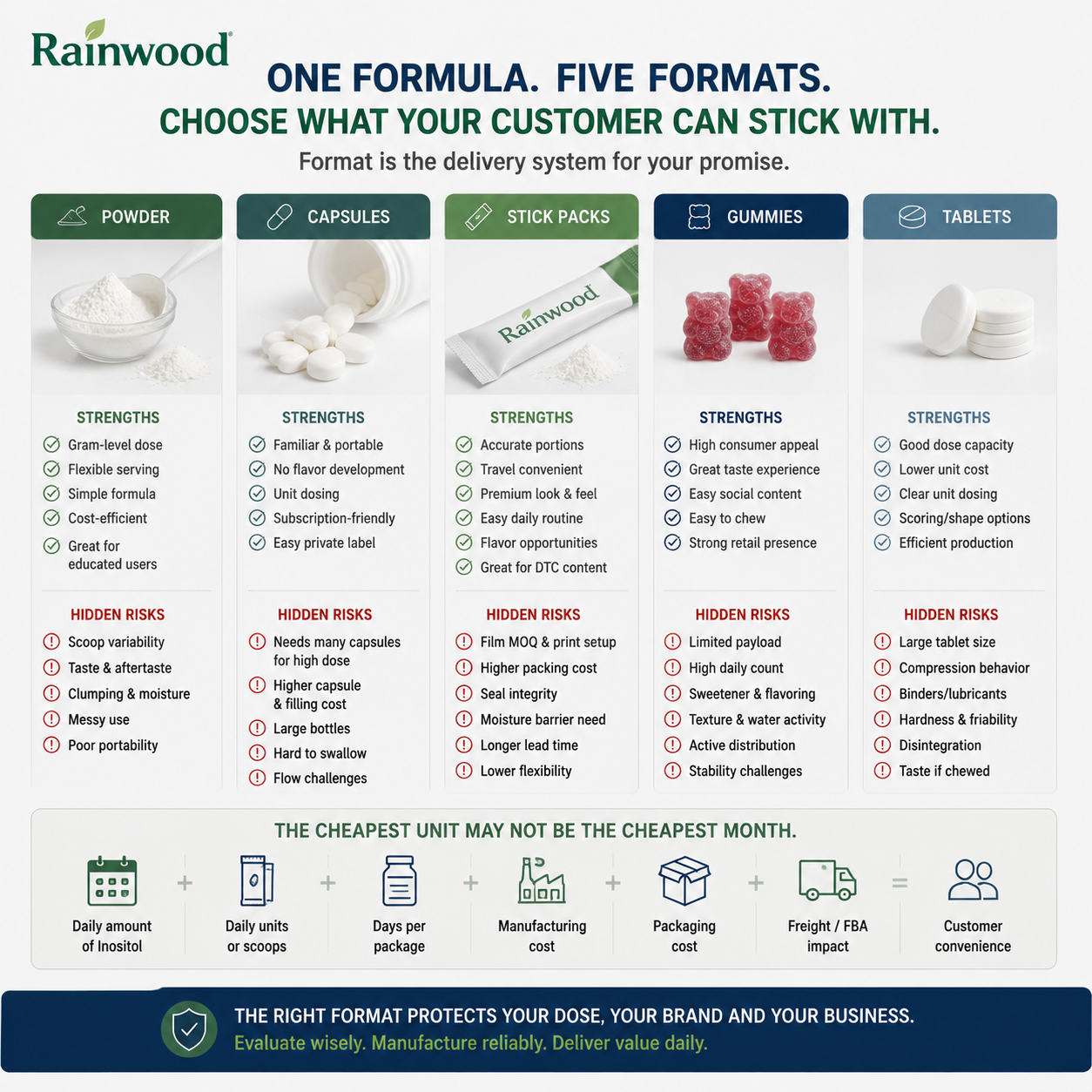
Option 1: bottled powder
Strengths
- carries gram-level amounts;
- simple formula possible;
- fewer dosage units;
- flexible serving;
- efficient raw-material cost; and
- strong fit for educated users.
Hidden risks
- scoop variability;
- taste and aftertaste;
- dissolution expectations;
- moisture and clumping;
- settling in blends;
- jar headspace;
- messy use; and
- weak portability.
Powder wins when the customer accepts the ritual.
Explore RainwoodBio’s custom inositol powder options.
Option 2: capsules
Strengths
- familiar;
- portable;
- no flavour development;
- unit dosing;
- subscription-friendly; and
- straightforward private label.
Hidden risks
- gram-level amounts need multiple capsules;
- shell and filling costs;
- larger bottles;
- difficult swallowing;
- flow challenges; and
- misleading bottle counts.
Option 3: stick packs
Strengths
- accurate portions;
- travel convenience;
- premium presentation;
- easy daily routine;
- flavour opportunities; and
- strong DTC content.
Hidden risks
- film MOQ;
- print setup;
- packing cost;
- seal integrity;
- carton volume;
- moisture barrier;
- longer component lead time; and
- lower flexibility after artwork.
Stick packs can improve use while making the first order more expensive.
Option 4: gummies
Strengths
- high consumer appeal;
- sensory differentiation;
- easy social content;
- lower swallowing resistance; and
- strong retail presence.
Hidden risks
- limited payload;
- high daily count;
- sweetener system;
- flavour masking;
- texture;
- water activity;
- active distribution;
- heat/process compatibility; and
- stability.
A gummy carrying a tiny amount should not borrow the story of a gram-level powder.
Option 5: tablets
Strengths
- potential capacity;
- lower shell cost;
- clear unit dosing;
- scoring or shape options; and
- efficient large-scale production.
Hidden risks
- tablet size;
- compression behaviour;
- binders/lubricants;
- hardness;
- friability;
- disintegration;
- taste if chewed; and
- customer acceptance.
Compare the customer month
For each format calculate:
| Variable | Powder | Capsules | Sticks | Gummies | Tablets |
|---|---:|---:|---:|---:|---:|
| Daily inositol amount | | | | | |
| Daily units/scoops | | | | | |
| Days per package | | | | | |
| Manufacturing cost | | | | | |
| Packaging cost | | | | | |
| Freight/FBA impact | | | | | |
| Customer convenience | | | | | |
The cheapest unit may not be the cheapest month.
Match testing to format
Format can change:
- uniformity;
- net content;
- dissolution/disintegration;
- microbiology;
- moisture;
- physical stability;
- packaging integrity; and
- sensory attributes.
Ingredient-level evidence does not automatically establish finished-format shelf life.
Packaging can reverse the format decision
The dosage form and package must be designed together.
A powder jar may need:
- wide opening;
- suitable closure;
- induction seal;
- scoop placement;
- desiccant;
- moisture barrier; and
- enough headspace for filling without looking deceptive.
Capsules may need a bottle large enough for the full count and desiccant without crossing an expensive shipping tier. Stick packs need film with appropriate barrier and reliable seals. Gummies may need protection from heat, moisture, sticking and texture change.
Prototype the finished pack, measure its dimensions and run transport-relevant checks before ordering printed components.
Customer behaviour is a technical input
Ask potential customers:
- Will they scoop powder at home?
- Do they travel?
- How many capsules will they accept?
- Do they prefer a flavoured drink?
- Will they pay more for individual sachets?
- Do they avoid sugar or sweeteners?
- Are large tablets acceptable?
The most efficient factory format may be the least acceptable consumer routine.
Use actual samples in the research. A survey about “capsules versus powder” is weaker than watching customers attempt the full daily serving.
Build a weighted decision matrix
Assign weights to:
- dose capacity;
- convenience;
- sensory experience;
- MOQ;
- development time;
- manufacturing cost;
- packaging cost;
- fulfilment;
- stability;
- testing;
- differentiation; and
- customer preference.
Score each format and document the assumption. This stops the loudest person in the meeting from choosing the package.
Prototype the customer month, not one attractive unit
A single gummy, capsule or stick pack can look excellent in a sample meeting. The customer buys and uses an entire month. Prototype the complete retail experience: total pieces, pack dimensions, daily opening actions, storage after opening, shipping weight and the instructions required to avoid mistakes.
Then run a simple fulfilment simulation. Put the product through pick-and-pack, parcel shipping, warm storage and real household use. Powders can clump, gummies can change texture, capsules can create an intimidating bottle, and stick packs can multiply packaging cost. These are commercial facts, not cosmetic details.
Ask representative users to follow the proposed directions for at least several days. Record missed servings, mess, taste fatigue, swallowing complaints and travel behaviour. The format that wins in a conference room may lose in a bathroom cabinet.
Choose the package that preserves the dose after the novelty disappears.
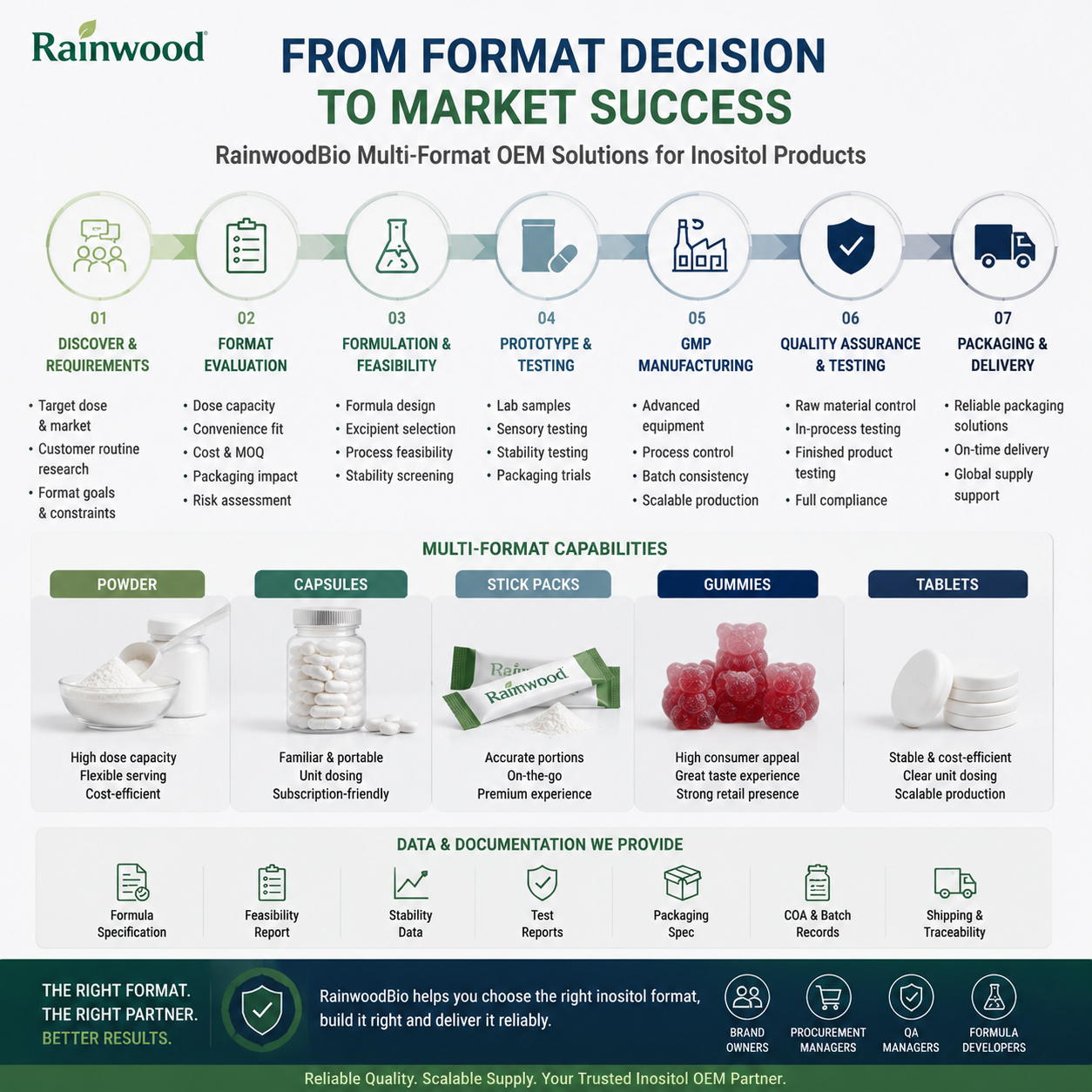
How RainwoodBio can compare formats before commitment
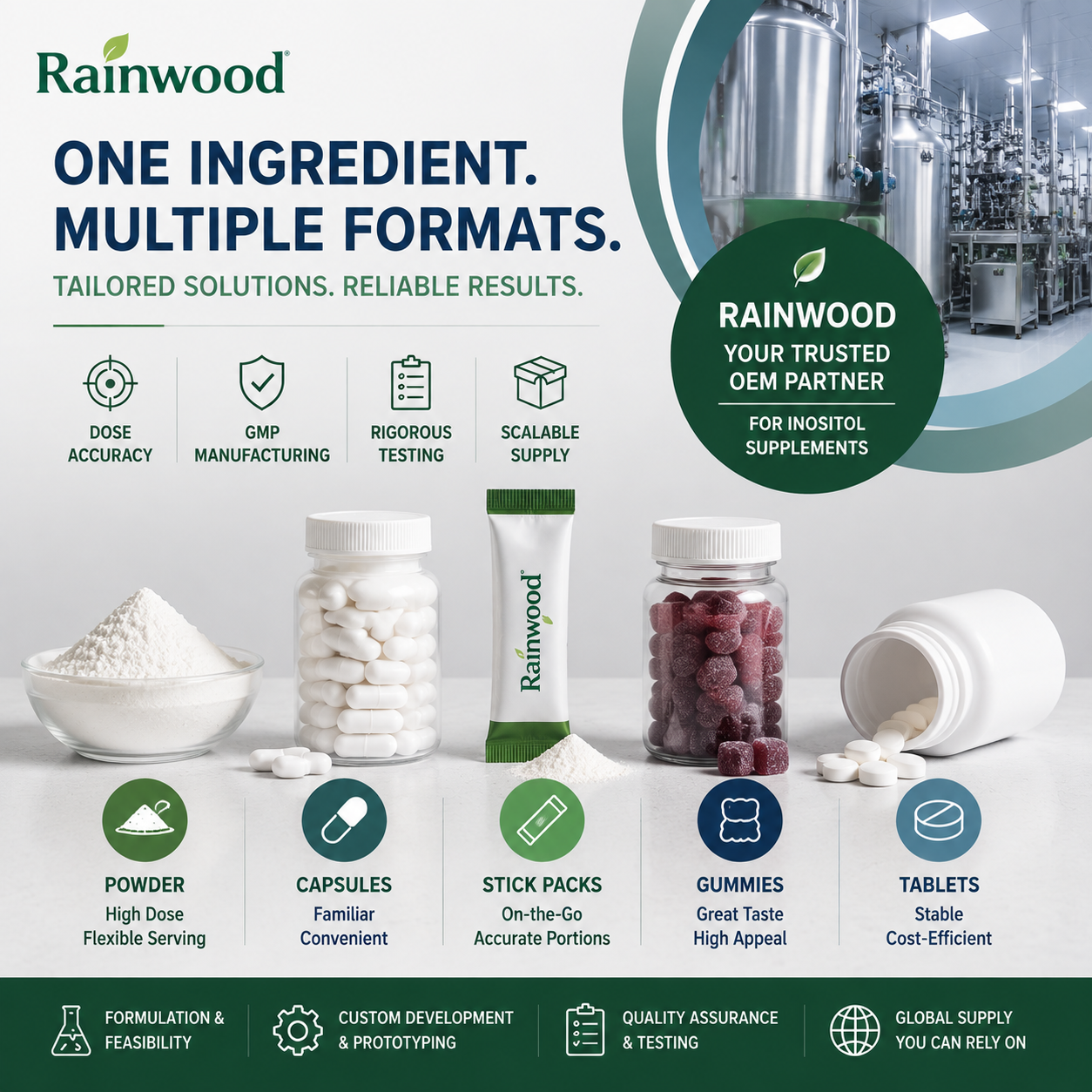
RainwoodBio publishes capabilities in hard capsules, gummies, powder sachets, tablets and other private-label forms.
A format assessment can compare:
- real dose capacity;
- sample feasibility;
- excipients;
- customer routine;
- packaging;
- production MOQ;
- test plan;
- cost; and
- lead time.
Explore RainwoodBio’s multi-format OEM manufacturing service.
Learn more about RainwoodBio’s production capabilities.
The format decision rule
Choose the format that best balances:
1. honest daily amount;
2. customer willingness to use it;
3. repeatable manufacture;
4. protectable shelf life;
5. clear label;
6. viable monthly cost; and
7. scalable supply.
Ignore whichever format is fashionable this month.
Frequently asked questions
1.Which format has the lowest MOQ?
Stock capsules or bottled powder may offer lower component complexity, but MOQ depends on formula, package, testing and customisation.
2.Are stick packs better than a scoop?
They improve portion control and portability but increase packaging cost and setup.
3.Can inositol gummies deliver a meaningful amount?
It depends on the intended amount and gummy system. High gram-level concepts may require an impractical serving.
Stop forcing the dose into the wrong package
Send RainwoodBio the intended daily amount, customer, market, format preference, quantity and target price.
Request an inositol format and packaging comparison.
References
- NIH Dietary Supplement Label Database, *Inositol dosage-form and serving examples*.
- US Food and Drug Administration, *Current Good Manufacturing Practice for Dietary Supplements*.
- RainwoodBio, *OEM dosage-form capabilities*.
*This article provides general product-development information. Final feasibility requires product-specific trials.*