 EN
EN
Meta title: Make an Inositol Product Retail-Ready
Meta description: Retail-ready inositol needs more than a bottle and COA. Build the formula, label, release file, shelf-life, traceability and supply controls buyers expect.
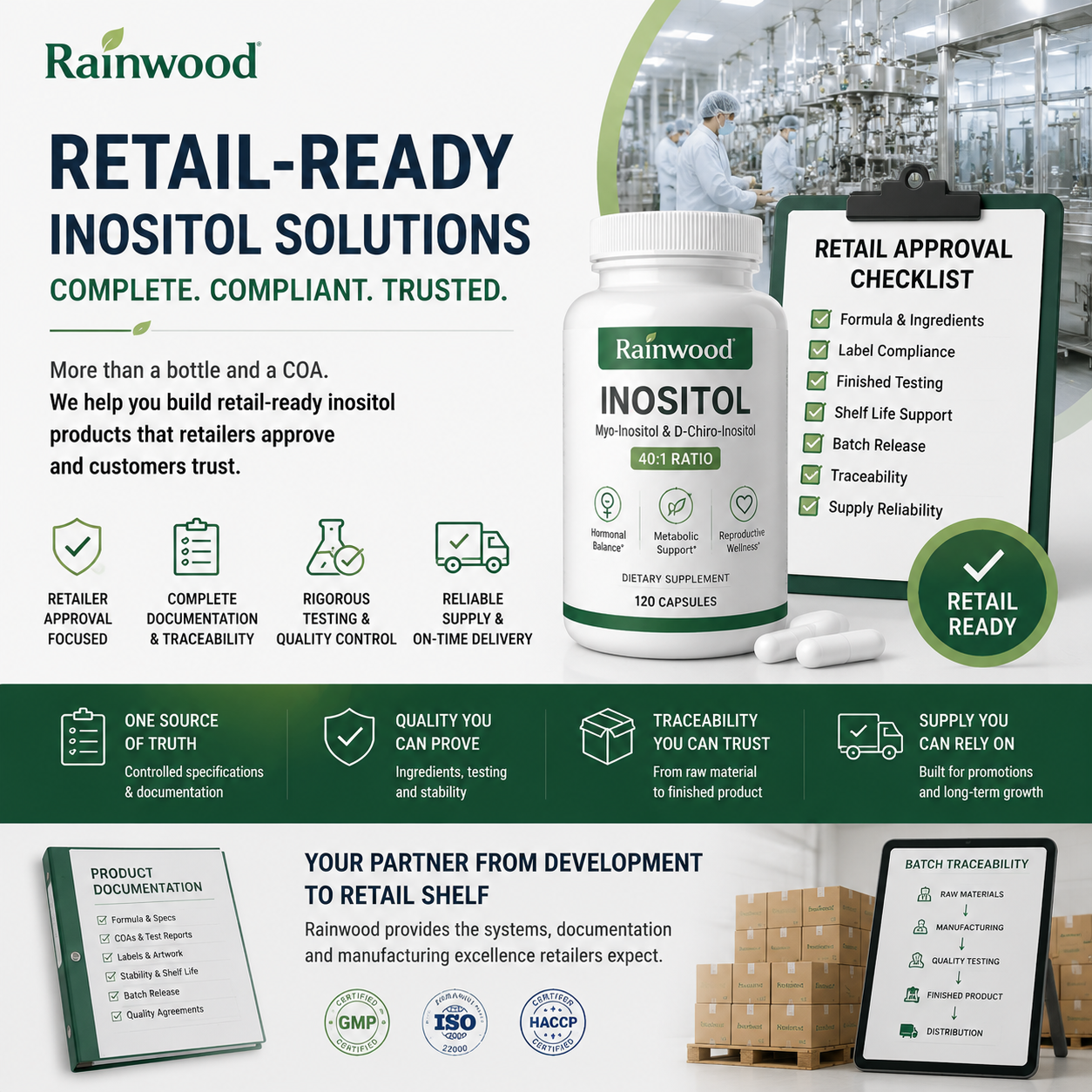
Getting a retailer interested is exciting.
Getting through technical approval is where weak inositol products collapse.
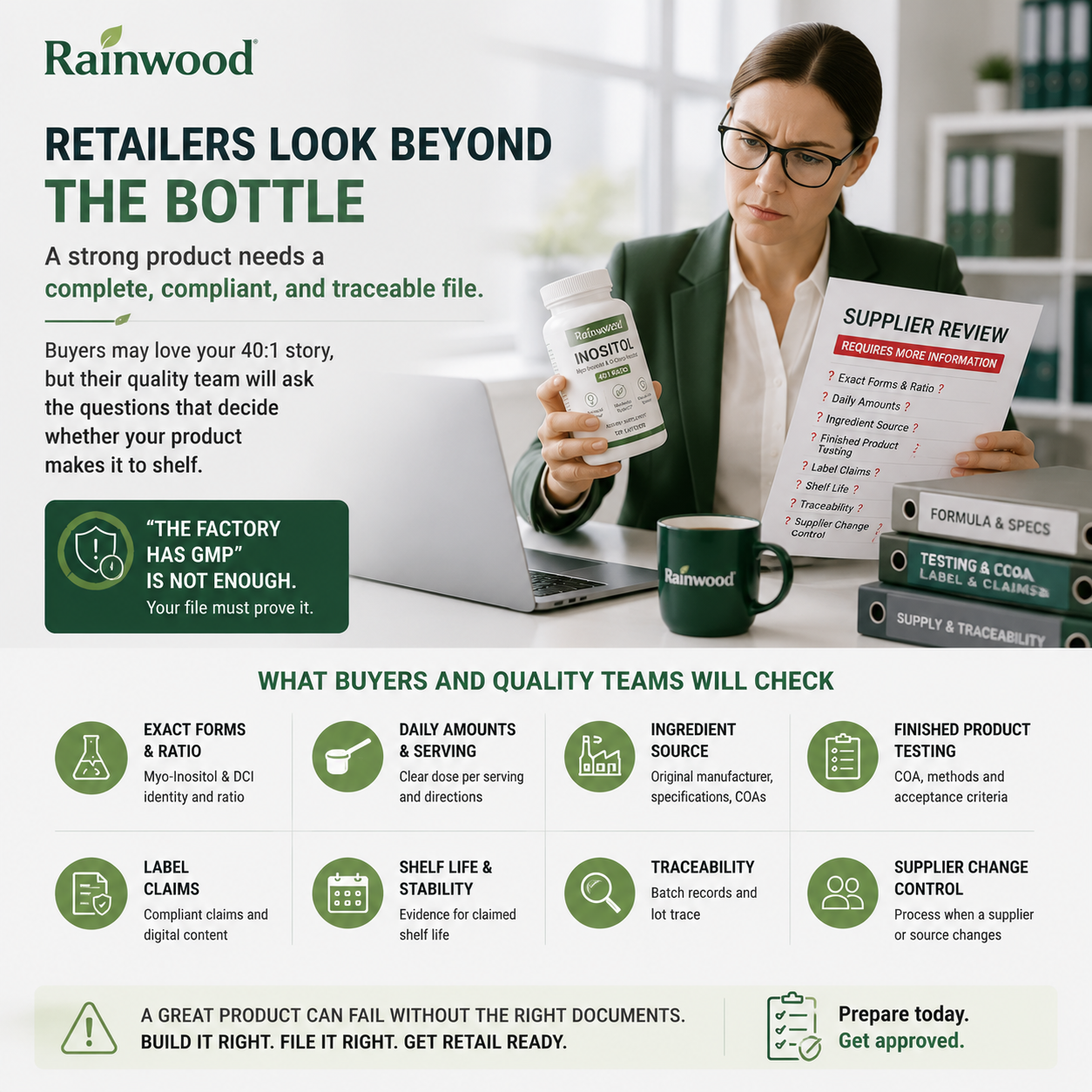
A buyer may like the 40:1 story, package and margin. The quality team will ask harder questions: exact forms, daily amounts, source, finished testing, label claims, shelf life, traceability and what happens when a supplier changes.
If your answer is “the factory has GMP,” the file is not ready.
Build one source of truth
Create a controlled product specification containing:
- product and SKU name;
- destination market;
- complete quantitative formula;
- ingredient sources;
- dosage form;
- serving and directions;
- finished specifications;
- packaging;
- shelf life;
- label revision;
- storage;
- case pack; and
- release documents.
Every retailer portal, label and sales sheet should derive from this file.
Use our retail-ready inositol technical checklist.
Prove the ingredients, not just the category
For Myo-Inositol and DCI, maintain:
- exact identity;
- original manufacturer;
- specification;
- representative and lot COAs;
- test methods;
- source statements;
- allergens/GMO information;
- storage; and
- change notification.
Do not let a backup source enter because it has the same short name.
Make the label survive digital expansion
Review:
- principal display panel;
- facts panel;
- ingredient list;
- directions;
- warnings;
- company details;
- net quantity;
- lot/expiry coding;
- barcode;
- country-specific language;
- product page;
- retailer description; and
- advertising claims.
The most aggressive website sentence can become the weakest point in the retail file.
Read PCOS Sells - But One Aggressive Claim Can Become a Regulatory Target.
Define batch release
Agree which documents accompany each shipment:
- finished-product COA;
- raw-material traceability where required;
- batch/lot number;
- manufacture and expiry date;
- allergen statement;
- certificate of conformity;
- packaging checks;
- quantity;
- pallet information; and
- shipping records.
The COA should reference the approved specification and actual lot.
Protect shelf life
Ingredient shelf life does not automatically prove finished-product shelf life.
Consider:
- formula interactions;
- moisture;
- temperature;
- light;
- packaging barrier;
- closure;
- desiccant;
- powder clumping;
- gummy texture;
- capsule integrity;
- label adhesion; and
- distribution conditions.
Retailers may require minimum remaining shelf life on receipt. Put it in the supply agreement.
Plan for complaints and recalls before the first sale
Define:
- complaint intake;
- lot identification;
- investigation;
- retained samples;
- laboratory follow-up;
- adverse-event escalation;
- root cause;
- corrective action; and
- retailer communication.
Traceability that works only during an audit is not traceability.
Test the recall path before you need it
Choose one finished lot and perform a desktop trace:
1. identify every raw-material lot;
2. identify production and packaging records;
3. confirm quantity manufactured and released;
4. locate all warehouses and customers that received it;
5. identify retained samples;
6. retrieve the approved label revision; and
7. confirm who can make and communicate a recall decision.
Record how long the exercise takes and which links fail.
A retailer should not discover during an incident that the manufacturer and exporter use different lot codes.
Prepare for retailer content audits
Technical approval does not end at listing. Retailers may later review:
- renewed certificates;
- updated COAs;
- website claims;
- consumer complaints;
- adverse events;
- test results;
- formula changes;
- packaging changes; and
- regulatory developments.
Assign owners and review dates. A certificate that was valid at launch may expire while the product remains on shelf.
Make service levels measurable
Agree:
- order acknowledgement time;
- production lead time;
- document turnaround;
- release time;
- on-time-in-full target;
- minimum shelf life at delivery;
- complaint-response time;
- deviation notification; and
- recall contact availability.
“Best service” is advertising. A measured response time is a supply commitment.
Build supply around promotions
Share:
- baseline forecast;
- promotional uplift;
- firm production window;
- ingredient lead time;
- printed-component lead time;
- laboratory release time;
- freight time;
- safety stock; and
- reorder trigger.
A promotion that empties the shelf and cannot be replenished may hand repeat customers to another brand.
Explore RainwoodBio’s inositol supply and private-label workflow.
How RainwoodBio can support retailer approval
RainwoodBio’s published process includes supplier management, production control, quality testing and release, compliance documentation, warehousing, logistics and traceability.
For a retail inositol SKU, the company information should become product-specific evidence:
- approved formula;
- agreed source;
- manufacturing record;
- release report;
- packaging configuration;
- shelf-life support;
- shipment traceability; and
- change-control route.
Learn more about RainwoodBio’s manufacturing and quality systems.
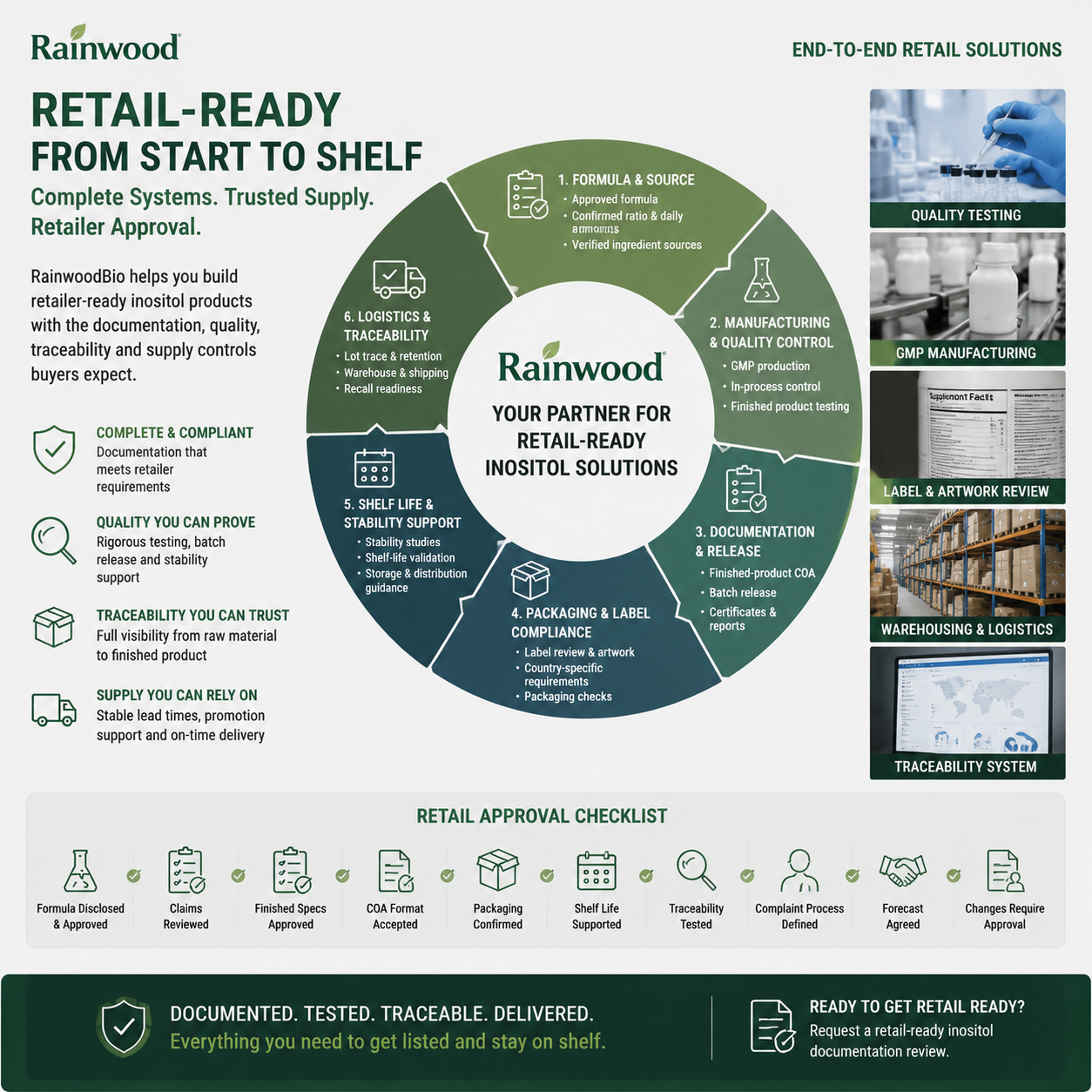
Retail approval checklist
- Formula disclosed and approved
- Ratio and daily amounts clear
- Ingredient identities verified
- Claims reviewed
- Finished specifications approved
- COA format accepted
- Packaging confirmed
- Shelf life supported
- Traceability tested
- Complaint process defined
- Forecast agreed
- Changes require approval
Give the buyer a clean document index
Do not send thirty randomly named attachments.
Create folders for:
1. company and facility;
2. ingredient specifications;
3. formula;
4. finished-product specification;
5. labels and artwork;
6. batch release;
7. stability and packaging;
8. claims and evidence;
9. logistics; and
10. quality agreements.
Add an index with document title, number, revision, date and owner.
The buyer should be able to locate the quantitative formula or latest COA without searching an email chain.
Prepare a retailer-specific commercial pack
Alongside the technical file, provide:
- product positioning;
- target shopper;
- pack and case dimensions;
- unit and case barcodes;
- wholesale and recommended retail price;
- promotional support;
- lead time;
- minimum order;
- shelf life at delivery; and
- approved product copy.
Strong technical approval gets the SKU listed. Strong commercial execution keeps it listed.
Frequently asked questions
1.Is a factory certificate enough for retailer approval?
No. Retailers normally need product, formula, label, batch and supply information in addition to facility credentials.
2.Can one label be used globally?
Not automatically. Requirements and permitted claims differ by market.
3.Should retailers receive raw-material COAs?
This depends on the technical agreement. At minimum, the manufacturer should maintain full traceability and provide agreed batch documents.
Make the technical file as convincing as the front panel
Send RainwoodBio the retailer manual, market, formula, forecast, package and target launch date.
Request a retail-ready inositol documentation review.
References
- US Food and Drug Administration, *Current Good Manufacturing Practice for Dietary Supplements*.
- US Food and Drug Administration, *Dietary Supplement Labeling Guide*.
- US Federal Trade Commission, *Health Products Compliance Guidance*.
- RainwoodBio, *Published manufacturing workflow*.
*This article provides general retail and quality information. Requirements should be confirmed for each retailer and market.*