 EN
EN

Meta title: How to Switch Inositol Suppliers Without Product Drift
Meta description: Change inositol suppliers without losing identity, ratio, capsule fill, labels, evidence or customers through qualification, trials and change control.
Your current inositol supplier is late, expensive or impossible to communicate with.
The replacement says, “Same 99% material. Easy switch.”
That sentence should make an established brand nervous.
A supplier switch can change chemical form, source, assay method, particle size, density, taste, capsule capacity, label assumptions, research relevance and market documents—even when both quotations say “inositol.”
The goal is not to find a similar white powder. It is to protect the product customers already trust.
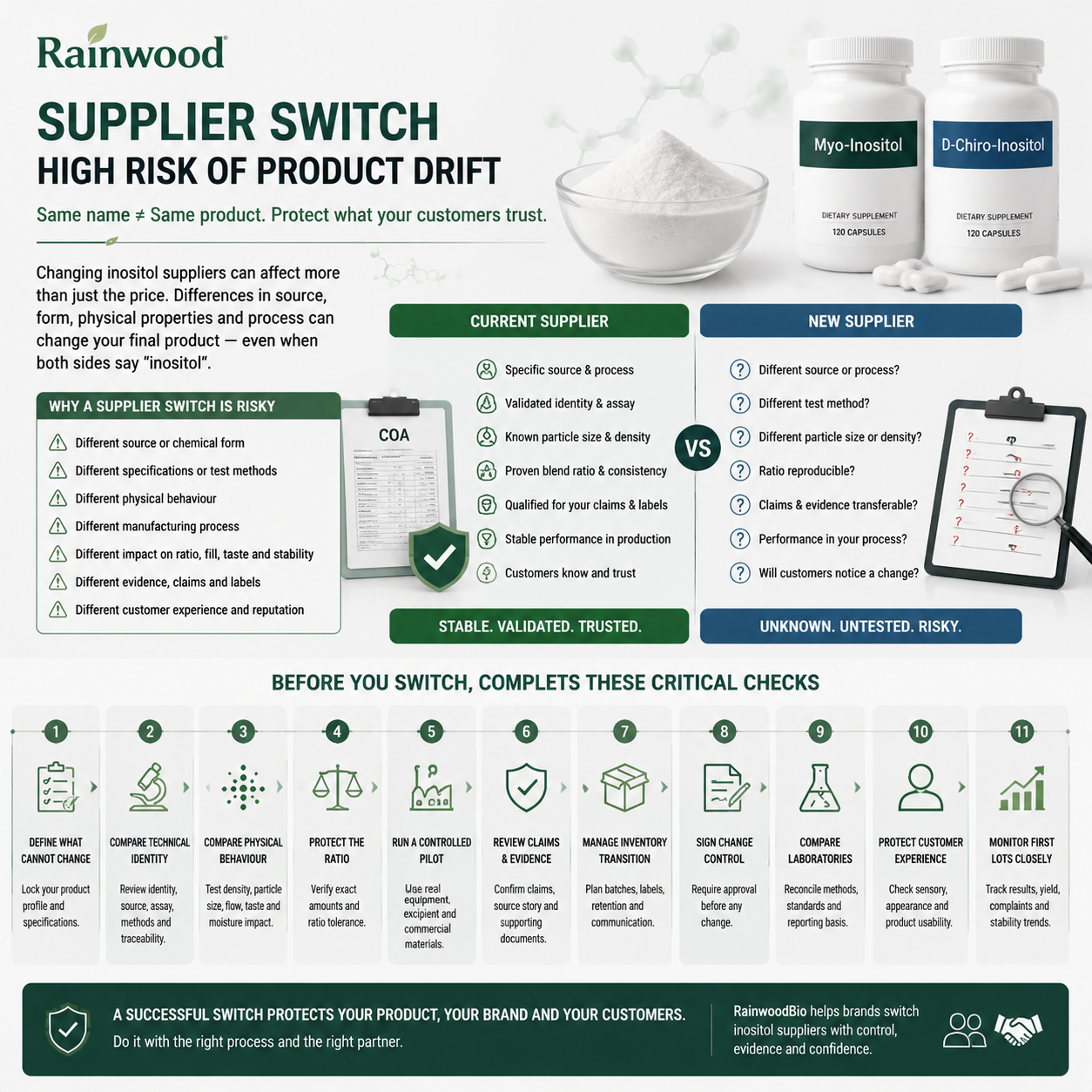
Step 1: define what cannot change
Create a locked product profile:
- ingredient form;
- original source restrictions;
- daily amounts;
- Myo/DCI ratio;
- companion ingredients;
- dosage form;
- physical attributes;
- finished specifications;
- package;
- shelf life;
- approved claims; and
- customer-visible characteristics.
Without this baseline, “equivalent” means whatever the new supplier wants it to mean.
Use our inositol supplier-switch specification checklist.
Step 2: compare technical identity
Review side by side:
- name;
- CAS number;
- molecular identity;
- source/process;
- manufacturer;
- specification;
- identity method;
- assay;
- related substances;
- moisture;
- contaminants; and
- traceability.
Do not substitute D-Pinitol for DCI or generic inositol for Myo-Inositol because the website keywords look similar.
Step 3: compare physical behaviour
Two chemically conforming materials may differ in:
- bulk density;
- particle size;
- flow;
- taste;
- moisture uptake;
- colour;
- compaction; and
- dissolution.
These differences can affect:
- capsule fill;
- excipient level;
- mixing;
- yield;
- scoop behaviour;
- powder appearance; and
- customer experience.
Run production-relevant tests.
Step 4: protect the ratio
For Myo/DCI products, confirm that the new materials and process can reproduce:
- exact amounts;
- ratio tolerance;
- blending;
- sampling;
- finished composition; and
- unit or serving consistency.
Read How to Lock the Myo-to-DCI Ratio Before Mass Production.
Step 5: run a controlled pilot
The pilot should use:
- commercial-source materials;
- intended equipment;
- approved formula;
- proposed excipients;
- production-representative process;
- actual package; and
- planned tests.
Compare with the approved current product:
- appearance;
- taste;
- fill;
- weight variation;
- disintegration/dissolution where relevant;
- assay/composition;
- packaging fit; and
- stability risk.
A hand-filled sample is not a supplier-transfer trial.
Step 6: review evidence and claims
If the existing brand story depends on:
- specific source;
- fermentation origin;
- non-GMO claim;
- branded ingredient;
- study material;
- 40:1 ratio;
- purity claim; or
- manufacturing location,
the switch may require new substantiation or copy.
Do not assume the new source inherits the old source’s evidence.
Step 7: manage inventory transition
Plan:
- last old-source batch;
- first new-source batch;
- label revision;
- lot coding;
- remaining materials;
- retailer notification;
- customer-service script;
- old/new retention samples; and
- complaint monitoring.
Avoid mixing old and new sources without documented assessment and traceability.
Step 8: sign change control before the first order
The new supplier must notify and obtain approval before changes to:
- original manufacturer;
- site;
- process;
- specification;
- method;
- formula;
- excipient;
- equipment;
- package; or
- laboratory.
A supplier-switch project should end silent changes—not create a new route for them.
Step 9: compare laboratories, not only limits
The old and new COAs may use identical acceptance limits while using different methods, standards or reporting bases.
Reconcile:
- identity technique;
- reference standard;
- assay method;
- dry or as-is basis;
- moisture method;
- reporting limit;
- related-substance profile;
- sampling;
- internal versus third-party laboratory; and
- method validation or verification.
A five-percent result difference may reflect material, sampling or method. Investigate before adjusting the formula or label.
Step 10: protect the customer-visible product
Create a sensory and physical comparison:
- powder colour;
- odour;
- taste;
- dissolution;
- clumping;
- capsule colour;
- fill level;
- tablet appearance;
- package dimensions; and
- label statements.
Customers may notice a harmless physical shift before the quality team does. Decide which differences are acceptable and how support staff will respond.
Step 11: monitor the first three commercial lots
Apply heightened review to:
- incoming results;
- machine settings;
- yield;
- deviations;
- finished composition;
- rejects;
- complaints;
- returns; and
- stability observations.
Supplier qualification does not end when the first lot passes. Early trend data shows whether the new source is truly stable.
How RainwoodBio can support the transfer
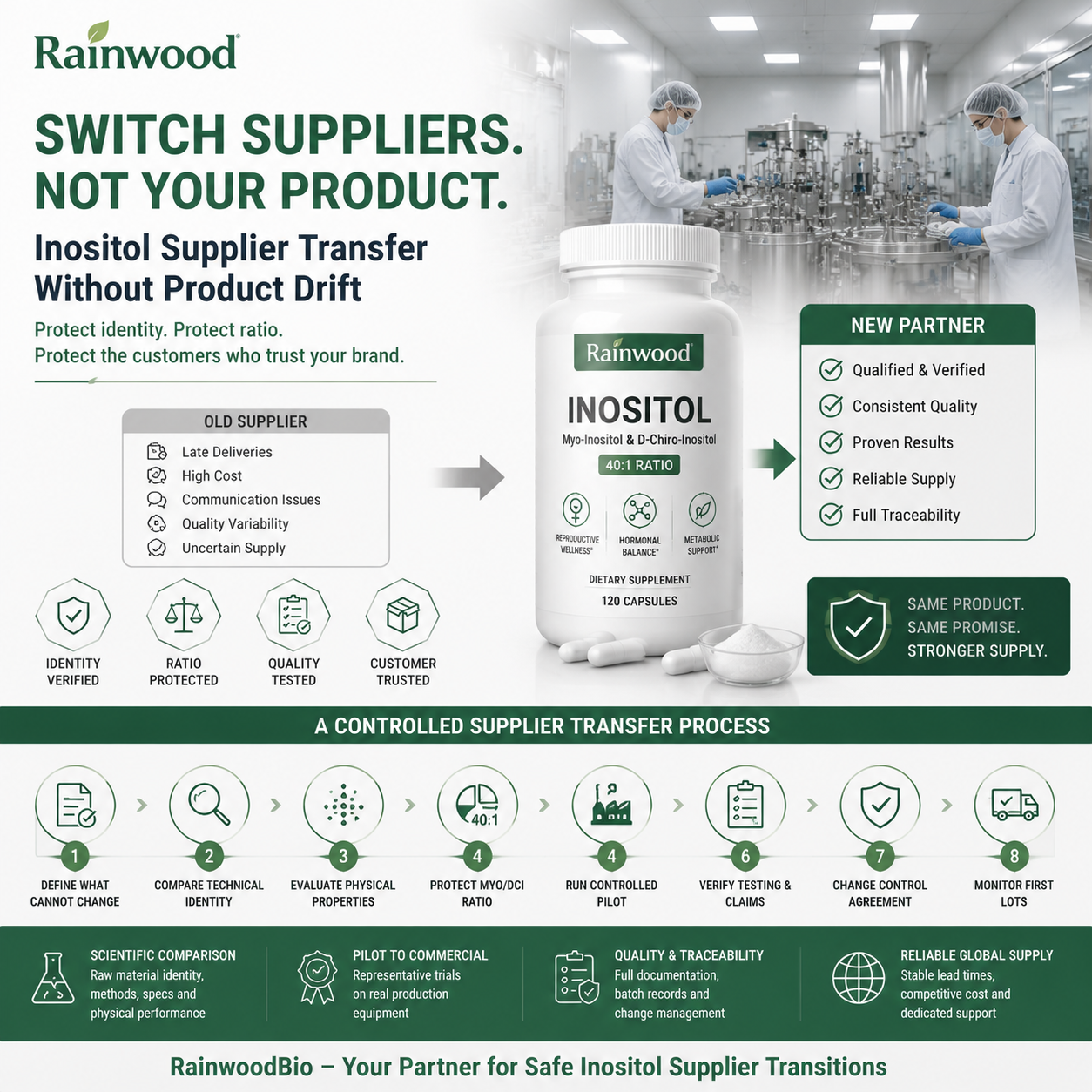
RainwoodBio’s published capabilities cover supplier management, sample development, production control, testing, documentation, logistics and traceability.
For a supplier transition, these can be organised into:
1. current-product gap assessment;
2. proposed-source comparison;
3. representative sample;
4. pilot production;
5. finished verification;
6. packaging confirmation;
7. change-control agreement; and
8. commercial supply plan.
Explore RainwoodBio’s inositol supplier-transfer and OEM service.
Learn more about RainwoodBio’s quality and traceability workflow.
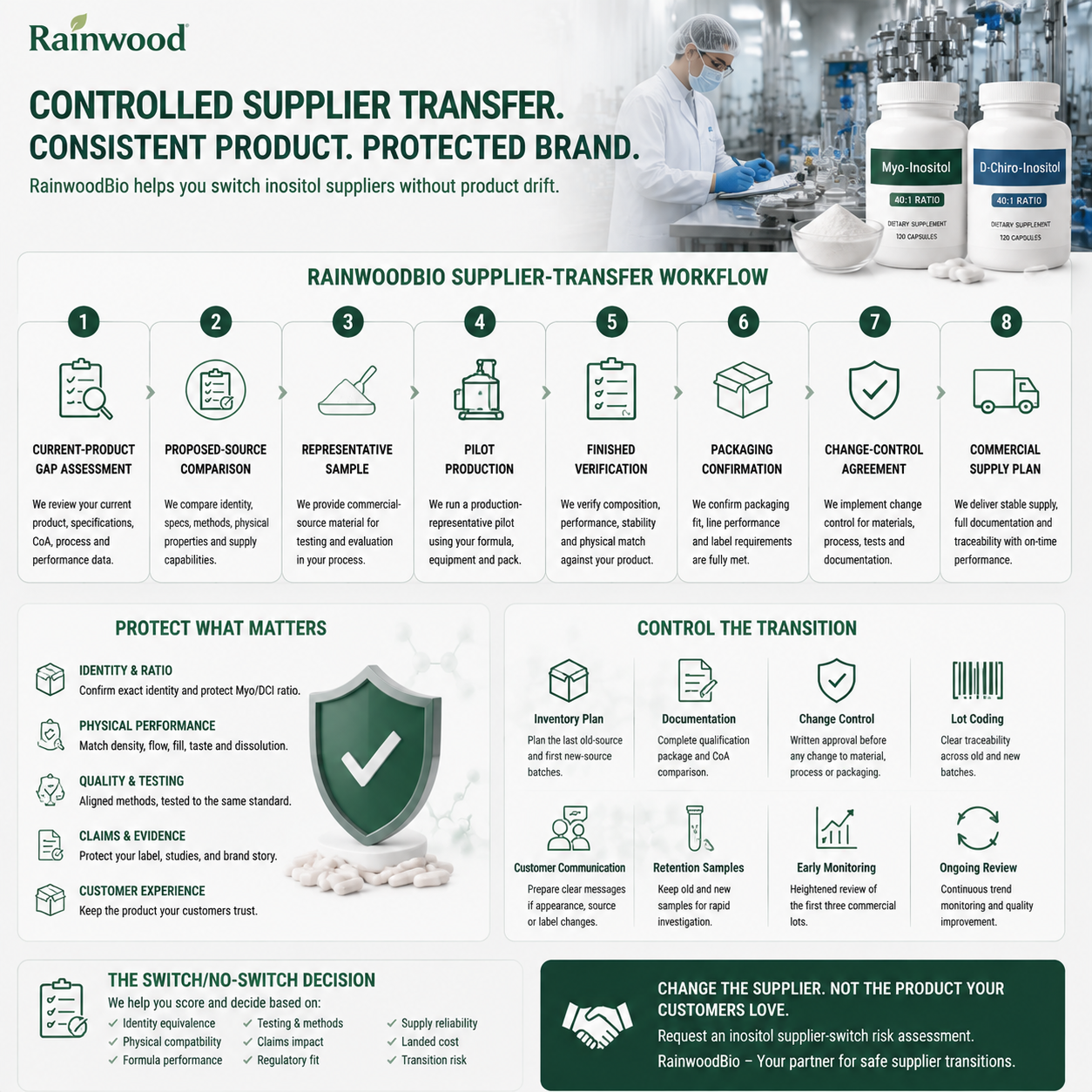
The switch/no-switch decision
Score:
- identity equivalence;
- physical compatibility;
- formula performance;
- testing;
- claims impact;
- regulatory fit;
- supply reliability;
- landed cost; and
- transition risk.
Reject the source if savings depend on unresolved technical differences.
Set an exit gate for the old supplier
Do not terminate the existing supply before the replacement has:
- passed document qualification;
- supplied representative material;
- completed the pilot;
- passed finished-product testing;
- confirmed packaging;
- agreed change control;
- demonstrated lead time; and
- produced an accepted commercial lot where required.
Maintain enough old-source inventory to cover realistic delay without holding so much that expiry or label change becomes a problem.
Communicate only what customers need
If the product remains materially consistent and no disclosure is required, customers may need no announcement. If taste, appearance, label, source story or serving changes, prepare clear language:
- what changed;
- what did not;
- why;
- quality checks completed; and
- where questions can be sent.
Silence can turn a harmless difference into a social-media conspiracy. Overexplaining can create concern where none existed. Plan the message based on actual impact.
Frequently asked questions
1.Must customers be told about a supplier change?
It depends on the change, label, contracts, retailer requirements and market. The brand should assess disclosure obligations and customer impact.
2.Can the same finished specification cover both sources?
Possibly, if it remains scientifically justified and both sources are qualified. Source-specific controls may still be necessary.
3.How many pilot units are needed?
Quantity depends on equipment, testing, stability and commercial risk. The pilot must be representative enough to answer the identified questions.
4.Can RainwoodBio duplicate an existing formula?
RainwoodBio can assess technical feasibility using the formula, label, specification and sample, subject to intellectual-property and contractual rights.
Change the supplier—not the product your customers love
Send RainwoodBio your current specification, proposed source, annual volume, format and problems with the existing supplier.
Request an inositol supplier-switch risk assessment.
References
- US Food and Drug Administration, *Current Good Manufacturing Practice for Dietary Supplements*.
- US Federal Trade Commission, *Health Products Compliance Guidance*.
- RainwoodBio, *Published supplier-management, testing and traceability workflow*.
*This article provides general sourcing and quality information. Supplier changes require product- and market-specific assessment.*