 EN
EN

Meta title: The 40:1 Inositol Trap Supplement Brands Miss
Meta description: A 40:1 Myo-Inositol to D-Chiro-Inositol ratio can be mathematically perfect and commercially weak. Learn what buyers should check beyond the ratio.
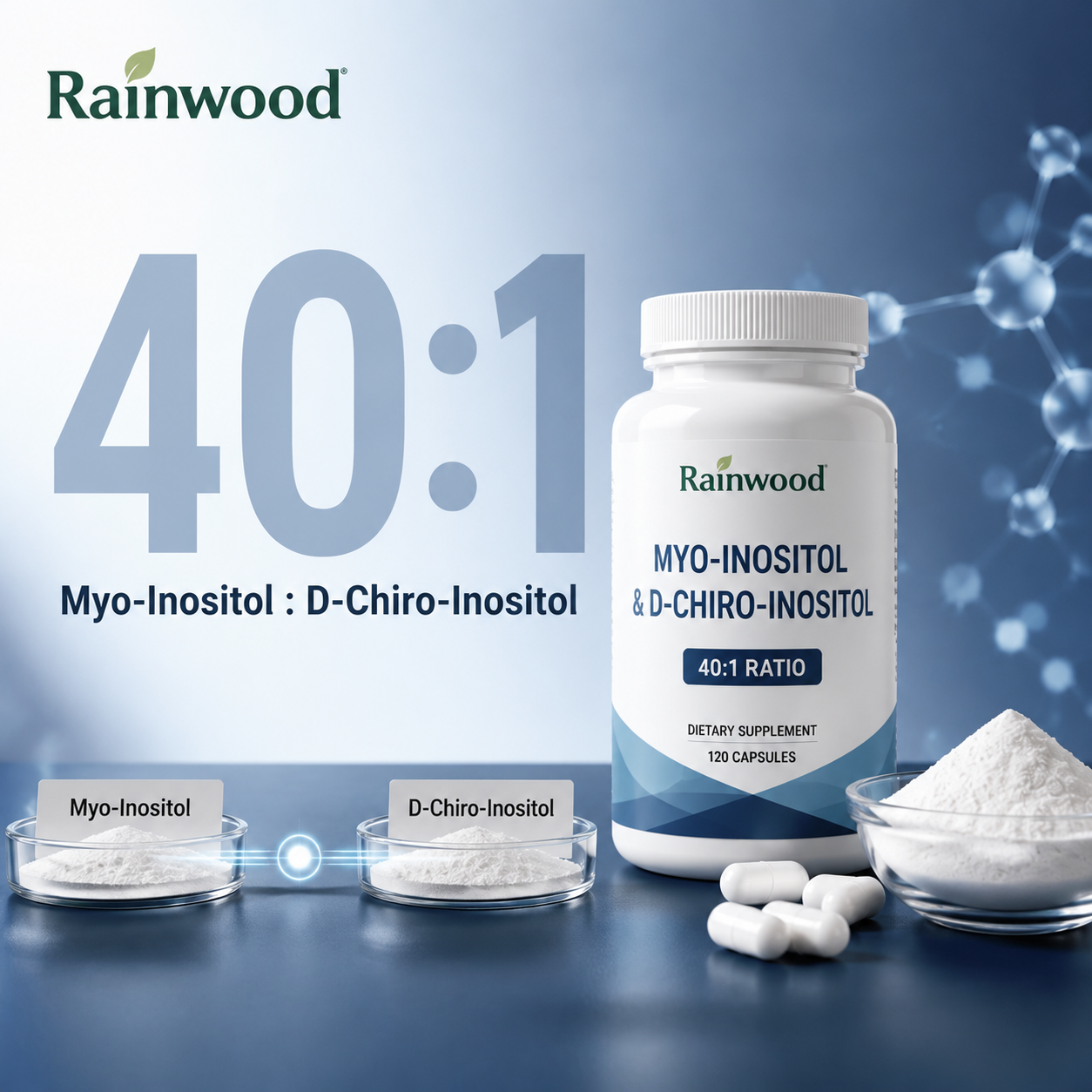
The inositol market has found its favourite number: 40:1.
It appears on bottles, Amazon images, ingredient pages and sales decks as though it were a complete formula, a quality certificate and a clinical conclusion rolled into one.
It is none of those things.
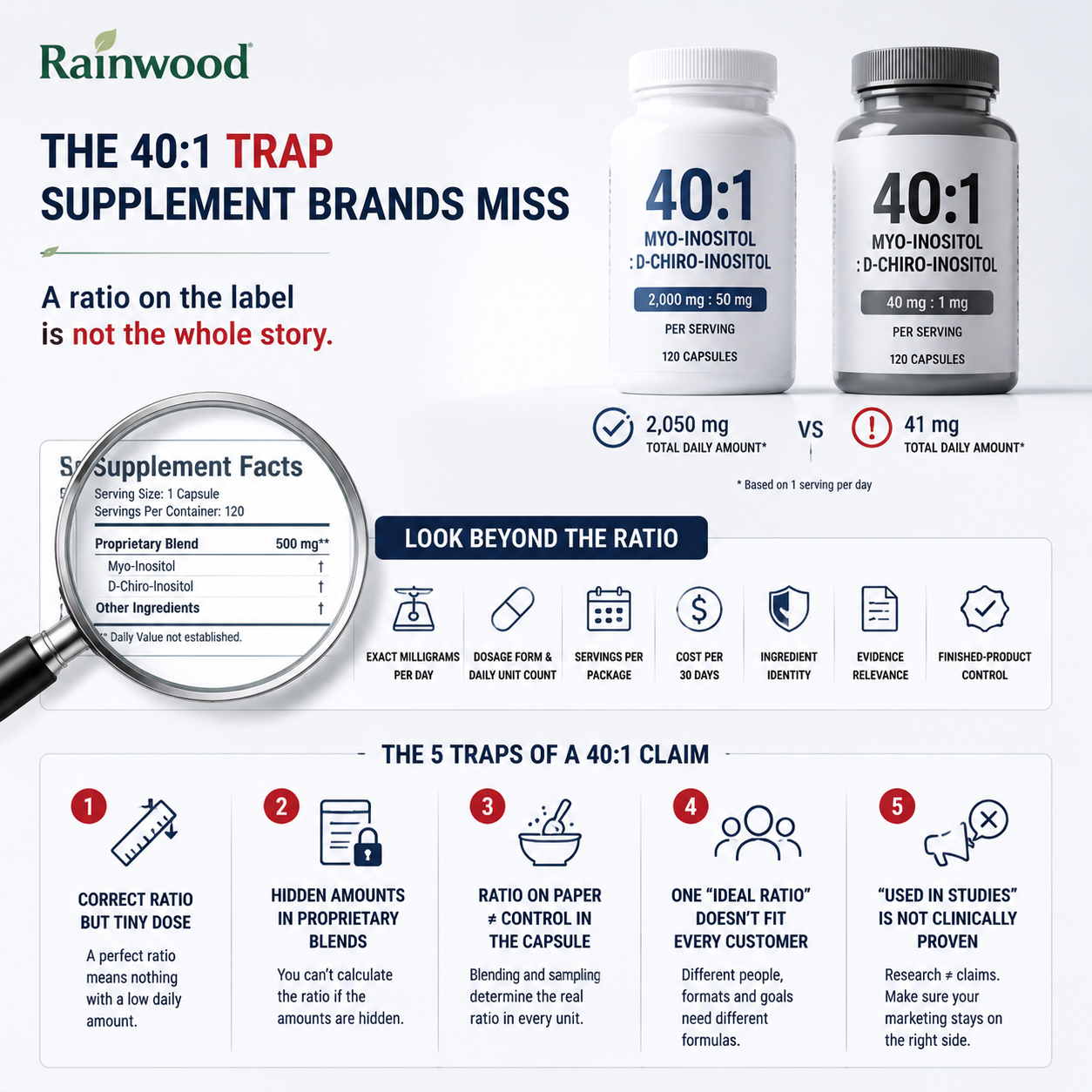
Forty to one is only a relationship between two numbers. A product containing 2,000 mg of Myo-Inositol and 50 mg of D-Chiro-Inositol is 40:1. So is a product containing 40 mg and 1 mg.
One delivers 2,050 mg of combined inositols. The other delivers 41 mg.
Both can print the same ratio in enormous gold lettering.
The ratio became a shortcut for trust
The 40:1 story is commercially powerful because it is easy to remember and sounds biological. It is often connected to the relative presence of Myo-Inositol and D-Chiro-Inositol in plasma and has been used in research and marketed formulations.
But the 2024 systematic review prepared to inform the international evidence-based PCOS guideline reached a more cautious conclusion: the overall evidence for inositol in PCOS was limited and inconclusive, with possible benefits for some outcomes and no effect for others.
That does not make 40:1 useless. It means the ratio should not be treated as a magic password that excuses weak formulation, hidden amounts or exaggerated claims.
Read our Myo-Inositol and D-Chiro-Inositol ingredient guide before selecting a ratio.
Trap 1: the ratio is correct, but the daily amount is tiny
Ask for four numbers:
1. Myo-Inositol per serving;
2. D-Chiro-Inositol per serving;
3. servings per day; and
4. total daily amount of each.
If the supplier shows only “40:1 blend 500 mg,” you still do not know whether the individual components are verified, whether the ratio is a formulation target or a finished result, or whether the dose supports the product position.
Never compare two formulas by ratio alone. Compare:
- exact milligrams per day;
- dosage form and daily unit count;
- servings per package;
- cost per 30 days;
- ingredient identity;
- evidence relevance; and
- finished-product control.
Trap 2: the front says 40:1, but the facts panel hides the amounts
Proprietary blends can create a premium-looking label without disclosing how much of each ingredient is present. The blend total may be visible while Myo-Inositol, D-Chiro-Inositol and several fashionable companion ingredients appear underneath without individual quantities.
The ratio claim then asks the customer to trust a number they cannot calculate.
For a brand, this creates three problems:
- sophisticated customers may see the lack of transparency;
- retailers may request a confidential formula and substantiation;
- future supplier changes become harder to evaluate.
Transparency is a sales asset in this category. If the ratio is important enough for the front panel, the component amounts should be important enough for the technical file.
Trap 3: the formula ratio is 40:1, but the finished blend is not controlled
Myo-Inositol may be used at gram-level quantities, while D-Chiro-Inositol may be present at tens of milligrams. That difference can make blending and sampling important.
A spreadsheet ratio does not prove that every capsule, scoop or sachet contains the intended distribution.
Ask the manufacturer how it controls:
- weighing and independent verification;
- order of addition;
- geometric dilution or preblending;
- mixer load and time;
- segregation risk;
- sampling locations;
- blend uniformity where appropriate;
- finished-product composition; and
- yield reconciliation.
If the answer is “we test the raw materials,” the manufacturer has not answered the finished-ratio question.
Review How to Lock the Myo-to-DCI Ratio Before Mass Production.
Trap 4: the “ideal ratio” is applied to every customer and every claim
The research does not support treating every person, product format or commercial use as identical.
Studies have used:
- Myo-Inositol alone;
- D-Chiro-Inositol alone;
- different combinations;
- different total daily amounts;
- formulas containing folate or other ingredients;
- different populations; and
- different durations and outcomes.
The most marketable ratio is not automatically the best answer for every product brief.
A single-ingredient Myo-Inositol powder may offer simplicity and dose transparency. A Myo/DCI blend may create a stronger comparison story. A professional formula may need a more detailed evidence and warning framework. A gummy may not carry the intended daily amount without an impractical serving.
Choose the formula around the customer and format, not around a badge every competitor already uses.
Trap 5: marketing turns “used in studies” into “clinically proven”
A study on one formula does not automatically validate:
- a lower-dose product;
- an undisclosed proprietary blend;
- a different ratio;
- a generic raw material with weak identity evidence;
- a gummy or capsule delivering a different routine; or
- every fertility, hormone, mood or blood-sugar promise.
FDA has already warned a seller whose inositol marketing included claims about PCOS fertility, blood sugar, anxiety and depression. Asterisks and a supplement disclaimer did not erase the disease messages.
Aggressive marketing can still work. The safer high-conversion angle is to expose weak competing formulas, show your numbers clearly, explain the quality controls and let transparency become the differentiator.
The comparison table every buyer should demand
| Question | Product A | Product B |
|---|---:|---:|
| Myo-Inositol per daily serving | | |
| D-Chiro-Inositol per daily serving | | |
| Calculated ratio | | |
| Daily capsules/scoops | | |
| Servings per package | | |
| Cost per 30 days | | |
| Raw-material identity method | | |
| Finished ratio/composition control | | |
| Other active ingredients | | |
| Claim evidence relevant to this formula | | |
Once those rows are complete, the large 40:1 badge becomes only one part of the decision.
How RainwoodBio can turn the ratio into a controlled product
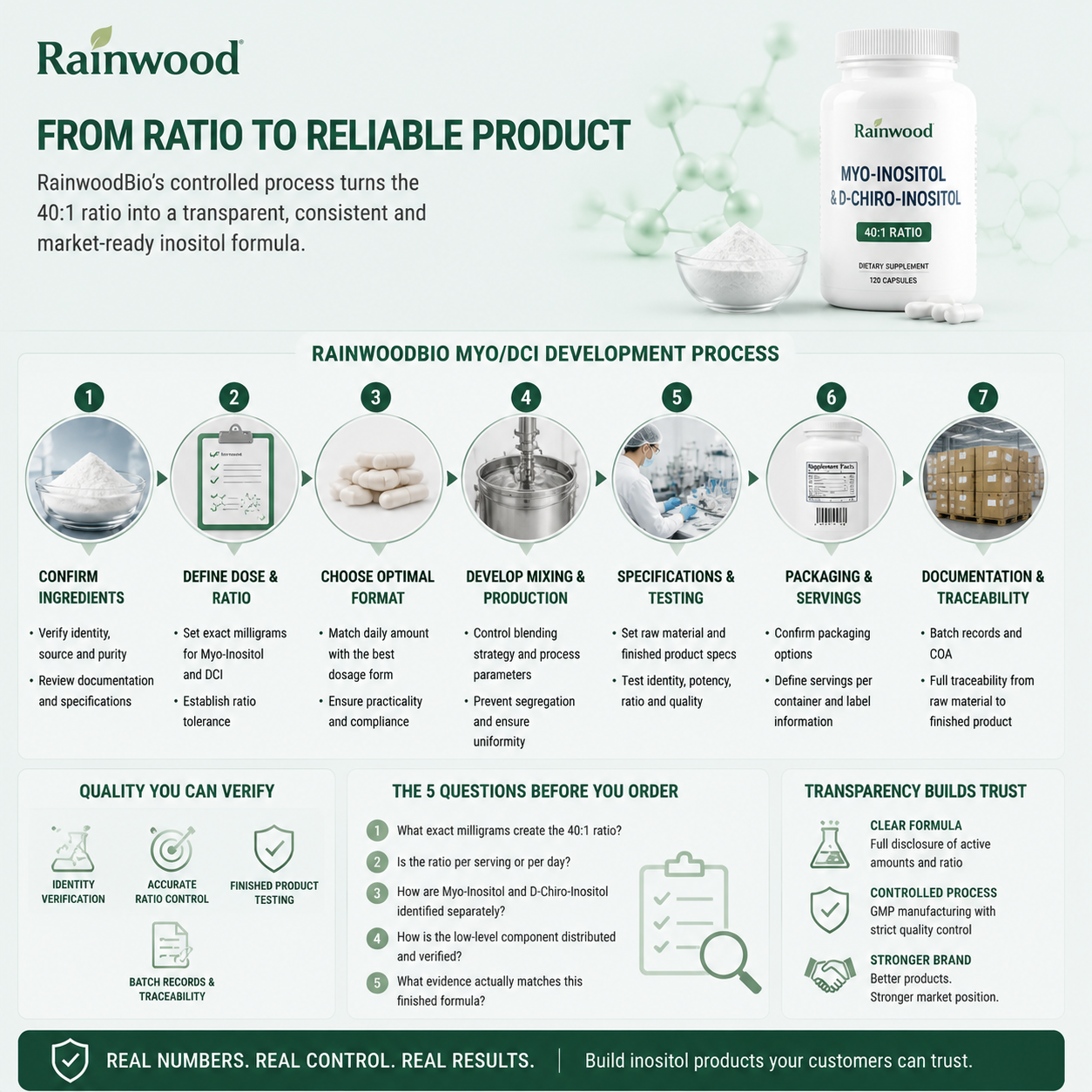
RainwoodBio’s published process includes requirement confirmation, supplier management, GMP production and process control, quality testing and release, documentation and traceability.
For a Myo/DCI project, that can be translated into a practical development path:
1. confirm exact ingredient identities and sources;
2. define milligrams and ratio tolerance;
3. choose a format that can carry the daily amount;
4. develop a mixing and production process;
5. agree raw-material and finished-product specifications;
6. confirm packaging and servings per container; and
7. align the label and sales story with the real formula.
Explore RainwoodBio’s custom inositol formulation service.
Five questions that should stop the order
Do not pay the deposit if the supplier cannot answer:
1. What exact milligrams create the 40:1 ratio?
2. Is the ratio per serving or per day?
3. How are Myo-Inositol and D-Chiro-Inositol identified separately?
4. How is the low-level component distributed and verified?
5. What evidence actually matches this finished formula?
Vague answers now become expensive explanations later.
Frequently asked questions
1.Does 40:1 mean 2,000 mg Myo-Inositol and 50 mg DCI?
That is a common example, but any two amounts with the same mathematical relationship are 40:1. Check the actual daily quantities.
2.Is 40:1 the only scientifically valid ratio?
No. The literature includes different single ingredients, combinations, doses and ratios. The evidence should be evaluated for the intended product and customer.
3.Can a 40:1 product be made in two capsules?
It depends on total daily amount, powder density, capsule size and excipients. Gram-level formulas commonly require multiple capsules.
4.Should the ratio be tested in the finished product?
The quality plan should verify that the finished product meets its defined composition. The appropriate methods and sampling depend on the formula and dosage form.
Make competitors defend their numbers
Send RainwoodBio your proposed Myo-Inositol amount, D-Chiro-Inositol amount, dosage form, target market and price point.
We will help identify whether the ratio, daily amount, capsule count and packaging form one credible product—or merely one attractive graphic.
Send your 40:1 formula for a ratio and dose reality check.
References
- Fitz et al., *Inositol for Polycystic Ovary Syndrome: A Systematic Review and Meta-analysis to Inform the 2023 International Evidence-based PCOS Guideline* (2024).
- Pustotina et al., *Effects of Myo-Inositol and D-Chiro-Inositol in a Ratio 40:1* (2024).
- NIH Dietary Supplement Label Database, *Inositol ingredient and product labels*.
- US Food and Drug Administration, *Warning Letter to FDC Nutrition Inc.* (2021).
*This article provides general product-development information and does not establish that one ratio or formula is appropriate for every consumer or market.*