 EN
EN

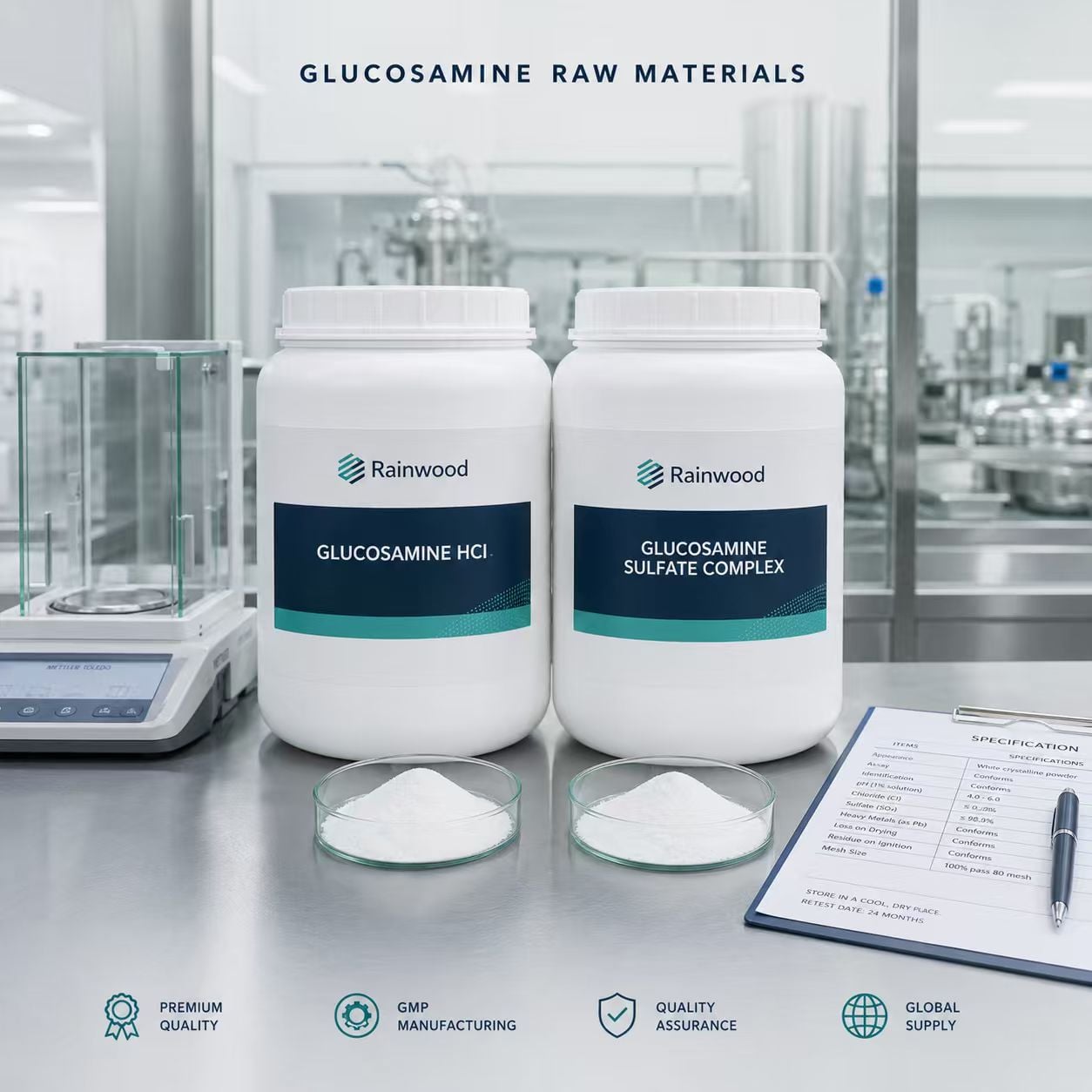
Meta title: Glucosamine Sulfate vs HCl The 1500 mg Label Trap
Meta description: A 1500 mg glucosamine claim can refer to different salts and active bases. Use this formula and label calculation before approving raw material.
The front label says 1,500 mg glucosamine. The formula sheet says 1,500 mg glucosamine hydrochloride. The supplier study used a stabilized glucosamine sulfate preparation.
Three documents. One number. Three different meanings.
If the brand does not define whether 1,500 mg refers to the commercial salt, glucosamine sulfate complex, or glucosamine equivalent, purchasing can order the wrong mass while marketing cites the wrong evidence.
For a joint-supplement formulator, “glucosamine” is not a complete bill-of-material description.
The salt changes the mass calculation
USP separately defines Glucosamine Hydrochloride and Glucosamine Sulfate Potassium Chloride. The public formulas show why equal material weights do not equal equal glucosamine-base weights.
Glucosamine hydrochloride has a formula mass of 215.63. The glucosamine parent portion is approximately 179.17. The theoretical glucosamine-base fraction is therefore about 83.1% before specification tolerances and calculation conventions.
Example:
`1,500 mg glucosamine HCl × 179.17 / 215.63 ≈ 1,246 mg glucosamine base`
The USP potassium chloride complex has a formula mass of 605.52 and contains two glucosamine units within the defined complex. Its material-to-glucosamine relationship is different again.
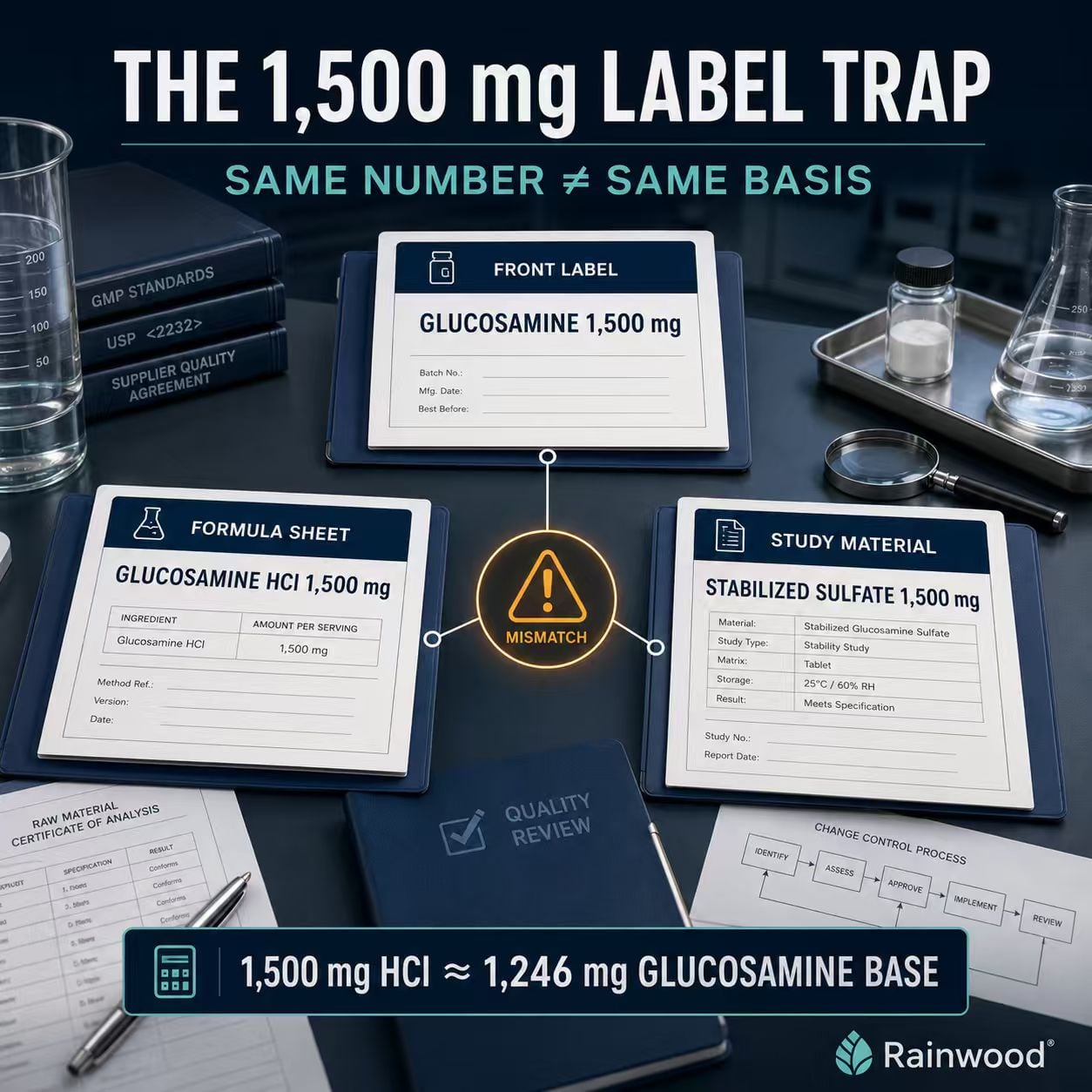
These are formula examples, not universal label instructions. The accepted declaration depends on the exact compound, specification, jurisdiction, category, and labeling rules. But the arithmetic proves why a buyer cannot copy 1,500 mg from one salt to another.
Review RainwoodBio's published glucosamine powder product option, then request the exact salt and current specification.
“Sulfate” is not one complete commercial identity
Glucosamine sulfate is commonly stabilized as a complex with potassium chloride or sodium chloride. A quotation that says only “glucosamine sulfate” leaves key questions:
- potassium chloride or sodium chloride form;
- exact molecular and commercial definition;
- assay basis and limits;
- glucosamine equivalent;
- counterion contribution;
- water or loss-on-drying basis;
- reference standard and method;
- study and label match.
The finished tablet monograph for glucosamine, chondroitin sulfate sodium, and MSM recognizes glucosamine hydrochloride, glucosamine sulfate sodium chloride, glucosamine sulfate potassium chloride, or mixtures. That flexibility is useful, but it requires the manufacturer to know what was used and to deliver the labeled amount under the applicable test.
Read what potassium and sodium glucosamine complexes really add to the formula before finalizing Supplement Facts.
Evidence cannot be transferred by ingredient family name
NCCIH explains that glucosamine trial results are inconsistent and that studies used different preparations. Some reviews have reported different patterns for prescription crystalline sulfate products and other glucosamine products, while also identifying bias and formulation differences as possible explanations.
This uncertainty requires precise matching, not a dramatic superiority claim.
For every proposed benefit statement, map:
1. Study product and manufacturer.
2. Salt, stabilized form, and commercial preparation.
3. Dose basis and daily schedule.
4. Coingredients and dosage form.
5. Population, duration, comparator, and endpoint.
6. Funding, limitations, and totality of evidence.
7. Exact commercial formula and consumer wording.
A study on a named prescription preparation does not automatically substantiate a generic HCl powder or a different sulfate complex. Trademark or study-use rights must also be confirmed.
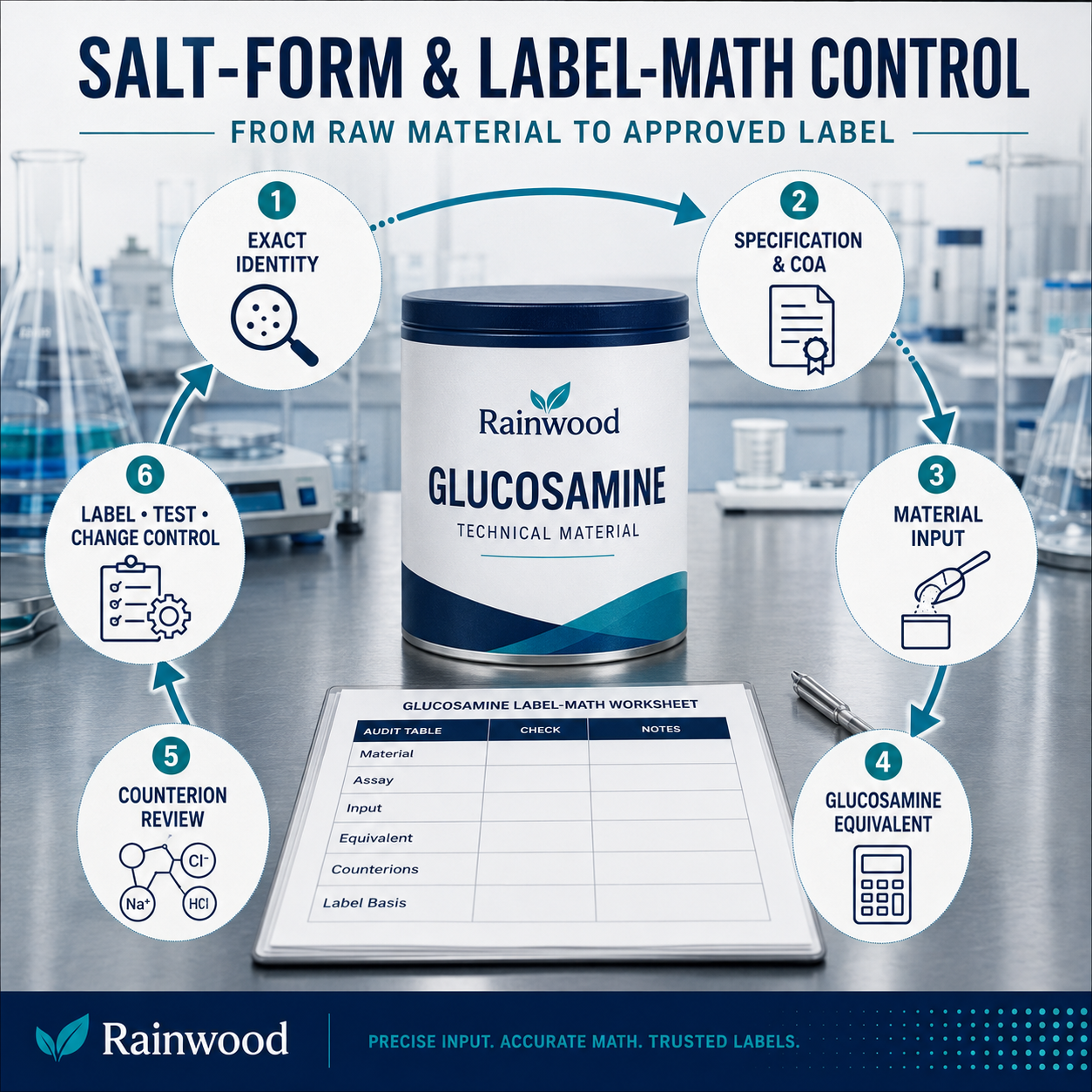
Use a glucosamine label-math worksheet
Create separate columns instead of one “mg glucosamine” field.
| Field | Required entry |
|---|---|
| Commercial raw material | Exact salt or stabilized complex |
| Supplier assay | Limit, actual result, and basis |
| Material input per serving | Milligrams physically added |
| Glucosamine equivalent | Calculation and molecular basis |
| Counterions | Potassium, sodium, chloride, or other contribution |
| Label declaration | Exact market-approved wording and amount |
| Study dose | Material and basis used in evidence |
| Manufacturing adjustment | Justified recovery or stability rationale, if any |
Reconcile units through quotation, specification, formula, master record, finished test, and label. Do not let one document use salt mass while another silently uses base equivalent.
Explore RainwoodBio's published joint-formula and dosage-form development service when the mass calculation affects capsule or tablet size.
The commercial consequences reach beyond the label
An incorrect basis can cause:
- under- or over-ordering of raw material;
- wrong formula input;
- failed finished-product testing;
- inconsistent supplier quotations;
- changed sodium or potassium contribution;
- artwork correction and relabeling;
- broken study-to-product substantiation;
- customer disputes over promised daily delivery.
Lock the identity and calculation before requesting the final price. Otherwise, suppliers may quote different forms under the same short ingredient name.
How RainwoodBio can support a salt-form decision
RainwoodBio publishes a glucosamine powder page and describes requirement confirmation, formula development, multiple dosage forms, production control, testing/release, and documentation. The public product page uses broad “glucosamine powder” language and should not be treated as proof of the exact salt, source, batch, or clinical effect for a new project.
Ask RainwoodBio to confirm:
- exact available glucosamine forms and product codes;
- specifications and representative lot documents;
- raw-material-to-label calculation;
- counterion and source implications;
- format feasibility and finished test plan;
- change control if the salt or supplier changes.
Review the published requirement-confirmation workflow and turn the target label into a signed input specification.
Formula approval gate
Do not approve artwork until:
- the exact salt or complex is named;
- material mass and glucosamine equivalent reconcile;
- sodium or potassium contribution is assessed;
- the study material matches—or the claim is narrowed;
- supplier quotes use the same basis;
- finished-product test and label conventions are agreed.
Request a glucosamine salt-form and label-math review. Send RainwoodBio the proposed Supplement Facts, full formula, supplier specification or COA, target dose, study references, dosage form, market, and batch size; the team can return a material-input calculation and mismatch list.
Frequently asked questions
1.Is 1,500 mg glucosamine HCl equal to 1,500 mg glucosamine base?
No. Glucosamine HCl includes hydrochloride mass. The theoretical glucosamine-parent fraction can be calculated from formula weights, but the commercial formula and label must use the approved specification and market convention.
2.Is glucosamine sulfate always better than HCl?
No universal claim is justified. Clinical evidence is inconsistent and preparation-specific. Evaluate the exact material, study quality, dose, product, claim, and market.
3.Can the supplier simply state “glucosamine 99%”?
That is incomplete. Ask 99% of which chemical form, by which method and basis, under which limits, and how the result connects to the intended label amount.
4.Does changing the salt require new artwork?
It may. The identity, declared amount, ingredient list, counterion contribution, formula input, evidence, and market requirements should all be reassessed before the change.
References
- USP Glucosamine Hydrochloride: https://doi.usp.org/USPNF/USPNF_M35200_05_01.html
- USP Glucosamine Sulfate Potassium Chloride: https://doi.usp.org/USPNF/USPNF_M35208_05_01.html
- USP Glucosamine, Chondroitin Sulfate Sodium, and MSM Tablets: https://doi.usp.org/USPNF/USPNF_M2189_01_01.html
- NCCIH Glucosamine and Chondroitin for Osteoarthritis: https://www.nccih.nih.gov/health/glucosamine-and-chondroitin-for-osteoarthritis-what-you-need-to-know
- RainwoodBio glucosamine powder page: https://www.rainwoodbio.com/hot-sale-glucosamine-powder-high-quality-pure-glucosamine-powder
- RainwoodBio OEM: https://www.rainwoodbio.com/oem
*This article is for international B2B formulation and educational purposes. Ingredient identity, calculations, specifications, methods, evidence, finished testing, labels, claims, and regulatory requirements must be confirmed for the exact raw material, formula, product, and destination market.*