 EN
EN
Meta title: Joint Support vs Arthritis Claims: Protect Your Supplement Listing
Meta description: A B2B claim-control guide for joint supplements covering disease implications, structure/function wording, evidence, images, reviews, and OEM approval.
Your label says “supports joint mobility.” Your product page says “arthritis relief.” The paid ad shows damaged cartilage being repaired. An influencer calls the capsules a natural alternative to treatment.
The ingredient formula did not change. The regulatory meaning did.
For supplement brands, importers, and private-label manufacturers, a joint product can move from general structure/function positioning into disease-treatment territory through one word, image, testimonial, metadata field, or retailer bullet. A scientifically interesting ingredient does not protect a prohibited or unsupported claim.
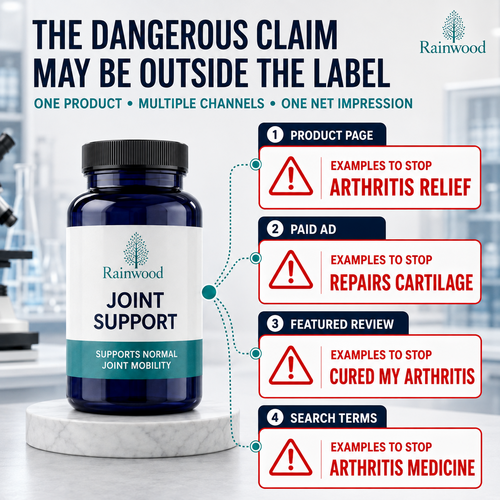
The dangerous word may be outside the label
Claims are communicated by the net impression of the marketing, not only the Supplement Facts panel. Review:
- product name and tagline;
- front, side, and back label;
- website title, URL, headings, and meta description;
- marketplace category and search terms;
- comparison charts and before/after imagery;
- diagrams of cartilage damage or inflammation;
- testimonials and customer reviews reused in ads;
- influencer scripts and affiliate copy;
- sales presentations, emails, and trade-show materials;
- chatbot and customer-service answers.
If one channel says “supports normal joint function” while another promises to treat osteoarthritis, the softer label does not neutralize the stronger message.
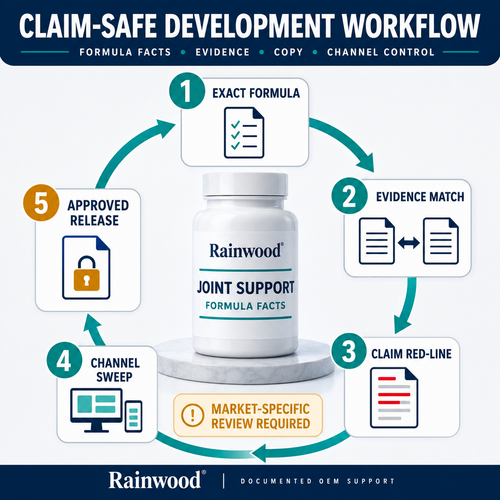
Use the study-to-formula match review before debating wording; a lawful claim still needs adequate support.
Structure/function positioning is not a free pass
In the United States, structure/function claims for dietary supplements describe effects on the normal structure or function of the body and operate under specific statutory and regulatory conditions, including substantiation and notification/disclaimer requirements. Disease claims can cause a product to be regulated as a drug.
The exact rules differ by market, category, channel, and wording. A phrase acceptable in one jurisdiction or context may not be acceptable in another. Translations can also change meaning.
Most importantly, “supports” is not a magic shield. “Supports the body's fight against arthritis” still names a disease. “Helps repair osteoarthritic cartilage” still implies treatment. Regulators and platforms assess the complete message.
FDA has denied qualified health claim petitions involving glucosamine and/or chondroitin sulfate and reduced risk of osteoarthritis-related joint degeneration. That public history is a strong warning against assuming these familiar ingredients have an FDA-authorized disease-risk claim.
Build a claim ladder before writing copy
Classify proposed statements by risk and evidence need:
Level 1: accurate composition
Examples: “contains glucosamine HCl” or “1,000 mg MSM per daily serving,” provided the identity, amount, serving, and label presentation are correct.
Level 2: general structure/function
Examples might address supporting normal joint structure, mobility, or flexibility, subject to exact wording, substantiation, required procedures, and destination-market review.
Level 3: specific performance or time-bound benefit
Statements such as “improves mobility in 14 days” require evidence matching the exact product, population, regimen, endpoint, and time frame. A general ingredient bibliography is unlikely to be enough.
Level 4: disease-risk or disease-treatment implication
References to arthritis, osteoarthritis, pain treatment, cartilage regeneration in disease, replacing medication, or preventing degeneration can trigger much higher legal risk and may be impermissible for a supplement.
Do not let marketing move a statement up the ladder without reopening evidence and regulatory approval.
Review the reformulation evidence-impact procedure whenever the formula, dose, audience, or claim changes.
Seven copy patterns that should stop the artwork
1. Disease name plus action verb
“Treats arthritis,” “prevents osteoarthritis,” and “reduces arthritic inflammation” are obvious warning signs.
2. Drug replacement
“Natural alternative to anti-inflammatory medicine” or “stop relying on painkillers” creates treatment and safety concerns.
3. Repair imagery
An animation showing eroded cartilage regrowing can imply disease reversal even if the caption says only “joint support.”
4. Guaranteed outcomes
“Pain-free in seven days” combines an outcome, timing, and certainty that require extraordinary support and may imply treatment.
5. Ingredient-study inflation
“Clinically proven formula” is used when only one ingredient, a different material, or a different dose was studied.
6. Testimonial laundering
A brand republishes “cured my arthritis” as a featured review. Consumer words can become advertising claims when selected or promoted by the seller.
7. Keyword contradiction
Compliant-looking on-page copy is paired with backend terms such as “arthritis medicine” or paid-search ads targeting treatment. Platforms may review these fields too.
Evidence quality must match the exact claim
FTC health-product guidance emphasizes competent and reliable scientific evidence and evaluates the amount and type of evidence in context. Stronger, more specific claims require stronger, more specific support.
For every proposed statement, build a claim record containing:
- exact wording and every placement;
- intended and reasonably implied meaning;
- exact product version and formula;
- ingredient identities and daily amounts;
- target population and use directions;
- full supporting studies and totality review;
- study-to-product match table;
- limitations and required qualifications;
- destination-market regulatory decision;
- approver, date, and version;
- monitoring and withdrawal plan.
A folder of PDFs is not a substantiation memo.
OEM responsibility cannot be hidden in the contract
Brand owner, manufacturer, distributor, importer, retailer, and marketing agencies can each control different parts of the message. A clause saying “customer is responsible for claims” does not make misleading factory-provided copy safe.
Create a practical division of work:
- the brand supplies intended market, audience, channels, and claims;
- the manufacturer supplies exact formula, specifications, test data, and accurate operational facts;
- qualified regulatory reviewers decide label and claim acceptability;
- marketing uses only approved wording and assets;
- both parties control changes and retain versions.
RainwoodBio's published OEM requirement-confirmation process is the right stage to request a claim list and market brief, but project-specific regulatory approval remains necessary.
How RainwoodBio can support claim-safe development
RainwoodBio publishes joint-product and OEM information. These pages are company-published context and should not be interpreted as FDA approval, a clinical conclusion, or permission to make disease claims.
For a custom project, ask RainwoodBio to provide:
- exact ingredient forms, sources, amounts, and serving;
- available raw and finished test documentation;
- formula and dosage-form feasibility;
- a red-line between factual composition statements and unsupported outcome language;
- traceability for any defined or branded ingredient;
- packaging data needed for the regulatory reviewer;
- version control when formula or copy changes.
Review the published joint-supplement overview only as a content starting point, then substantiate and approve each final product statement independently.
The pre-publication sweep
Before launch, search every asset for:
`arthritis`, `osteoarthritis`, `pain`, `inflammation`, `repair`, `regenerate`, `cure`, `treat`, `prevent`, `medicine`, `drug`, `clinically proven`, `guaranteed`, and time-to-result phrases.
Do not automatically delete every occurrence; use the search to route each item for contextual review. Scientific education can discuss disease in appropriate contexts without turning the product into a treatment, but proximity, links, calls to action, and net impression matter.
Then verify retailer feeds, translated pages, image alt text, metadata, ads, affiliates, and customer-service scripts. The listing is only as controlled as its least-reviewed channel.
Request a joint-supplement claim and listing risk review. Send RainwoodBio the formula, ingredient forms and amounts, market, channel, complete label, product page, ad copy, images, claims, cited studies, dosage form, pack, and volume. RainwoodBio can supply formula facts and project documents; qualified regulatory counsel should approve the final claims for the destination.
Frequently asked questions
1.Can a supplement product page mention osteoarthritis?
Educational discussion and product claims are assessed in context. Proximity to product promotion, calls to action, implied treatment, jurisdiction, and platform rules matter. Obtain qualified review rather than relying on a disclaimer.
2.Does the FDA disclaimer make a disease claim acceptable?
No. A disclaimer does not transform an otherwise impermissible disease claim into a lawful structure/function claim.
3.Can we quote a clinical paper's disease language?
Accurate quotation does not automatically make promotional use lawful or non-misleading. Consider context, product match, prominence, audience, and total impression.
4.Are customer reviews the customer's responsibility?
When a business selects, highlights, edits, rewards, or repurposes reviews, they can become part of its advertising. Establish moderation and escalation rules.
5.Can the same English claim be used worldwide?
Do not assume so. Ingredient status, permitted wording, notification, label format, evidence standards, and advertising rules vary by destination.
References
- FDA, Structure/Function Claims: https://www.fda.gov/food/nutrition-food-labeling-and-critical-foods/structurefunction-claims
- FDA, Qualified Health Claims—Letters of Denial: https://www.fda.gov/food/nutrition-food-labeling-and-critical-foods/qualified-health-claims-letters-denial
- FTC, Health Products Compliance Guidance: https://www.ftc.gov/business-guidance/resources/health-products-compliance-guidance
- NCCIH, Glucosamine and Chondroitin for Osteoarthritis: https://www.nccih.nih.gov/health/glucosamine-and-chondroitin-for-osteoarthritis-what-you-need-to-know
- RainwoodBio OEM service: https://www.rainwoodbio.com/oem
- RainwoodBio joint health supplements article: https://www.rainwoodbio.com/blog/joint-health-supplements-1
*This article provides international B2B educational information, not legal advice. Product classification, ingredient status, substantiation, structure/function statements, disease implications, disclosures, labels, advertising, testimonials, platform rules, and regulatory requirements must be reviewed for the exact product, content, channel, and destination market.*