 EN
EN
Meta title: Why a 99.8% MSM COA Is Not a Complete Release Decision
Meta description: A B2B MSM sourcing guide to identity, assay, chromatographic purity, DMSO, water, contaminants, methods, and finished-product release.
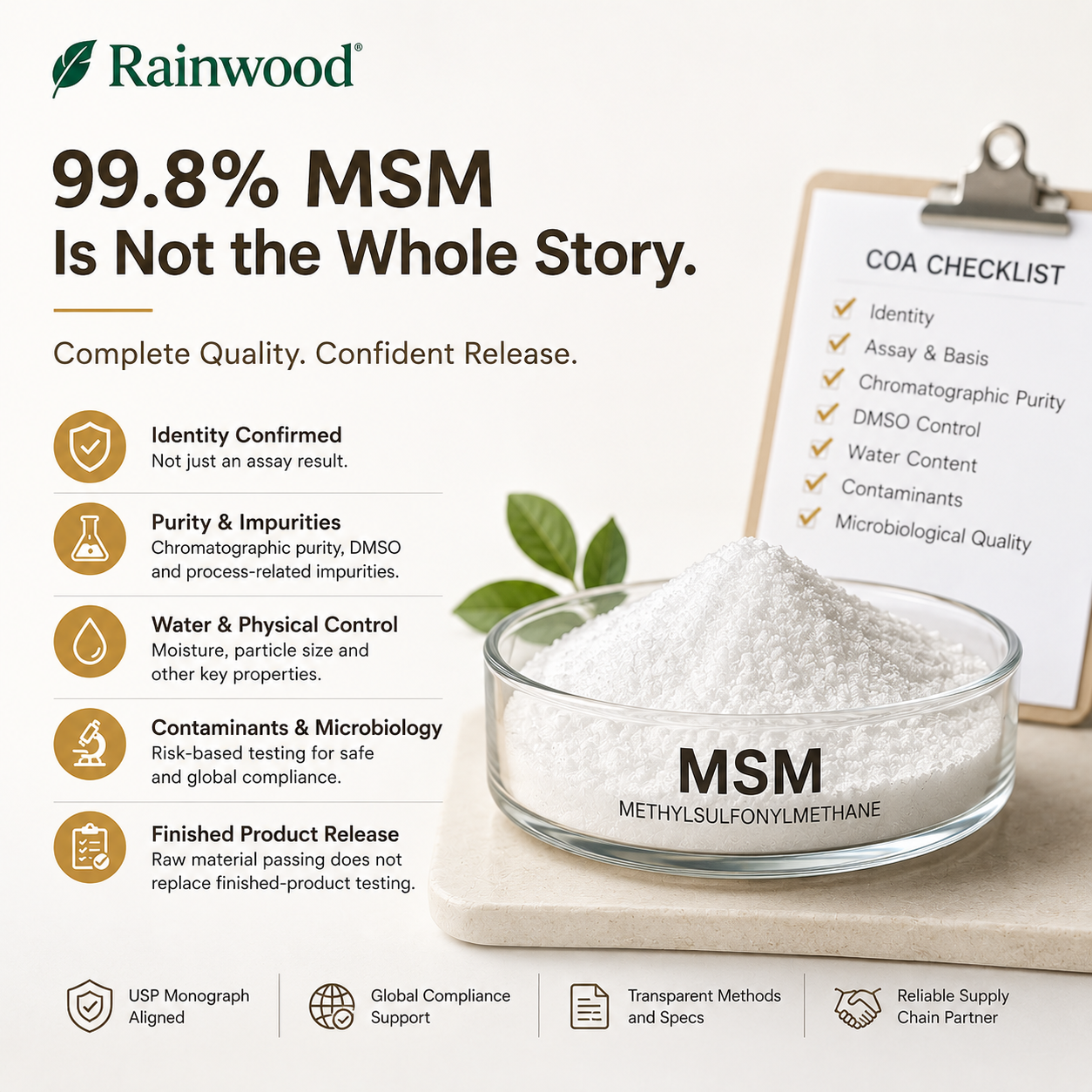
The MSM quotation says “99.8% purity.” The COA repeats “99.8%.” Purchasing sees a premium number and approves the supplier.
But what exactly is 99.8%?
Is it assay on an anhydrous basis? Chromatographic purity by a specified method? A typical value copied from a product sheet? Does the result identify methylsulfonylmethane, control dimethyl sulfoxide, or say anything about water, elemental impurities, microbiology, and the finished dosage form?
For joint-supplement brands and contract manufacturers, a high number can be useful. It cannot carry the entire release decision.
One percentage can describe different tests
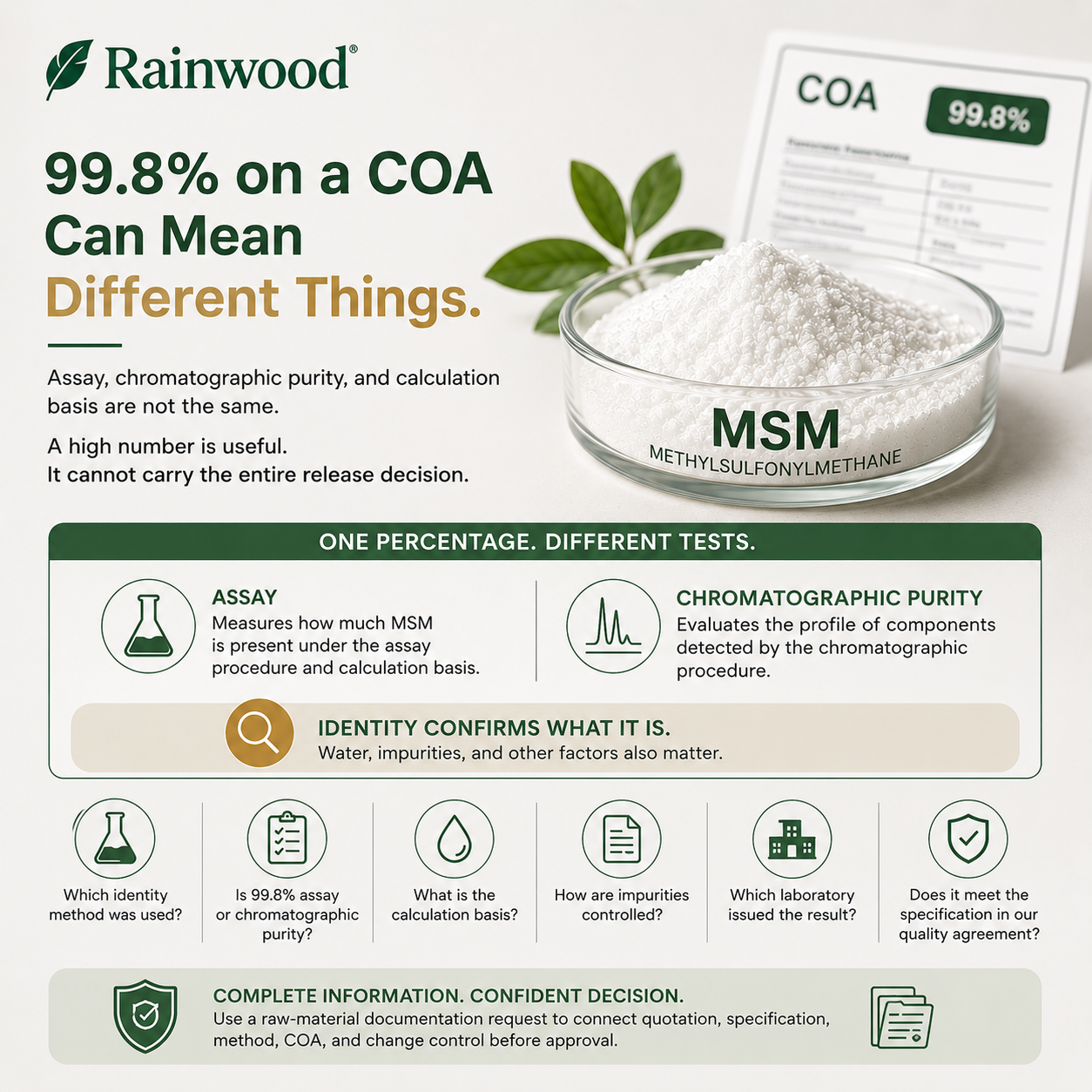
The public USP monograph for Methylsulfonylmethane defines the substance and includes an assay range of 98.0% to 102.0% on the anhydrous basis. It separately lists a chromatographic purity requirement of not less than 99.8%. Those are not redundant statements.
Assay asks how much of the specified compound is measured under the assay procedure and calculation basis. Chromatographic purity evaluates the profile measured by that chromatographic procedure. Water affects an anhydrous-basis calculation. Identity establishes that the material is what the label and specification say it is.
A supplier who places “Purity: 99.8%” on one line without the test name, method, units, basis, and acceptance criterion has not given the buyer enough information to interpret the result.
Before comparing MSM offers, inspect the glucosamine form calculation trap as a parallel example: impressive ingredient numbers become misleading when their basis is hidden.
The release decision needs separate gates
Gate 1: identity
An assay result is not a substitute for identity. The material must meet suitable identification requirements for the exact specification. Procurement should confirm which method is used, which reference standard or comparison is involved, and whether the laboratory has demonstrated suitability.
Gate 2: assay and calculation basis
The report should name the test and specify whether the result is as-is, dried, or anhydrous basis. It should also show the applicable acceptance criterion. A number without its basis cannot be reconciled to a monograph or an internal specification.
Gate 3: chromatographic purity and process-relevant impurities
Ask for the method, reportable components, quantitation approach, system suitability, and specification. The USP monograph lists dimethyl sulfoxide as a relevant reference standard. That does not mean DMSO is the only risk in every process, or that every supplier must use identical private methods. It means a blanket “99.8%” should not replace an impurity-control discussion.
Gate 4: water and physical characteristics
Water can affect calculation basis, flow, processing, and storage. Particle size, bulk density, appearance, and odor may also matter for capsule filling, tablets, stick packs, or powders even when they are not the headline identity specification.
Gate 5: contaminants and microbiological quality
Risk-based controls may include elemental impurities, residual solvents, microbiological limits, and other market- or process-relevant requirements. Define them from the manufacturing route, intended use, dosage, destination market, and finished-product risk assessment—not from a generic template alone.
Gate 6: finished-product release
A conforming raw material does not prove that the blend is uniform, the labeled amount is delivered, the capsules meet physical requirements, or stability is adequate. Finished specifications and suitable methods remain necessary.
Review RainwoodBio's published joint-supplement context, then require formula-specific evidence rather than transferring general product statements to your batch.
A five-line COA that looks complete—but is not
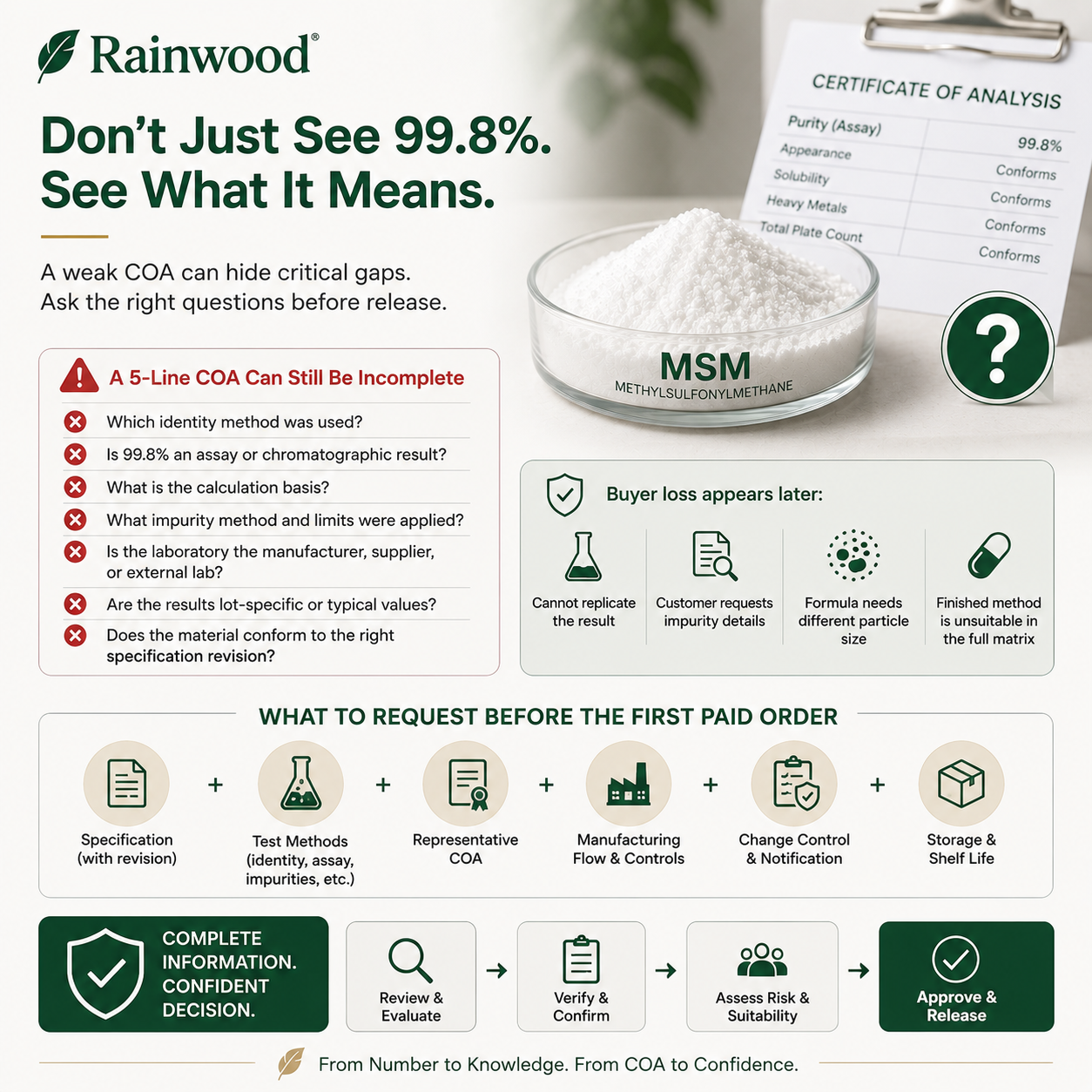
A weak COA may list appearance, solubility, “purity 99.8%,” heavy metals, and total plate count. It can still fail procurement because it does not answer:
- Which identity method was used?
- Is 99.8% an assay or chromatographic result?
- What is the calculation basis?
- What impurity method and limits were applied?
- Is the reported laboratory the manufacturer, supplier, or external laboratory?
- Are the results lot-specific or copied typical values?
- Does the material conform to the revision of the specification in the quality agreement?
The buyer loss appears later: an incoming laboratory cannot reproduce the number, a customer requests impurity details, a formula needs a different particle size, or the finished-product method is unsuitable in the full matrix.
Use a raw-material documentation request to connect the quotation, specification, method, representative COA, and change-control record before approval.
What to request before the first paid order
Build a supplier packet with:
1. Exact material name, manufacturer, manufacturing site, and country of origin.
2. Current approved specification with methods and acceptance criteria.
3. Representative and, when ordering, lot-specific COA.
4. Identity-method description and method suitability information.
5. Assay method, basis, and calculation.
6. Chromatographic purity method and impurity controls.
7. Water method and limit.
8. Risk-based contaminant, residual-solvent, and microbiological controls.
9. Physical attributes needed for the selected dosage form.
10. Stability, storage, packaging, retest or expiry basis.
11. Change-notification commitments.
12. Proposed incoming and finished-product test plans.
This file turns “99.8% MSM” from a sales phrase into a controlled material definition.
Do not compare suppliers by the decimal places
Supplier A reports 99.9%. Supplier B reports 99.8%. That apparent 0.1-point advantage may be meaningless if the laboratories use different methods, integration rules, standards, sample preparation, or reporting bases.
Compare normalized evidence:
| Question | Supplier A | Supplier B |
|---|---|---|
| Exact test called “purity” | Defined? | Defined? |
| Method shared or referenced | Yes/No | Yes/No |
| Calculation basis | Defined? | Defined? |
| Identity appropriate | Yes/No | Yes/No |
| Impurity limits | Listed? | Listed? |
| Water included | Yes/No | Yes/No |
| Lot-specific results | Yes/No | Yes/No |
| Method transferable to buyer lab | Assessed? | Assessed? |
| Change control | Contracted? | Contracted? |
The lower printed percentage can belong to the stronger control system.
How RainwoodBio can support an MSM project
RainwoodBio describes an OEM path covering requirements, formulation, sampling, production, testing, and documentation. Its public pages should be treated as company-published context, not as proof that a particular MSM lot meets a particular monograph or that every listed test is performed on every batch.
For your project, ask RainwoodBio to confirm:
- the exact MSM manufacturer and material specification proposed;
- the interpretation of assay versus chromatographic purity;
- representative method and COA information available;
- physical attributes needed for the chosen dosage form;
- incoming, in-process, and finished-product controls;
- documents and test reports supplied with the order;
- notification conditions for manufacturer, site, method, or specification changes.
Review the published OEM process, then place every agreed deliverable into the signed project specification.
The buyer's release rule
Never release MSM because a percentage looks familiar. Release the exact lot because:
- identity is confirmed;
- assay is interpreted on the correct basis;
- chromatographic purity and relevant impurities comply;
- water and risk-based contaminants comply;
- physical properties fit the process;
- documents remain tied to the approved manufacturer and site;
- finished-product controls address what raw testing cannot prove.
Request an MSM COA and specification gap review. Send RainwoodBio the supplier specification or COA, target market, daily amount, formula, dosage form, pack, planned claims, testing expectations, and order volume. The team can return a release-gap checklist before you approve a number that has not been defined.
Frequently asked questions
1.Does 99.8% chromatographic purity mean 99.8% assay?
Not automatically. They are different test concepts and may use different methods and calculation bases. Require both to be clearly named and interpreted against the applicable specification.
2.Does a pharmacopeial raw-material result make the finished supplement compendial?
No. The finished product has its own formula, matrix, manufacturing process, specifications, methods, labeling, and regulatory status.
3.Should every COA show DMSO?
The relevant impurity controls and reporting format must be defined for the exact specification and method. Ask how DMSO and other process-relevant impurities are controlled rather than assuming one universal COA format.
4.Can the supplier's assay method be used directly on a multi-ingredient tablet?
Do not assume so. The finished matrix may interfere with extraction, separation, detection, or calculation. Demonstrate suitability for the exact formula.
References
- USP Methylsulfonylmethane: https://doi.usp.org/USPNF/USPNF_M53000_04_01.html
- USP Glucosamine, Chondroitin Sulfate Sodium, and MSM Tablets: https://doi.usp.org/USPNF/USPNF_M2189_01_01.html
- RainwoodBio OEM service: https://www.rainwoodbio.com/oem
- RainwoodBio About Us: https://www.rainwoodbio.com/about-us
- RainwoodBio joint health supplements article: https://www.rainwoodbio.com/blog/joint-health-supplements-1
*This article is for international B2B sourcing and educational purposes. Identity, assay, chromatographic purity, impurities, water, physical properties, contaminants, methods, specifications, finished-product testing, labels, and regulatory requirements must be verified for the exact material, formula, site, and destination market.*