 EN
EN

Meta title: N-Acetyl Glucosamine vs Glucosamine: A B2B Buyer Guide
Meta description: Why N-acetyl glucosamine cannot silently replace glucosamine HCl or sulfate in joint formulas, evidence, labels, and specifications.
“N-acetyl” sounds advanced. That makes N-acetyl glucosamine easy to sell as a premium upgrade.
It also makes it easy to misuse.
N-acetyl glucosamine, glucosamine hydrochloride, and stabilized glucosamine sulfate preparations are not three quality grades of one interchangeable purchase. They are distinguishable materials with different chemical identities, mass relationships, specifications, evidence histories, and labeling implications. If a development team substitutes N-acetyl glucosamine because it sounds more innovative, the formula may no longer match the intended dose, benchmark product, or cited study.
For brand owners, formulators, sourcing teams, and contract manufacturers, the decision starts with identity—not with which name creates the strongest front-label story.
The acetyl group is not a marketing adjective
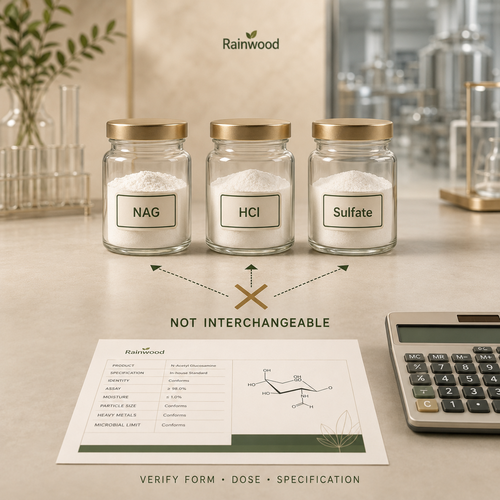
N-acetyl glucosamine, commonly abbreviated NAG, is an acetylated amino sugar. Glucosamine hydrochloride is a hydrochloride salt of glucosamine. Commercial glucosamine sulfate is commonly supplied as a stabilized complex. These forms should not be renamed, calculated, or released as if the only difference were packaging.
A practical procurement rule is simple:
> If the chemical form changes, reopen the formula, specification, evidence, label, and cost model.
Do not let an ERP description such as “glucosamine powder” hide the form. The purchase order, approved specification, COA, formula sheet, manufacturing record, artwork, and study dossier should all point to the same identity.
Start with the glucosamine salt and label-basis comparison if your team is already switching between hydrochloride and sulfate.
Four commercial questions expose a false substitution
1. What exact compound is entering the batch?
Require the unambiguous material name, CAS or other identity information where appropriate, molecular or compositional definition, source, assay basis, and applicable specification. “Glucosamine 98%” is incomplete if the form is missing.
2. What amount will the label communicate?
The raw-material input, compound amount, glucosamine-equivalent amount, and serving declaration are not automatically the same. A supplier's assay percentage does not tell a formulator how a destination-market label should describe the ingredient.
3. Which exact preparation was used in the evidence?
An article about one glucosamine form does not validate another. Match the test material, dose basis, regimen, population, duration, dosage form, and co-ingredients. If these do not match, describe the evidence gap rather than borrowing the conclusion.
4. What consumer promise is the formula designed to support?
A traditional joint-support benchmark, a differentiated fermentation story, and a multi-benefit beauty or gut concept may lead to different ingredient decisions. The ingredient should follow the product brief. The product brief should not be rewritten after a fashionable raw material arrives.
Review the source-proof checklist for shellfish and fermented glucosamine separately; chemical form and biological source are two different approval gates.
The “premium” trap can create four expensive mismatches
Evidence mismatch
Much public discussion about glucosamine and osteoarthritis concerns particular glucosamine preparations. NCCIH notes that study findings have been inconsistent and that results can differ by product and study. That is a warning against extrapolation, not permission to select the most favorable conclusion.
If a formula uses NAG, the evidence file must be built for NAG and the exact intended claim. A bibliography containing studies on glucosamine sulfate does not repair that mismatch.
Dose mismatch
Replacing 1,500 mg of one commercial material with 1,500 mg of another may preserve tablet weight while changing the number of moles, parent-glucosamine relationship, counterions, and study comparability. Never perform a one-for-one substitution by weight without an approved calculation and a clear reason.
Specification mismatch
Different compounds require appropriate identity tests, assay calculations, impurity controls, and reference standards. Copying a hydrochloride specification into an NAG purchase order can create a document that looks complete but cannot properly control the material.
Positioning mismatch
Marketing may place NAG into a joint formula because buyers recognize “glucosamine.” Yet a retailer or informed consumer may expect the form used in a benchmark or evidence dossier. The resulting product is neither a clean traditional comparison nor a clearly explained differentiated formula.
Use a form-specific raw-material review before requesting a production sample.
A decision tree for formulators
Choose the intended market job first
Write one sentence that describes the formula's job without a disease claim. Examples include supporting joint mobility, providing a traditional glucosamine-based joint formula, or creating a differentiated amino-sugar concept. Then define the target consumer, channel, price, serving, format, and destination.
Lock the evidence standard
Decide whether the product will rely on ingredient tradition, general nutritional positioning, published human research, customer-supplied claims, or a combination. For every proposed statement, record the exact supporting material and the degree of match.
Compare forms on the same worksheet
For each candidate, record:
- exact chemical identity and commercial preparation;
- source and manufacturing route;
- specification and method;
- input mass and declaration basis;
- evidence preparation and dose;
- serving and dosage-form feasibility;
- sensory and processing considerations;
- landed cost per compliant daily serving;
- claim and label review status.
This makes “premium” measurable. A higher-price material may be valuable when it enables a defendable product concept. It is not valuable merely because its name sounds more technical.
Run a substitution review
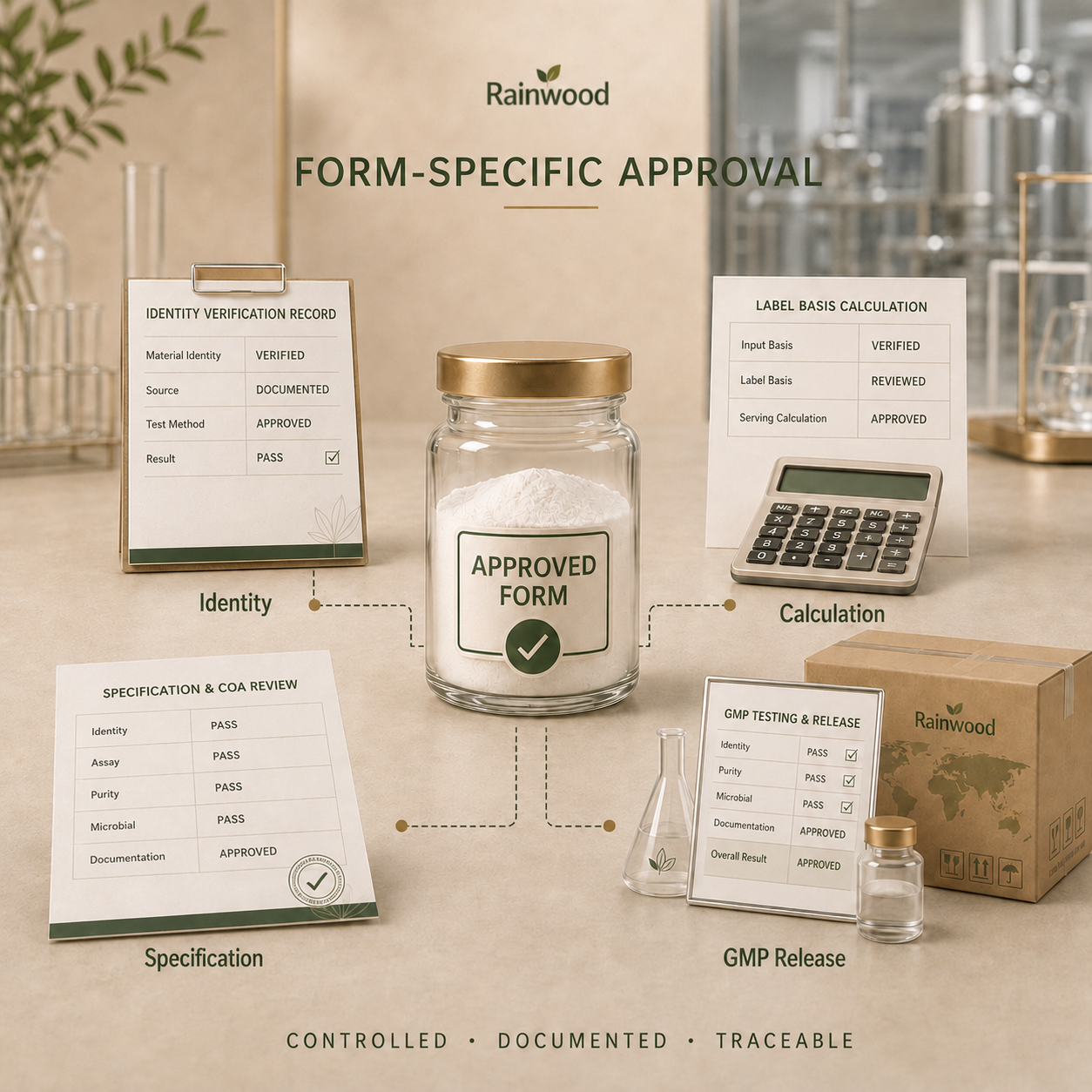
When the form changes, quality should open formal change control. Regulatory rechecks the label and claims. Formulation recalculates the bill of materials and serving. Purchasing reissues the specification. Production and analytical teams confirm method and process suitability. Marketing removes any evidence that no longer matches.
What a useful COA package must answer
The COA is one record within the evidence set. It should make the lot traceable and report results against the approved, form-specific specification. Depending on the exact material and market, the package may address:
- identity using suitable methods;
- assay with the calculation basis stated;
- water or loss on drying where relevant;
- specific rotation or other compendial characteristics where applicable;
- related substances or process-relevant impurities;
- residual solvents, elemental impurities, and microbiological limits as required;
- source and claim documents cross-referenced to the approved material.
A result of “99%” does not answer whether the laboratory tested the compound named on your label. Identity comes first.
How RainwoodBio can support the decision
RainwoodBio publishes a glucosamine raw-material page and a glucosamine-plus-chondroitin capsule page. It also describes OEM steps including requirement confirmation, formulation, sampling, production, testing, and documentation. These public pages do not establish that every glucosamine form, source, specification, or evidence package is available for every project.
For a real development, ask RainwoodBio to provide or confirm:
- available exact glucosamine forms and their specifications;
- source/manufacturing-route documents for the selected option;
- input and label-basis calculations;
- sample formula with achievable serving and dosage form;
- proposed raw and finished testing;
- evidence-match and claim questions requiring regulatory review.
Review RainwoodBio's published OEM development sequence and require the chemical form to be signed off at the requirement-confirmation stage.
The commercial rule worth remembering
NAG is not “better glucosamine” in the abstract. Glucosamine HCl is not automatically inferior because it is familiar. A sulfate complex is not automatically evidence-matched because its front name resembles one used in a paper.
The right form is the form that can be:
1. identified and controlled;
2. calculated correctly;
3. manufactured in the intended serving;
4. supported for the intended positioning;
5. labeled and sold in the destination market.
Request a glucosamine form and evidence-fit review. Send RainwoodBio your target claim, destination, formula benchmark, preferred form, daily serving, dosage form, source requirements, evidence references, pack size, and volume. The team can build a comparison worksheet before you pay for a sample that answers the wrong brief.
Frequently asked questions
1.Is N-acetyl glucosamine the same as glucosamine hydrochloride?
No. They are distinct chemical forms. They require form-specific identity, specifications, calculations, evidence review, and label assessment.
2.Can I cite a glucosamine sulfate study for an NAG formula?
Not as direct product proof without a justified bridge and compliant context. Disclose the mismatch internally and obtain qualified scientific and regulatory review before making a claim.
3.Can NAG replace glucosamine one for one by weight?
Do not assume it can. Recalculate the chemistry, dose basis, serving, specification, and evidence fit, then approve the change formally.
4.Is fermented NAG always non-animal and vegan?
The route may support a differentiated source story, but the exact claim requires controlled documentation for relevant inputs, processing aids, excipients, capsule, manufacturing, and cross-contact.
5.What should appear in the product master data?
Use the exact approved chemical form and connect it to one specification code, supplier/manufacturer chain, test method, claim file, and change-control status. Avoid a shared generic “glucosamine” material code.
References
- Review of microbial production of glucosamine and N-acetylglucosamine: https://pubmed.ncbi.nlm.nih.gov/40424515/
- NCCIH, Glucosamine and Chondroitin for Osteoarthritis: https://www.nccih.nih.gov/health/glucosamine-and-chondroitin-for-osteoarthritis-what-you-need-to-know
- USP Glucosamine Hydrochloride: https://doi.usp.org/USPNF/USPNF_M35200_05_01.html
- USP Glucosamine Sulfate Potassium Chloride: https://doi.usp.org/USPNF/USPNF_M35208_05_01.html
- RainwoodBio glucosamine powder page: https://www.rainwoodbio.com/hot-sale-glucosamine-powder-high-quality-pure-glucosamine-powder
- RainwoodBio OEM service: https://www.rainwoodbio.com/oem
*This article is for international B2B formulation and educational purposes. Ingredient identity, source, composition, specifications, calculations, test methods, evidence, dose, labels, claims, and regulatory requirements must be verified for the exact raw material, finished product, and destination market.*