 EN
EN

Meta title: Reformulated Joint Supplement? Your Old Study May Not Transfer
Meta description: A B2B change-control guide for matching joint-formula studies after ingredient, source, dose, format, serving, or manufacturing changes.
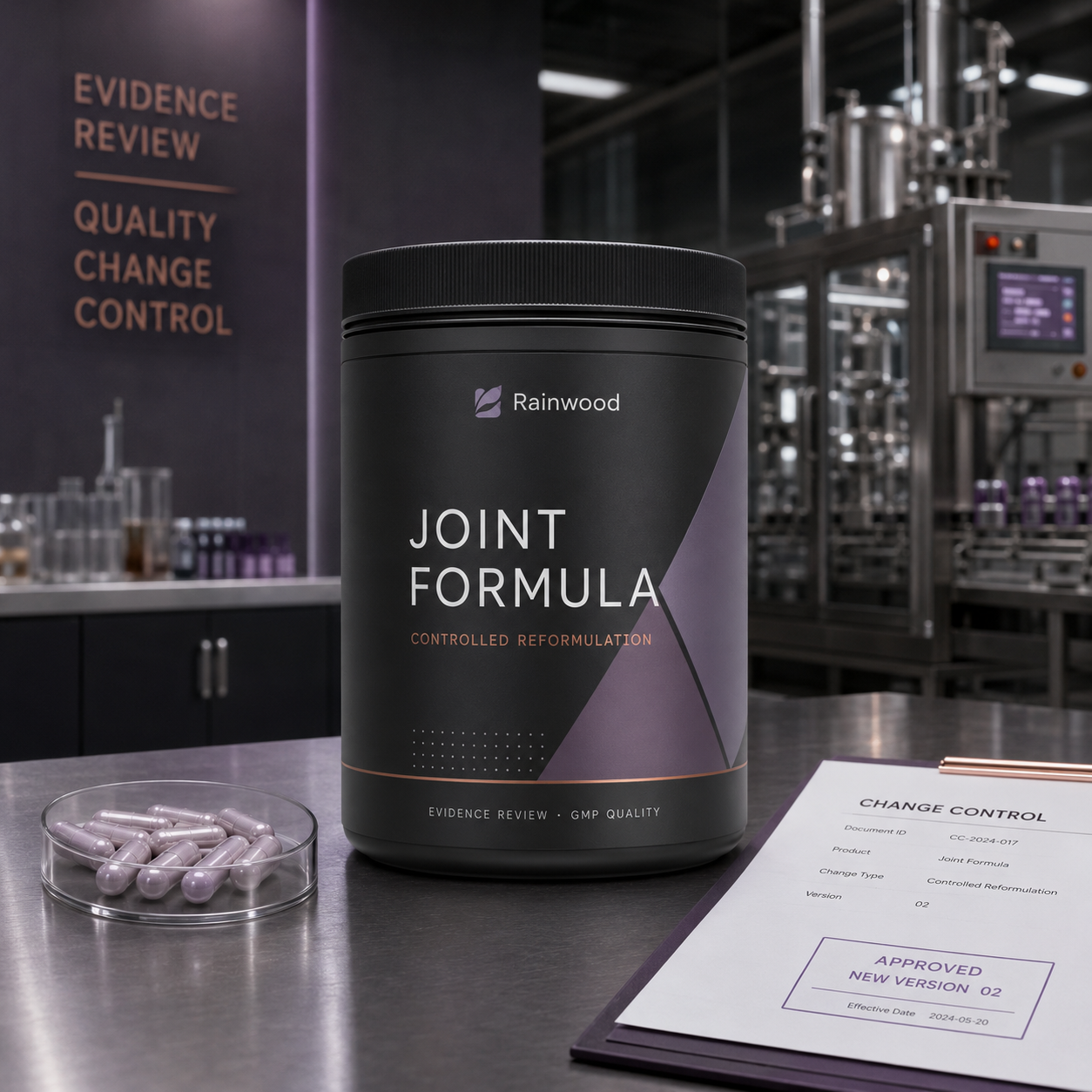
Your original joint formula had a study, evidence dossier, and approved claims. Then the business improved it: a cheaper chondroitin source, fermented glucosamine, a new MSM supplier, added curcumin, fewer capsules, and a different coating.
The marketing page still says “clinically studied formula.”
At what point did the old study stop proving the new product?
There is no safe answer based on the number of changes alone. Each change must be assessed for identity, dose, exposure, product performance, evidence relevance, and claim impact. Reformulation is not only a purchasing or manufacturing event. It is an evidence event.
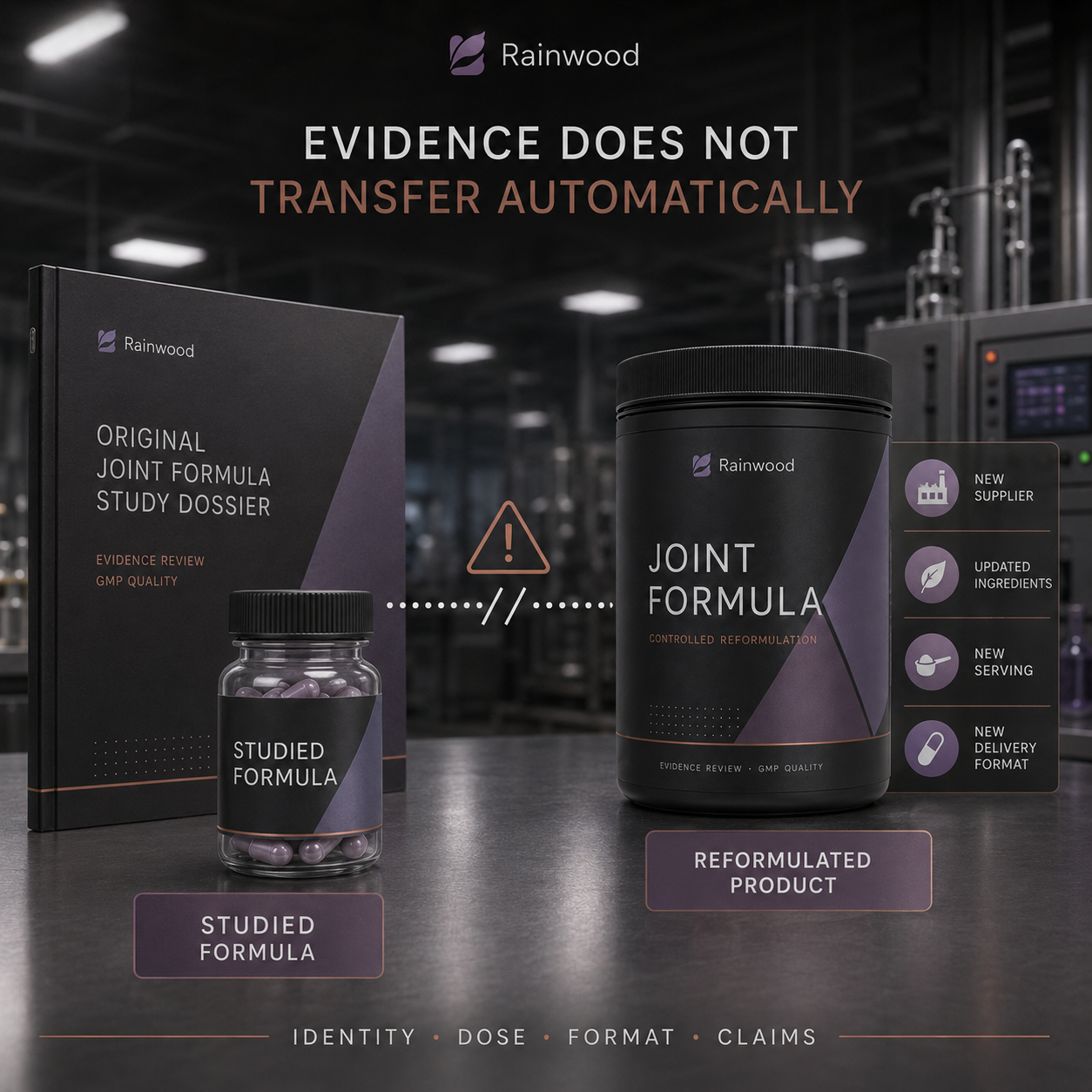
“Same label ingredients” does not mean “same studied product”
Two Supplement Facts panels can look similar while the underlying products differ in:
- chemical forms and salt complexes;
- animal, marine, or fermentation sources;
- molecular or impurity profiles;
- standardized constituent levels;
- particle size and physical characteristics;
- excipients and delivery systems;
- actual daily intake and instructions;
- dosage form, disintegration, dissolution, or dispersion;
- manufacturing process and stability.
A study evaluates a defined intervention. If your commercial product is not that intervention, the evidence bridge must explain why the result remains relevant—and where it does not.
Use the MSM study-match framework for ingredient-level comparisons, then extend it to the entire formula.
Every change belongs in one of four evidence-risk tiers
Tier 1: administrative change
Examples may include a packaging artwork correction or internal code update with no impact on product identity, composition, directions, protection, or claims. Document the rationale for no evidence impact.
Tier 2: potentially equivalent material or supplier change
A new supplier may offer the same named chemical form and specification. That still requires manufacturer/site traceability, method comparison, impurity and physical-property assessment, process suitability, and evidence-identity review. “Meets spec” is not automatically “same studied material.”
Tier 3: formulation or delivery change
Changes to amount, ingredient form, source, active ratio, excipients, dosage form, coating, serving, directions, or packaging can affect exposure, feasibility, stability, consumer use, or claim relevance. Revalidation and possibly new studies may be necessary.
Tier 4: positioning or claim change
A new target population, disease-adjacent phrase, outcome, comparison, or “clinically proven” statement can exceed the original evidence even if the formula does not change. Claims themselves require change control.
The tier determines the depth of review; qualified scientific and regulatory judgment determines the conclusion.
The reformulation traps in common joint ingredients
Chondroitin source changes
Moving among bovine, porcine, avian, or marine sources can alter the source claim, customer acceptance, traceability file, analytical profile, and relevance to a studied material. A simple assay number does not establish full equivalence.
Review the chondroitin source-lock procedure before approving the new supplier.
Glucosamine form changes
Hydrochloride, stabilized sulfate complexes, and N-acetyl glucosamine are distinct. A weight-for-weight switch changes chemistry and can break the dose and evidence comparison.
MSM manufacturer changes
If the evidence used a defined MSM material, a generic source change can remove the ingredient match, brand authorization, process claim, or impurity-profile connection.
Botanical additions
Adding Boswellia or curcumin may change claims, interactions, sensory properties, capsule volume, methods, contaminants, stability, and the product's commercial identity. More ingredients do not preserve the original study; they create a new matrix.
Serving reduction
Reducing four capsules to two may improve convenience while cutting active intake. If the label highlights the per-serving amount but directions or consumer behavior do not deliver the studied daily regimen, the evidence bridge fails.
The evidence-impact assessment
Before approving a change, quality, formulation, regulatory, and marketing should complete one shared table:
| Field | Studied product | Current product | Proposed product | Impact |
|---|---|---|---|---|
| Exact ingredient forms | Recorded | Recorded | Recorded | None/uncertain/material |
| Manufacturers and sites | Recorded | Recorded | Recorded | None/uncertain/material |
| Sources and processes | Recorded | Recorded | Recorded | None/uncertain/material |
| Amounts and basis | Recorded | Recorded | Recorded | None/uncertain/material |
| Daily regimen | Recorded | Recorded | Recorded | None/uncertain/material |
| Complete formula | Recorded | Recorded | Recorded | None/uncertain/material |
| Dosage form/excipients | Recorded | Recorded | Recorded | None/uncertain/material |
| Physical performance | Recorded | Recorded | Recorded | None/uncertain/material |
| Stability and shelf life | Recorded | Recorded | Recorded | None/uncertain/material |
| Target consumer | Recorded | Recorded | Recorded | None/uncertain/material |
| Claims and context | Recorded | Recorded | Recorded | None/uncertain/material |
Every “uncertain” item needs data, a narrower claim, or explicit acceptance by qualified reviewers. It must not silently become “no impact” because inventory is running low.
Analytical equivalence is necessary—but may not be sufficient
Testing can help compare identity, assay, impurities, physical properties, and finished content. It may not establish that two materials have identical clinical performance or that a finished reformulation preserves the studied effect.
Similarly, a certificate of analysis cannot prove:
- identical manufacturing history;
- equivalence to a proprietary studied ingredient;
- unchanged consumer exposure;
- unchanged stability across shelf life;
- authorization to use a trademark or study;
- legal acceptability of the claim.
Use testing to answer analytical questions. Use traceability, contracts, scientific assessment, stability work, and regulatory review for the other questions.
Stop calling it the “same formula” in internal records
Give the reformulation a new version number and effective date. Preserve:
- old and new bills of material;
- red-lined specifications;
- supplier and manufacturer changes;
- rationale and risk assessment;
- sample, pilot, test, and stability results;
- label and claim decisions;
- disposition of old packaging;
- customer notifications where required;
- post-launch monitoring plan.
This creates a defensible history and prevents teams from attaching the wrong study or COA to the new version.
RainwoodBio's published OEM development workflow can be used as the operational backbone, but the reformulation and evidence decisions must be specified for the project.
When new finished-product evidence may be needed
The need for additional analytical, stability, performance, consumer, or clinical work depends on the magnitude and relevance of the change and the intended statement. Consider new evidence when changes affect:
- the defining studied ingredient;
- material dose or daily exposure;
- route or dosage form;
- availability or product performance;
- active combination and possible interactions;
- target population or outcome;
- shelf-life behavior;
- central marketing claim.
Do not promise in advance that a “bridging memo” will always be enough. Its conclusion depends on facts.
How RainwoodBio can support controlled reformulation
RainwoodBio publicly describes requirement confirmation, formula development, samples, production, testing, packaging, and documentation. Those statements do not prove clinical equivalence between an old product and a new one.
For a reformulation request, ask RainwoodBio to prepare:
- an exact red-line of ingredients, manufacturers, forms, sources, and amounts;
- old-to-new specification comparison;
- serving and dosage-form feasibility analysis;
- proposed analytical and stability work;
- pilot or sample plan;
- packaging and shelf-life impact questions;
- documents available for scientific and regulatory reviewers;
- change-control conditions for the approved commercial version.
Review RainwoodBio's published company and documentation context, then verify the exact capabilities, methods, sites, and deliverables for your project.
The release rule
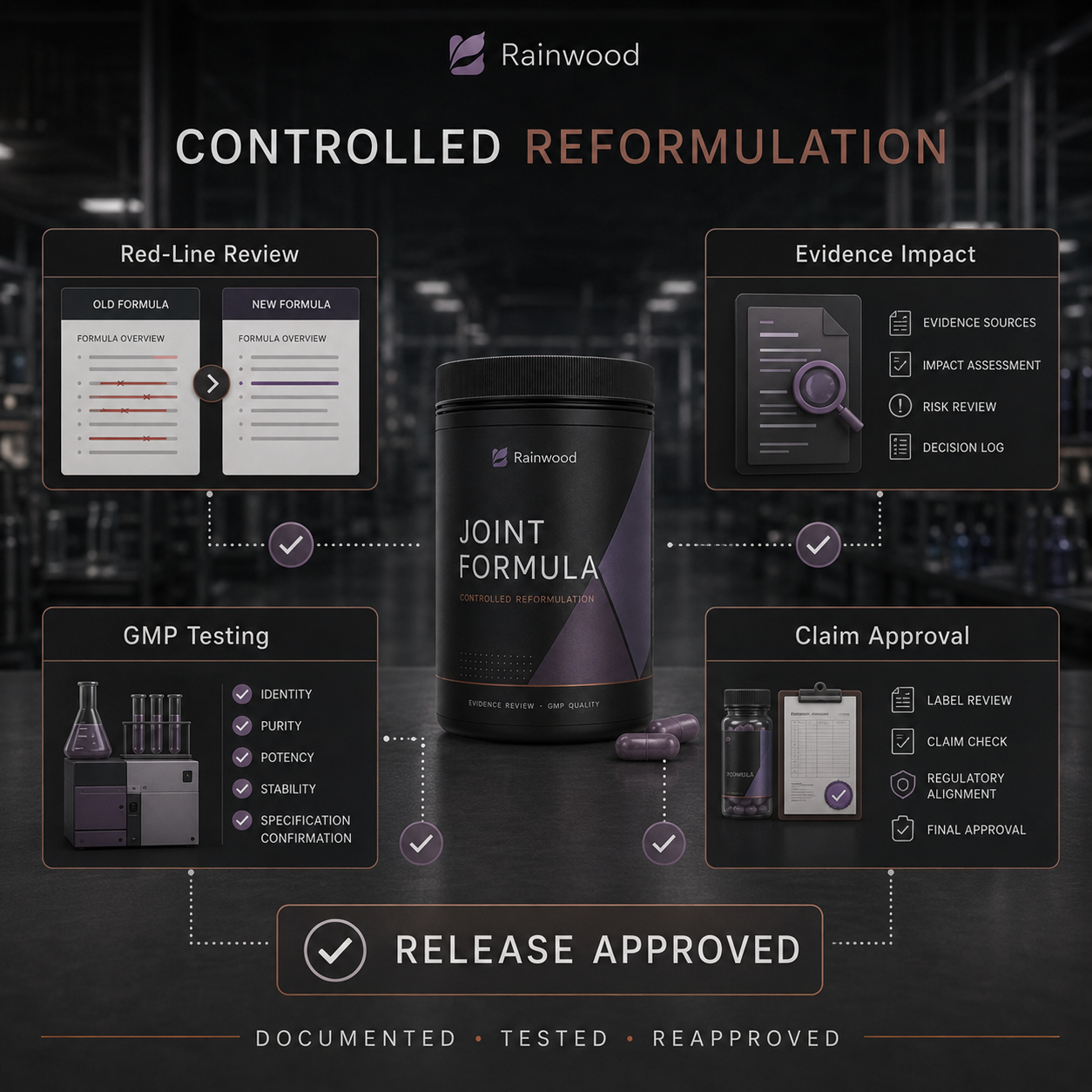
Do not release the reformulated product until five statements are true:
1. We can identify every material and supplier chain.
2. We can reconcile the new formula, daily serving, and label.
3. We have tested the risks created by the change.
4. We know which old evidence still applies and which does not.
5. Every marketed claim has been reapproved for the exact new product.
Request a joint-formula change and evidence-impact review. Send RainwoodBio the old and proposed formulas, specifications, COAs, cited studies, daily serving, claims, target consumer, market, dosage form, packaging, annual volume, launch date, and reason for change. The team can return an operational red line for your quality, scientific, and regulatory reviewers.
Frequently asked questions
1.If the Supplement Facts panel stays the same, is the product unchanged?
Not necessarily. Manufacturer, source, process, specification, impurity profile, excipients, methods, and physical performance may change behind the panel.
2.Does meeting the same raw-material specification prove clinical equivalence?
No. It supports defined quality comparability, but clinical relevance may depend on attributes outside the specification and on the complete intervention.
3.Can we keep “clinically studied” during a supplier transition?
Only after confirming the exact meaning, material traceability, evidence match, authorization, and market compliance. Pause or narrow the statement if the bridge is incomplete.
4.Does adding another active ingredient invalidate all old evidence?
Not automatically, but it creates a different formula and may change safety, performance, testing, serving, and claim interpretation. Conduct a documented impact assessment.
5.Who should sign the assessment?
At minimum, designated formulation, quality, regulatory, and commercial owners should approve within their competence. Obtain external scientific, legal, or clinical expertise when needed.
References
- FTC, Health Products Compliance Guidance: https://www.ftc.gov/business-guidance/resources/health-products-compliance-guidance
- FDA, Structure/Function Claims: https://www.fda.gov/food/nutrition-food-labeling-and-critical-foods/structurefunction-claims
- NCCIH, Glucosamine and Chondroitin for Osteoarthritis: https://www.nccih.nih.gov/health/glucosamine-and-chondroitin-for-osteoarthritis-what-you-need-to-know
- USP Glucosamine, Chondroitin Sulfate Sodium, and MSM Tablets: https://doi.usp.org/USPNF/USPNF_M2189_01_01.html
- RainwoodBio OEM service: https://www.rainwoodbio.com/oem
- RainwoodBio About Us: https://www.rainwoodbio.com/about-us
*This article is for international B2B change-control and educational purposes. Material identity, equivalence, specifications, testing, stability, study relevance, substantiation, labeling, claims, and regulatory requirements must be assessed for the exact old and new products and destination market.*