 EN
EN
Meta title: Perfect Chondroitin Sample Wrong Bulk How to Lock Scale
Meta description: A good chondroitin sample does not lock source, polymer profile, processing, or commercial release. Use this OEM sample-to-bulk control gate.
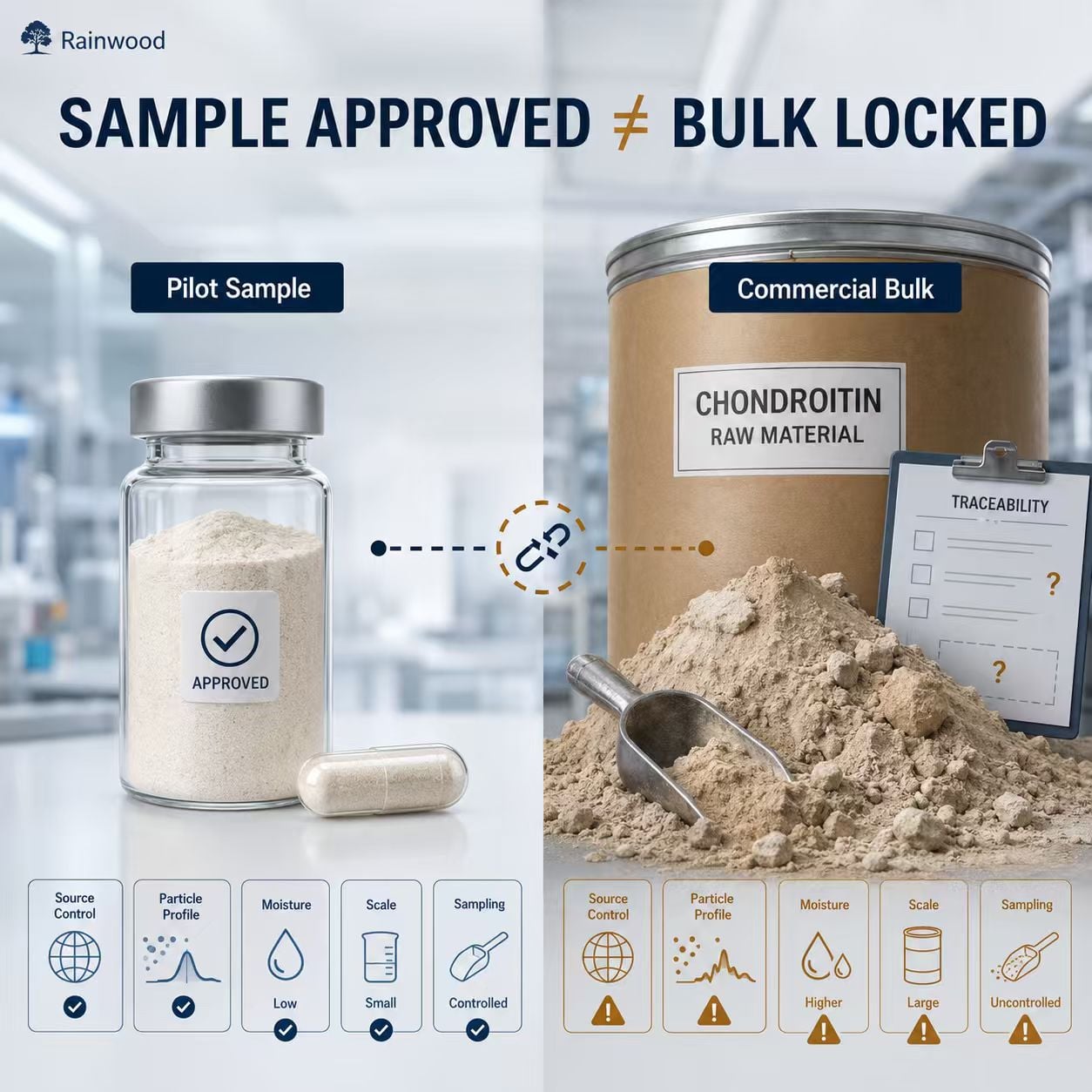
The pilot capsules look perfect. The sample powder dissolves acceptably. The customer approves the color and signs the artwork.
The commercial batch then arrives darker, behaves differently in the blend, and carries a source declaration that was never part of sample approval.
No one necessarily changed the formula line that says “chondroitin sulfate.” The problem is that the line never defined enough of the material.
For an OEM buyer, a successful sample proves one sample worked. It does not lock the supply and process system that must reproduce it.
The sample can hide uncontrolled variables
A bench or pilot sample may differ from commercial production in:
- manufacturer and source lot;
- bovine, porcine, avian, marine, or mixed origin;
- content and calculation basis;
- molecular mass and sulfation profile;
- moisture, particle size, density, color, odor, and solubility;
- storage time and packaging;
- blend scale, equipment, order of addition, and hold time;
- sampling and finished-product test plan.
If these attributes were not recorded, “match the sample” becomes a subjective instruction. The producer may match appearance while the buyer expected source, profile, documents, and performance to stay controlled.
Start with a commercial chondroitin material definition, not only a retained jar.
Turn the golden sample into a data package
Keep the approved sample, but attach it to measurable records:
1. Supplier, manufacturer, source, product code, and lot.
2. Signed specification and full COA.
3. Relevant profile and physical data.
4. Actual formula input and calculation basis.
5. Batch size, equipment, order, time, and process conditions.
6. In-process observations and results.
7. Finished-product specifications and test reports.
8. Packaging, storage, label, and claim version.
The retained sample is a visual and sensory reference where appropriate. It should not replace quantitative release criteria or source traceability.
Read why equal 90 percent chondroitin can still mean a different polymer profile before approving a source switch.
Commercial scale changes the formula's behavior
Larger equipment changes fill level, mixing dynamics, transfer distance, residence time, and environmental exposure. The chondroitin may interact differently with glucosamine, MSM, minerals, flavors, binders, or other excipients.
Risks include:
- blend segregation;
- adhesion or loss during transfer;
- moisture pickup and caking;
- weight variation;
- altered tablet compression or disintegration;
- changed powder dissolution or sediment;
- color and odor drift;
- nonrepresentative finished-product sampling.
Do not solve every difference by mixing longer. More time can help an under-mixed system but may worsen segregation in another. The control strategy should follow the actual formulation and equipment.
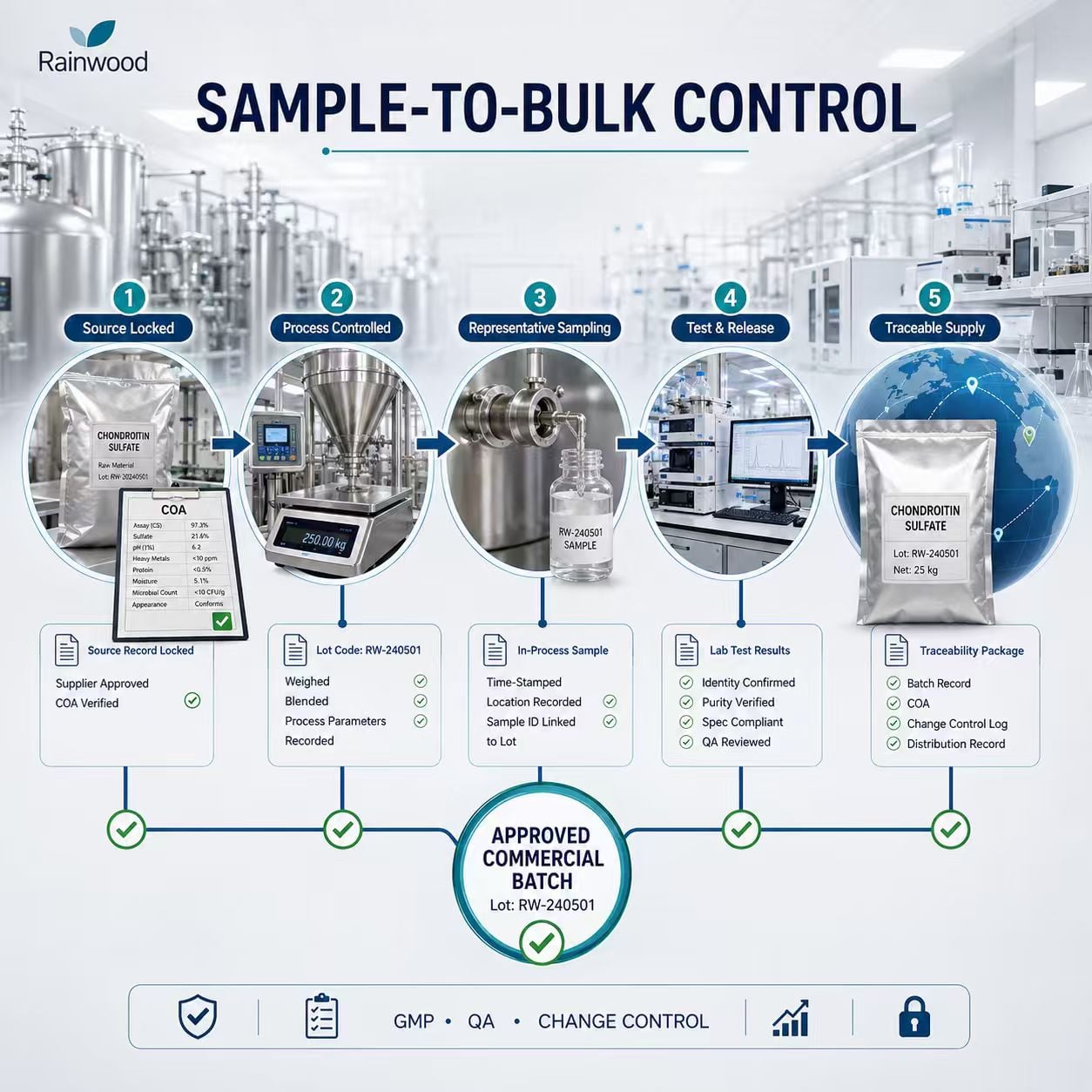
Use a sample-to-bulk release map
| Stage | What must be locked | Release evidence |
|---|---|---|
| Raw material | Source, grade, supplier, specification | Lot COA, source records, acceptance result |
| Dispensing | Correct material and quantity | Weighing and reconciliation records |
| Blending | Order, time, equipment, fill, transfer | Master record and in-process checks |
| Forming/filling | Weight and process performance | In-process data and deviations |
| Finished product | Identity, strength, composition, quality | Representative samples and agreed methods |
| Packaging | Material, seal, label, storage | Packaging record and checks |
| Shelf life | Formula and package remain suitable | Product-specific stability plan and data |
Define which differences from the sample require customer notification, technical assessment, re-sampling, or approval.
Explore RainwoodBio's published capsule tablet gummy and powder OEM services when selecting the commercial route.
Sampling should challenge the scale-up risk
One composite result can hide variation between locations or times. A qualified sampling plan may need to consider blender positions, containers, early/middle/late discharge, start/middle/end of filling, or multiple packaging points.
The exact plan depends on the process. Document:
- sampling purpose;
- locations and timing;
- sample number and mass;
- handling and preparation;
- method variability;
- acceptance and investigation logic.
The objective is not to collect the most samples. It is to collect evidence capable of finding the failure you are trying to control.
Change control protects the second order
The first bulk lot may pass. The second can drift if source, supplier, process, or packaging changes without review.
Require notification for changes to:
- animal or marine source;
- manufacturer, site, or supplier;
- specification or test method;
- molecular or physical attributes;
- packaging and storage;
- formula, excipient, batch size, equipment, or process;
- external laboratory or sampling plan.
Write who investigates, who approves, what evidence is required, and what happens to affected stock.
Review RainwoodBio's published production and traceability workflow as a project framework, then verify exact records for the product.
How RainwoodBio can support controlled commercial production
RainwoodBio describes requirement confirmation, sample development, supplier management, production control, testing/release, documentation, packaging, and traceability. Those published steps can become a useful scale-up plan, but they do not guarantee absolute sample-to-bulk identity.
For the order, request:
- the sample and bulk bill-of-material comparison;
- commercial raw-material specification and lot evidence;
- approved master record and critical process inputs;
- in-process and finished-product sampling plan;
- package and stability rationale;
- deviation and change-notification agreement.
Commercial production gate
Do not release bulk production until:
- sample and commercial material definitions match or differences are approved;
- source and supplier are controlled;
- process scale-up risks and pilot criteria are documented;
- methods and sampling are agreed before testing;
- packaging and shelf-life plans fit the actual formula;
- changes, failures, rework, rejection, and replacement have owners.
Request a chondroitin sample-to-bulk control plan. Send RainwoodBio the approved sample formula, raw-material COA, proposed commercial formula, source requirements, batch size, dosage form, packaging, tests, target market, and launch date; the team can map the missing scale-up gates.
Frequently asked questions
1.Does an approved sample guarantee commercial consistency?
No. It is one reference result. Commercial consistency requires material specifications, process controls, sampling, testing, packaging, stability, traceability, and change control.
2.Can the OEM change chondroitin source if the assay remains 90%?
Not without assessment when source affects the specification, customer promise, certificates, profile, evidence, or label. Treat it as a controlled material change.
3.Is visual comparison enough to approve bulk?
No. Appearance can be useful, but it cannot establish identity, source, content, profile, contaminants, or finished-product delivery.
4.Should the sample and bulk use the same batch size?
They cannot be the same scale, but the differences should be identified, assessed, trialed where needed, and connected by measurable acceptance criteria.
References
- 21 CFR 111.70, dietary supplement specifications: https://www.ecfr.gov/current/title-21/chapter-I/subchapter-B/part-111/subpart-E/section-111.70
- 21 CFR 111.75, determining whether specifications are met: https://www.ecfr.gov/current/title-21/chapter-I/subchapter-B/part-111/subpart-E/section-111.75
- Chondroitin Sulfate Safety and Quality review: https://pmc.ncbi.nlm.nih.gov/articles/PMC6515237/
- USP Chondroitin Sulfate Sodium: https://doi.usp.org/USPNF/USPNF_M17460_04_01.html
- RainwoodBio OEM: https://www.rainwoodbio.com/oem
- RainwoodBio About Us: https://www.rainwoodbio.com/about-us
*This article is for international B2B procurement and educational purposes. Source, specifications, scale-up, sampling, methods, process controls, packaging, stability, labeling, and regulatory requirements must be confirmed for the exact material, site, batch, finished product, and destination market.*