 EN
EN

Meta title: Same 90% Chondroitin Different Molecular Profile
Meta description: Two 90% chondroitin lots may differ in molecular mass, sulfation pattern, source, and process. Learn what formulators should compare before switching.
Two chondroitin samples both report 90%. One dissolves differently. One changes the blend's bulk behavior. Their source histories do not match, and their supporting studies do not describe the same material.
The purchasing team calls them equivalent because the assay number is equal.
That conclusion treats chondroitin like a small, uniform molecule. It is a heterogeneous sulfated polymer whose chain characteristics can vary with species, tissue, processing, and degradation. A total content result cannot describe that complete profile.
For a technical product manager, 90% is a release field—not an equivalence study.
Chondroitin is a family of chains, not one identical particle
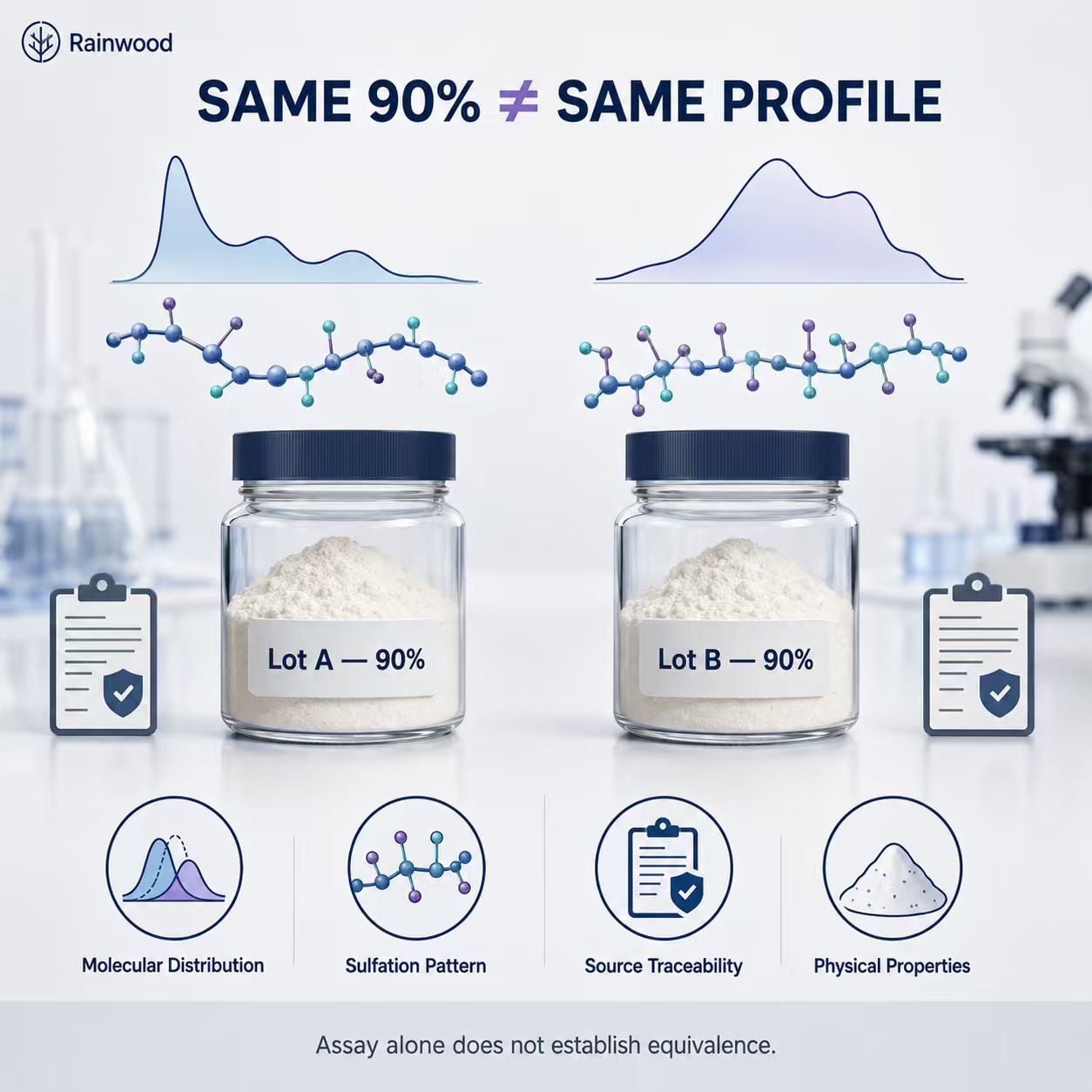
Chondroitin sulfate contains repeating sugar units with sulfate groups at different positions. Commercial material contains chains with a distribution of molecular masses rather than one exact molecular weight. Source and processing can influence sulfation patterns, chain length, charge density, and copurified components.
These differences may matter when you are:
- matching a raw material to a study;
- switching suppliers without changing a customer promise;
- controlling solution behavior, viscosity, color, odor, or processing;
- comparing terrestrial and marine sources;
- establishing a consistent analytical fingerprint;
- investigating batch-to-batch drift.
They do not prove that one material is universally more effective or bioavailable. They prove that “same assay” is too small a definition for a polymer-sensitive decision.
Build a chondroitin technical specification package that separates content from structural and physical attributes.
Molecular mass is not a magic marketing number
“Low molecular weight” can sound like an automatic absorption advantage. That claim needs far more than a supplier slide.
Before paying a premium, ask:
- What is being measured: average molecular mass, distribution, or a cut-off category?
- Which method, calibration, and reference materials are used?
- Is the value a specification with limits or only a typical result?
- Does the tested lot match the commercial material?
- What human evidence uses this exact material, dose, and endpoint?
- Does the intended claim comply in the target market?
Size-exclusion methods can help characterize polymer distribution, but an instrument name alone does not create a validated result. The method, detector, calibration model, sample preparation, suitability, and interpretation matter.
Do not turn “smaller” into “better absorbed” or “more effective” without material-matched evidence.
Sulfation pattern can help describe source and identity
Scientific literature describes differences in chondroitin 4-sulfate and 6-sulfate patterns among sources. Enzymatic digestion followed by separation of disaccharides can contribute to characterization and source comparison.
That is useful for:
- qualifying a reference material;
- checking consistency across lots;
- investigating a suspected source change;
- comparing the study material with a commercial ingredient;
- supporting a multi-analytical identity strategy.
It is not always capable of proving a single species, especially when sources are mixed or profiles overlap. Use analytical profiling with traceability records instead of asking one test to solve the entire supply-chain question.
Read how to lock bovine porcine avian or marine source evidence before interpreting a profile.
Create a technical equivalence matrix
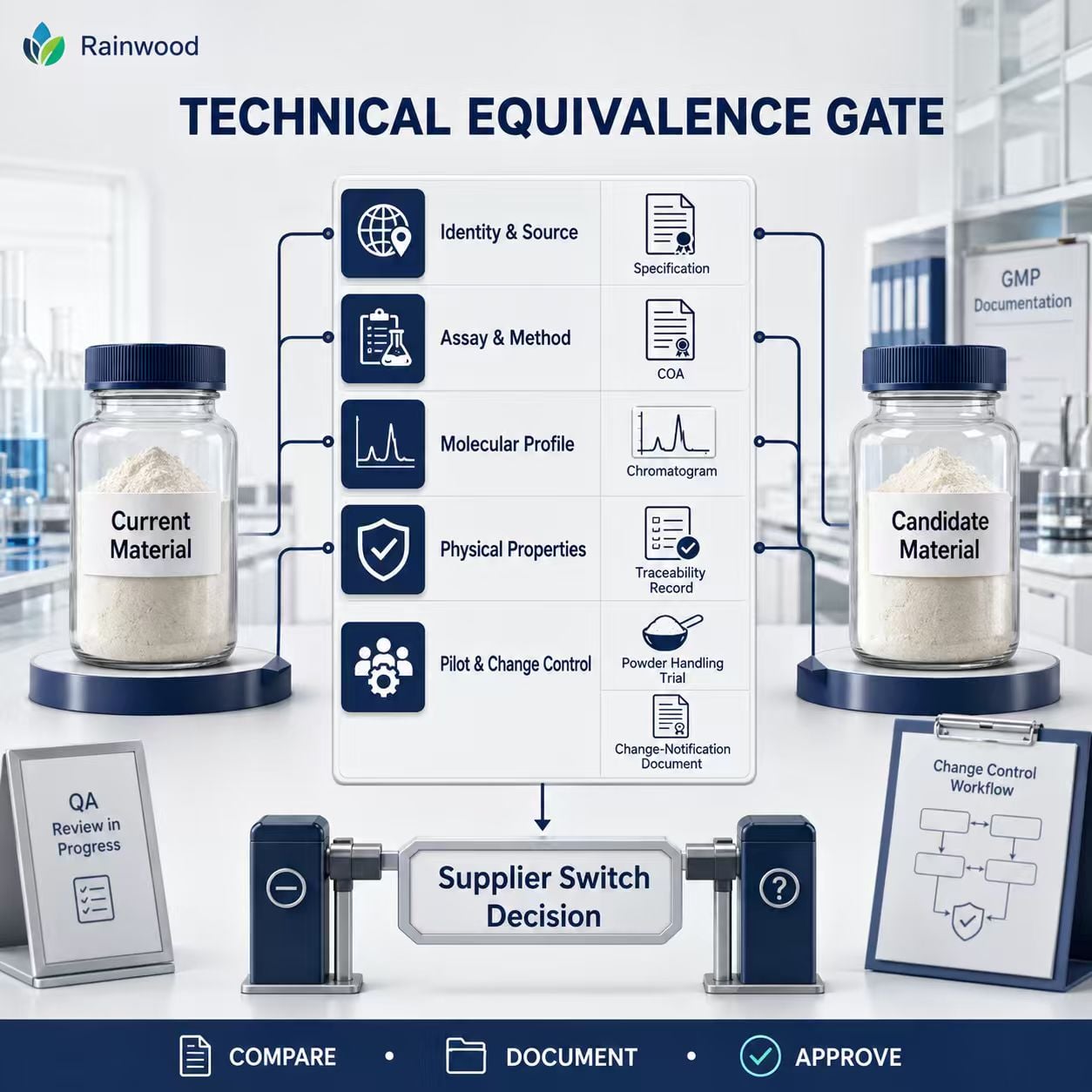
When adding or switching a supplier, compare the old and new material line by line.
| Attribute | Why it matters | Evidence to compare |
|---|---|---|
| Exact identity and salt | Prevents near-name substitution | Approved specification and identity package |
| Source and tissue | Affects profile, claims, and traceability | Source records and change control |
| Chondroitin content | Confirms quantity under defined conditions | Method, basis, limits, actual results |
| Molecular mass distribution | Describes polymer chain profile | Fit-for-purpose chromatographic data |
| Sulfation/disaccharide profile | Supports characterization and consistency | Enzymatic/profile method and reference |
| Copurified material | Can affect purity and method response | Specific impurity and orthogonal tests |
| Physical properties | Affects handling and finished process | Moisture, particle, density, solubility data |
| Lot history | Shows commercial consistency | Multiple representative lot results |
Set pass, conditional-pass, and fail criteria before the new sample arrives. Otherwise, the first attractive result becomes the acceptance standard by accident.
Explore RainwoodBio's published sample and production-development workflow when the equivalence decision affects a finished dosage form.
The study-to-material bridge is especially important
NCCIH notes that chondroitin clinical results are inconsistent and that some analyses found differences among brands or pharmaceutical-grade preparations. This does not prove a commercial supplement will work or fail. It makes evidence matching more important.
Check:
- exact preparation and source;
- manufacturer or branded status;
- dose and serving;
- molecular and analytical description;
- formulation and coingredients;
- population, duration, comparator, and endpoint;
- conflicts of interest and totality of evidence;
- rights to use a branded study or trademark.
A generic 90% raw material should not borrow a result merely because “chondroitin” appears in both documents.
How RainwoodBio can support a controlled comparison
RainwoodBio publishes requirement confirmation, supplier management, sample development, production control, testing/release, and documentation as service steps. These statements do not prove that molecular-profile tests are available for every grade.
For a supplier comparison, request:
- current specifications and representative lot documents;
- source, process, and change-control information;
- physical and profile data relevant to the application;
- a sample plan tied to commercial acceptance criteria;
- finished-formula trials when handling or serving is affected.
Review the published quality and traceability context, then verify the exact product-level evidence.
Supplier-switch gate
Do not approve the replacement material until:
- assay, identity, source, profile, and physical data have separate decisions;
- the new material meets the signed specification;
- study and claim implications are reviewed;
- pilot performance is acceptable where needed;
- retained samples and commercial-lot criteria are defined;
- future material changes require notice.
Request a chondroitin technical equivalence assessment. Send RainwoodBio the old and new specifications, COAs, source declarations, target formula, dosage form, study or claim file, annual quantity, and current problem; the team can build a comparison matrix for your approval meeting.
Frequently asked questions
1.Does equal chondroitin assay mean two lots are equivalent?
No. Assay is important, but identity, source, structural profile, impurities, physical properties, and intended use may also matter.
2.Is lower molecular weight always better?
No universal conclusion is justified. Define the measurement, commercial material, evidence, target use, and claim before assigning value to the number.
3.Can a sulfation profile prove the exact animal species?
It can support characterization and source assessment, but mixed sources and overlapping profiles can limit attribution. Combine analysis with controlled traceability.
4.Must every buyer specify molecular mass distribution?
Not necessarily. Include it when it materially affects identity, consistency, evidence matching, processing, customer requirements, or risk. Specifications should be useful, not decorative.
References
- USP Chondroitin Sulfate Sodium: https://doi.usp.org/USPNF/USPNF_M17460_04_01.html
- Chondroitin Sulfate Safety and Quality review: https://pmc.ncbi.nlm.nih.gov/articles/PMC6515237/
- Pharmacoproteomic comparison of chondroitin sources: https://pmc.ncbi.nlm.nih.gov/articles/PMC3433908/
- NCCIH Glucosamine and Chondroitin for Osteoarthritis: https://www.nccih.nih.gov/health/glucosamine-and-chondroitin-for-osteoarthritis-what-you-need-to-know
- RainwoodBio OEM: https://www.rainwoodbio.com/oem
*This article is for international B2B procurement and educational purposes. Polymer profile, source, identity, specifications, methods, evidence, formulation, claims, and regulatory requirements must be confirmed for the exact material, lot, finished product, and destination market.*