 EN
EN
Meta title: Shellfish vs Fermented Glucosamine: Source Proof for Buyers
Meta description: A B2B checklist for verifying shellfish-derived or fermented glucosamine before approving vegan, allergen, source, and label claims.
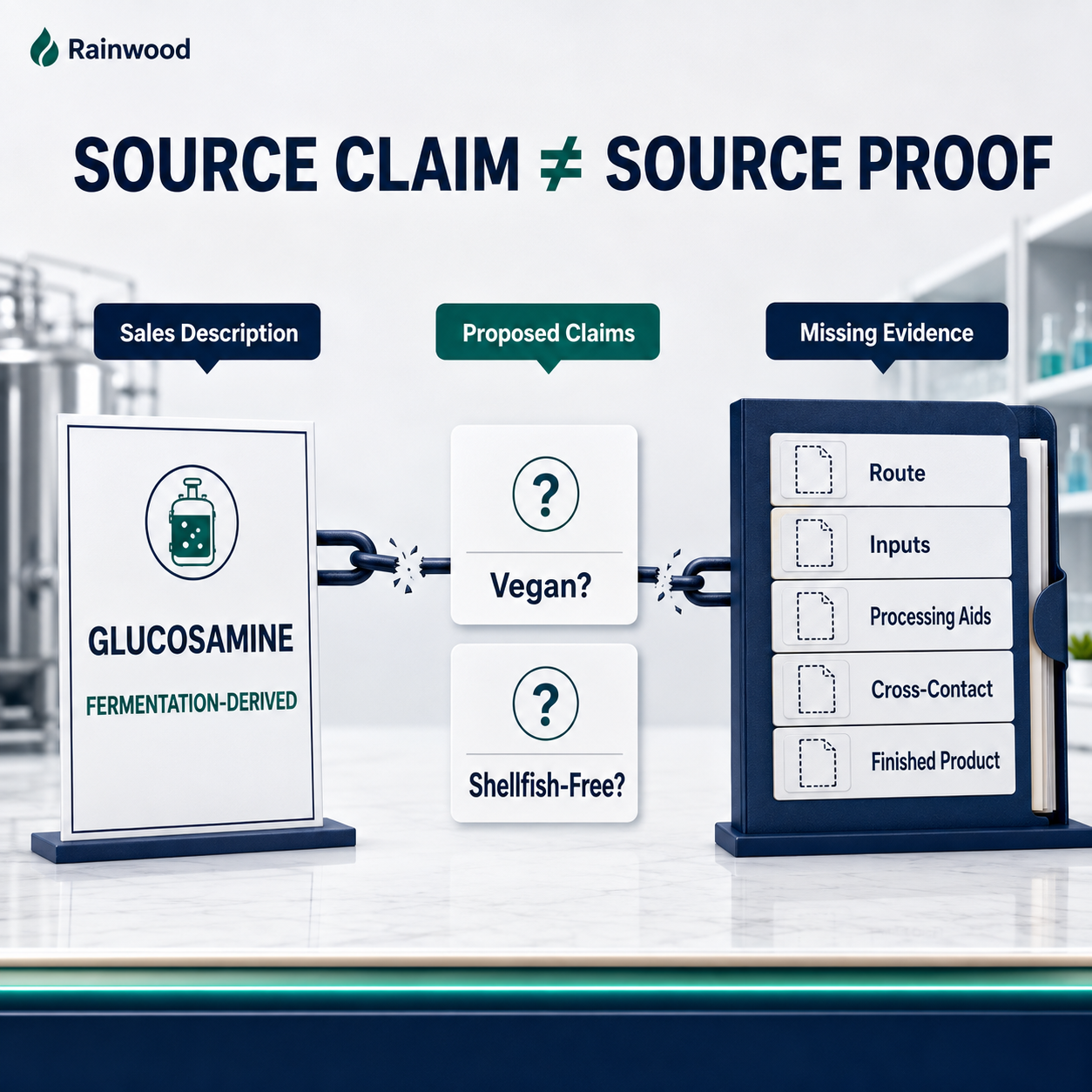
A supplier writes “fermented glucosamine” in a quotation. Marketing turns that into “vegan.” Procurement tells the retailer the product is shellfish-free. Then the audit begins—and nobody can show how the organism, feedstock, processing aids, segregation, or finished-product test supports those words.
That is not a copywriting problem. It is a source-identity and supply-chain problem.
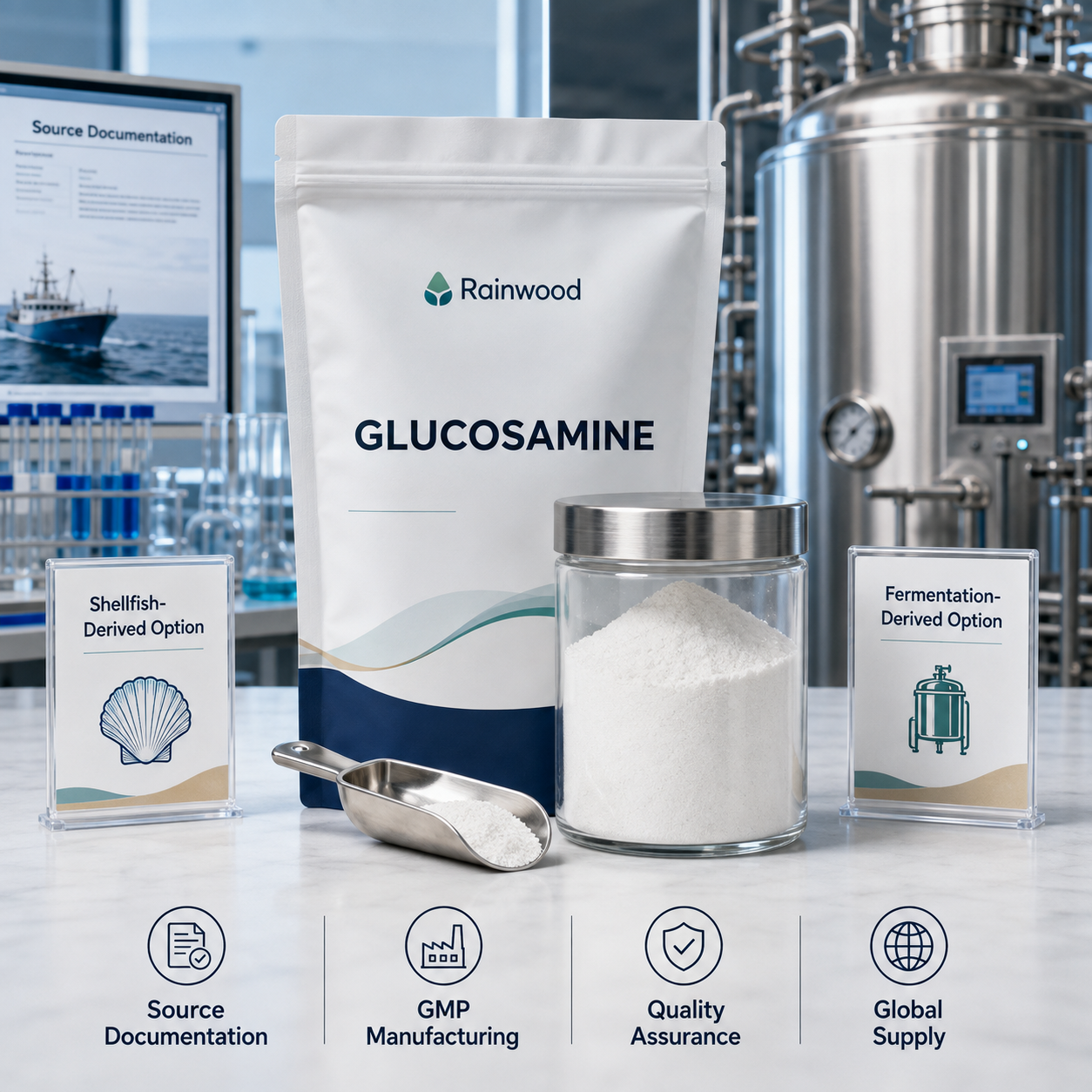
For supplement brands, contract manufacturers, importers, and private-label buyers, shellfish-derived and fermentation-derived glucosamine can both be commercially legitimate. The danger is approving the source claim from a sales description rather than a controlled evidence package.
One ingredient name can hide two very different supply chains
Traditional commercial glucosamine is often associated with chitin-containing marine raw materials. Fermentation routes use microorganisms and controlled production systems, and their input chains can differ materially. The finished glucosamine name alone does not document either route.
Before comparing prices, define at least four layers:
1. The glucosamine chemical form: hydrochloride, a stabilized sulfate complex, N-acetyl glucosamine, or another specified form.
2. The production route: extraction/hydrolysis from a named biological source or fermentation followed by purification.
3. The source inputs and processing aids relevant to your claim.
4. The evidence required by the destination market and customer.
If those layers are collapsed into one word—“glucosamine”—a buyer can receive the right assay and still receive the wrong commercial story.
See the separate glucosamine form comparison before treating source as the only variable.
“Non-shellfish” and “vegan” are not automatically the same claim
A non-shellfish route may remove one obvious animal-source concern, but “vegan” can reach further than the principal starting material. Depending on the claim standard and customer, the review may need to address fermentation media, nutrients, enzymes, antifoaming agents, processing aids, capsule shell, carriers, flavors, lubricants, and cross-contact controls.
The correct commercial question is therefore not merely:
> Is this glucosamine fermented?
It is:
> What precisely does the proposed claim mean, and which controlled records support every relevant part of that meaning?
A buyer should also separate source claims from allergen declarations. In the United States, crustacean shellfish is a major food allergen, but the applicability and wording for a particular ingredient and finished supplement depend on the actual source, proteins present, manufacturing controls, and applicable regulation. A raw-material statement should not be converted into a finished-product legal conclusion without qualified review.
Use RainwoodBio's OEM workflow overview to place source and claim review before sample approval, not after artwork.
The five-document source file
1. A specific source declaration
The declaration should identify the manufacturing route and relevant source rather than repeat “natural,” “non-shellfish,” or “fermented.” For an extracted material, ask for the named biological source. For a fermented material, ask for a controlled description of the route and the basis of the requested source claim.
2. A process-flow summary
You do not necessarily need the supplier's proprietary parameters. You do need enough of a process map to connect the input to the finished ingredient and identify where cross-contact, processing aids, or source-changing substitutions could occur.
3. Allergen and cross-contact assessment
Ask which regulated allergens are handled at the raw-material and finished-product sites, how segregation and cleaning are controlled, and whether the statement covers only intentional inputs or also assessed cross-contact. A generic allergen letter without the material name, manufacturing site, revision date, and authorization is weak evidence.
4. Claim-specific declarations
If your label will say vegan, vegetarian, shellfish-free, non-GMO, or fermentation-derived, obtain a separate approval record for each term. One declaration should not be silently stretched to support five claims.
5. Identity and release records
Source documentation never replaces chemical identity, assay, impurity, microbiological, and other specification testing. The source can be correct while the material fails its chemical specification. The chemistry can pass while the source file is incomplete. Both gates matter.
Ask for a representative specification and COA package and check that the product name and chemical form match your formula.
The substitution risk buyers often miss
Source claims are vulnerable to changes that purchasing teams may consider “equivalent”: a new plant, a second upstream producer, a different fermentation medium, a changed processing aid, or a temporary raw-material source. The assay may remain in specification while the basis of the marketing claim changes.
Put these events under notification and approval:
- upstream manufacturer or manufacturing-site change;
- biological source or production-route change;
- fermentation organism or relevant feedstock change;
- change to claim-relevant processing aids;
- allergen-control or shared-equipment change;
- specification, method, or material-name change.
The purchase order and quality agreement should require notice before shipment, not after a retailer asks for evidence.
How to compare two offers without paying for a false equivalence
Imagine Supplier A offers lower-cost shellfish-derived glucosamine with a clear species/source declaration and a complete allergen assessment. Supplier B offers “fermented vegan glucosamine” at a premium but provides only a brochure. Supplier B is not automatically the lower-risk option. Its claim package is simply incomplete.
Now imagine Supplier C supplies fermented glucosamine with a traceable route, controlled declarations, a suitable specification, method details, and change control. Its premium may buy a defendable positioning option—but only if your entire finished formula, dosage form, and manufacturing chain also meet the claim.
Compare the offers using an evidence matrix:
| Decision point | Supplier A | Supplier B | Supplier C |
|---|---|---|---|
| Exact chemical form | Confirmed? | Confirmed? | Confirmed? |
| Production route | Documented? | Documented? | Documented? |
| Source/claim basis | Specific? | Specific? | Specific? |
| Allergen assessment | Site-specific? | Site-specific? | Site-specific? |
| Claim-relevant inputs | Reviewed? | Reviewed? | Reviewed? |
| Change control | Contracted? | Contracted? | Contracted? |
| Identity and assay | Method-suitable? | Method-suitable? | Method-suitable? |
Price should enter the comparison only after the mandatory cells are complete.
How RainwoodBio can support source-claim development
RainwoodBio publishes a glucosamine raw-material page and describes OEM services including requirement confirmation, formulation, sample confirmation, production, testing, and documentation. Those published pages do not prove that every glucosamine option is fermentation-derived, vegan, shellfish-free, or suitable for every market.
For a specific project, ask RainwoodBio to assemble:
- the exact chemical-form specification;
- source and manufacturing-route declarations available for the proposed lot chain;
- allergen and cross-contact documents;
- a claim-by-claim evidence checklist for the complete formula;
- proposed change-notification requirements;
- sample and finished-product release plan.
Review the company's published quality and document context, then verify the exact entity, site, material, scope, and current documents for your order.
The approval rule
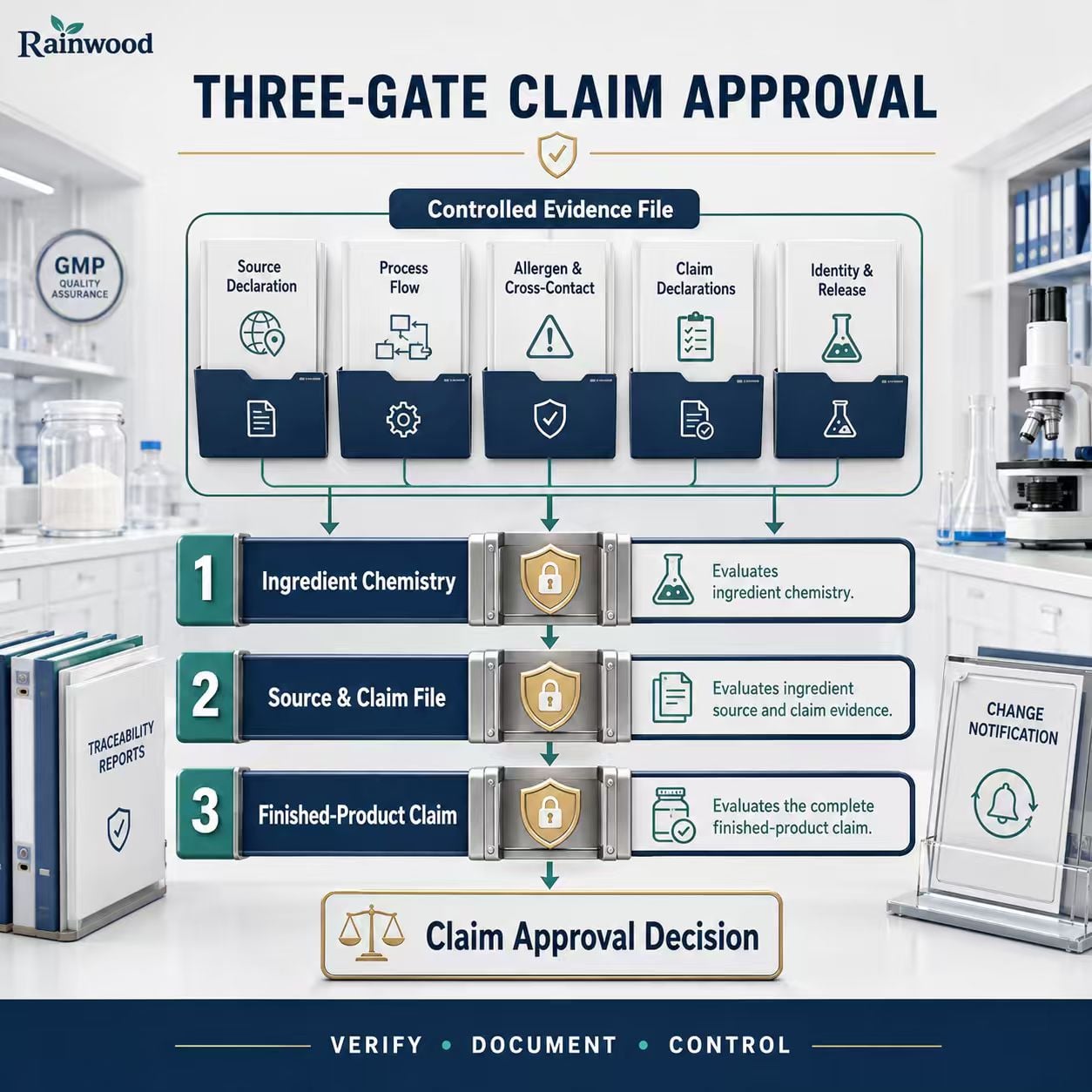
Approve three separate things:
1. The ingredient chemistry.
2. The ingredient source and claim file.
3. The complete finished-product claim.
Do not allow approval of one to stand in for the others. This three-gate rule gives procurement, quality, regulatory, and marketing the same definition of “approved.”
Request a glucosamine source-claim evidence review. Send RainwoodBio your target chemical form, desired source claims, destination market, dosage form, complete formula, allergen requirements, serving, pack format, and volume. The team can identify which declarations are available and which claims still require evidence or qualified regulatory review.
Frequently asked questions
1.Is fermented glucosamine automatically vegan?
Do not assume so. Review the production route, claim-relevant inputs and processing aids, capsule and excipients, manufacturing controls, and the definition used by your market or certifier.
2.Is shellfish-derived glucosamine automatically unsafe for people with shellfish allergy?
This is a medical and regulatory question that should not be answered from the source name alone. Evaluate the exact ingredient, residual-protein information, controls, applicable labeling rules, and qualified advice. Do not make a blanket safety promise.
3.Can a finished-product test prove “fermented”?
Routine identity and assay tests generally establish chemistry, not the complete historical production route. Route and source claims normally depend heavily on controlled supply-chain records and change control.
4.Should source appear on the COA?
The COA should identify the material and lot, but source support may sit in controlled declarations, specifications, questionnaires, process summaries, and quality agreements. Cross-reference them so the evidence cannot be detached from the lot chain.
References
- FDA, Food Allergies: https://www.fda.gov/food/nutrition-food-labeling-and-critical-foods/food-allergies
- FDA, Questions and Answers Regarding Food Allergen Labeling: https://www.fda.gov/media/117410/download
- Review of microbial production of glucosamine and N-acetylglucosamine: https://pubmed.ncbi.nlm.nih.gov/40424515/
- USP Glucosamine Hydrochloride: https://doi.usp.org/USPNF/USPNF_M35200_05_01.html
- RainwoodBio glucosamine powder page: https://www.rainwoodbio.com/hot-sale-glucosamine-powder-high-quality-pure-glucosamine-powder
- RainwoodBio OEM service: https://www.rainwoodbio.com/oem
- RainwoodBio About Us: https://www.rainwoodbio.com/about-us
*This article is for international B2B sourcing and educational purposes. Ingredient identity, biological source, manufacturing route, allergen status, cross-contact, vegan or vegetarian claims, specifications, test methods, labels, and regulatory requirements must be verified for the exact raw material, finished product, site, and destination market.*