 EN
EN

Meta title: The Cheap Chondroitin Quote That Raises Landed Cost
Meta description: Normalize chondroitin quotes by source, specification, testing, freight, release, and rejection risk before a low unit price reaches your warehouse.
Supplier A is 18% cheaper per kilogram. Procurement celebrates the saving. Quality later discovers that the quote excludes the required source evidence, independent confirmation, and replacement freight for a rejected lot.
The discount did not disappear. It was transferred from the purchase price into your warehouse, laboratory, release schedule, and dispute file.
For a chondroitin procurement manager, price per kilogram is not the final buying unit. The useful unit is one kilogram of accepted material, delivered under the same specification and commercial responsibilities.
Two chondroitin quotes can describe different products
Before comparing numbers, normalize the product definition:
- chondroitin sulfate or chondroitin sulfate sodium;
- animal or marine source;
- single, mixed, or flexible source policy;
- content limit and calculation basis;
- monograph or customer specification;
- included identity and purity tests;
- molecular or physical attributes where required;
- pack size, MOQ, lead time, and shelf-life basis.
If one quote says only “90% chondroitin” and the other includes a signed source-specific specification, they are not equivalent offers. The lower price may still win, but it should win after the missing requirements are priced.
Use a chondroitin specification request to force both suppliers onto the same commercial definition.
Testing exclusions create invisible landed cost
Ask which evidence is included in the material price:
- full supplier COA;
- source and manufacturer documents;
- applicable monograph tests;
- customer-specific contaminant tests;
- representative sampling;
- external laboratory confirmation;
- method attachments or raw data where required;
- certificates and market documentation.
A cheaper offer may use a shorter test package without any dishonesty. The supplier is pricing a different responsibility. Your comparison must show who pays for the missing work, how long release takes, and what happens if results disagree.
Read why a 90 percent chondroitin line may not survive a method challenge before valuing a short COA as a complete package.
Incoterms do not settle rejection responsibility
Trade terms allocate parts of transport cost and risk. They do not automatically create a complete rejected-lot remedy.
Your purchase documents should answer:
- Who arranges and pays for pre-shipment sampling?
- Which result controls if supplier and destination laboratories disagree?
- Can the buyer hold payment pending release?
- Who pays for storage during investigation?
- Who pays return freight, disposal, replacement, and retesting?
- What is the replacement timeline?
- Can the supplier substitute a source to accelerate delivery?
A low price with no practical remedy is a bet that nothing will go wrong. Quality procurement prices the failure path before ordering.
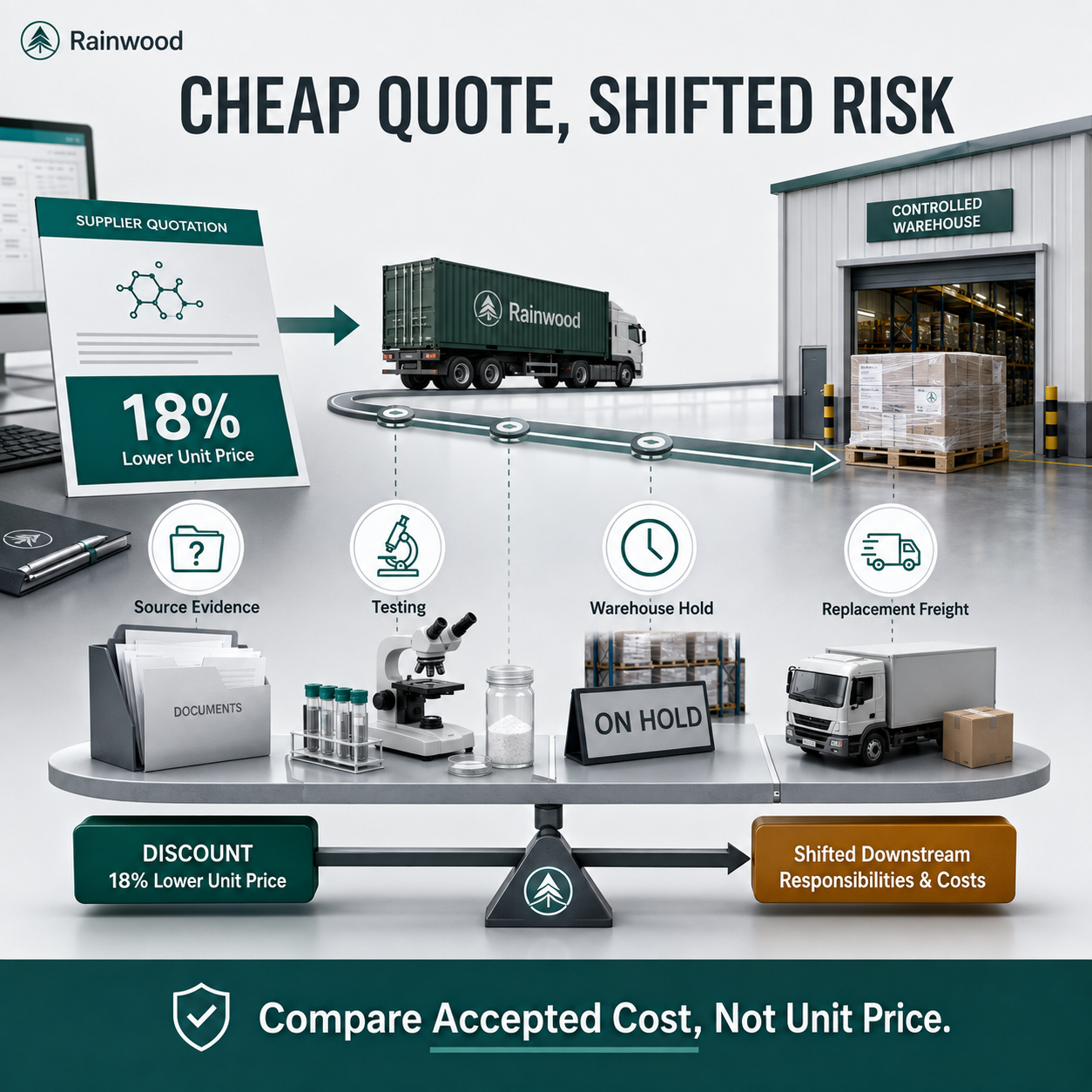
Calculate cost per released kilogram
Use this model:
`released cost per kg = total material + evidence + logistics + release + failure cost / accepted kilograms`
Include:
1. Material price and MOQ.
2. Packaging and usable yield.
3. Freight, insurance, duty, and finance cost.
4. Sampling, testing, and document review.
5. Warehouse hold and release time.
6. Expected retest, rejection, or replacement exposure.
7. Formula or label changes caused by source or grade differences.
Do not invent a failure percentage to make one supplier look bad. Run transparent scenarios: clean release, delayed release, and rejected lot. Let the buyer see how each contract behaves.
| Quote field | Supplier A | Supplier B |
|---|---|---|
| Exact product and source | | |
| Assay basis and specification | | |
| Included test package | | |
| MOQ and packaging | | |
| Incoterm and freight | | |
| Release timeline | | |
| Rejection and replacement remedy | | |
| Change notification | | |
| Cost per accepted kilogram | | |
Explore RainwoodBio's published sourcing and documentation workflow and request a quotation that identifies which steps and records are included.
Source flexibility has a price
If the supplier may change bovine, porcine, avian, or marine origin, price the consequences for customer approval, labels, certificates, analytical profiles, and evidence.
Source flexibility can be commercially useful. It should be declared, controlled, and reflected in the specification. An undisclosed switch can turn a supply solution into rejected stock.
Use the chondroitin source-control guide when evaluating the lowest offer.
How RainwoodBio can support a clean quotation
RainwoodBio's website publishes requirement confirmation, supplier management, testing and release, documentation, logistics, and traceability as its general workflow. Treat those as the headings for a quotation, not as proof that every item is included.
Ask RainwoodBio to state:
- exact grade, source, concentration, MOQ, and packaging;
- specification and included lot documents;
- testing and sampling responsibility;
- lead time and trade term;
- change-notification process;
- hold, rejection, and replacement procedure.
The result is a quotation your finance, quality, and commercial teams can evaluate together.
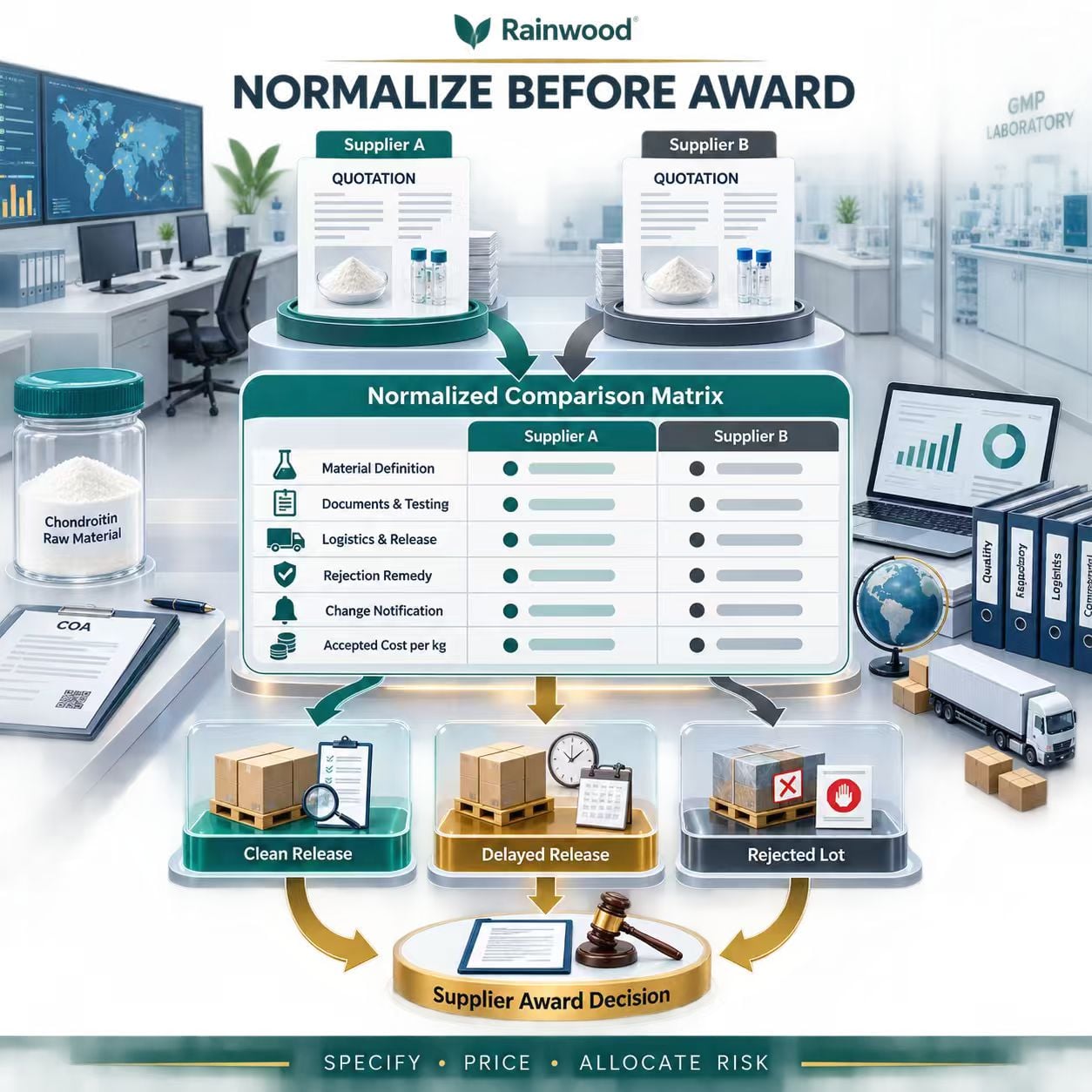
Award gate
Do not choose the supplier until:
- both offers use the same material definition;
- missing tests and documents are priced;
- landed and release costs are included;
- failure responsibilities are written;
- source changes require review;
- the expected cost per accepted kilogram is visible.
Request a two-quotation chondroitin normalization. Send RainwoodBio both quotations, specifications, COAs, destination, annual volume, required source, tests, packaging, Incoterm, and launch deadline; the team can return a line-by-line commercial comparison.
Frequently asked questions
1.Is the cheapest chondroitin supplier usually lower quality?
Not necessarily. Price differences can come from source, scale, specification, testing, logistics, MOQ, and risk allocation. Compare evidence and responsibilities rather than assuming intent.
2.Should testing always be included in the quoted price?
The commercial structure can vary. What matters is that included and excluded work is explicit, suitable for the project, and included in the landed-cost comparison.
3.How should rejected-lot risk be valued?
Use transparent scenarios covering retesting, storage, return or disposal, replacement freight, delay, and lost sales. Do not present an invented probability as fact.
4.Can a lower MOQ justify a higher kilogram price?
Yes. It may reduce cash, storage, expiry, and launch risk. Compare total project economics and accepted usable quantity.
5.What should procurement do when suppliers use different specifications?
Create one buyer specification or comparison baseline before negotiating the final price. Ask each supplier to identify every deviation, alternative method, source option, excluded document, and commercial assumption. Quality should decide whether the differences are acceptable; procurement can then price the accepted deviations instead of forcing unlike materials into one price column.
References
- USP Chondroitin Sulfate Sodium: https://doi.usp.org/USPNF/USPNF_M17460_04_01.html
- 21 CFR 111.70, dietary supplement specifications: https://www.ecfr.gov/current/title-21/chapter-I/subchapter-B/part-111/subpart-E/section-111.70
- 21 CFR 111.75, supplier COA and specification verification: https://www.ecfr.gov/current/title-21/chapter-I/subchapter-B/part-111/subpart-E/section-111.75
- Chondroitin Sulfate Safety and Quality review: https://pmc.ncbi.nlm.nih.gov/articles/PMC6515237/
- RainwoodBio About Us: https://www.rainwoodbio.com/about-us
- RainwoodBio Contact: https://www.rainwoodbio.com/contact-us
*This article is for international B2B procurement and educational purposes. Prices, sources, specifications, tests, trade terms, import costs, remedies, and regulatory requirements must be confirmed for the exact material, supplier, lot, customer, and destination market.*