 EN
EN

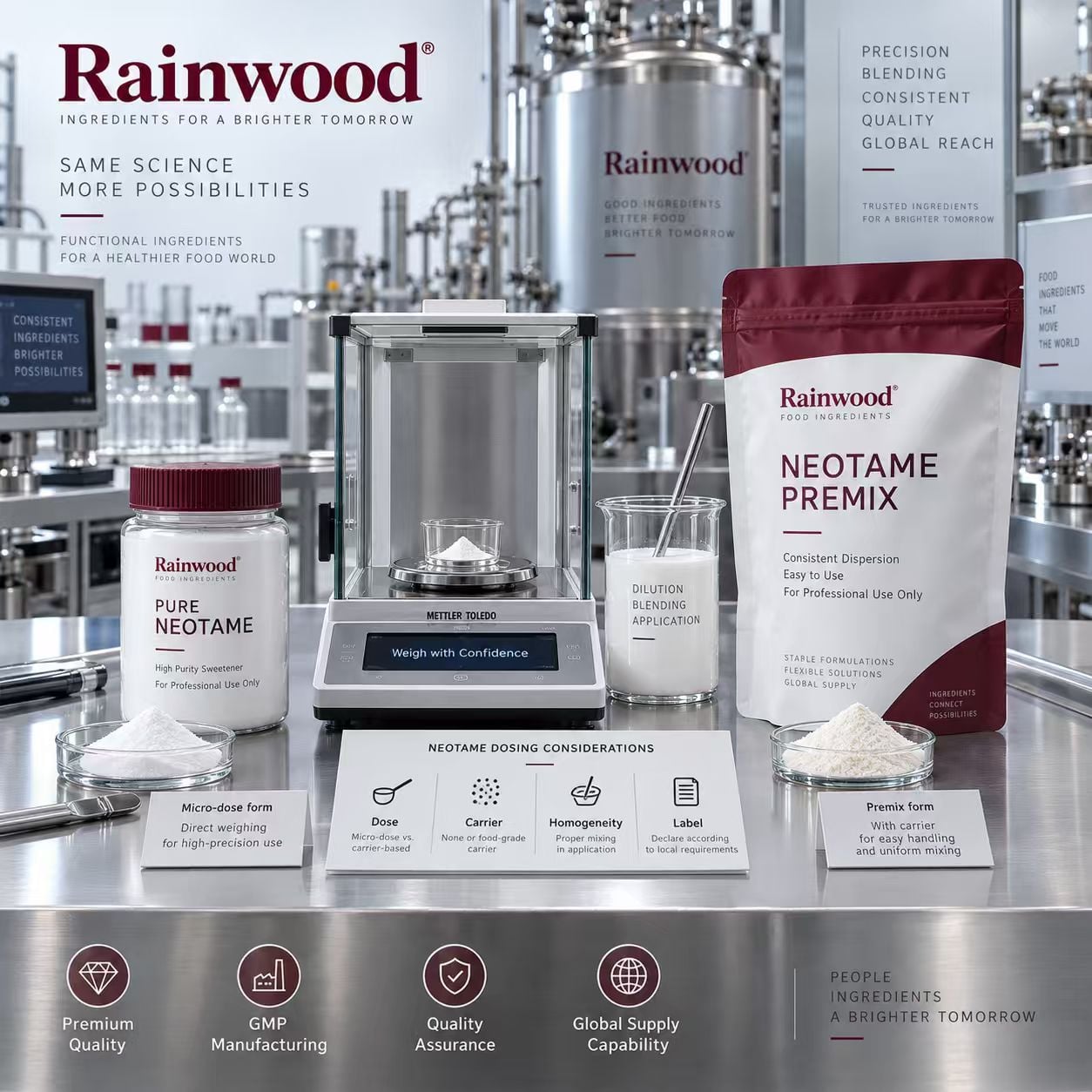
Meta title: Pure Neotame Powder or Premix: Which Form Is Safer?
Meta description: Pure neotame and premixes create different dosing, carrier, segregation, label, and testing risks. Learn how OEM buyers choose the form their line can control.
The product brief says “pure neotame.” The process engineer asks how the line will reliably weigh a tiny dose. The supplier recommends a premix. Purchasing worries that the carrier changes the label.
No one is wrong. Pure powder and premix solve different commercial problems.
Neotame’s extreme potency means that the best form is not necessarily the material with the highest headline purity. The best form is the one your receiving, blending, filling, testing, and label systems can control consistently.
Review the RainwoodBio neotame powder information, then compare pure powder and premix using the finished format, not just the product name.
Pure powder gives a clean ingredient story—but demands precision
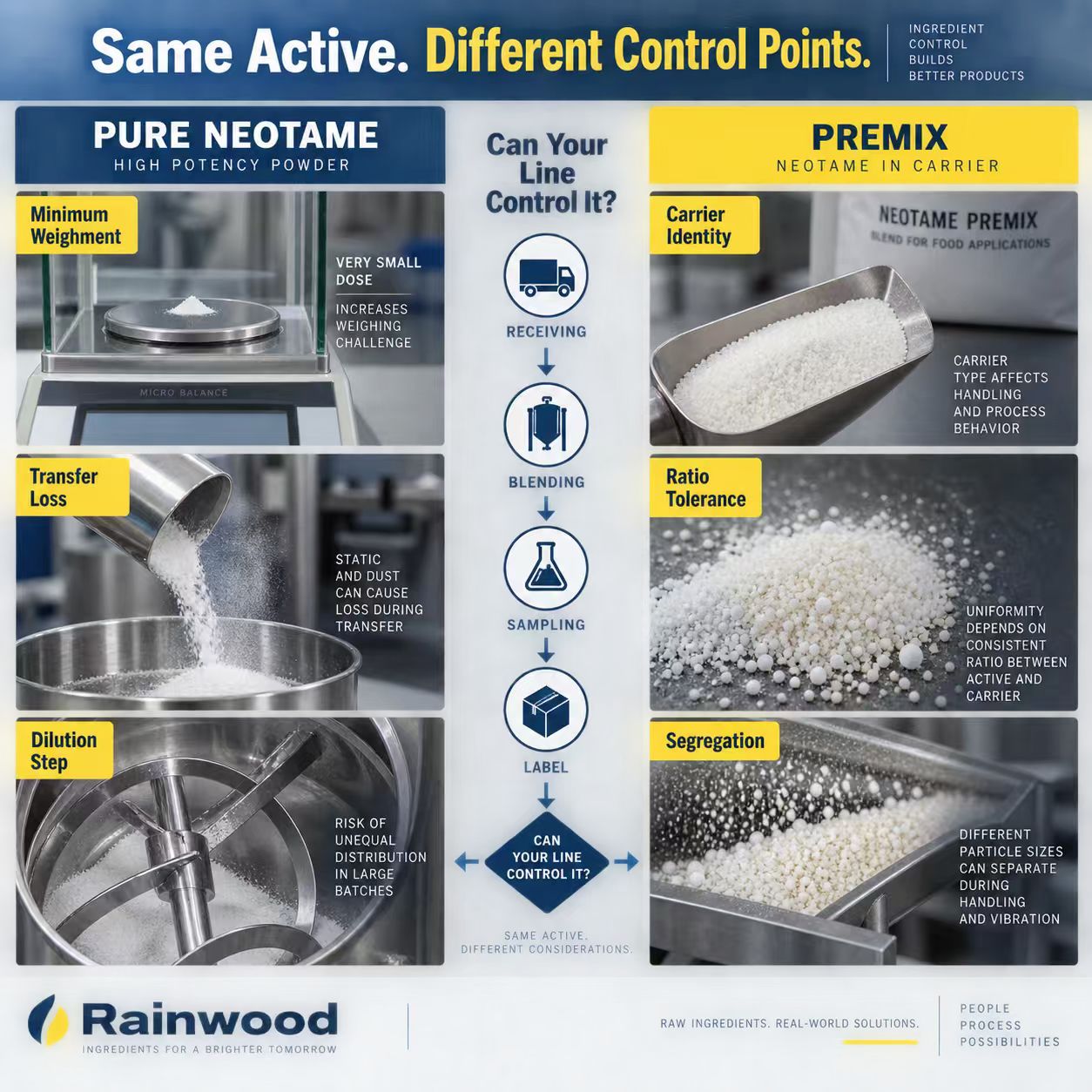
Pure neotame powder can simplify the ingredient declaration and allow a formulator to control the final recipe. It can also create practical handling challenges:
- very small weighments;
- static and dust;
- loss on transfer;
- uneven distribution in a large batch;
- difficulty sampling a tiny active fraction;
- high consequence of a balance error;
- need for a validated dilution step.
The official U.S. specification includes assay, water, related substances, residue on ignition, lead, and rotation, but it does not guarantee that pure powder will flow or blend on your exact equipment. [21 CFR 172.829](https://www.govinfo.gov/content/pkg/CFR-2020-title21-vol3/pdf/CFR-2020-title21-vol3.pdf) is a chemical and regulatory reference, not a machine-feasibility report.
Read the neotame micro-dose blending article before committing to direct addition.
Premix improves handling by changing the commercial identity
A premix dilutes neotame into a larger, easier-to-dose carrier. That can improve weighment, distribution, and line control. It also creates new questions:
- What carrier is used and at what percentage?
- Is the blend physical or co-processed?
- Does the carrier require a different allergen or label review?
- Are the particle sizes and densities compatible?
- What is the blend tolerance and homogeneity result?
- Can the blend segregate during transport or filling?
- Is the assay reported on the active fraction or total product?
A premix is not “pure neotame at a lower price.” It is a new material that needs its own specification and release strategy.
The line-control decision should start with a dose calculation
Calculate the expected neotame amount per batch and per finished serving. Then compare it with the accuracy, minimum weighment, and loss characteristics of the equipment.
| Decision point | Pure powder | Premix |
|---|---|---|
| Weighment | Very small | Larger and easier |
| Carrier | None | Must be specified |
| Label | Simpler ingredient story | Carrier appears in formula |
| Uniformity | Depends on dilution process | Depends on blend homogeneity |
| Shipping weight | Lower | Higher |
| Sampling | Tiny active fraction | Larger sample possible |
| Segregation | Powder behavior | Density and particle mismatch risk |
| Cost | More concentrated | Includes carrier and handling |
Use the neotame active-dose calculation checklist to choose based on the real process.
A dilution train is often safer than one direct addition
If a pure powder dose is too small for a reliable scale, the manufacturer may create a staged dilution:
1. Weigh pure neotame with a validated high-accuracy balance.
2. Blend it with a defined portion of carrier.
3. Confirm the intermediate premix is homogeneous.
4. Add the intermediate premix to the main batch.
5. Sample from defined locations and test the matrix.
This approach can work, but the intermediate blend becomes a controlled material. The batch record should identify the operator, equipment, mixing time, carrier lot, sample locations, result, and disposition.
Do not use an informal “small amount mixed into sugar” step without a specification. The same ratio can perform differently if density, particle size, moisture, or mixing energy changes.
Segregation can erase the benefit of a premix
Neotame premix may separate from its carrier when particles differ in size, density, surface texture, or electrostatic behavior. Vibration during transport can create a concentration gradient in a bag. A top sample can pass while the bottom is outside the target ratio.
Request:
- particle-size distribution for neotame and carrier;
- bulk and tapped density;
- blend homogeneity method;
- sampling plan at multiple locations;
- segregation or transport-stress assessment;
- packaging and reclosure requirements;
- retest period after opening.
Use the sample-to-bulk and premix-flow guide to connect supplier data to your line.
The label is part of the form decision
The finished label must reflect the actual formula. If the carrier is maltodextrin, erythritol, soluble fiber, or another food ingredient, the ingredient declaration, nutrition panel, allergens, and market claims may change.
U.S. regulation permits neotame as a sweetener and flavor enhancer under specified conditions, but it does not make every carrier or every finished claim automatically compliant. [FDA’s substance database](https://hfpappexternal.fda.gov/scripts/fdcc/index.cfm?id=NEOTAME&set=FoodSubstances) identifies neotame’s technical effects and the applicable regulation; it is not a premix approval document.
The EU’s E 961 framework also requires review of the use category and current specifications. Confirm the premix and finished-product dossier, not only the pure active’s status.
How RainwoodBio can support the form choice
RainwoodBio’s public neotame page lists a powder product and related applications such as powdered blends and tabletop packets. These are company-published context. The exact carrier, ratio, homogeneity, MOQ, and testing plan need confirmation for each project.
Ask RainwoodBio to compare:
- direct pure-powder addition;
- staged dilution using the customer’s approved carrier;
- a supplier-prepared premix;
- sachet or tabletop formats;
- testing and batch-record requirements.
Use the neotame format and OEM feasibility review before committing to the first commercial batch.
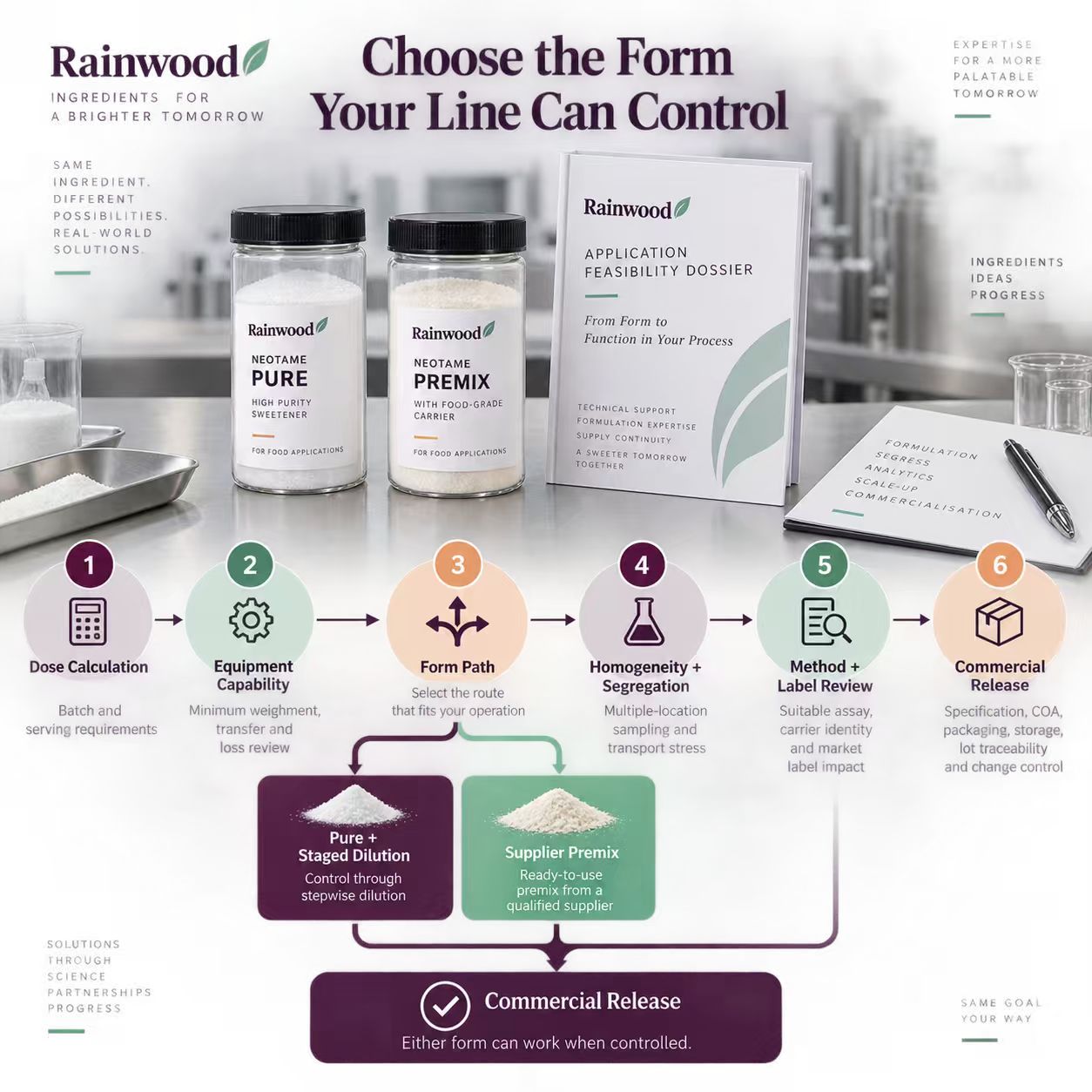
The approval gate
Approve the commercial form only after:
1. Dose and balance capability are documented.
2. Pure or premix identity is clear.
3. Carrier, ratio, and label impact are approved.
4. Homogeneity and segregation controls are defined.
5. Sampling and assay methods fit the form.
6. Packaging and storage protect the material.
7. Change-control terms cover carrier, ratio, source, and site.
Request a pure-neotame versus premix feasibility review. Send RainwoodBio the target dose, batch size, equipment, format, carrier restrictions, market, quantity, and label draft so the team can recommend a controllable form rather than the most impressive purity number.
Frequently asked questions
1.Is pure neotame always the professional choice?
No. Pure powder may be appropriate when the facility can control micro-weighing and dilution. A premix may be safer when the use level is too small for reliable direct dosing.
2.Does a premix make the neotame less effective?
Not necessarily. It changes the commercial form and the amount of material needed. Confirm the ratio, homogeneity, assay, and finished sweetness.
3.Can I test a premix with the pure-neotame method?
Only if the sample preparation, recovery, calibration, and matrix are suitable. A method for pure powder may not answer a premix or finished-product question.
References
- U.S. 21 CFR 172.829: https://www.govinfo.gov/content/pkg/CFR-2020-title21-vol3/pdf/CFR-2020-title21-vol3.pdf
- FDA Neotame substance database: https://hfpappexternal.fda.gov/scripts/fdcc/index.cfm?id=NEOTAME&set=FoodSubstances
- FAO/JECFA neotame specification: https://www.fao.org/fileadmin/user_upload/jecfa_additives/docs/Monograph1/Additive-294.pdf
- RainwoodBio neotame powder page: https://www.rainwoodbio.com/custom-neotame-powder
This article is for international B2B procurement and educational purposes. Commercial form, carrier, dose, homogeneity, testing, labelling, safety, and regulatory requirements must be confirmed for the exact premix, finished product, and destination market.