 EN
EN

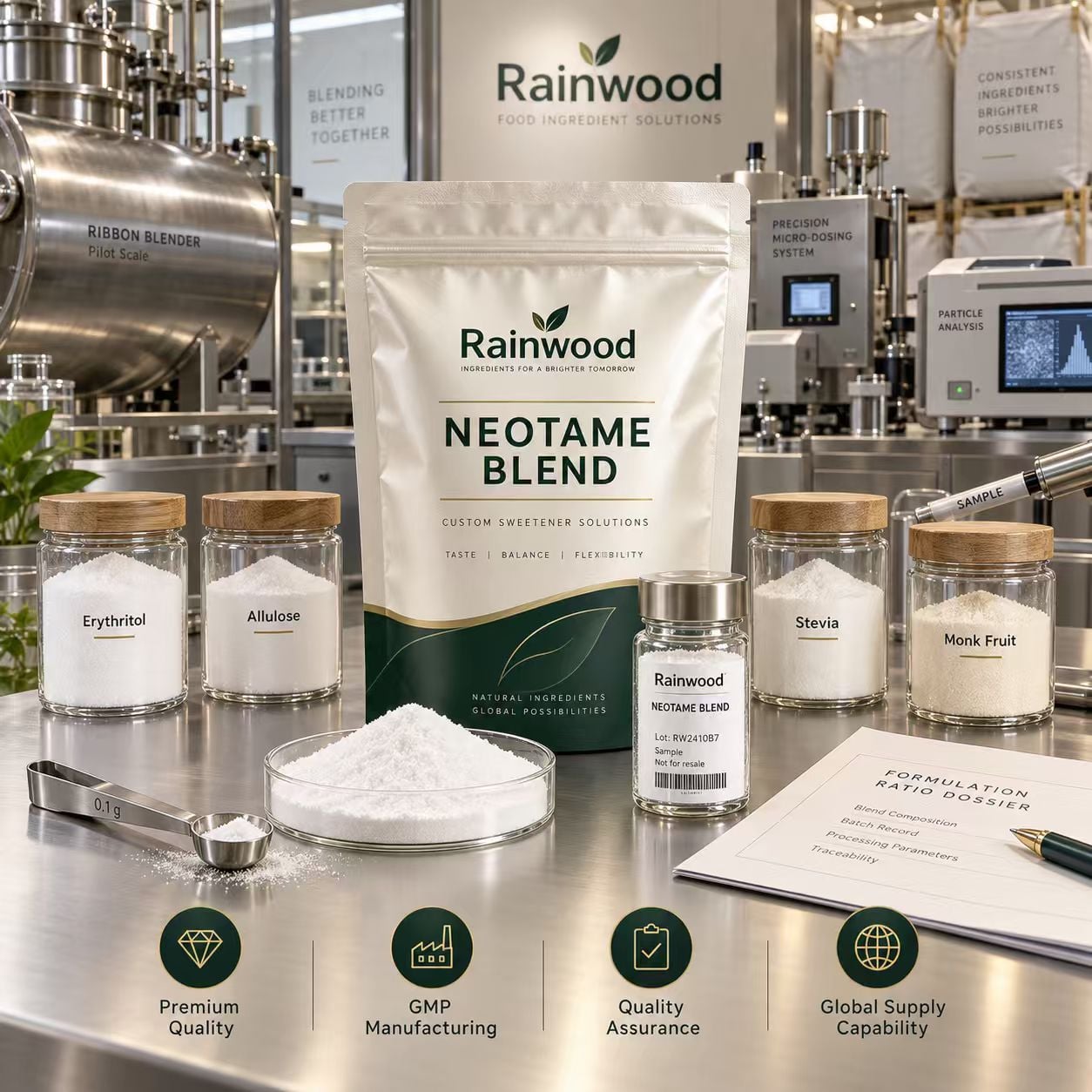
Meta title: Neotame Blends: Erythritol, Allulose, Stevia, or Monk Fruit?
Meta description: Neotame blends can improve taste and cost but create ratio, carrier, segregation, label, and evidence risks. Learn how buyers qualify a defensible formula.
The brief asks for a “clean-label sugar-free blend with no aftertaste.” The supplier adds neotame, erythritol, allulose, stevia, and monk fruit. The sample tastes good.
Then QA asks for the exact ratio, regulatory asks which component supports the claim, and production discovers the top and bottom of the bag do not taste identical.
That is when a high-intensity sweetener blend becomes a real procurement project.
Neotame can be paired with bulk sweeteners and other high-intensity sweeteners to adjust sweetness, mouthfeel, cost, or aftertaste. But every added component changes the specification, label, exposure, physical behavior, and evidence chain.
Use the RainwoodBio neotame product context, then qualify the exact blend rather than buying a marketing name such as “premium sweetener system.”
Each component performs a different job
- Neotame: extreme sweetness at a very low use level.
- Erythritol: bulk, cooling, crystallization, and polyol-related tolerance considerations.
- Allulose: bulk and rare-sugar positioning with its own label and regulatory file.
- Stevia: high-intensity sweetness with glycoside-dependent taste and standardization.
- Monk fruit: extract-based sweetness whose performance depends on mogroside content, carrier, and grade.
A blend may be technically smart. The risk begins when the quotation does not specify which grade, ratio, carrier, or standardization is actually being delivered.
Read the neotame pure-powder versus premix guide before accepting a total-blend “purity” number.
Sweetness curves do not add like percentages
Sweetness perception changes with concentration, timing, temperature, acidity, and flavor. Neotame may provide rapid intense sweetness while erythritol changes cooling and bulk. Stevia or monk fruit may introduce persistence or bitterness. Allulose may change mouthfeel and solids.
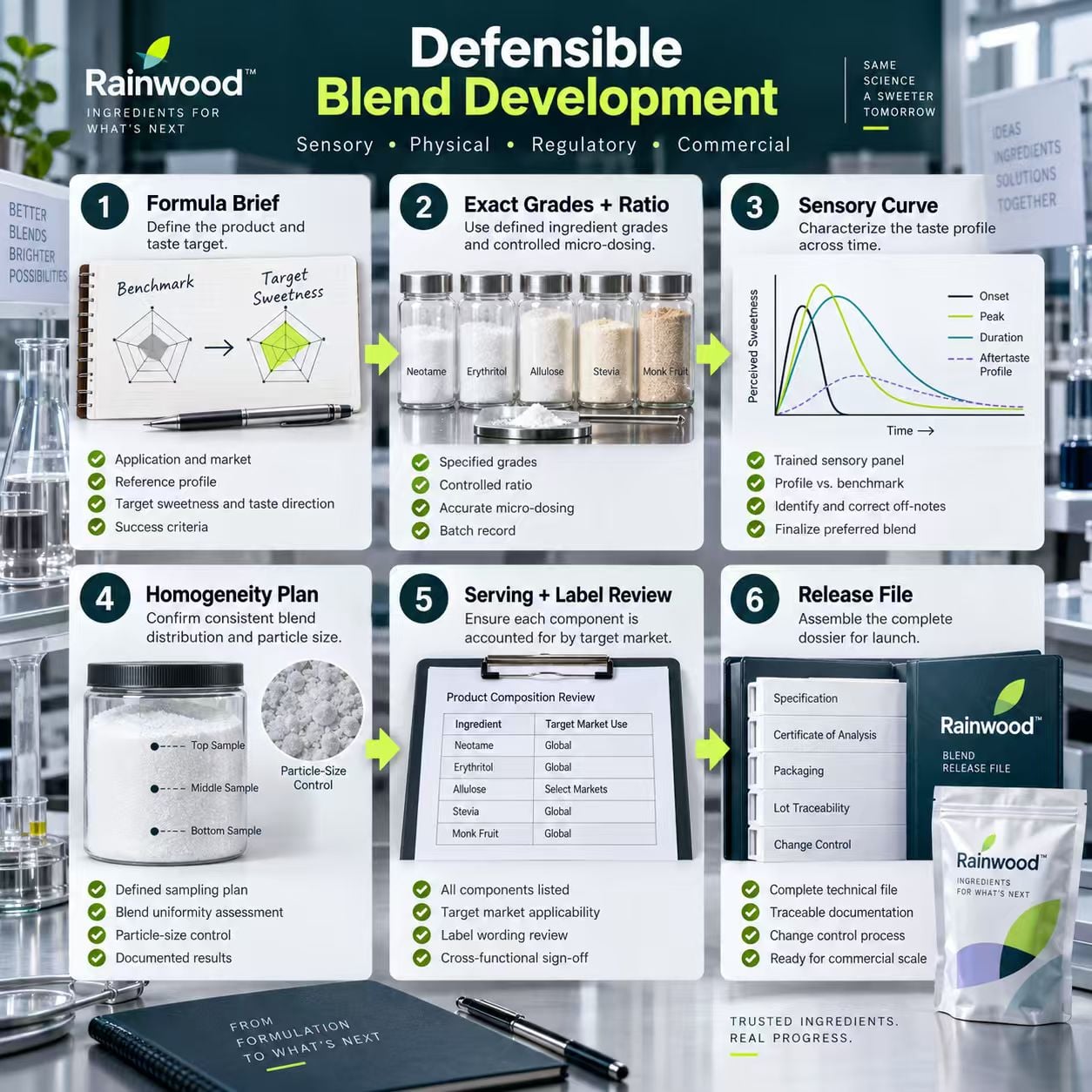
Run a controlled sensory design:
1. Benchmark the current sucrose or competitor product.
2. Test neotame at the target concentration.
3. Add the bulk sweetener and record solids and body.
4. Add stevia or monk fruit one at a time.
5. Test the complete blend in the final matrix.
6. Repeat after storage and at the intended serving temperature.
Record sweetness onset, peak, duration, aftertaste, cooling, acid balance, and flavor compatibility. Do not approve by brochure sweetness ratios alone.
The blend ratio is part of the identity
Require the supplier to state:
- exact ingredient names and grades;
- percentage or mass ratio and tolerance;
- neotame assay basis;
- stevia or monk-fruit standardization;
- erythritol or allulose content;
- carrier and processing aids;
- mixing order and homogeneity method;
- particle-size and density ranges;
- packaging and segregation controls.
If a blend is specified as 0.1% neotame, 70% erythritol, 20% allulose, and 9.9% carrier, a lot at a different ratio may still pass a generic “sweetener blend” test while changing sensory and label outcomes.
Use the neotame micro-dose blending guide to connect ratio tolerance with batch release.
Physical segregation can change the serving
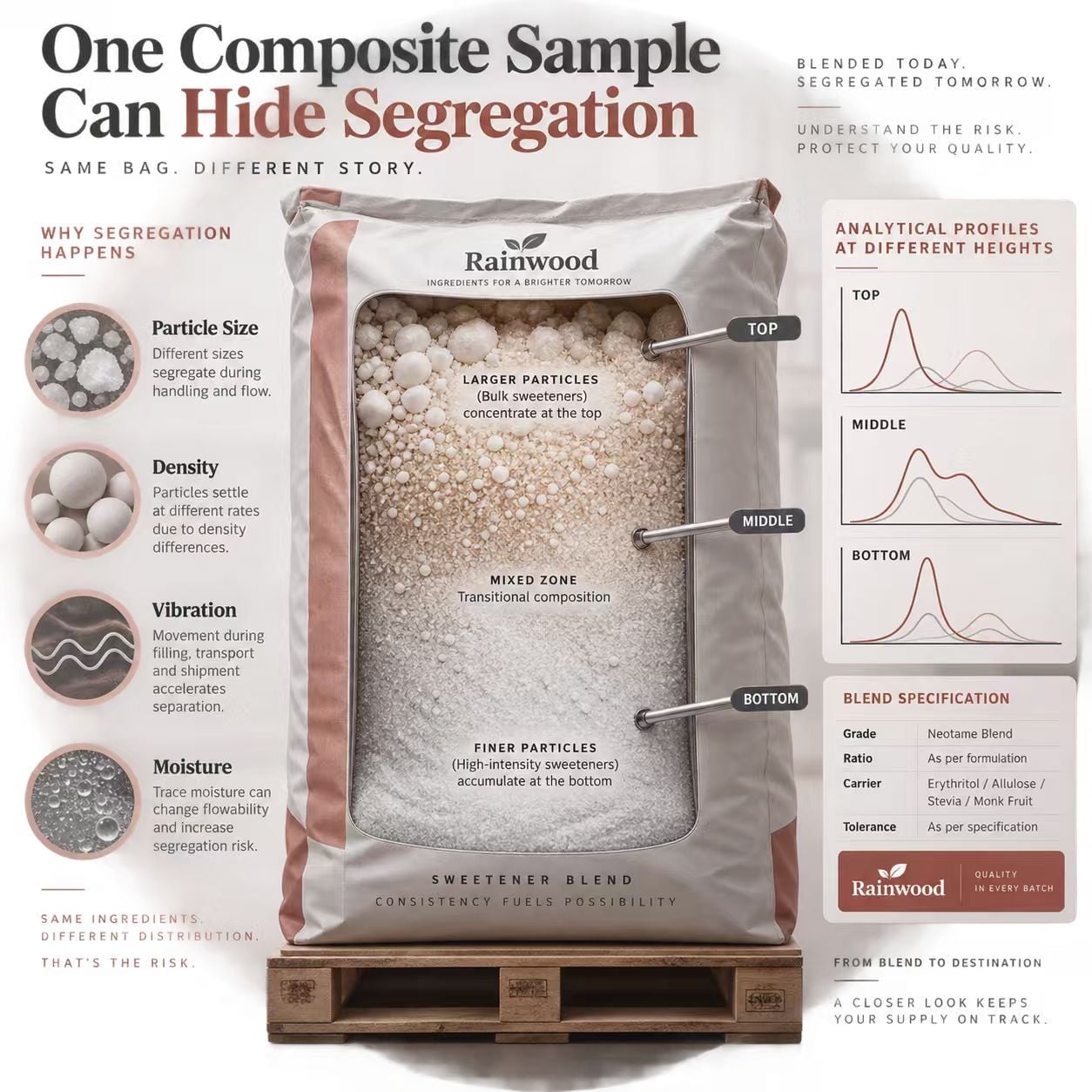
Different densities and particle sizes can separate during blending, bag filling, vibration, and shipment. The top sample may contain more of one sweetener; the bottom sample may contain more of another. This matters when neotame represents a tiny fraction of the blend.
Test:
- homogeneity from multiple sampling locations;
- bulk and tapped density;
- particle-size compatibility;
- vibration or transport stress;
- caking and moisture pickup;
- fill-weight and sweetener distribution;
- rework and reblending controls.
Do not let a single composite sample hide a concentration gradient. The sampling plan should be designed around the failure that matters to the product.
Label and exposure calculations include every component
U.S. regulation defines neotame’s use as a sweetener and flavor enhancer under specified conditions. [21 CFR 172.829](https://www.govinfo.gov/content/pkg/CFR-2020-title21-vol3/pdf/CFR-2020-title21-vol3.pdf) does not answer the label or maximum-use questions for every co-sweetener.
The EU uses E 961 for neotame and has separate rules for other sweeteners and polyols. FDA and EFSA documents must not be mixed into one “global approval” sentence. The finished serving, carrier, and market determine the practical compliance review.
Calculate:
- neotame per serving;
- each co-sweetener per serving;
- calorie and carbohydrate contribution;
- polyol or extract labeling;
- relevant exposure assumptions;
- claim wording permitted in the target market.
Read the neotame ADI and market-file guide before finalizing a blend label.
Evidence for one ingredient does not prove the blend
A neotame safety or sensory study may not support a product containing neotame plus erythritol, allulose, stevia, and monk fruit. The dose, matrix, consumer exposure, taste, and tolerance can all change.
Build the evidence chain:
| Layer | Question |
|---|---|
| Ingredient | Which exact grades are used? |
| Ratio | Is the blend controlled within tolerance? |
| Serving | How much of each component is consumed? |
| Matrix | Was the evidence generated in the same product format? |
| Endpoint | Sensory, stability, exposure, or health claim? |
| Market | Is the wording permitted in the target country? |
How RainwoodBio can support blend development
RainwoodBio’s public OEM materials describe custom formulation and multiple formats as company-published capabilities. They do not prove a specific blend ratio, extract standardization, batch uniformity, or market authorization.
Ask RainwoodBio for:
- a formula brief and benchmark comparison;
- exact component grades and ratio tolerance;
- homogeneity and sampling plan;
- label and serving calculation;
- powder, beverage, gummy, or tablet feasibility;
- MOQ, cost-per-serving, packaging, and change-control terms.
Use the custom neotame blend feasibility review to keep the sensory, physical, and regulatory decisions in one project file.
The approval gate
Before ordering, confirm:
1. Every component and grade is named.
2. The ratio and carrier are controlled.
3. The blend remains uniform in storage and transport.
4. The finished sensory target is met.
5. Label, exposure, and claims include every component.
6. The test methods fit the blend and finished matrix.
Request a neotame blend formula and evidence review. Send RainwoodBio the target sweetness, benchmark, formula, serving, market, package, cost target, quantity, and desired claims so the team can identify the blend controls before artwork is printed.
Frequently asked questions
1.Is adding stevia or monk fruit always better than using more neotame?
No. It depends on taste, cost, label, standardization, and evidence. Run a controlled sensory and stability comparison.
2.Can one assay number prove the whole blend is correct?
No. Component identity, ratio, standardization, homogeneity, and finished serving need separate controls.
3.Does a pure-neotame study support a multi-sweetener claim?
Not automatically. Match the evidence to the exact blend, dose, product, population, endpoint, and market.
References
- U.S. 21 CFR 172.829: https://www.govinfo.gov/content/pkg/CFR-2020-title21-vol3/pdf/CFR-2020-title21-vol3.pdf
- FDA Neotame information: https://www.fda.gov/food/food-additives-petitions/aspartame-and-other-sweeteners-food
- EFSA neotame re-evaluation: https://efsa.onlinelibrary.wiley.com/doi/10.2903/j.efsa.2025.9480
- RainwoodBio OEM service: https://www.rainwoodbio.com/oem
This article is for international B2B procurement and educational purposes. Blend composition, sensory performance, exposure, safety, labelling, claims, and regulatory requirements must be confirmed for the exact formula, finished lot, and destination market.