 EN
EN

Meta title: Neotame vs Aspartame, Sucralose, or Stevia: Test Stability
Meta description: “More stable” is not a universal sweetener claim. Compare neotame, aspartame, sucralose, and stevia in the exact pH, heat, matrix, and shelf-life conditions.
The supplier says neotame is “more stable than aspartame.” Another says sucralose is the safer choice. A third sends a stevia beverage sample that tastes fine after one day.
The buyer chooses a sweetener by a comparison sentence. The production team later discovers that the real formula uses a different pH, heat load, storage time, and flavor system.
“More stable” is not a product specification. It is a hypothesis that must be tested in the finished matrix.
FDA describes neotame as heat stable and approved as a general-purpose sweetener and flavor enhancer in foods except meat and poultry under specified conditions. [FDA’s sweetener information](https://www.fda.gov/food/food-additives-petitions/aspartame-and-other-sweeteners-food) is useful regulatory context, but it does not prove identical behavior in every product.
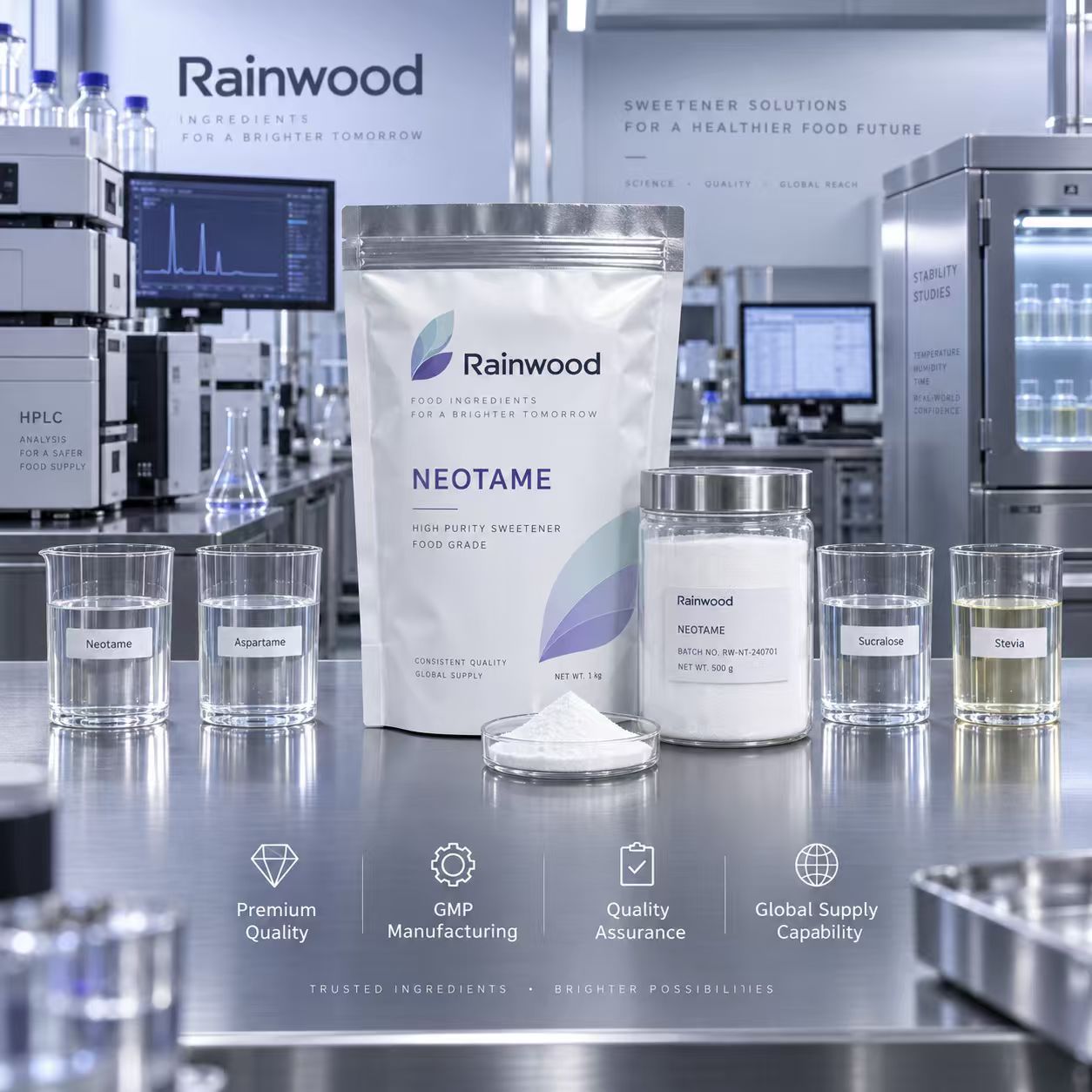
Review the RainwoodBio neotame powder product context, then compare sweeteners under the process and storage conditions your customer will actually use.
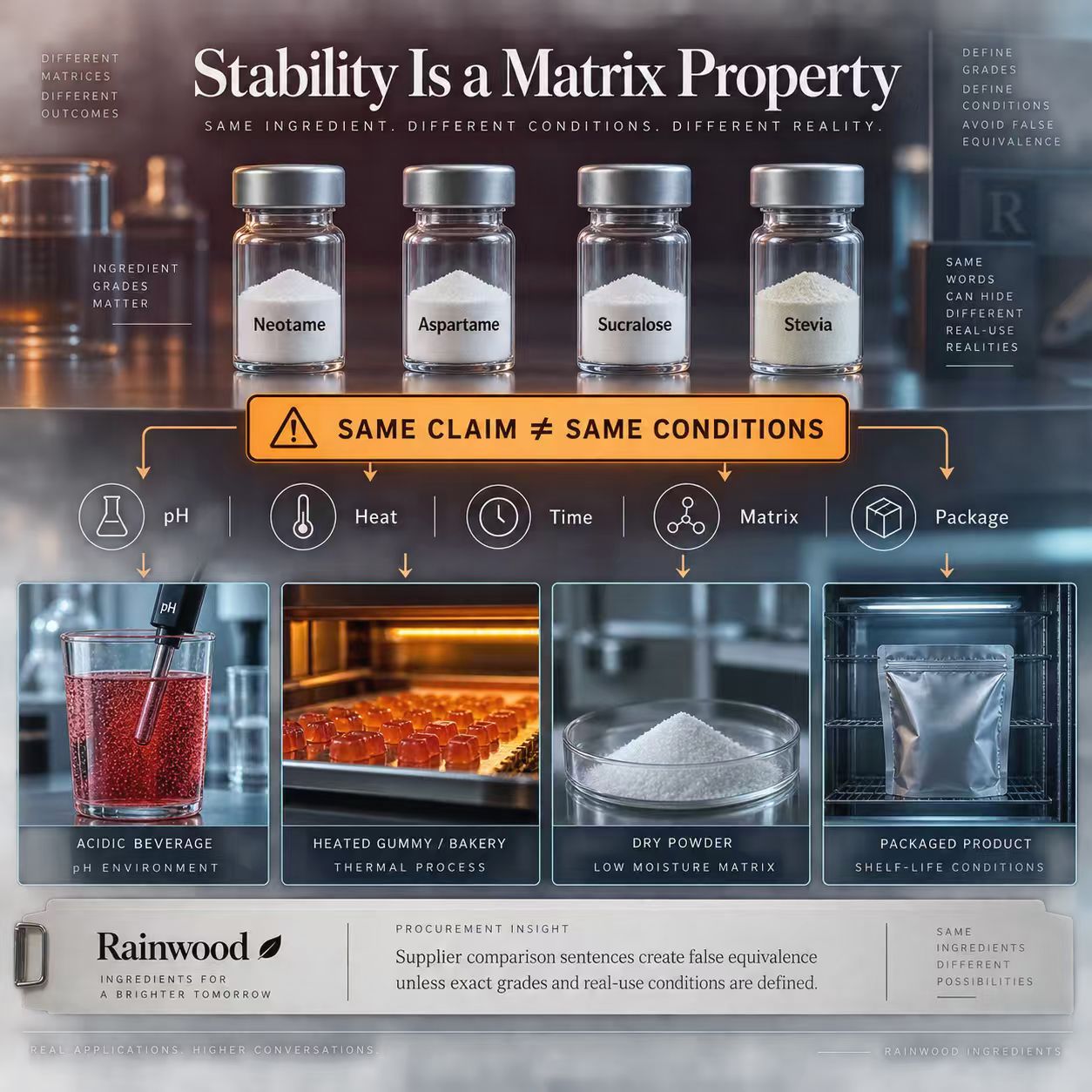
Stability is a matrix property
The chemical stability of a sweetener depends on pH, temperature, water, time, oxygen, light, catalysts, packaging, and co-ingredients. A dry powder stored at room temperature is not the same system as an acidic beverage held at 30°C or a baked product exposed to high heat.
EFSA’s 2025 re-evaluation reports that neotame stability is pH-, temperature-, and time-dependent, with higher degradation at extreme pH and higher temperatures. It also summarizes studies in dairy and other food matrices. [The EFSA opinion](https://pmc.ncbi.nlm.nih.gov/articles/PMC12231243/) makes the key point: a stability claim needs conditions, not an adjective.
Read the **neotame beverage stability guide** **[INTERNAL LINK -> Neotame Beverage Blog]** before approving a sweetener based on a room-temperature powder test.
Comparing four sweeteners without creating false equivalence
Neotame
Neotame is a high-intensity sweetener with a very small use level. Its stability and sensory performance depend on the formulation. The dose, carrier, and analytical sensitivity are central procurement questions.
Aspartame
Aspartame has its own identity, use conditions, degradation pathways, and phenylalanine labeling considerations. A supplier’s statement that neotame is more stable does not transfer aspartame’s full regulatory or sensory file to neotame.
Sucralose
Sucralose has different chemistry, use levels, and market rules. A sucralose reference product cannot prove that a neotame formulation will deliver the same sweetness onset, aftertaste, or long-term stability.
Steviol glycosides
Stevia products vary by glycoside composition, purity, carrier, and standardization. A comparison to “stevia” without identifying the exact grade is not analytically useful.
Use the neotame blend comparison checklist to define the exact materials before comparing them.
The test design buyers should request
Set a comparison matrix that uses the same product base and target sweetness:
| Variable | Test levels |
|---|---|
| pH | Actual target plus justified stress range |
| Temperature | Processing, storage, and transport conditions |
| Time | Release, midpoint, and claimed shelf life |
| Matrix | Final beverage, gummy, bakery, tablet, or powder |
| Sweetness | Sensory-normalized concentration |
| Packaging | Commercial barrier and seal |
| Measurements | Assay, degradation products, color, taste, pH, physical stability |
Do not change five variables at once and then call the result a stability conclusion. If the test is exploratory, label it exploratory.
Stability testing and sensory testing answer different questions
An analytical assay can show how much neotame remains. It may not show whether the consumer detects a taste change. Sensory testing can reveal a problem before the assay reaches a regulatory limit, but it is not a substitute for quantification.
Use both where the product risk justifies it:
- chemical assay and related-substance profile;
- pH and water activity where relevant;
- color and clarity;
- sweetness onset and aftertaste;
- package integrity;
- active and flavor stability;
- microbial and physical stability for the full product.
Keep the sample, storage condition, test date, method, and lot linked. A supplier’s general stability statement cannot replace evidence from your formula and package.
When comparing alternatives, normalize the sweetness target and the sensory method. Otherwise the “more stable” sample may simply contain a different concentration or masking system. Keep the benchmark, preparation instructions, storage history, and evaluation panel consistent across the comparison.
“Heat stable” still needs a heat history
Neotame can perform better than aspartame in some applications, but the exact result depends on the temperature profile, moisture, pH, exposure time, and matrix. A 10-second high-temperature step may create a different result from 30 minutes in a holding tank or a slow bake.
Record:
- maximum temperature;
- time at temperature;
- heating and cooling rate;
- pH before and after heating;
- water content and solids;
- contact with proteins, reducing sugars, acids, or minerals;
- packaging and post-process storage.
Read the neotame baking and gummy process guide before using “heat stable” as a blanket release criterion.
How RainwoodBio can support a comparison trial
RainwoodBio’s public neotame page describes applications across beverages, baked goods, confectionery, and sweetener blends as company-published product context. It does not establish that the proposed neotame outperforms every alternative in your formula.
Ask RainwoodBio for:
- exact grades and current specifications;
- side-by-side samples at sensory-equivalent sweetness;
- pH and temperature trial conditions;
- assay and degradation testing options;
- commercial-package stability plan;
- cost per verified serving and change-control terms.
Use the sweetener comparison and formula feasibility review to move from marketing comparison to project evidence.
The approval gate
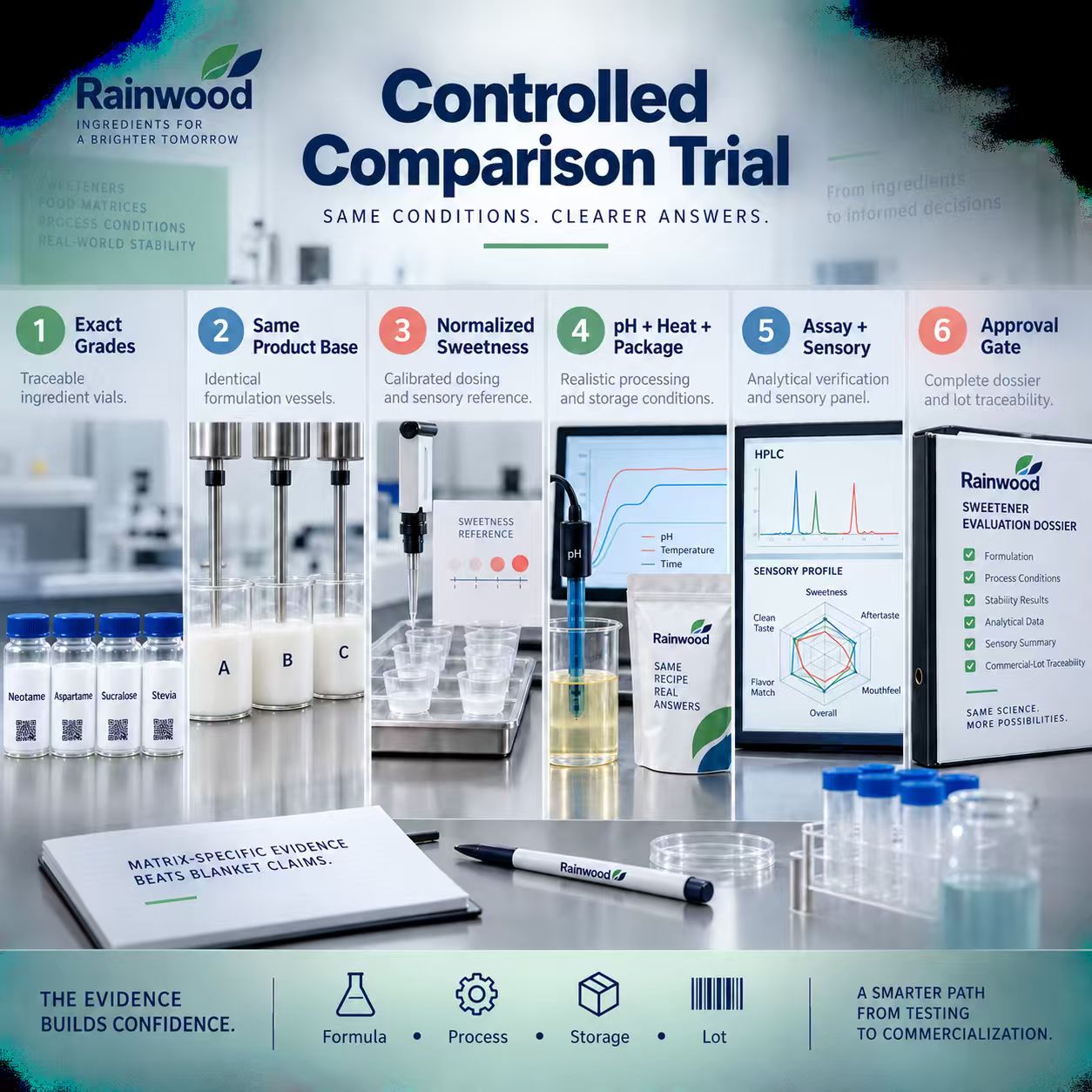
Approve a “more stable” claim only when:
1. The compared materials are exact grades and forms.
2. The finished matrix and package are the same.
3. pH, heat, time, and storage reflect the real use.
4. Analytical and sensory endpoints are defined.
5. The result is traceable to the commercial lot.
6. The label and claim wording are permitted in the target market.
Request a neotame stability-comparison and evidence revie. Send RainwoodBio the current sweetener, formula, pH, heat process, package, stability claim, target market, quantity, and timeline so the team can design a relevant comparison.
Frequently asked questions
1.Is neotame always more stable than aspartame?
No. Stability depends on pH, temperature, time, moisture, matrix, and packaging. Compare the exact finished products under the intended conditions.
2.Can a supplier’s powder stability study prove beverage shelf life?
No. The beverage introduces water, pH, processing, co-ingredients, and package effects. Finished-product stability is required.
3.Is stevia a single comparable ingredient?
No. Steviol glycoside composition, standardization, carrier, and extraction affect taste and stability. Name the exact grade before comparing.
References
- FDA neotame and other sweeteners: https://www.fda.gov/food/food-additives-petitions/aspartame-and-other-sweeteners-food
- EFSA 2025 neotame re-evaluation (PMC): https://pmc.ncbi.nlm.nih.gov/articles/PMC12231243/
- Food Standards Agency simultaneous sweetener method: https://www.food.gov.uk/research/chemical-hazards-in-food-and-feed/method-development-for-the-simultaneous-determination-of-sweeteners-including-neotame-and-steviol-glycosides
- RainwoodBio neotame powder page: https://www.rainwoodbio.com/custom-neotame-powder
This article is for international B2B procurement and educational purposes. Stability, sensory performance, degradation, safety, labelling, claims, and regulatory requirements must be confirmed for the exact sweetener, formula, package, lot, and destination market.