 EN
EN

Meta title: Neotame in Beverages: pH, Pasteurization, Shelf Life
Meta description: Neotame beverage performance depends on pH, heat, storage time, co-ingredients, and packaging. Build a finished-product stability plan before launch.
The bench beverage tastes clean at day one. After pasteurization and two months in a warm warehouse, sweetness has shifted and the brand is investigating a complaint.
The original test did not fail because it was careless. It failed because it did not model the product’s actual pH, heat, storage, and packaging history.
Neotame can be useful in beverage systems because it delivers intense sweetness at a low use level. That same low use level makes the finished product sensitive to dosing, recovery, and analytical interpretation. Stability is not a single number. It is the result of the whole beverage system.
Use the RainwoodBio neotame powder information, then qualify the sweetener in the exact beverage and process before approving commercial artwork.
pH is a design variable, not a footnote
EFSA’s 2025 review describes neotame stability as dependent on pH, temperature, and time, with higher degradation at extreme pH. It reports relative stability in an acidic range but still emphasizes the conditions of use. [The EFSA evaluation](https://pmc.ncbi.nlm.nih.gov/articles/PMC12231243/) supports a practical rule: record the beverage pH and do not generalize from another matrix.
Measure pH at:
- water and syrup preparation;
- after acid and flavor addition;
- before pasteurization;
- after cooling;
- at release;
- during stability storage.
If pH drifts during storage, the neotame result and sensory profile may drift with it.
Read the neotame stability comparison guide before selecting a sweetener from a static supplier table.
Pasteurization changes the exposure profile
Record the complete heat history rather than writing “pasteurized.” Two products with the same maximum temperature can have different outcomes if one has a longer hold, slower cooling, or a hot-fill step.
The beverage protocol should capture:
- preheat temperature;
- hold time;
- maximum temperature;
- pressure or carbonation condition;
- cooling rate;
- fill temperature;
- package headspace;
- oxygen and light exposure.
Test neotame before and after processing and after storage. If the formulation uses proteins, minerals, vitamin premixes, fruit acids, or other sweeteners, include them in the trial.
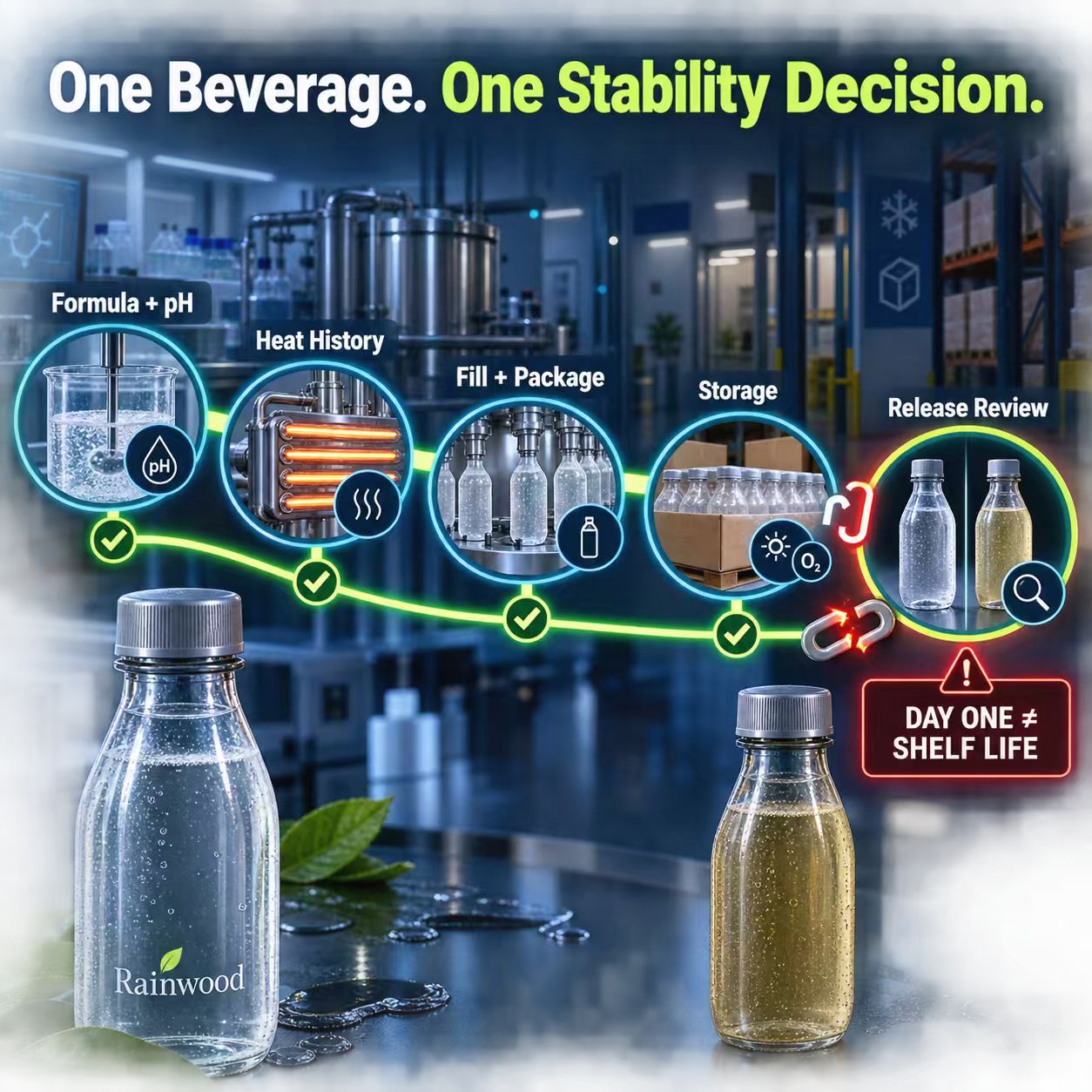
A clean day-one sample proves very little
Use a time-point plan that includes release, accelerated or stress storage where justified, and the intended shelf-life endpoint. Evaluate both chemistry and consumer experience:
| Endpoint | Why it matters |
|---|---|
| Neotame assay | Confirms remaining sweetener under the method |
| Related substances | Flags degradation or process changes |
| pH | Explains drift and supports interpretation |
| Sweetness | Detects consumer-visible change |
| Aftertaste | Shows flavor balance after aging |
| Color/clarity | Identifies co-ingredient or package effects |
| Microbiology | Confirms the beverage remains safe and stable |
| Package integrity | Connects stability to the commercial container |
Keep a retain sample and record the lot, bottle, storage condition, test method, and date for every result.
Neotame assay in a beverage is a matrix question
The JECFA monograph provides an HPLC method for neotame in the additive specification. [The JECFA method](https://www.fao.org/fileadmin/user_upload/jecfa_additives/docs/Monograph1/Additive-294.pdf) may not be directly transferable to a colored, acidic, carbonated, protein-containing, or multi-sweetener beverage without checking extraction, recovery, selectivity, and detection limits.
Ask the laboratory:
- How are flavor oils, colors, acids, and other sweeteners separated?
- Is recovery acceptable at the actual use level?
- Are degradation products resolved?
- Does filtration or sample storage change the result?
- Is the method suitable for a carbonated or viscous matrix?
A lab result without matrix suitability can create false confidence.
Use the commercial water, flavor, acidulant, vitamin premix, color, and preservative system in the trial. Changing from deionized laboratory water to mineral-containing process water can change clarity, taste, and analytical recovery. Record the lot of every major co-ingredient so a later reformulation does not silently invalidate the stability file.
If the beverage is carbonated, also record the carbonation level, fill pressure, and closure system. A sweetener result from a still drink may not explain a carbonated product complaint. The stability file should describe the package a consumer buys, not only the liquid that was prepared in the laboratory.
Packaging can determine the real shelf life
Light, oxygen, moisture, and temperature can interact with the beverage and its sweetener. Select the bottle, cap, liner, pouch, or can based on the complete stability risk.
Define:
- light barrier;
- oxygen exposure and headspace;
- seal and closure integrity;
- storage temperature;
- shipping and warehouse conditions;
- opening and reclosure instructions;
- retained-sample plan.
Do not transfer the raw powder’s “two-year shelf life” directly to a finished beverage. Water, pH, heat, and package create a different product.
The claim and label risk
U.S. regulation permits neotame as a sweetener and flavor enhancer under the conditions in 21 CFR 172.829. [The regulation](https://www.govinfo.gov/content/pkg/CFR-2020-title21-vol3/pdf/CFR-2020-title21-vol3.pdf) does not automatically approve a finished beverage claim such as “zero calorie,” “diabetic-friendly,” or “no aftertaste.” Review the full formula and market rules.
In the EU, neotame is authorised as E 961 in specified categories. The buyer should verify the use category, maximum level, ingredient declaration, and current specification before finalizing the label.
How RainwoodBio can support a beverage project
RainwoodBio’s public product and OEM pages describe powder, beverage, and private-label format support as company-published context. They do not prove stability in your exact pH, heat process, package, or commercial lot.
Ask RainwoodBio for:
- a beverage sample at the target sweetness;
- pH and pasteurization trial design;
- assay and degradation testing options;
- package and storage recommendations;
- sensory and stability checkpoints;
- MOQ, lead time, and change-control conditions.
Use the neotame beverage OEM feasibility review before the label and production schedule are fixed.
The beverage release gate
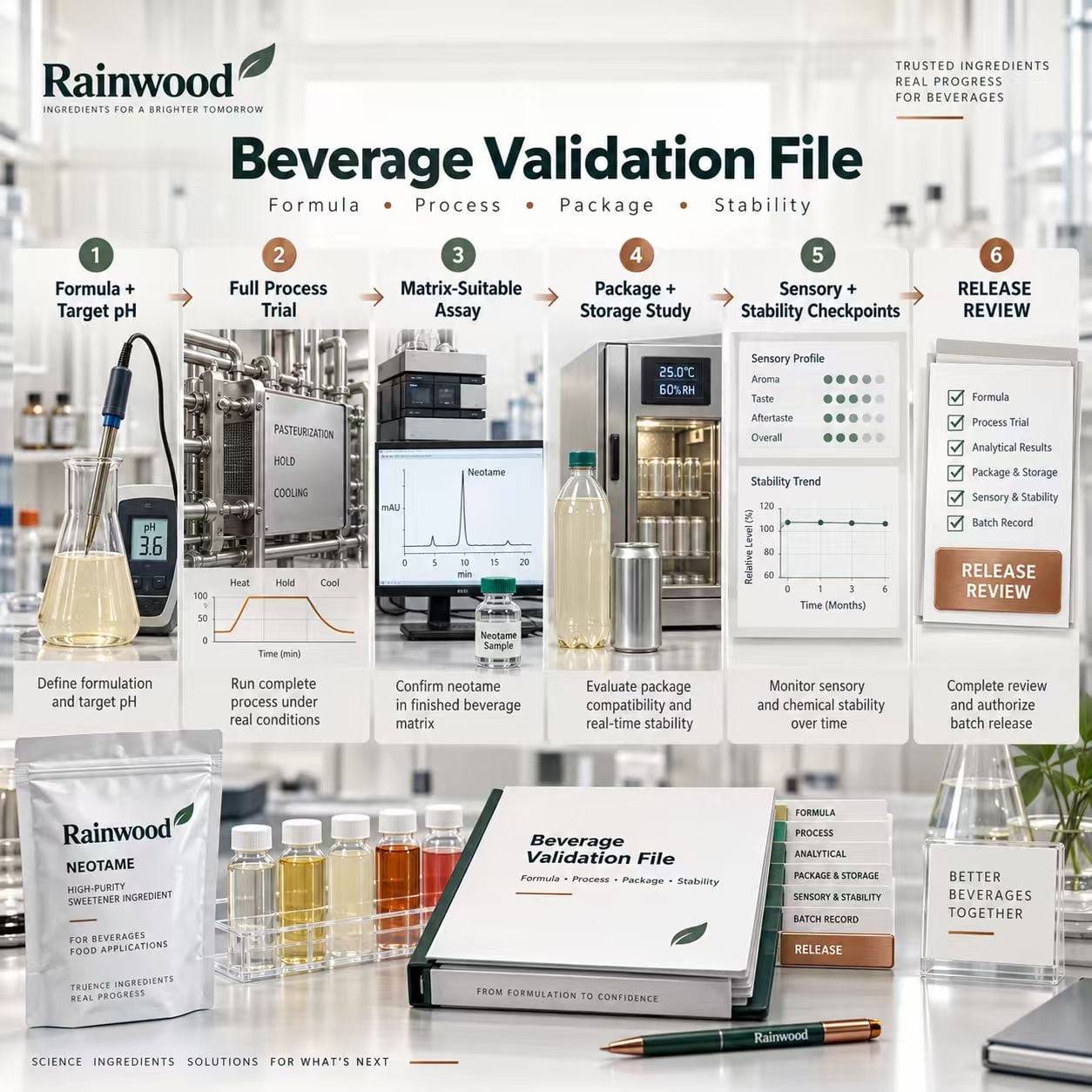
Approve the commercial formula only after:
1. pH and heat history are defined.
2. The analytical method is suitable for the beverage matrix.
3. Assay, related substances, sensory, and package data meet the target.
4. Stability covers the intended storage and transport.
5. Label and claims match the destination market.
6. The lot and finished batch are traceable.
Request a neotame beverage stability and label review. Send RainwoodBio the formula, pH, process temperatures, package, serving, target market, quantity, and shelf-life claim so the team can identify the evidence gaps before production.
Frequently asked questions
1.Is neotame stable in every acidic beverage?
No. Stability depends on pH, temperature, time, co-ingredients, and packaging. Test the actual beverage.
2.Can the raw-material HPLC method be used for the finished drink?
Only after checking extraction, recovery, selectivity, and detection at the finished-product concentration.
3.Does pasteurization guarantee a stable neotame beverage?
No. Pasteurization is one heat condition. Storage, pH, oxygen, light, and the package also affect the result.
References
- EFSA 2025 neotame re-evaluation: https://pmc.ncbi.nlm.nih.gov/articles/PMC12231243/
- FAO/JECFA neotame method: https://www.fao.org/fileadmin/user_upload/jecfa_additives/docs/Monograph1/Additive-294.pdf
- U.S. 21 CFR 172.829: https://www.govinfo.gov/content/pkg/CFR-2020-title21-vol3/pdf/CFR-2020-title21-vol3.pdf
- RainwoodBio OEM service: https://www.rainwoodbio.com/oem
This article is for international B2B procurement and educational purposes. Beverage stability, assay, degradation, safety, labelling, claims, and regulatory requirements must be confirmed for the exact formula, process, package, lot, and destination market.