 EN
EN

Meta title: Neotame in Baking and Gummies: Heat-Stable Is Not Proof
Meta description: Neotame’s heat-stable positioning does not guarantee baking or gummy performance. Test temperature, moisture, pH, residence time, texture, and shelf life.
The product brief says “neotame is heat stable, so it can go into any baked good or gummy.” The first production run comes out with a different sweetness profile and a package that does not hold the target texture.
The problem is the word “any.”
Heat stability is a bounded property. Baking and gummy processes expose neotame to temperature, time, water, acids, proteins, reducing sugars, minerals, and cooling conditions. The finished product also needs to survive storage and distribution.
FDA describes neotame as heat stable and suitable for use in baked goods under its U.S. authorization. [FDA’s overview](https://www.fda.gov/food/food-additives-petitions/aspartame-and-other-sweeteners-food) is useful context, but it does not guarantee your process, formula, or shelf life.
Review the RainwoodBio neotame powder context, then build a format-specific pilot before using “heat stable” as the release argument.
Baking and gummies create different heat histories
Baking
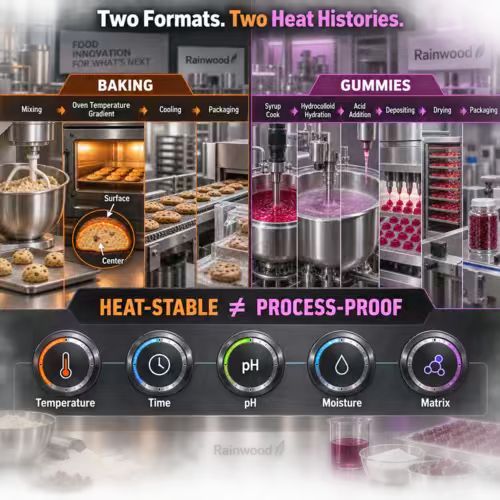
An oven exposes the product to a temperature gradient. The surface, center, and cooling stage may see different moisture and heat. The formula may contain flour, proteins, fats, acids, reducing sugars, minerals, and flavors that interact with sweetness and stability.
Gummies
A gummy process may involve syrup concentration, hydrocolloid hydration, vacuum, acid addition, deposit temperature, cooling, drying, oiling, and package storage. A short laboratory cook may not reproduce the residence time or surface exposure of a commercial kettle.
The same neotame powder can behave differently in these two formats. Qualify the exact matrix.
Read the neotame stability-comparison guide before borrowing a result from another sweetener or another product category.
“Heat stable” does not mean “no loss”
EFSA’s 2025 re-evaluation describes neotame stability as dependent on pH, temperature, and time, with higher degradation at extreme pH and higher temperatures. It summarizes studies in different food matrices, including heat-treated dairy. [The EFSA review](https://pmc.ncbi.nlm.nih.gov/articles/PMC12231243/) supports a narrower statement: neotame may be suitable for certain heat processes when the exact conditions are validated.
Record:
- maximum and average product temperature;
- residence time at each temperature;
- water content and solids;
- pH before and after processing;
- cooling rate;
- contact with acids, proteins, and reducing sugars;
- packaging and storage temperature.
Do not convert a supplier’s broad application list into a finished-product guarantee.
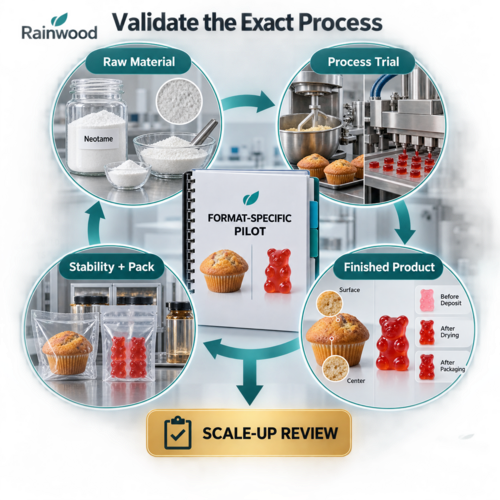
For a baked good, compare center and surface samples because water loss and heat exposure can differ. For a gummy, compare the syrup before depositing, pieces after drying, and pieces after packaging. These sampling points can reveal whether a sweetness shift is caused by the neotame itself, a concentration gradient, moisture migration, or a process change.
Keep the pilot material and the commercial material under the same specification code. If the supplier changes the particle size, carrier, source, or premix ratio between development and production, repeat the relevant process and stability checks. The fastest launch can become the slowest one when the “same” ingredient is changed without notice.
The sensory profile can change even when assay passes
The finished product may show a different sweetness onset, aftertaste, or intensity because heat changes the matrix and other ingredients. In a gummy, drying and moisture migration can alter perception. In a baked good, the sweetener may be concentrated in the surface or distributed differently after water loss.
Use a sensory protocol that records:
- sweetness onset and peak;
- aftertaste and persistence;
- flavor interactions;
- piece-to-piece or bite-to-bite variation;
- texture and mouthfeel;
- color and aroma;
- sensory results after storage.
An analytical result and a taste panel answer different questions. Use both when a consumer complaint would be expensive.
A pilot plan for baking and gummy formats
Raw material
Confirm identity, assay basis, related substances, water, appearance, and lot traceability. If a premix is used, confirm carrier ratio and homogeneity.
Process trial
Reproduce the intended batch size, addition sequence, heating profile, hold time, cooling, deposit, bake, or drying step. Record all deviations from commercial equipment.
Finished product
Test neotame or the relevant sweetness system, texture, color, water activity, moisture, package integrity, and sensory profile. Retain samples from different positions in the run.
Stability
Store at intended and justified stress conditions. Check assay, related substances, taste, color, texture, water activity, and package performance through the claimed shelf life.
Use the neotame gummy and baking format checklist to keep the raw-material and finished-product tests connected.
A raw COA cannot prove a gummy or baked product
The U.S. specification includes neotame assay and related substances, but the finished product can introduce extraction, matrix, and recovery issues. [21 CFR 172.829](https://www.govinfo.gov/content/pkg/CFR-2020-title21-vol3/pdf/CFR-2020-title21-vol3.pdf) should be used as a raw-material reference, not as a finished-gummy release specification.
Ask the laboratory whether the method is suitable for:
- proteins and gelatin;
- pectin, starch, or hydrocolloids;
- fats and oils;
- acids and minerals;
- colors and flavors;
- low concentration in a large serving;
- heat-processed and aged samples.
How RainwoodBio can support the process trial
RainwoodBio’s public OEM materials describe custom gummies, tablets, powders, and other formats as company-published capabilities. They do not prove that a specific neotame formula has passed your process or that a public certificate covers your finished batch.
Ask RainwoodBio for:
- a sample using the exact intended format;
- heat and residence-time trial conditions;
- sensory, texture, and stability checkpoints;
- package recommendations;
- batch and change-control documentation;
- MOQ, lead time, and production scale-up assumptions.
Use the neotame baking and gummy OEM feasibility review to identify the process gate before purchasing a large quantity.
The approval gate
Do not approve a “heat-stable neotame” claim until:
1. The exact grade and form are defined.
2. The commercial heat history is reproduced.
3. Assay and degradation testing fit the matrix.
4. Sensory, texture, color, and water activity meet the target.
5. Packaging and shelf life are supported.
6. Label and claims match the destination market.
Request a neotame baking/gummy process and stability review. Send RainwoodBio the formula, target dose, hydrocolloid or bakery base, processing temperature, hold time, package, market, quantity, and shelf-life claim so the team can map the required validation.
Frequently asked questions
1.Does FDA’s heat-stable description mean neotame never degrades in baking?
No. It describes a regulatory and general-use context. Degradation depends on the exact temperature, time, pH, moisture, matrix, and storage conditions.
2.Can I use a beverage stability study for a gummy?
No. The matrix, heat history, water activity, and package differ. Use evidence from the actual finished format.
3.Is a taste test enough for release?
Not when identity, dose, stability, or regulatory documentation matters. Sensory data should be combined with fit-for-purpose analytical and process evidence.
References
- FDA neotame overview: https://www.fda.gov/food/food-additives-petitions/aspartame-and-other-sweeteners-food
- EFSA neotame re-evaluation: https://pmc.ncbi.nlm.nih.gov/articles/PMC12231243/
- U.S. 21 CFR 172.829: https://www.govinfo.gov/content/pkg/CFR-2020-title21-vol3/pdf/CFR-2020-title21-vol3.pdf
- RainwoodBio OEM service: https://www.rainwoodbio.com/oem
This article is for international B2B procurement and educational purposes. Heat performance, assay, degradation, sensory quality, texture, safety, labelling, claims, and regulatory requirements must be confirmed for the exact formula, process, finished lot, and destination market.