 EN
EN

Meta title: Neotame and Phenylalanine: The PKU Label Question
Meta description: Neotame is related to aspartame, but the phenylalanine and PKU label analysis is different. Learn what importers must verify before making a label decision.
The draft label team sees “phenylalanine” in the chemical name and assumes the product needs the same warning used for aspartame. Another team says neotame is automatically safe for every consumer. Both conclusions are too broad.
Neotame contains an aspartyl-phenylalanine structure, but its metabolism, use level, regulatory history, and label treatment must be assessed separately from aspartame. The correct commercial question is not “does the name look similar?” It is “what does the applicable market require for this exact ingredient, serving, formula, and consumer communication?”
Review the RainwoodBio neotame product page, then build a documented PKU and phenylalanine review for the destination market.
Neotame is not simply aspartame with a new label
FDA identifies neotame as a separate food additive and states that it is approved as a sweetener and flavor enhancer under specified conditions. [FDA’s sweetener information](https://www.fda.gov/food/food-additives-petitions/aspartame-and-other-sweeteners-food) distinguishes the two substances and notes that the FDA review of neotame included extensive safety data.
The U.S. regulation defines neotame by its own chemical name and CAS number. [21 CFR 172.829](https://www.govinfo.gov/content/pkg/CFR-2020-title21-vol3/pdf/CFR-2020-title21-vol3.pdf) should be used instead of importing aspartame’s specification or label assumptions into a neotame purchase.
The phenylalanine question is dose-dependent
EFSA’s 2025 re-evaluation states that phenylalanine is only a minor metabolite of neotame, less than 1% of the dose, and assessed the potential exposure at its proposed ADI. [The EFSA opinion](https://efsa.onlinelibrary.wiley.com/doi/10.2903/j.efsa.2025.9480) does not mean a buyer can write “safe for PKU” on a product without checking the target market and claim rules.
JECFA’s evaluation also discussed the applicability of the ADI to individuals with phenylketonuria because phenylalanine formation from normal neotame use was not considered significant in relation to the condition. [The WHO JECFA record](https://apps.who.int/food-additives-contaminants-jecfa-database/Home/Chemical/5107) is authoritative context, not a substitute for local label review.
The distinction is important: a regulator’s safety assessment is not the same as a brand’s permission to make a medical or disease-management claim.
Read the neotame regulatory-file comparison before finalizing a warning, omission, or “PKU safe” marketing statement.
Why the raw-material name is not enough
The finished exposure depends on:
- pure neotame or premix form;
- serving size and number of servings;
- neotame concentration in the product;
- other aspartame-containing or protein ingredients;
- target market and product category;
- consumer population and intended use;
- local warning and claim rules.
If a product uses a sweetener blend, the PKU review must address every relevant component. A conclusion about pure neotame cannot automatically be applied to an aspartame-containing blend.
Use the pure-neotame versus premix review to ensure the commercial form matches the label analysis.
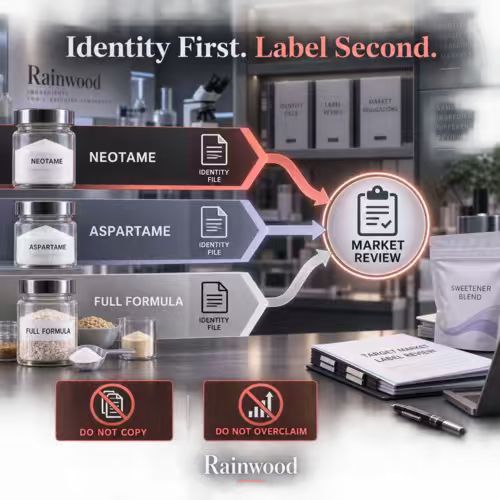
The documents a buyer should request
For a responsible label decision, request:
1. Exact ingredient identity and CAS number.
2. Manufacturer and production site.
3. Current specification and related-substance limits.
4. Neotame assay and moisture basis.
5. Product form, carrier, and blend ratio.
6. Intended use and expected serving exposure.
7. Market-specific regulatory assessment.
8. Proposed ingredient declaration and warning language.
9. Evidence supporting any PKU, phenylalanine, or medical statement.
10. Change-control process for source, form, or recipe.
Keep a written record of who approved the label and which version of the regulation or guidance was used. The answer may change if the formula, market, serving, or sweetener blend changes.
Avoid the two dangerous extremes
Extreme 1: “It is related to aspartame, so it needs exactly the same warning.”
This can create an inaccurate label, unnecessary consumer alarm, or a market-specific non-compliance issue. Review the exact substance and applicable law.
Extreme 2: “It produces negligible phenylalanine, so it is safe for every person and every claim.”
This overreaches the evidence. It turns a regulatory safety assessment into a consumer guarantee and may drift into a medical claim.
The professional position is narrower: verify the market rule, calculate the finished exposure, use the exact ingredient file, and keep marketing language within the evidence.
Also check the actual ingredient declaration. If the formula contains protein hydrolysates, aspartame, or another source of phenylalanine, a review limited to neotame is incomplete. If the product is sold as a tabletop packet or premix, the carrier and serving instructions can change the amount consumed. Record the formula version, serving instruction, and label approval date so a later supplier or carrier change triggers a new review.
For an importer, this record also helps customer-service teams answer questions without improvising. Give them the approved ingredient name, the permitted explanation, and the escalation path for medical questions. Do not ask a sales representative to interpret a PKU condition from a generic COA or a supplier’s marketing paragraph.
Keep medical questions with the responsible regulatory or healthcare professional. The supplier can provide identity, specification, serving, and document inputs; it should not promise a clinical outcome for an individual consumer.
How RainwoodBio can support the document review
RainwoodBio’s public neotame page provides company-published product context. It does not, on its own, establish a universal PKU label conclusion, finished-product exposure, or authorization in every market.
Ask RainwoodBio to provide or confirm:
- source and form of the proposed neotame;
- current COA and specification;
- premix or carrier composition;
- intended serving and format;
- available regulatory documents;
- proposed target-market label review;
- change-notification conditions.
Use the neotame compliance and label-gap assessment before printing packaging.
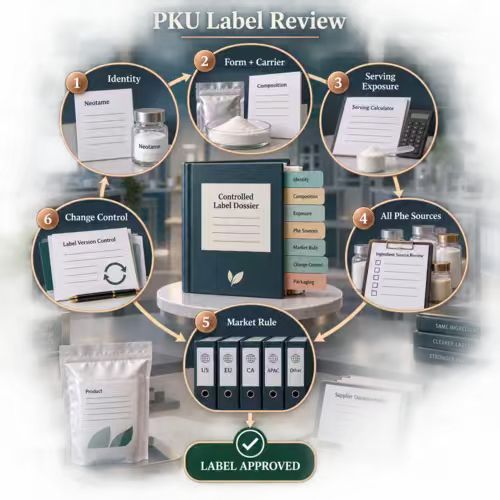
The label approval gate
Before launch, confirm:
1. The material is neotame, not aspartame or a mixed sweetener.
2. The finished serving exposure is calculated.
3. The target market’s rule is current and identified.
4. The ingredient declaration and warning are reviewed.
5. No disease, treatment, or universal safety claim appears in copy.
6. The documentation is linked to the actual supplier and lot.
Request a neotame phenylalanine and PKU label review. Send RainwoodBio the country, product category, formula, serving, sweetener blend, label draft, supplier dossier, and intended consumer language so the team can identify evidence gaps before the listing is published.
Frequently asked questions
1.Is neotame the same as aspartame?
No. They are separate substances with different identities, specifications, use conditions, and regulatory files.
2.Can a brand claim “safe for people with PKU”?
Do not assume that from a general safety assessment. Such wording requires market-specific regulatory and medical review and may be inappropriate as a consumer-facing claim.
3.Does a neotame COA answer the phenylalanine label question?
No. The COA supports raw-material identity and quality. The label decision also requires the formula, serving, market, and claim review.
References
- FDA aspartame and neotame information: https://www.fda.gov/food/food-additives-petitions/aspartame-and-other-sweeteners-food
- U.S. 21 CFR 172.829: https://www.govinfo.gov/content/pkg/CFR-2020-title21-vol3/pdf/CFR-2020-title21-vol3.pdf
- EFSA 2025 neotame re-evaluation: https://efsa.onlinelibrary.wiley.com/doi/10.2903/j.efsa.2025.9480
- WHO/JECFA neotame record: https://apps.who.int/food-additives-contaminants-jecfa-database/Home/Chemical/5107
- RainwoodBio neotame product page: https://www.rainwoodbio.com/custom-neotame-powder
This article is for international B2B procurement and educational purposes. PKU, phenylalanine, safety, warning, labelling, and health-claim decisions must be confirmed by qualified professionals for the exact ingredient, formula, serving, and destination market.