 EN
EN

Meta title: Neotame ADI: Why 2 or 10 mg/kg Depends on the Market
Meta description: JECFA and EFSA do not show one universal neotame number. Learn how importers build a market-specific ADI, use-level, label, and evidence dossier.
The supplier’s technical sheet says “ADI: 2 mg/kg body weight.” Your regulatory consultant sends the 2025 EFSA opinion, which establishes 10 mg/kg body weight for the EU assessment. A sales manager says the larger number proves the ingredient is globally approved.
That is how one number can create three different mistakes.
An ADI is a health-based guidance value within a specific evaluation framework. It is not a universal formula target, a finished-product serving recommendation, or a global market-access certificate. The buyer must identify which authority, date, product category, and use conditions apply.
Review the RainwoodBio neotame product information, then build a dossier that matches the customer’s destination market instead of copying the most favorable number.
Why the numbers differ
The WHO/JECFA database records an ADI of 0–2 mg/kg body weight for neotame based on a 2003 evaluation. [The JECFA record](https://apps.who.int/food-additives-contaminants-jecfa-database/Home/Chemical/5107) identifies neotame, INS 961, and the basis for that ADI.
EFSA’s 2025 re-evaluation established an ADI of 10 mg/kg body weight per day for the EU assessment and stated that it replaces the earlier EFSA ADI of 2 mg/kg. [The current EFSA opinion](https://efsa.onlinelibrary.wiley.com/doi/10.2903/j.efsa.2025.9480) also concluded that estimated dietary exposures did not exceed the new ADI under the assessed authorised uses and use levels.
The two numbers are not evidence that one authority is careless. They reflect different evaluations, datasets, reference points, uncertainty factors, and regulatory systems. A buyer should report them with their authority and date attached.
Read the neotame regulatory and label file guide before using an ADI number in marketing or formula instructions.
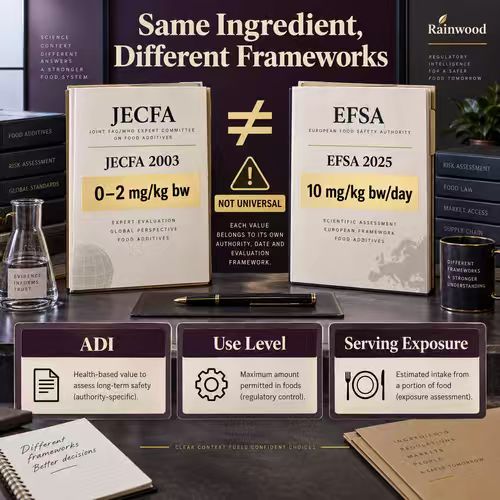
ADI is not the same as a permitted food-use level
The ADI applies to estimated human exposure over a lifetime. A food additive regulation may also set use levels by food category, good manufacturing practice, or intended technical effect. Those controls answer different questions.
For the United States, 21 CFR 172.829 permits neotame as a sweetener and flavor enhancer in foods generally except meat and poultry, under current good manufacturing practice and conditions of intended effect. [The U.S. regulation](https://www.govinfo.gov/content/pkg/CFR-2020-title21-vol3/pdf/CFR-2020-title21-vol3.pdf) does not tell a brand to dose every product up to the ADI.
For the EU, neotame is authorised as E 961 in specified categories under Regulation (EC) 1333/2008 and related specifications. The buyer must check the category, maximum level, and current consolidated rule for the exact food.
Use the neotame dose and exposure calculation checklist to keep the health-based value separate from the permitted formulation level.
Build the exposure calculation from the finished product
Use the actual finished formula:
`consumer exposure = neotame per serving × servings per day ÷ body weight`
Then consider:
- consumer-only versus population exposure;
- intended age group;
- multiple products containing neotame;
- pure powder or premix concentration;
- serving size and frequency;
- use in beverages, confectionery, bakery, supplements, or tabletop products;
- target country and food category.
A raw-material quote cannot answer exposure. A finished product containing a very small neotame dose may have low exposure, but the buyer still needs to know the actual concentration and serving.
Keep the calculation auditable. Record the body-weight assumption, serving frequency, use level, and any conservative exposure scenario. If the customer sells several products containing neotame, assess whether the market review expects combined exposure rather than treating each SKU as isolated. A single number without its assumptions is easy to copy and difficult to defend.
The dossier should show the authority, not just the number
For each target market, label the file:
| File field | Example question |
|---|---|
| Authority | JECFA, FDA, EFSA, or national regulator? |
| Date | Which evaluation or consolidated rule? |
| Identity | Does the file cover the exact neotame form? |
| Use | Which food categories and technical effect? |
| Level | GMP or numerical maximum? |
| Exposure | What serving and population assumptions? |
| Label | What ingredient name and warnings? |
| Claims | What language is permitted? |
| Evidence | Which source and limitation? |
If a supplier’s file says “global approval,” ask it to identify the exact legal basis for each market. Do not turn a marketing phrase into a customs or label decision.
The 2025 EFSA update changes the conversation, not every label
EFSA’s revised ADI is important for current EU regulatory work, but it does not automatically revise every national rule, product specification, or customer claim. Confirm how the European Commission and applicable national authorities have implemented the evaluation for your product category.
The EFSA opinion also recommends that the European Commission consider revising EU specifications. That is a reminder that safety evaluation and specification maintenance are separate regulatory processes.
Use the neotame specification and related-substance review to check whether the purchased material matches the market file.
How RainwoodBio can support a market-specific dossier
RainwoodBio’s public neotame page and OEM materials are company-published context. They do not establish universal authorisation, current use levels, or a finished-product claim in every market.
Ask RainwoodBio to prepare or confirm:
- exact source, form, and specification;
- current COA and test methods;
- target country and food category;
- serving and expected exposure;
- label and documentation questions;
- sample and finished-product testing;
- change-control and traceability records.
Use the target-market compliance assessment to convert conflicting numbers into a documented decision.
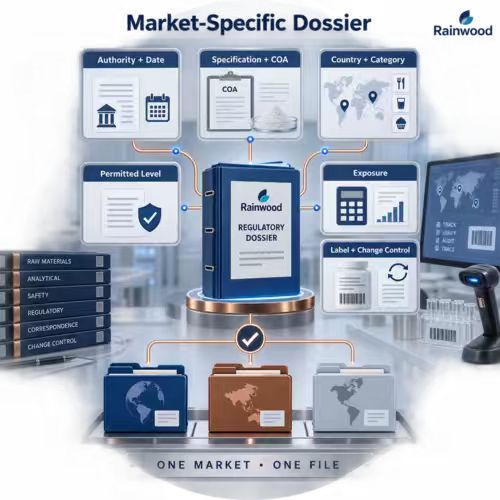
The approval gate
Do not approve a dossier until:
1. The authority and evaluation date are named.
2. ADI, use level, and serving exposure are kept separate.
3. The exact product category and country are confirmed.
4. Raw-material identity and specifications match the file.
5. Label and claims are reviewed for the finished product.
6. Any regulatory change triggers a controlled reassessment.
Request a neotame ADI and market-compliance review. Send RainwoodBio the target markets, formula, serving, consumer group, current supplier dossier, label draft, quantity, and launch schedule so the team can identify which number and which document actually apply.
Frequently asked questions
1.Is 10 mg/kg the worldwide neotame ADI now?
No. It is the ADI established by EFSA in its 2025 EU re-evaluation. JECFA’s record shows 0–2 mg/kg bw from its evaluation. Always name the authority and market.
2.Can a brand dose up to the ADI?
No. ADI is not a formulation target. Use levels, technical effect, food category, serving, and market rules still apply.
3.Does a current EFSA opinion replace a supplier’s COA?
No. It addresses safety evaluation. The COA proves—or fails to prove—the identity and quality of the purchased lot.
References
- WHO/JECFA neotame record: https://apps.who.int/food-additives-contaminants-jecfa-database/Home/Chemical/5107
- EFSA 2025 re-evaluation: https://efsa.onlinelibrary.wiley.com/doi/10.2903/j.efsa.2025.9480
- U.S. 21 CFR 172.829: https://www.govinfo.gov/content/pkg/CFR-2020-title21-vol3/pdf/CFR-2020-title21-vol3.pdf
- EFSA sweeteners overview: https://www.efsa.europa.eu/en/topics/topic/sweeteners
- RainwoodBio neotame page: https://www.rainwoodbio.com/custom-neotame-powder
This article is for international B2B procurement and educational purposes. ADI, permitted use levels, exposure, labels, claims, and regulatory status must be confirmed by qualified professionals for the exact product category, formula, serving, and destination market.