 EN
EN


Meta title: Neotame Claims: Low-Calorie Is Not Diabetic-Friendly
Meta description: Neotame can support sugar-reduction formulas, but “diabetic-friendly” and disease claims require more than a sweetener brochure. Build a defensible claim file.
The product listing says “neotame sweetener for diabetic-friendly products.” The formula contains a small amount of neotame, plus erythritol, allulose, flavor, and a carrier. The brand assumes the claim is protected because the sweetener itself contributes very little energy.
That assumption can sink a listing.
“Low calorie,” “sugar-free,” “low glycemic,” “diabetic-friendly,” and “supports blood sugar” are not interchangeable claims. They involve different calculations, evidence, and regulatory expectations. A raw sweetener’s potency does not prove the finished product meets a nutrient-content definition or is appropriate for people with a disease.
Use the RainwoodBio neotame product page, then build the claim from the finished formula, serving, market, and evidence—not from the ingredient’s sales language.
Neotame can reduce sugar without creating a disease claim
FDA describes neotame as a non-nutritive sweetener and approved it as a sweetener and flavor enhancer under specified conditions. [FDA’s sweetener information](https://www.fda.gov/food/food-additives-petitions/aspartame-and-other-sweeteners-food) supports its food-additive context. It does not authorize a brand to tell consumers that a product treats, prevents, or manages diabetes.
The safer commercial distinction is:
- Ingredient function: neotame provides intense sweetness at a very low use level.
- Finished nutrition: the complete formula may qualify—or fail to qualify—for a nutrient-content claim.
- Health claim: a statement about disease risk, blood glucose, or medical suitability needs separate evidence and regulatory review.
Read the neotame PKU and label guide when the draft copy moves from ingredient facts to consumer health language.

Low calorie is a formula calculation
The finished calorie value depends on every ingredient and the serving size. A neotame dose may contribute little energy, but the carrier, erythritol, allulose, starch, protein, fat, and flavor system still matter.
Calculate:
- neotame mass per serving;
- carrier mass and energy contribution;
- bulk sweetener contribution;
- available carbohydrate;
- serving size and number of servings;
- jurisdiction-specific rounding and claim threshold.
Do not copy a supplier’s “zero calorie” phrase into packaging before the complete nutrition panel is calculated and reviewed.
Sugar-free is not the same as blood-glucose neutral
A product can contain little or no sucrose and still deliver carbohydrates from other ingredients. A low-calorie formulation can still produce a glycemic response that varies with the full matrix, serving, and consumer.
If the brand wants “low glycemic” or a similar claim, define:
- exact product and serving;
- available carbohydrate;
- comparator;
- population;
- test design and endpoint;
- timing of measurements;
- statistical and practical significance;
- market-specific wording.
Do not convert an ingredient’s non-nutritive classification into a finished-product glycemic claim.
“Diabetic-friendly” is a high-risk phrase
“Diabetic-friendly” sounds like a suitability promise for a medical population. It can imply safety, disease management, or professional endorsement even when the brand intends only “reduced sugar.” A disclaimer does not automatically fix an overbroad statement.
Use precise, supportable language that describes the product’s verified attributes, and ask qualified regulatory counsel to review any claim directed at people with diabetes. Avoid:
- “controls blood sugar”;
- “prevents glucose spikes”;
- “safe for all diabetics”;
- “replaces diabetes medication”;
- “doctor recommended,” unless independently substantiated and permitted.
Read the neotame ADI and market-file guide before deciding what can appear on the listing or in customer-service replies.
The market file must match the exact product
U.S. regulation permits neotame as a food additive under 21 CFR 172.829. [The U.S. regulation](https://www.govinfo.gov/content/pkg/CFR-2020-title21-vol3/pdf/CFR-2020-title21-vol3.pdf) does not establish a universal low-calorie or diabetic-friendly claim.
EFSA’s 2025 re-evaluation sets an EU ADI of 10 mg/kg body weight per day for neotame and concludes no safety concern at currently permitted and reported uses and levels. [The EFSA opinion](https://efsa.onlinelibrary.wiley.com/doi/10.2903/j.efsa.2025.9480) is a safety assessment, not permission to claim that a finished product manages diabetes.
The brand must separate:
1. additive authorization;
2. finished nutrition claims;
3. health claims;
4. disease-related language;
5. evidence and label review.
A claim-to-evidence matrix
| Proposed wording | Evidence and review question |
|---|---|
| Contains neotame | Exact ingredient identity and label declaration |
| Reduced sugar | Finished formula and local threshold |
| Sugar-free | Finished label and all carbohydrate sources |
| Low calorie | Complete serving calculation and local rule |
| Low glycemic | Appropriate finished-product evidence |
| Diabetic-friendly | Whether the wording is permitted and what it implies |
| Supports blood sugar | Health-claim substantiation and jurisdiction |
| Zero impact on glucose | Strong finished-product evidence; often risky wording |
The matrix should be reviewed by formulation, QA, regulatory, and marketing. A supplier brochure is not a finished-product substantiation file.
The serving and dose can change the claim
If the brand increases the neotame premix to improve sweetness, the carrier and other sweeteners may increase as well. If the serving grows from one gummy to three or one scoop to two, the nutrient panel and exposure calculations change.
Record:
- final serving size;
- neotame and carrier per serving;
- number of servings per day;
- other sweeteners and carbohydrates;
- consumer instructions;
- target market and product category.
Use the neotame micro-dose and premix calculation guide to keep the label tied to the released formula.
How RainwoodBio can support a claim-gap review
RainwoodBio’s public neotame page presents food-grade powder information and broad application language as company-published context. It does not prove that a specific finished product is low calorie, low glycemic, suitable for people with diabetes, or authorized for a health claim.
Ask RainwoodBio to organize:
- exact ingredient and carrier documents;
- serving and nutrition calculations;
- target-market label questions;
- claim-to-evidence mapping;
- sample and finished-product test plan;
- stability and complaint-response controls.
Use the neotame label and evidence-gap assessment before the listing team turns “sugar reduction” into a medical promise.
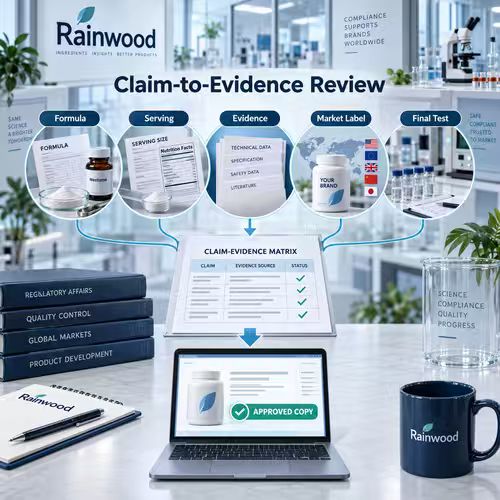
The launch gate
Before publishing the claim, confirm:
1. The wording is defined and permitted in the target market.
2. The finished formula meets the relevant nutrient threshold.
3. The serving and exposure are calculated from the actual batch.
4. Evidence matches the exact product, dose, population, and endpoint.
5. Disease or treatment implications are removed unless legally substantiated.
6. Customer-service and advertising language use the same approved claims.
Request a neotame claim and label evidence review. Send RainwoodBio the proposed copy, formula, serving, complete ingredient list, market, label draft, supporting studies, quantity, and launch date so the team can identify gaps before the listing goes live.
Frequently asked questions
1.Can I call a neotame product diabetic-friendly because neotame is non-nutritive?
Not automatically. The full formula, serving, local claim rules, and the meaning implied to consumers must be reviewed.
2.Does low calorie prove low glycemic?
No. Calorie contribution and glycemic response are different questions. Finished-product evidence is needed for a glycemic claim.
3.Does a disclaimer protect an unsupported health claim?
No. A disclaimer does not convert treatment, prevention, or disease-management language into an acceptable claim.
References
- FDA neotame and sweetener information: https://www.fda.gov/food/food-additives-petitions/aspartame-and-other-sweeteners-food
- U.S. 21 CFR 172.829: https://www.govinfo.gov/content/pkg/CFR-2020-title21-vol3/pdf/CFR-2020-title21-vol3.pdf
- EFSA 2025 neotame re-evaluation: https://efsa.onlinelibrary.wiley.com/doi/10.2903/j.efsa.2025.9480
- WHO/JECFA neotame record: https://apps.who.int/food-additives-contaminants-jecfa-database/Home/Chemical/5107
- RainwoodBio neotame page: https://www.rainwoodbio.com/custom-neotame-powder
This article is for international B2B procurement and educational purposes. Nutrition, glycemic, diabetes-related, safety, and health claims must be substantiated and reviewed for the exact formula, serving, evidence, and destination market.