 EN
EN

Meta title: 13,000 Times Sweeter: Why Neotame Can Still Cost More
Meta description: Neotame’s extreme sweetness does not guarantee a lower formula cost. Compare dilution, carrier, blending, testing, waste, and cost per sucrose-equivalent serving.
The supplier leads with the strongest possible selling point: neotame can be thousands of times sweeter than sucrose. The buyer expects the finished formula to become automatically cheaper.
Then the quote includes a premix, a minimum order, special testing, a micro-dosing step, and production loss. The raw ingredient is powerful. The project is not automatically economical.
FDA describes neotame as approximately 7,000 to 13,000 times sweeter than table sugar. [FDA’s sweetener overview](https://www.fda.gov/food/food-additives-petitions/aspartame-and-other-sweeteners-food) supports the potency claim, but potency is not the same as cost per accepted finished serving.
For procurement teams, the correct question is not “What is the price per kilogram?” It is “What does it cost to deliver the required sweetness, uniformly, legally, and consistently in the finished format?”
Review the RainwoodBio neotame product context, then normalize every quote using the same sweetness target and process assumptions.
Extreme potency creates a handling problem
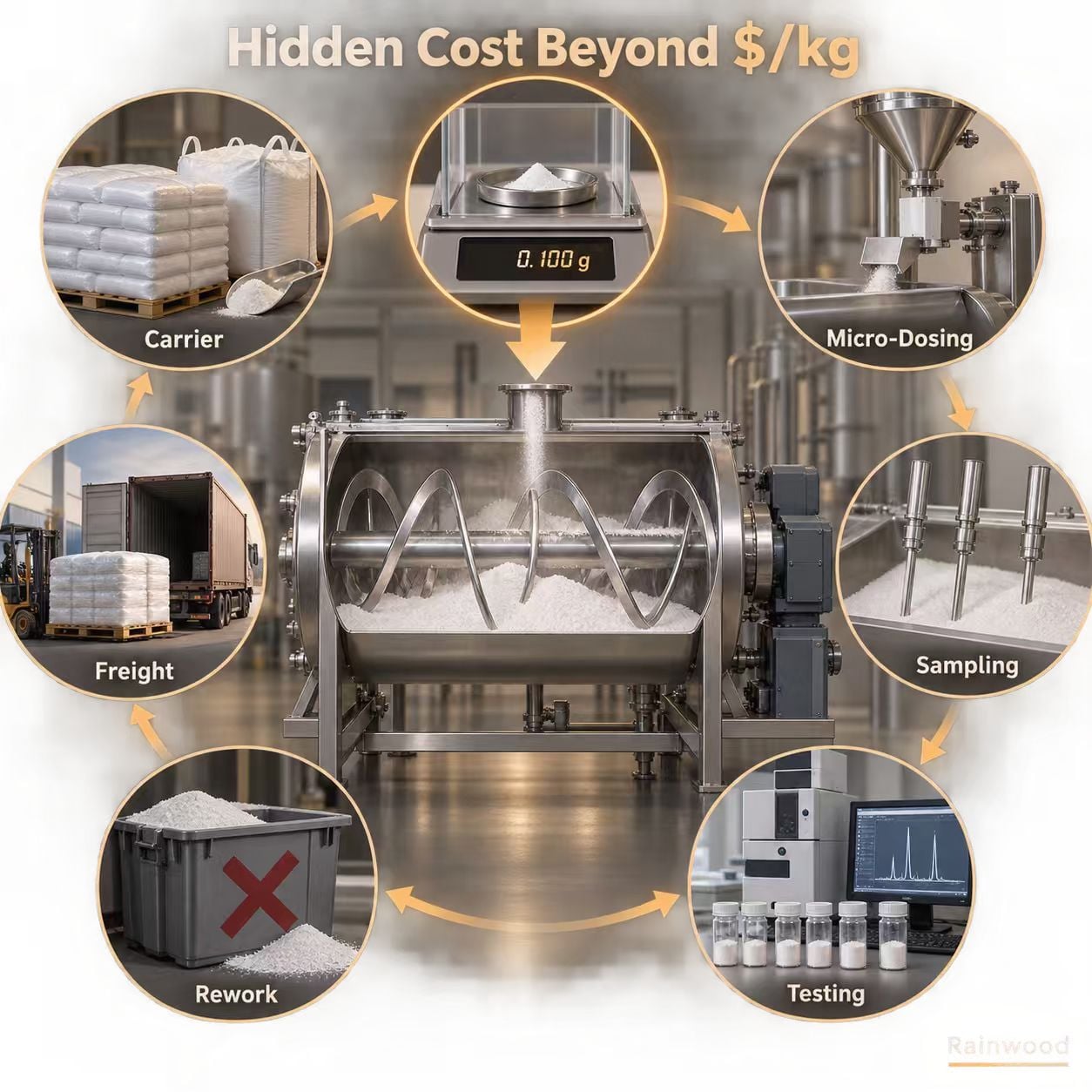
If the target formula needs only a few grams of neotame per tonne of product, direct weighing may be impractical. A manufacturer may use a carrier or premix so the sweetener can be dosed and blended more reliably.
That solution adds new cost and risk:
- carrier material and its label impact;
- larger shipping weight;
- storage volume;
- blend homogeneity;
- segregation during transport;
- sampling and assay of a diluted mixture;
- overage or loss during transfer;
- additional production and cleaning steps.
The carrier may be the correct control. It is not free, and it does not make a premix identical to pure neotame.
Read the pure powder versus premix comparison before comparing a pure-neotame quote with a carrier-based quote by kilogram.
Cost per kilogram is the wrong denominator
Use a cost model based on the intended sweetness contribution:
`cost per sucrose-equivalent unit = delivered neotame cost ÷ verified sweetness contribution`
Then add the costs that the headline quotation may omit:
- carrier or dilution;
- blending and micro-dosing labor;
- quality testing and outside-lab confirmation;
- sampling and retain materials;
- rejected or reworked batches;
- packaging and humidity control;
- freight based on total shipment weight;
- inventory created by MOQ;
- label and regulatory review;
- stability testing in the finished format.
If Supplier A offers pure neotame at $X/kg and Supplier B offers a 1% premix at a lower price per kilogram, the comparison is meaningless until the buyer calculates the verified neotame amount and target sweetness delivered by each option.
Potency claims can hide a taste-optimization cost
The theoretical sweetness ratio is not the same as consumer acceptance. In the finished food, the sensory result depends on acid, bitterness, aroma, temperature, bulk sweeteners, and the timing of sweetness onset and fade.
A buyer may need to add erythritol, allulose, stevia, monk fruit, flavor maskers, or another sweetener to build a useful profile. Those additions change the formula cost and the label, and they may reduce the expected advantage of a single high-intensity ingredient.
Run a controlled sensory comparison with:
- the current sucrose benchmark;
- neotame alone at the target range;
- neotame with the intended carrier;
- the full co-sweetener system;
- aged samples after the planned storage period.
Use the neotame blend and sensory evaluation guide to document the real formula value.
Tiny dose means bigger sampling consequences
When the active represents a very small fraction of a premix, a top-of-bag sample can look compliant while another location is under- or over-concentrated. The production loss is not just a sweetener loss. It can create a finished batch with uneven taste or an unrepresentative COA.
Define:
- blend ratio and tolerance;
- mixing order and time;
- sampling locations;
- sample size and preparation;
- neotame assay method in the matrix;
- acceptance criteria for relative uniformity;
- rework and rejection rules.
Do not treat “well mixed” as a measurable control. The method and sampling plan must show whether the blend is uniform enough for the intended use.
Regulatory restrictions can change the cost model
U.S. regulation permits neotame as a sweetening agent and flavor enhancer in foods generally, except meat and poultry, under current good manufacturing practice and intended technical effect conditions. [21 CFR 172.829](https://www.govinfo.gov/content/pkg/CFR-2020-title21-vol3/pdf/CFR-2020-title21-vol3.pdf) is not a universal approval for every country or every product category.
The EU treats neotame as food additive E 961 and EFSA’s 2025 re-evaluation reports use in 34 authorised food categories under the current EU framework. [The EFSA opinion](https://efsa.onlinelibrary.wiley.com/doi/10.2903/j.efsa.2025.9480) also discusses exposure and specifications. A market-specific dossier may cost more than a generic product brochure, but it can prevent artwork, import, and listing failures.
A quote-normalization table
| Cost field | Pure neotame | Neotame premix |
|---|---:|---:|
| Neotame assay basis | Defined? | Defined? |
| Carrier percentage | None/confirmed | Confirmed? |
| Cost per verified neotame kg | Calculated | Calculated |
| Cost per target sweetness unit | Calculated | Calculated |
| Minimum order | Confirmed | Confirmed |
| Blending charge | Included? | Included? |
| Testing and retain | Included? | Included? |
| Freight and storage | Based on total weight | Based on total weight |
| Rework/rejection terms | Contracted? | Contracted? |
| Finished-format trial | Available? | Available? |
Use the neotame quotation normalization checklist before approving a price that only looks low on a per-kilogram basis.
How RainwoodBio can support the cost calculation
RainwoodBio’s public neotame page lists powder, premix, tabletop, liquid, and baking-related application directions as company-published product context. The page does not prove a specific finished cost, blend ratio, or batch yield.
Ask RainwoodBio for:
- pure powder and premix options where relevant;
- verified assay and carrier information;
- target sweetness calculation;
- sample and production-trial plan;
- MOQ, lead time, packaging, and freight inputs;
- cost per finished serving rather than only cost per kilogram.
Use the neotame landed-cost and format feasibility review to see whether the ingredient is economical after the real controls are included.
The approval gate
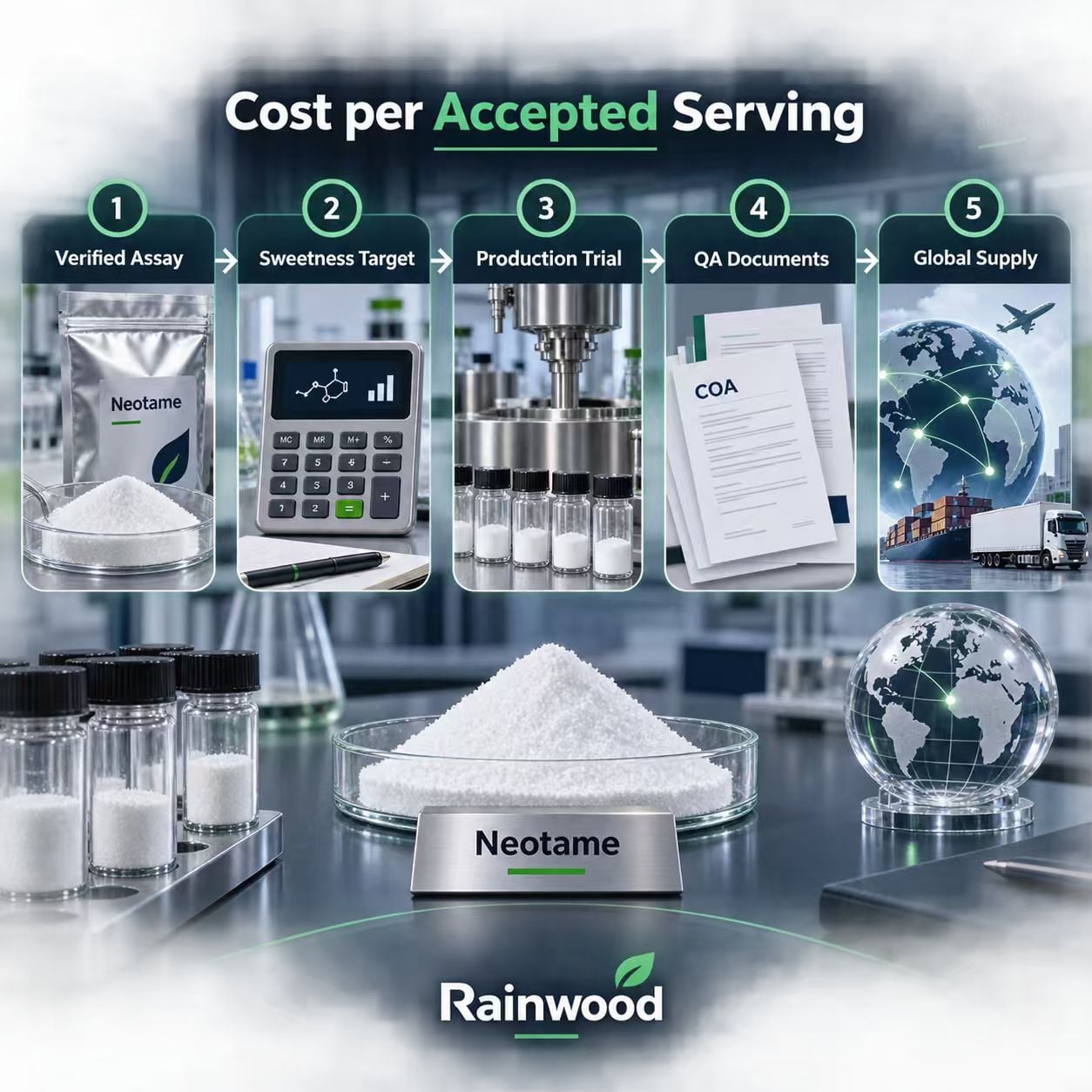
Before selecting the low quote, confirm:
1. Target sweetness and sensory acceptance.
2. Pure or premix form and carrier composition.
3. Verified neotame amount per shipment and per serving.
4. Blend uniformity and sampling plan.
5. Testing, waste, and rework assumptions.
6. Market-specific use and label requirements.
7. MOQ, lead time, storage, and change-control terms.
Request a neotame cost-per-serving and quotation review. Send RainwoodBio the competing offers, sweetness target, formula, format, serving, market, quantity, and packaging so the team can normalize the real cost before you approve the deposit.
Frequently asked questions
1.Does higher sweetness always mean a lower finished-product cost?
No. The required carrier, blending, testing, sensory adjustment, MOQ, and waste can offset the raw-material advantage.
2.Is a premix less professional than pure neotame?
Not necessarily. A premix can improve dosing and uniformity when its carrier, ratio, homogeneity, and label are controlled. It is simply a different commercial form.
3.Should the buyer compare sweetness claims from different suppliers?
Yes, but use a common benchmark and finished-matrix sensory trial. A brochure range does not replace a controlled formulation result.
References
- FDA sweetener information: https://www.fda.gov/food/food-additives-petitions/aspartame-and-other-sweeteners-food
- U.S. 21 CFR 172.829 Neotame: https://www.govinfo.gov/content/pkg/CFR-2020-title21-vol3/pdf/CFR-2020-title21-vol3.pdf
- EFSA 2025 neotame re-evaluation: https://efsa.onlinelibrary.wiley.com/doi/10.2903/j.efsa.2025.9480
- RainwoodBio neotame powder page: https://www.rainwoodbio.com/custom-neotame-powder
This article is for international B2B procurement and educational purposes. Sweetness potency, cost, formula performance, blend uniformity, safety, labelling, and regulatory requirements must be confirmed for the exact grade, finished product, and destination market.