 EN
EN

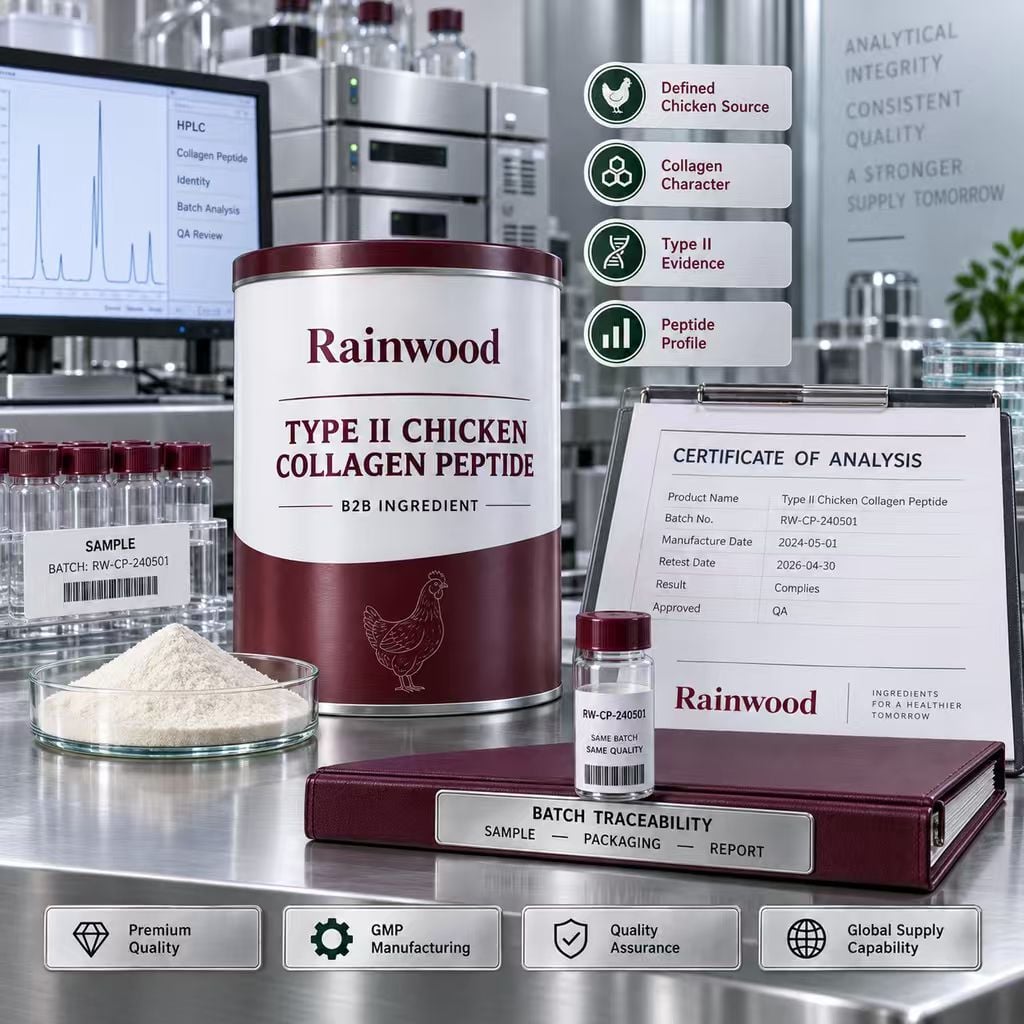
Meta title: Type II Chicken Collagen Peptide COA Identity Check
Meta description: A protein result is not proof of type II collagen. Learn how buyers verify chicken source, peptide identity, molecular weight, and lot control.
The COA arrives with an impressive protein number. Your purchasing team approves the lot, the label team prints “type II collagen peptides,” and the production schedule moves forward. Then a customer or auditor asks a simple question: what proves that this is actually type II chicken collagen rather than another collagen-rich protein?
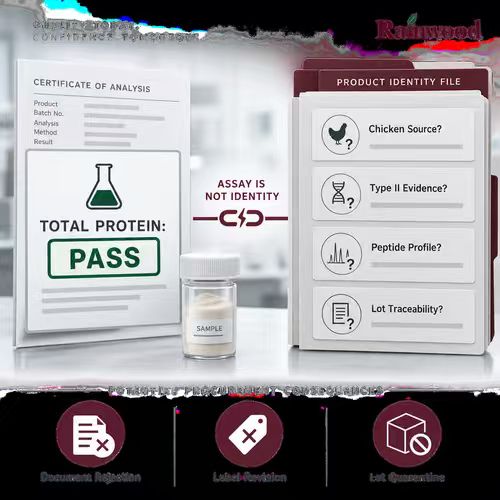
That question is where many ingredient dossiers become uncomfortable. A total protein assay can tell you how much nitrogen-containing material the laboratory measured. It does not automatically identify the collagen type, confirm the chicken cartilage source, or show that the material matches the peptide profile used in your formula. For an importer, the gap can become a rejected document package. For a brand, it can become a label correction, delayed launch, or expensive finished-goods rework.
The central mistake: treating an assay as an identity test
Hydrolyzed type II chicken collagen peptide is not a single number. It is a source-specific, process-created mixture of peptides. The final material reflects the starting cartilage, the enzymes, hydrolysis time, pH, temperature, filtration, drying, and any permitted processing aids. A protein result is only one part of that story.
The practical distinction is important. Hydroxyproline can support the presence of collagenous material, while a total protein method can support the amount of protein-like material. Neither result, by itself, proves that the collagen came from chicken sternum cartilage or that the collagen was type II. Even an HPLC label on a report does not explain whether the method measures identity, amino acid composition, molecular-weight distribution, or a particular marker.
Use our type II chicken collagen peptide specification guide when you build the first version of your purchasing specification.
Why the wrong result can still look commercially convincing
There is a strong supplier incentive to present the easiest number first. Protein percentage is familiar, inexpensive to report, and easy to compare across quotations. It also creates a clean sales conversation: one percentage, one price, one apparent ranking. The buyer may not notice that two materials with similar protein results can differ in source, ash, moisture, peptide distribution, accompanying cartilage compounds, and suitability for the intended format.
The loss is not theoretical. If the source statement later fails a customer review, you may need to quarantine stock while requesting new evidence. If your formula depends on a defined peptide range but the supplier only controls total protein, powder behavior can drift between lots. If your label uses a type-specific name without a supportable identity package, the problem reaches beyond procurement and into regulatory review.
The right response is not to demand every possible test. It is to match each question with a fit-for-purpose check.
Build an identity package instead of collecting random numbers
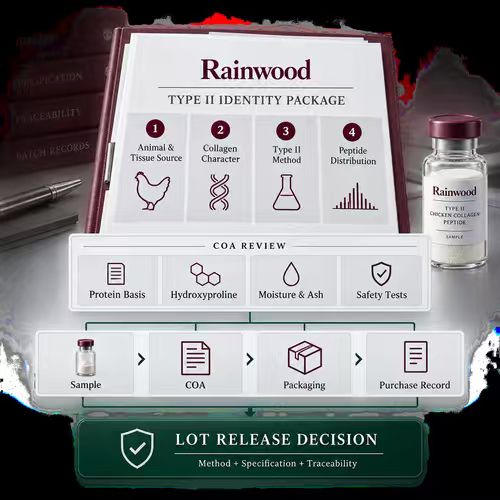
Start with four separate questions:
1. What is the animal and anatomical source? Ask for the species, tissue, source statement, processing site, and traceability route. “Chicken collagen” is not as precise as chicken sternum cartilage or another defined source.
2. What chemical family is present? Request an assay suitable for collagen or protein content, with the basis clearly stated: as-is, dry basis, or another calculation.
3. What confirms type II? Ask the supplier to explain the identity method and its specificity. If the material is hydrolyzed, a native-structure assay may not answer the same question as it would for undenatured collagen.
4. What does the peptide population look like? Request molecular-weight distribution or average molecular weight when the specification, application, or target market depends on it.
The key is the explanation attached to the method. “Tested by HPLC” is not a release criterion until you know the analyte, column, reference standard, sample preparation, calculation, and acceptance range.
Read hydrolyzed versus undenatured type II collagen differences before comparing a generic peptide quotation with a branded undenatured ingredient.
Do not let hydroxyproline carry a claim it cannot carry
Hydroxyproline is useful because it is associated with collagenous proteins. It can help investigate whether a material behaves like collagen rather than a conventional carbohydrate or mineral. But it is not a universal fingerprint for collagen type II. A report showing hydroxyproline does not automatically establish species, tissue source, native structure, peptide sequence, or trademark equivalence.
That limitation changes how you write your internal approval note. Instead of recording “hydroxyproline confirms type II,” record “hydroxyproline supports collagenous character; type and source require additional evidence.” This wording protects the buyer from turning a supporting test into a claim-making shortcut.
For a hydrolyzed ingredient, ask whether the supplier has an amino acid profile, molecular-weight method, source documentation, and process record that together support the intended identity. For a native or undenatured material, ask whether the method preserves and detects the structural epitopes that the product is supposed to retain. These are different evidence paths, not two prices for the same test.
A practical COA review table for procurement
Before approving a lot, put the supplier report into a table with these columns:
| Question | What the COA may show | What you still need |
|---|---|---|
| Protein amount | Percentage and test basis | Method suitability and dry-basis conversion |
| Collagen character | Hydroxyproline or collagen calculation | Source and type evidence |
| Peptide profile | Average or range, if reported | Distribution method and acceptance limits |
| Contaminants | Microbiology, metals, or other limits | Lot identity and sampling record |
| Physical behavior | Color, odor, mesh, or bulk density | Test conditions and format relevance |
| Traceability | Lot number and production date | Manufacturer-to-lot chain and change history |
Then add a decision gate: no commercial release until the identity questions are answered, the calculation basis is aligned, and the lot number on the report matches the packaging and purchase documents.
How RainwoodBio can help turn a COA into a usable release file
RainwoodBio publishes a workflow covering requirement confirmation, supplier management, testing and release documentation, packaging, logistics, and traceability. For this product, the useful capability is not a generic promise of quality. It is the ability to define the requested identity and physical specification before a quotation is treated as comparable.
The project should establish which evidence is available at website, product, batch, and finished-formula levels. A supplier page may describe a capability; only a lot-specific report and agreed sampling record can support release of the purchased material. Ask for batch testing and traceability controls that match your exact grade and target market.
The buyer decision gate
Approve a type II chicken collagen peptide supplier only when the answer to each question is documented:
- Is the chicken source defined beyond the word “animal” or “collagen”?
- Does the method actually address the identity question you are asking?
- Is the peptide or molecular-weight requirement written into the specification?
- Are protein, moisture, ash, microbiology, and heavy-metal limits stated with bases and units?
- Does the lot number link the COA, production record, packaging, and sample?
- Is there a change-control commitment for source, enzyme, site, and process changes?
- Can the supplier explain what the evidence does not prove?
Send your current COA, specification, target market, and planned format for a COA identity-gap review. RainwoodBio can use those inputs to identify missing tests, normalize the specification, and flag questions before you commit to a large purchase.
Frequently asked questions
1.Does a 90% protein result prove type II collagen?
No. It supports the amount of measured protein under the stated method. It does not independently prove the collagen type, chicken source, peptide distribution, or equivalence to a branded ingredient.
2.Is hydroxyproline useless for this product?
No. It can support collagenous character and help compare materials when used correctly. It should be treated as one layer of evidence, not as a complete source-and-type identity package.
3.Should hydrolyzed peptides be tested like undenatured collagen?
Not automatically. Hydrolysis changes the structure and molecular population, so the method must match the form you are buying and the claim you want to support.
References
- U.S. FDA, Exploring the Scope of Dietary Supplement Ingredients: https://www.fda.gov/media/191964/download
- TGA, Hydrolysed Chicken Cartilage Extract compositional guideline: https://www.tga.gov.au/resources/resources/compositional-guidelines/hydrolysed-chicken-cartilage-extract
- Comparative analysis of chicken cartilage compounds and type II collagen peptides: https://pmc.ncbi.nlm.nih.gov/articles/PMC9005812/
- RainwoodBio company information: https://www.rainwoodbio.com/about-us
This article is for B2B procurement and educational purposes. Product identity, analytical methods, safety, labeling, and regulatory requirements must be confirmed for the exact ingredient, finished product, and destination market.