 EN
EN

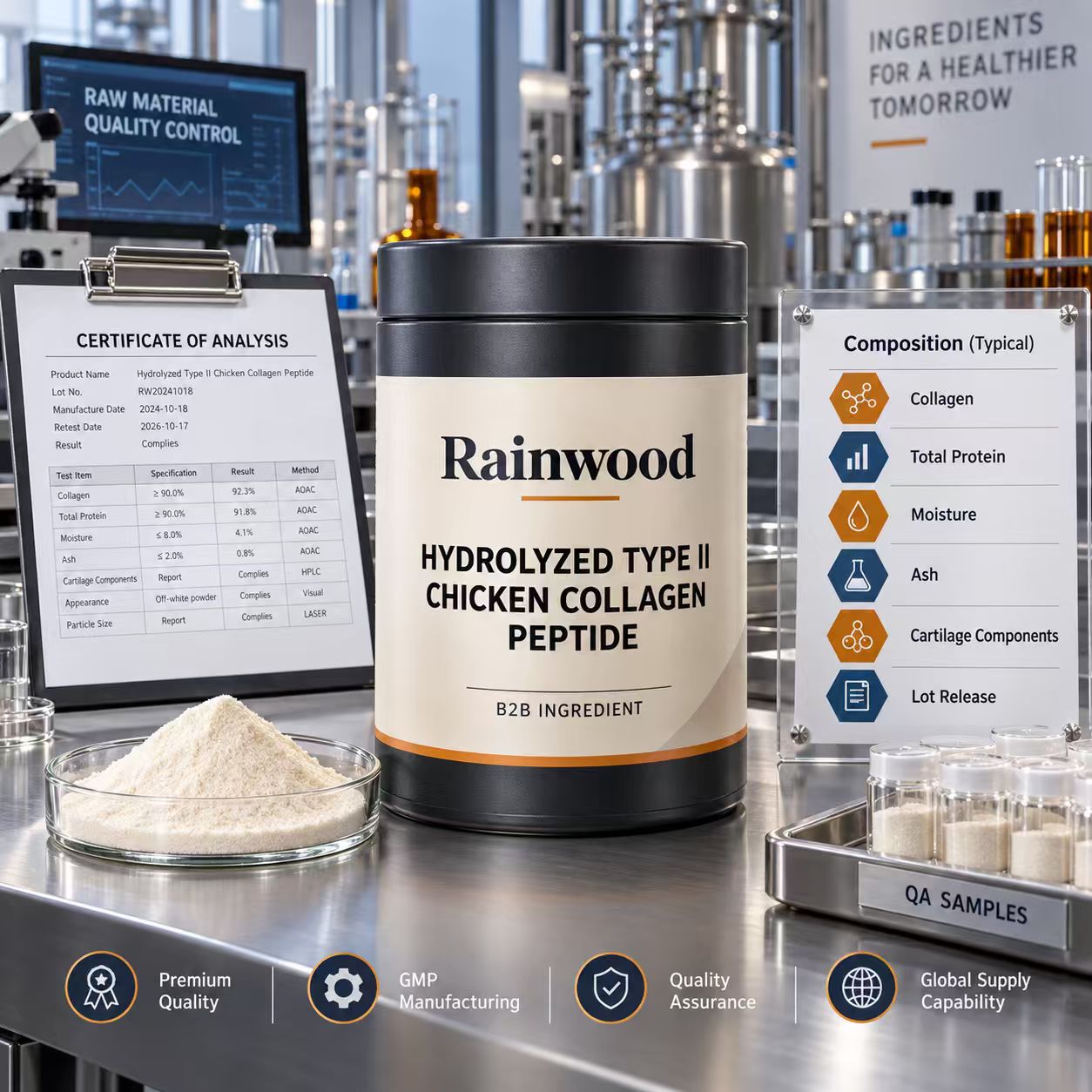
Meta title: Type II Chicken Collagen Peptide Composition Check
Meta description: A collagen peptide powder may carry cartilage compounds, ash, moisture, and other proteins. Learn what QA should request before release.
The supplier calls the product “type II collagen peptide.” Your laboratory reports a satisfactory protein value. But what else is in the powder, and is that “else” part of the specification or an uncontrolled consequence of the raw material and process?
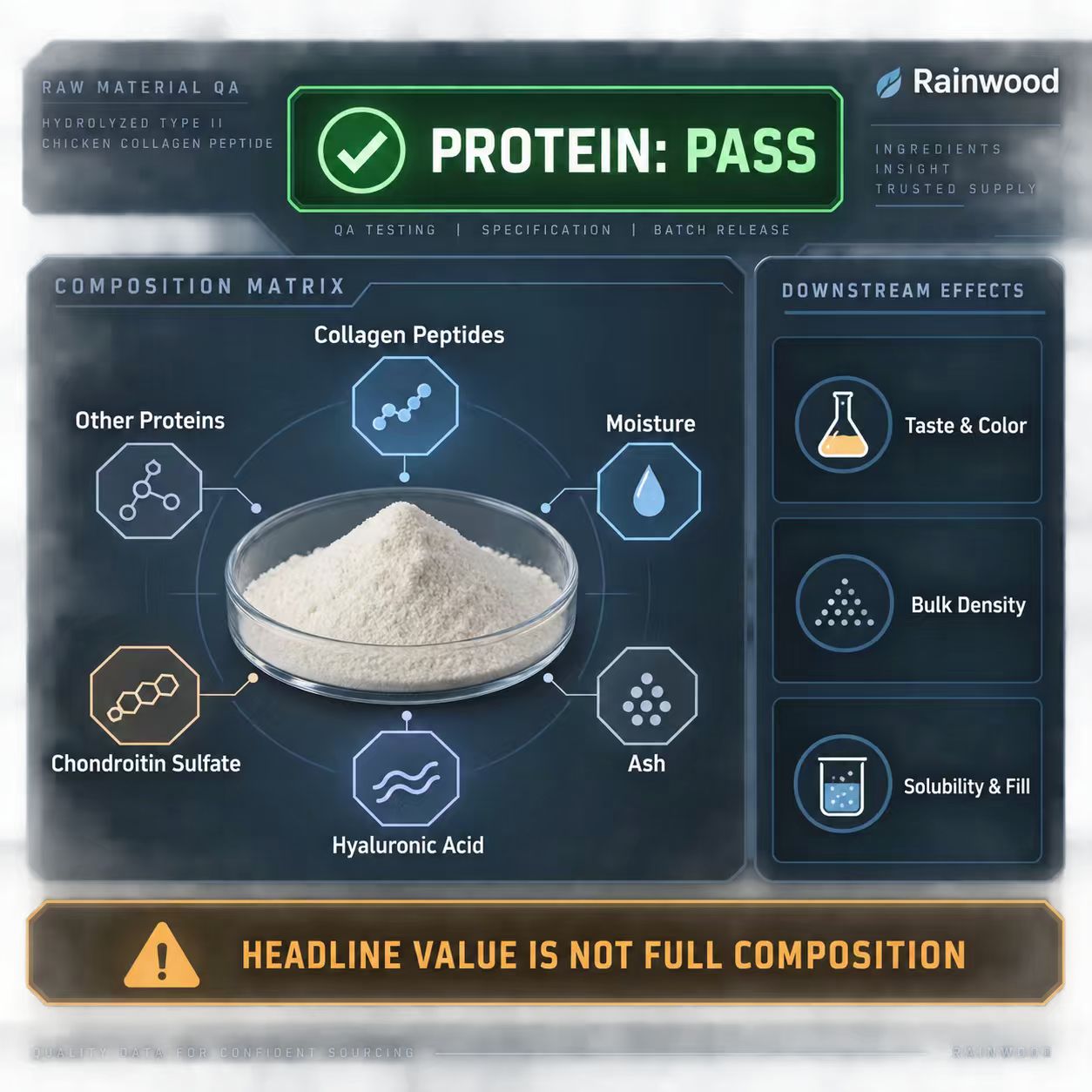
Chicken cartilage is not a bottle of isolated collagen. It is a biological tissue that can carry other proteins, glycosaminoglycans, minerals, moisture, and process residues. Enzymatic hydrolysis changes the matrix but does not automatically make every non-collagen component disappear. If your purchase specification controls only collagen or total protein, the remaining composition can drift while the headline number stays inside range.
That drift can change taste, color, bulk density, solubility, capsule fill, and customer documentation. The risk is not that every supplier is hiding something. The risk is that your specification may never have asked the right question.
The composition of cartilage shapes the commercial material
The TGA compositional guideline for hydrolysed chicken cartilage extract illustrates why buyers should define the matrix. It describes a material from chicken sternum cartilage and includes expectations for hydrolysed collagen type II, chondroitin sulfate, hyaluronic acid, molecular weight, bulk density, particle size, and heavy metals. Those parameters are not a universal recipe for every product, but they show that a cartilage-derived ingredient can contain more than one commercially relevant component.
Use our cartilage-derived peptide specification checklist to decide which accompanying components matter to your formula and market.
Why “high protein” can hide a formula problem
Protein is not a complete description of composition. A material can meet a high protein number and still vary in moisture, ash, peptide distribution, chondroitin sulfate, hyaluronic acid, or non-collagen proteins. On an as-is basis, extra moisture can dilute the reported percentage; on a dry basis, the calculation can look stronger while the delivered mass changes.
The supplier incentive is understandable: one headline result is easier to sell than a detailed composition table. The buyer loss is less visible at quotation stage. Later, the same material may produce a stronger animal note, a different dispersion time, or a larger capsule fill requirement. A finished product can require flavor reformulation or packaging changes even though the COA says “protein passed.”
Accompanying cartilage compounds are not automatically defects
Chondroitin sulfate and hyaluronic acid may be expected components of a defined chicken cartilage extract, while they may be unexpected in a peptide grade sold as a narrow collagen ingredient. The question is not whether every lot must be stripped to one molecule. The question is whether the declared composition matches the way you price, label, formulate, and support the product.
If the material is sold on a type II collagen basis, define whether accompanying components are included, limited, or separately reported. If your finished formula also contains chondroitin sulfate, a hidden contribution from the collagen ingredient can affect label math. If the market has allergen or animal-origin requirements, the composition file may also need additional review.
Read hydrolyzed and undenatured type II collagen evidence boundaries before using studies or label language that assume a purified or structure-preserved material.
The ash and moisture question that procurement often misses
Ash is a useful signal for mineral residue and inorganic content, but its interpretation depends on the source and process. A higher value can affect taste, color, density, and the calculation of protein on a dry basis. Moisture affects delivered active mass, microbial risk, clumping, flow, and shelf life. Neither parameter should be treated as a generic pass-or-fail number copied from another collagen product.
Ask the supplier to state:
- whether protein and collagen values are as-is or dry basis;
- how moisture is measured and what range is accepted;
- how ash is measured and whether it is included in the commercial grade;
- whether mineral, salt, or processing aids are intentionally added;
- how water activity or microbiological controls relate to the packaging format.
The answer should connect to your formula. A powder in a moisture-barrier sachet may tolerate different handling than a high-dose capsule stored in a humid warehouse.
A composition review that works in a real QA meeting
Put the following items into a release table:
| Component or property | Why it matters | Release question |
|---|---|---|
| Type II collagen or collagen protein | Label and product identity | What is the method and basis? |
| Total protein | Composition and dose calculation | Does it include other proteins? |
| Chondroitin sulfate | Formula overlap and source profile | Is it expected, limited, or separately declared? |
| Hyaluronic acid | Source profile and label review | Is a minimum or maximum needed? |
| Moisture and water activity | Flow, shelf life, microbiology | Does the limit fit the package? |
| Ash | Mineral residue and sensory behavior | What process or source explains the result? |
| Heavy metals and microbiology | Safety and release | Are limits market-specific and lot-specific? |
Then compare the approved sample and commercial lot. A composition trend is often more useful than a single pass result. If ash, moisture, or an accompanying cartilage component moves sharply, investigate the source or process before the batch becomes finished inventory.
How RainwoodBio can use composition data before production
RainwoodBio publishes requirement confirmation, supplier management, sample development, testing and release documentation, packaging, and traceability as parts of its OEM workflow. For this ingredient, the practical value is translating a broad “collagen peptide” request into a composition and format specification that production can actually use.
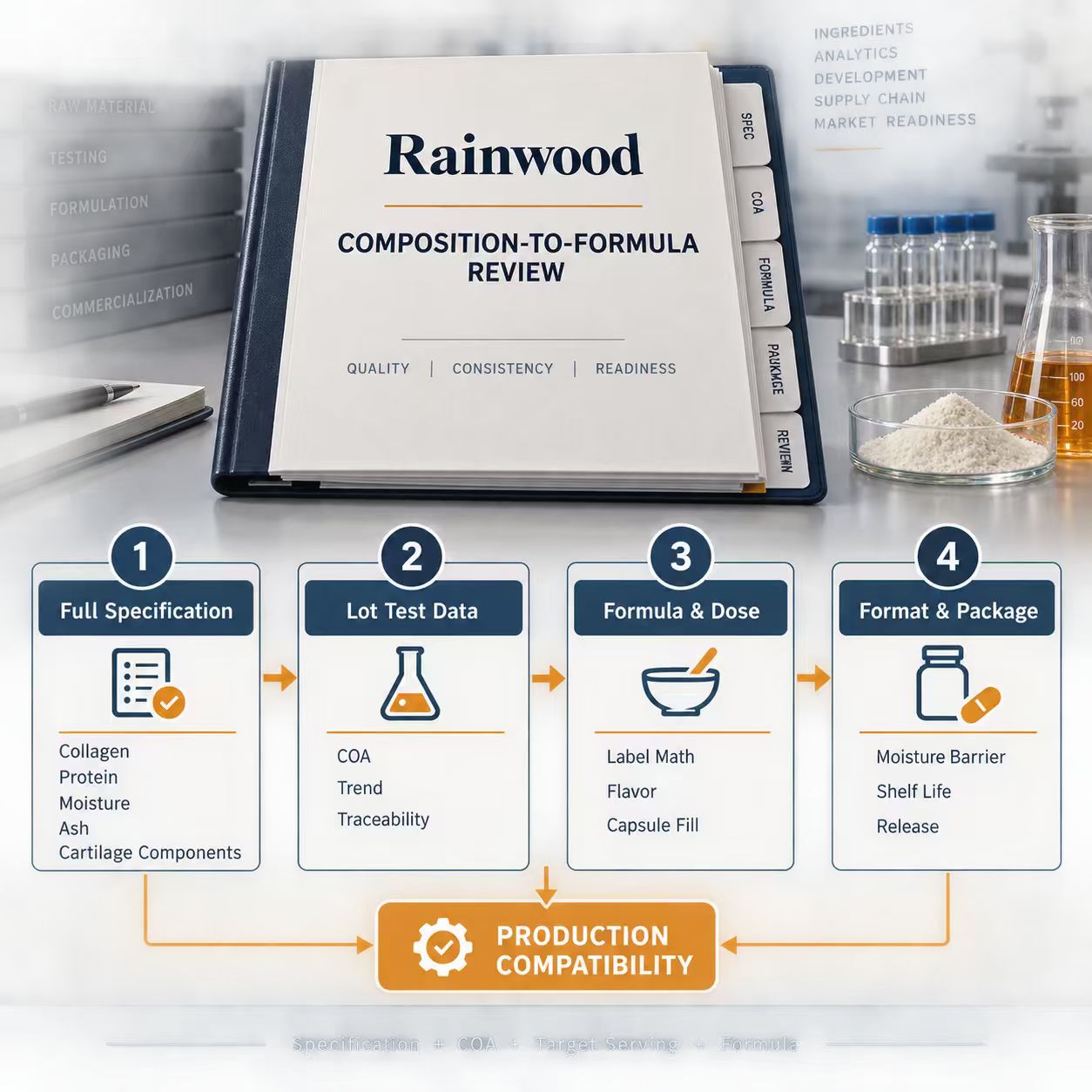
Ask for a composition-to-formula compatibility review before approving flavor, capsule fill, tablet weight, or packaging.
Your release decision
Do not release the material until you can answer:
- What percentage is collagen, what percentage is total protein, and how are they calculated?
- Are chondroitin sulfate and hyaluronic acid declared or controlled?
- Are moisture and ash limits linked to the approved format?
- Does the lot match the approved source, process, and molecular-weight profile?
- Are any carriers, salts, enzymes, or processing aids present?
- Which tests are repeated on each lot and which are periodic qualification tests?
Send the COA, full specification, target serving, and formula composition for a collagen peptide composition-gap review. The useful output is a prioritized list of missing controls, not another generic quality statement.
Frequently asked questions
1.Is chondroitin sulfate contamination in a chicken collagen peptide?
Not automatically. It may be an expected cartilage-derived component in some grades and an unwanted overlap in others. The correct treatment depends on the product definition, label, formula, and market.
2.Should the highest protein percentage always win?
No. Compare identity, dry-basis calculation, molecular-weight profile, contaminants, physical behavior, documentation, and total delivered cost. A headline percentage can hide a poor fit for your process.
3.Does low ash prove a better peptide?
No. Ash is one composition indicator. It should be interpreted with source, process, moisture, protein, accompanying compounds, and the intended application.
References
- TGA, Hydrolysed Chicken Cartilage Extract compositional guideline: https://www.tga.gov.au/resources/resources/compositional-guidelines/hydrolysed-chicken-cartilage-extract
- Comparative analysis of chicken cartilage compounds and type II collagen peptides: https://pmc.ncbi.nlm.nih.gov/articles/PMC9005812/
- U.S. FDA, Exploring the Scope of Dietary Supplement Ingredients: https://www.fda.gov/media/191964/download
- RainwoodBio OEM information: https://www.rainwoodbio.com/oem
This article is for B2B procurement and educational purposes. Composition, analytical, safety, labeling, and regulatory requirements must be confirmed for the exact grade, lot, finished formula, and destination market.