 EN
EN

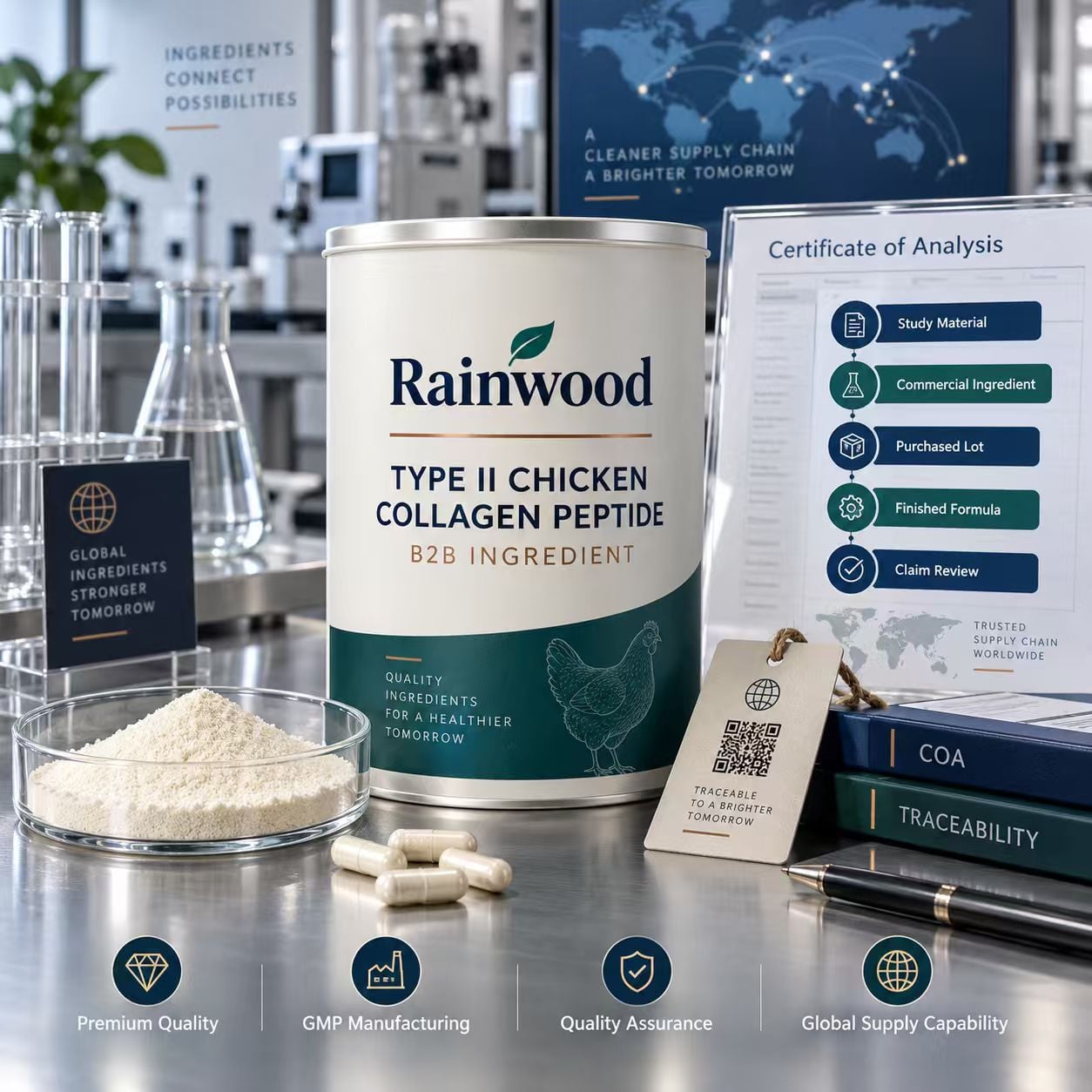
Meta title: UC-II Evidence vs Generic Type II Collagen Peptides
Meta description: UC-II studies cannot automatically prove a generic chicken collagen peptide. Learn how buyers match study material, dose, identity, and claims.
The sales presentation shows a recognizable joint-support study. The next slide shows your generic type II chicken collagen peptide. The conclusion is implied: the study proves the product. That is the evidence shortcut your regulatory reviewer, retailer, or informed customer may challenge first.
A study supports the material, dose, formulation, population, and outcome it actually tested. UC-II is associated with a specific undenatured type II collagen ingredient and evidence package. A hydrolyzed chicken collagen peptide may share a source category but differ in structure, molecular-weight distribution, manufacturing process, dose, and mechanism. Similar words do not close that evidence gap.
Evidence starts with material identity
Before using a study, write a material-match statement. Identify the study ingredient, manufacturer or branded identity, chicken tissue source, processing form, serving amount, dosage schedule, delivery format, and study population. Then compare those fields with the commercial raw material and finished product you plan to sell.
Use our type II collagen evidence matching checklist that different analytical approaches answer different questions. A comparative study of undenatured type II collagen supplements also found that products using similar terminology were not necessarily interchangeable. Those sources support a conservative procurement conclusion: prove the match or describe the evidence as indirect.
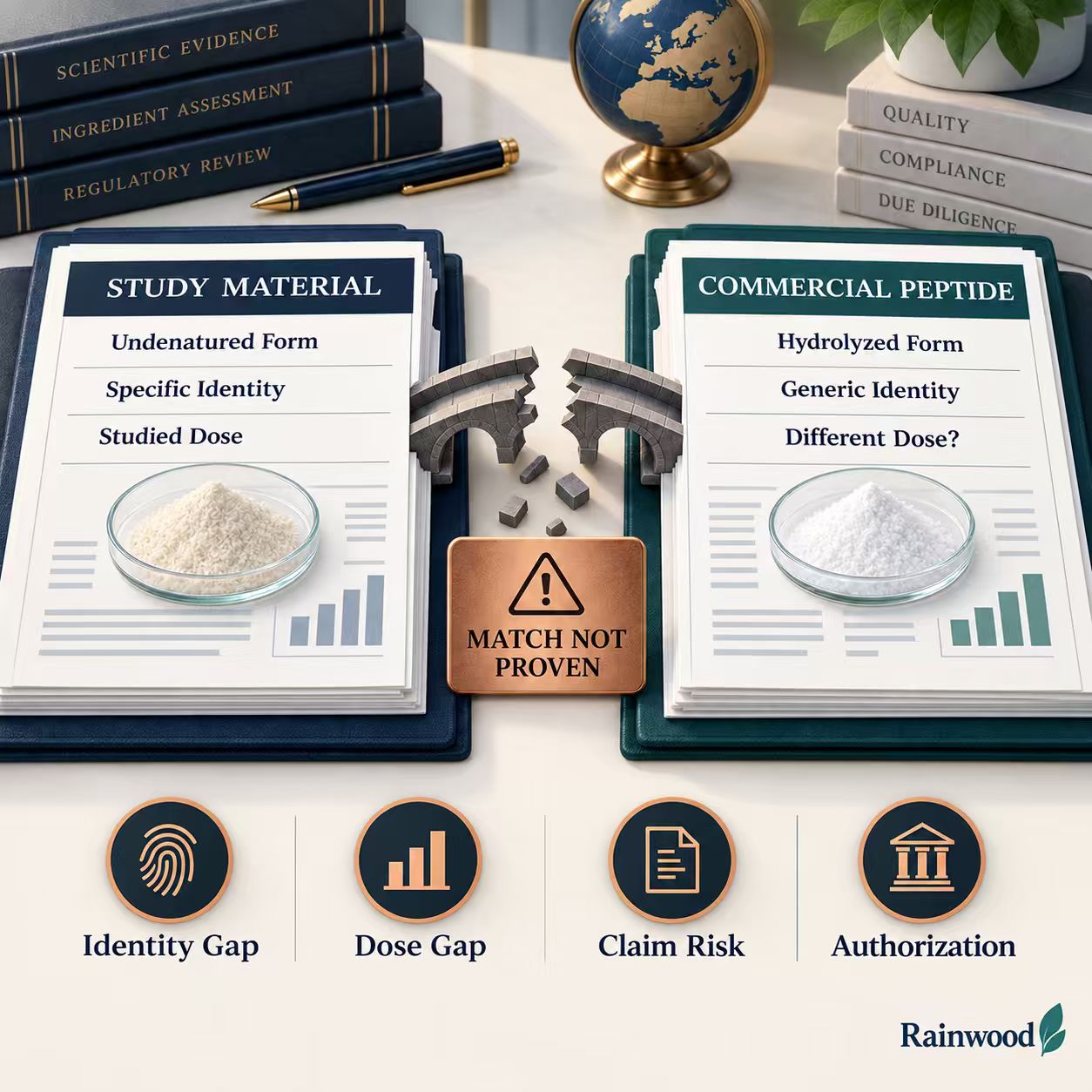
The evidence chain buyers should document
Build the chain in five steps:
1. Study material. What exact ingredient was tested?
2. Commercial ingredient. Is the purchased raw material the same ingredient, form, and source?
3. Purchased lot. Do the COA, manufacturing record, and traceability documents connect the lot to the qualified ingredient?
4. Finished formula. Does the product deliver the studied dose in the same or a meaningfully comparable format?
5. Customer claim. Does the proposed language stay within what the study and market rules support?
If a step is missing, the claim may need to be narrowed. “Contains type II collagen peptide” may be supportable as an ingredient description when identity evidence exists. “Clinically proven like UC-II” is a much stronger statement and may require authorization, equivalence, and market-specific review.
Read the hydrolyzed versus undenatured form distinction before your team labels a generic peptide as a study-equivalent ingredient.
Why dosage matching matters more than a familiar number
The study dose is not a decorative citation. It is part of the tested intervention. A low-dose undenatured capsule study cannot automatically support a high-dose hydrolyzed peptide, and a peptide study at one serving amount cannot automatically prove a smaller finished-product serving. Check dose per day, dose per capsule, serving frequency, study duration, compliance, and whether the material was combined with other ingredients.
If your formula uses a blend, identify the contribution of each component. The study may have tested the collagen alone, while your finished product adds glucosamine, chondroitin, turmeric, or vitamins. Additional ingredients do not make the evidence stronger by default; they make the evidence match more complex.
The claim can overrun the evidence even when the citation is real
A real study can still be misused. A result in a specific population may not support a universal outcome. A measure of joint comfort may not support treatment of arthritis. An ingredient study may not prove that your finished product improves a consumer outcome. A disclaimer at the bottom of the page does not convert a disease claim into a compliant one.
For an international B2B product, create a claim matrix with columns for market, audience, wording, evidence source, dose match, and approval status. Keep disease, prevention, and guaranteed-outcome language out of the general product copy unless a qualified regulatory review says otherwise.
A study-match scorecard
Score each field as exact, comparable, indirect, or missing:
| Field | Buyer question |
|---|---|
| Form | Hydrolyzed, partially hydrolyzed, or undenatured? |
| Source | Same chicken tissue and species? |
| Identity | Same manufacturer, grade, or authorized branded material? |
| Dose | Same daily amount and serving schedule? |
| Formula | Same ingredient alone or a different blend? |
| Population | Same target customer or a clearly bounded audience? |
| Endpoint | Does the result match the proposed claim? |
| Market | Is the wording allowed in the destination jurisdiction? |
Do not turn a scorecard into a marketing percentage. Use it to decide which evidence can be cited, which wording must be softened, and which gaps require a new study or expert review.
How RainwoodBio can keep evidence attached to the exact project
RainwoodBio publishes requirement confirmation, supplier management, testing and release documentation, and OEM development across multiple formats. For a study-sensitive ingredient, the useful control is to collect the target market, draft claim, raw-material identity, dose, format, and lot evidence in one project file.
Request a claim-to-evidence dossier review before a study citation appears on a label, product page, or distributor presentation.
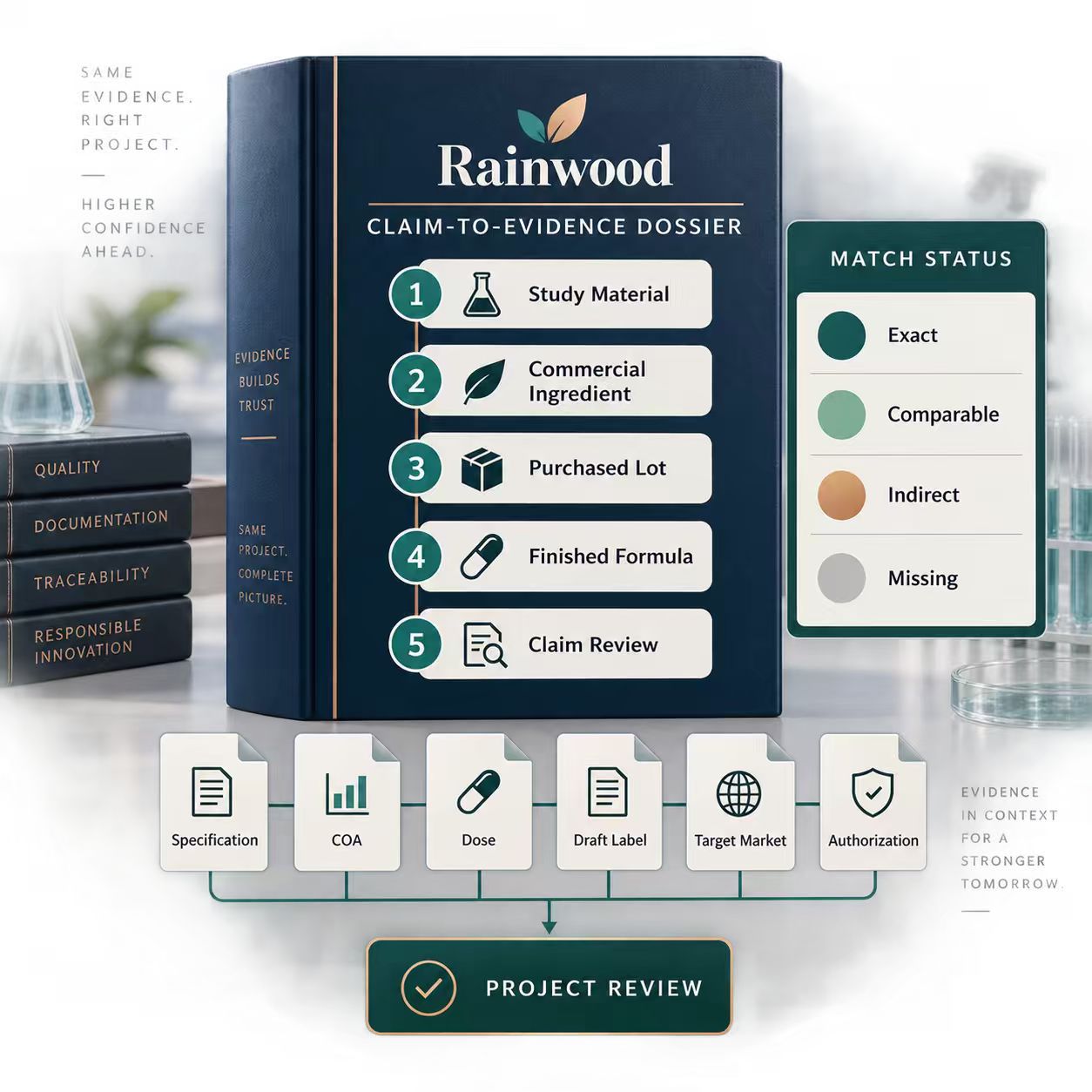
The evidence approval gate
Before launch, require:
- the exact study material and form to be identified;
- commercial ingredient identity and source to be documented;
- the purchased lot to be traceable;
- serving dose and finished format to be compared with the study;
- blend differences to be disclosed;
- target-market claim language to be reviewed;
- trademark and authorization questions to be closed.
Send the study, supplier specification, COA, draft label, target market, and proposed claim for a type II collagen evidence-match review. RainwoodBio can help identify whether the evidence is direct, comparable, indirect, or not suitable for the intended wording.
What to do with indirect evidence
Indirect evidence is not useless, but it must be described honestly. It can support background education about collagen biology, the source category, or why a formulation question deserves investigation. It should not be presented as proof that the commercial peptide produced the outcome observed in another ingredient. Put the limitation next to the citation in your internal dossier, not only in a footnote. If the product team wants a stronger claim, identify the missing bridge: exact ingredient confirmation, a matched dose, a finished-product study, or a qualified market review. That makes the next investment decision clearer than simply collecting more unrelated references.
Also preserve unfavorable or inconclusive evidence in the file. A balanced dossier is more credible during retailer and distributor review than a folder containing only favorable summaries.
Frequently asked questions
1.Can I cite a UC-II study for any chicken type II collagen product?
No. The study material, form, source, dose, authorization, and finished-product match must be assessed. Similar terminology is not proof of equivalence.
2.Does a human study eliminate regulatory review?
No. Human evidence can support an evidence file, but claims remain market-specific and must match the product and wording.
3.Can a generic peptide use the phrase “clinically studied”?
Only if the statement accurately describes the evidence for that exact material or clearly states the limits. Do not imply that another branded or undenatured ingredient study tested the generic peptide.
References
- U.S. FDA, Exploring the Scope of Dietary Supplement Ingredients: https://www.fda.gov/media/191964/download
- Functional Characterization of Undenatured Type II Collagen Supplements: https://www.tandfonline.com/doi/pdf/10.1080/19390211.2021.1931621
- NIH Dietary Supplement Label Database, UC-II label example: https://dsld.od.nih.gov/label/283151
- RainwoodBio Quality and company information: https://www.rainwoodbio.com/about-us
This article is for B2B procurement and educational purposes. Evidence, safety, labeling, trademark rights, and regulatory requirements must be confirmed for the exact ingredient, finished formula, claim, and destination market.