 EN
EN

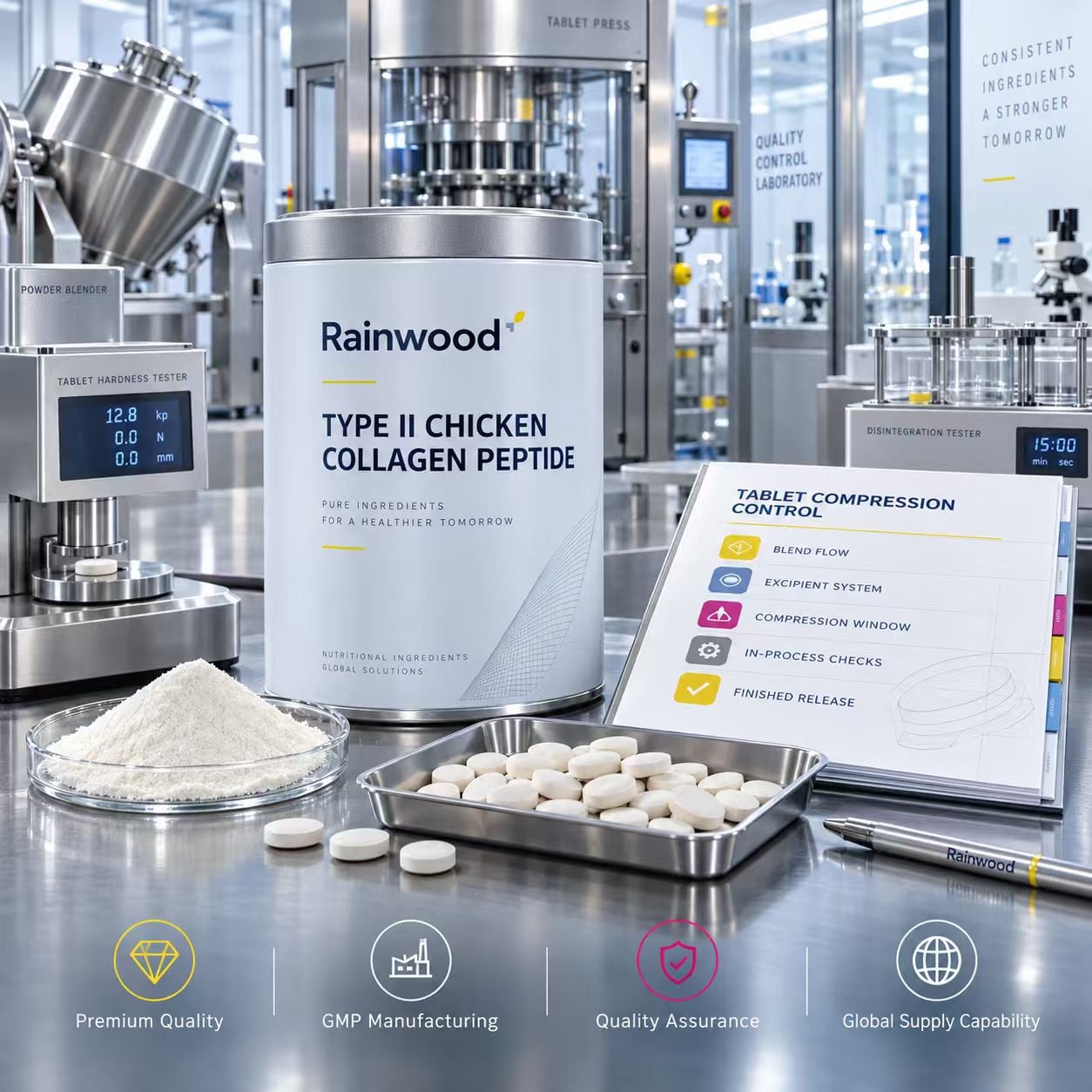
Meta title: Type II Collagen Peptide Tablet Compression Guide
Meta description: Tablet compression can alter flow, hardness, disintegration, and dose uniformity. Learn how to qualify a type II collagen peptide tablet formula.
The powder is approved, the tablet artwork is finished, and the first production run begins. Then the press starts. Tablets cap, edges chip, the weight drifts, or disintegration takes too long. The team asks whether the raw material “changed,” but the real issue may be that compression created a product the original sample never represented.
Type II chicken collagen peptide is a protein-rich powder with its own moisture, particle, density, and flow behavior. Compression turns those properties into a mechanical problem involving excipients, tooling, pressure, dwell time, lubrication, and environmental humidity. A raw-material COA cannot predict the finished tablet without a process-relevant trial.
The tablet is a new system, not a pressed powder sample
A capsule can tolerate certain flow limitations because the powder is dosed into a shell. A tablet must form a coherent compact and then release its contents at the intended rate. Peptide particle shape, molecular-weight distribution, moisture, and bulk density influence how the blend fills the die, deforms, bonds, and ejects.
Use our type II collagen tablet development requirements to connect the raw-material specification to the compression process.
The first hidden loss: adding excipient until the dose no longer fits
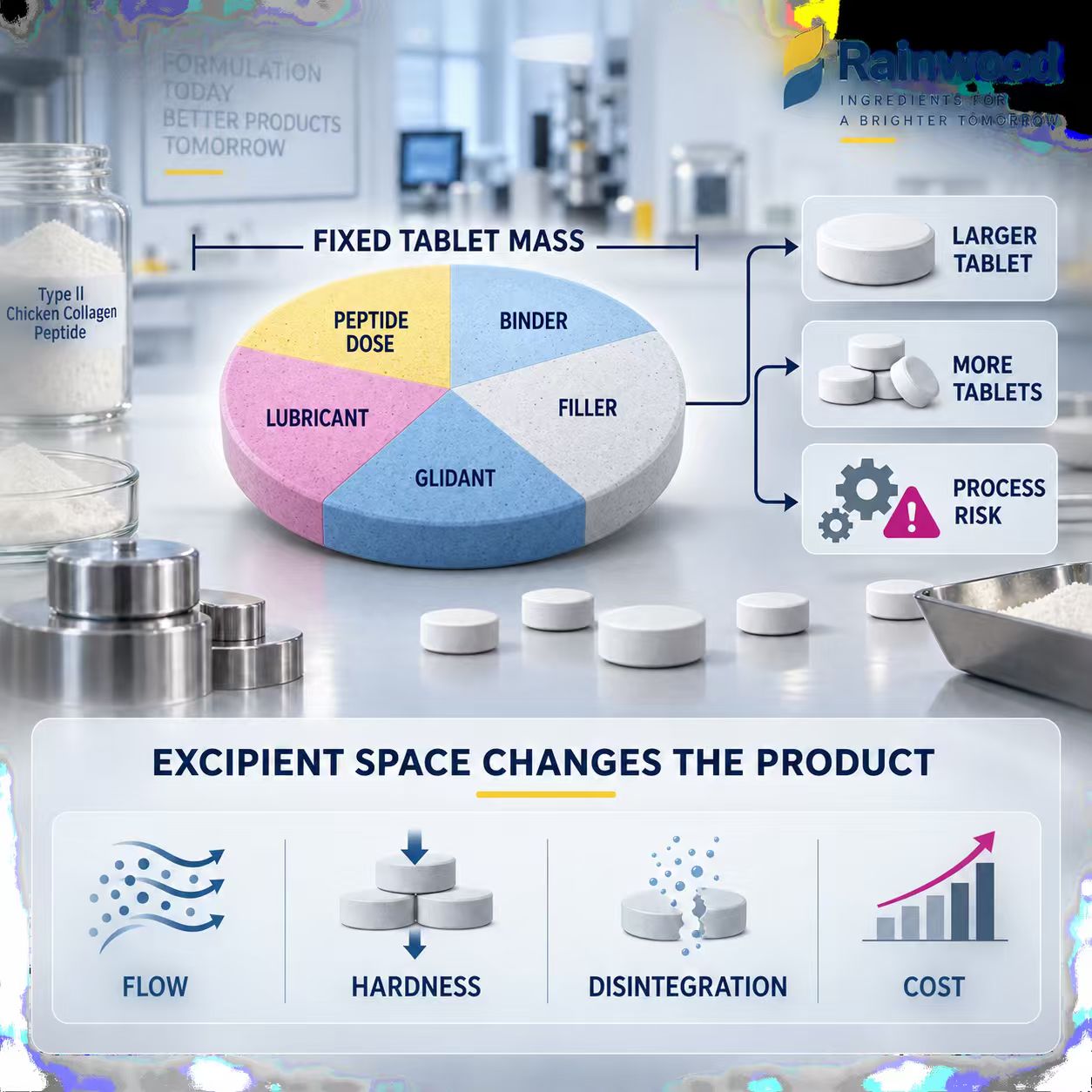
When a peptide has poor flow or weak compactability, the formulation team may add more binder, filler, glidant, or lubricant. Each addition consumes tablet weight and changes the active percentage. The product may require two tablets instead of one, or a larger tablet that customers dislike swallowing.
This is the commercial trade-off that a “high collagen per serving” claim can conceal. A formula can meet the target amount on paper while becoming too large, too hard, too slow to disintegrate, or too expensive to manufacture. If the marketing team refuses to change the serving size, the press operator may compensate with pressure and create a different release profile.
Calculate the tablet mass early. Include peptide dose, excipient system, expected overage, coating, and tooling limits. Then run a pilot at a realistic scale and speed.
Read the capsule dose and density calculation for type II peptides because tablet feasibility begins with the same mass and density reality.
Compression can expose lot-to-lot variation
A small shift in moisture or particle-size distribution can change flow and compaction. A lot with higher moisture may stick to tooling, while a drier lot may create more fines and segregate from larger excipients. A different peptide distribution can alter binding or tablet hardness without changing the headline protein assay.
The supplier incentive is to report the easiest chemical result, while the buyer needs physical performance data. Add format-relevant parameters to the specification: moisture, bulk density, particle size, flow behavior, and a defined sample-to-bulk compression check. The exact limits should be validated against your equipment rather than copied from an unrelated powder.
The compression variables that need a decision record
Record the variables that can change the finished product:
- pre-blend and lubrication time;
- room temperature and relative humidity;
- feeder speed and dwell time;
- compression force and tablet weight;
- tooling size and shape;
- binder, filler, and disintegrant grade;
- coating or polishing exposure;
- in-process weight, hardness, thickness, friability, and appearance checks.
If a supplier changes the peptide source, hydrolysis process, drying system, or packaging, repeat the impact assessment. Do not treat the new lot as equivalent because the average protein number matches.
A tablet release table that catches more than hardness
| Check | Why it matters | Buyer decision |
|---|---|---|
| Average tablet weight | Dose consistency | Define target and variation |
| Hardness and friability | Handling and packaging | Balance strength with release |
| Thickness | Bottle and blister fit | Confirm tooling and pack count |
| Disintegration or dissolution | Finished-product performance | Set method and limit for formula |
| Content uniformity | Serving consistency | Link to blend and sampling plan |
| Moisture | Stability and sticking | Check before and after storage |
| Appearance | Consumer acceptance | Define color, chips, capping, and mottling |
A tablet that looks perfect can still fail disintegration. A tablet that passes hardness can still fail content uniformity. Keep the release panel connected to the buyer promise.
How RainwoodBio can validate the format before artwork locks the formula
RainwoodBio publishes tablet and other supplement format capabilities, along with requirement confirmation, sample development, production control, testing and release documentation, packaging, and traceability. For a type II peptide tablet, the useful control is a pilot that tests the actual dose and tablet weight before commercial artwork and tooling are fixed.
Request a tablet compression feasibility review with your peptide COA, target dose, tablet size, excipient preference, and packaging plan.
Your compression approval gate
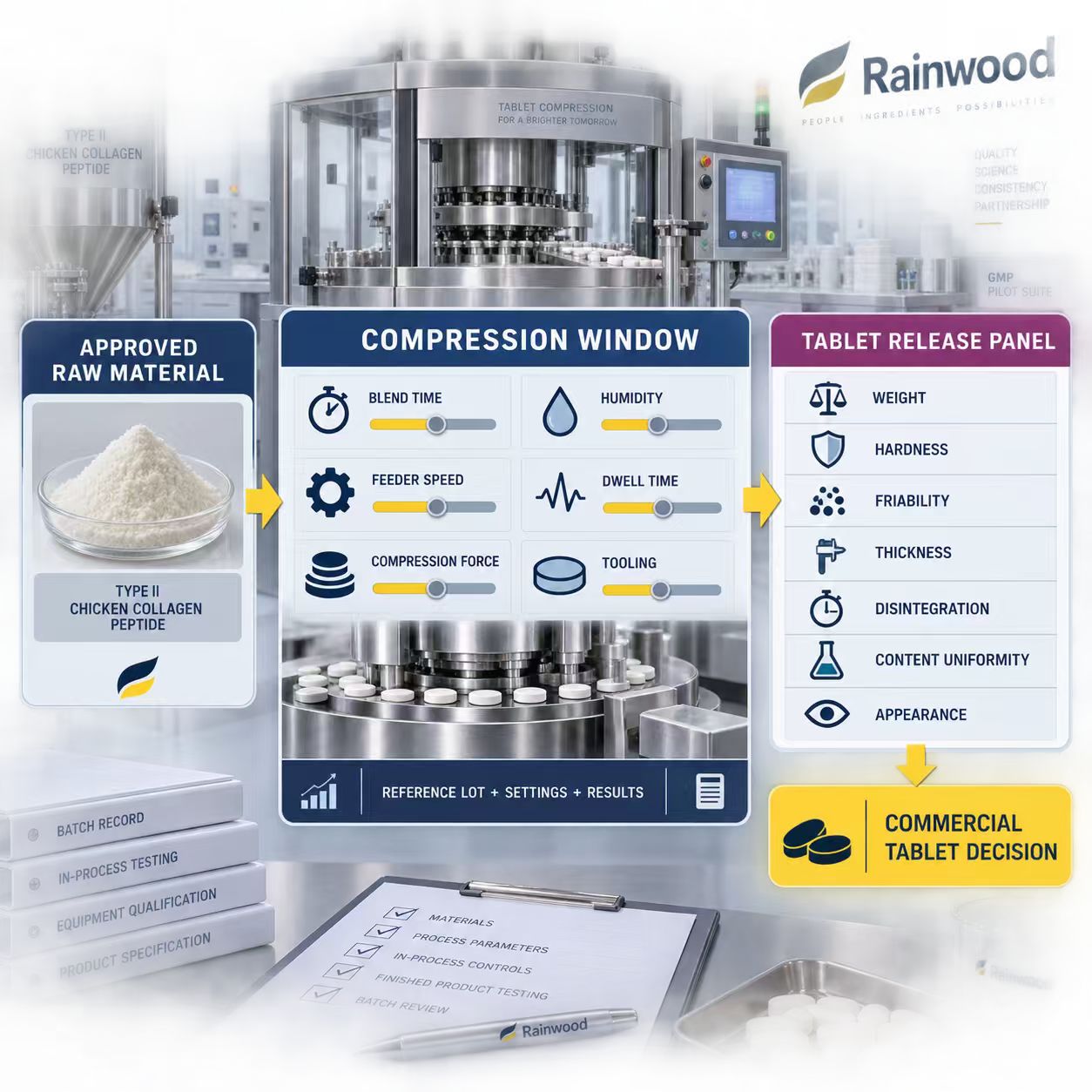
Before production approval, require:
- a defined raw-material physical specification;
- a pilot using the commercial or representative lot;
- a documented compression window, not one successful setting;
- in-process controls for weight, hardness, friability, and appearance;
- finished-product testing for content uniformity and disintegration or dissolution;
- an impact assessment for source, enzyme, drying, or moisture changes;
- a package and stability plan appropriate to the peptide and tablet.
Send the proposed formula, tablet dimensions, target serving, equipment constraints, and supplier documents for a type II collagen tablet-risk review. RainwoodBio can help determine whether the problem is a raw-material issue, a formulation issue, or a compression-window issue.
Keep compression data with the supplier record
When a tablet pilot succeeds, retain the lot number, blend order, equipment settings, humidity, tooling, and in-process results. Those details create a reference window for the next shipment. Without them, a future operator may repeat the formula at a different speed or pressure and blame the peptide for a process difference. The record also helps distinguish a genuine raw-material drift from a machine-maintenance problem. For a supplier change, run the new material through the same reference window before approving a new tablet specification.
If the tablet must be coated, include coating weight, drying exposure, and final disintegration in the comparison. Compression and coating can interact with moisture and release behavior.
Frequently asked questions
1.Can I use the same tablet process for every collagen peptide?
No. Particle properties, moisture, density, molecular-weight distribution, and source components can change compression behavior. Validate the specific grade and formula.
2.Does higher compression force fix weak tablets?
Not reliably. It can increase hardness while worsening capping, sticking, disintegration, or release. Adjust the formulation and process based on measured results.
3.Is tablet hardness enough for release?
No. Hardness should be reviewed with friability, weight, appearance, content uniformity, disintegration or dissolution, and stability.
References
- TGA, Hydrolysed Chicken Cartilage Extract compositional guideline: https://www.tga.gov.au/resources/resources/compositional-guidelines/hydrolysed-chicken-cartilage-extract
- Preparation of Type II Collagen Short Peptides: https://pubmed.ncbi.nlm.nih.gov/34046790/
- RainwoodBio OEM information: https://www.rainwoodbio.com/oem
This article is for B2B procurement and educational purposes. Tablet performance, safety, labeling, stability, and regulatory requirements must be confirmed for the exact ingredient, formula, equipment, and destination market.