 EN
EN

Meta title: Type II Collagen Peptide Gummies and Powder Guide
Meta description: Type II chicken collagen peptide can create taste, solubility, clumping, and moisture problems. Test the format before you promise a clean experience.
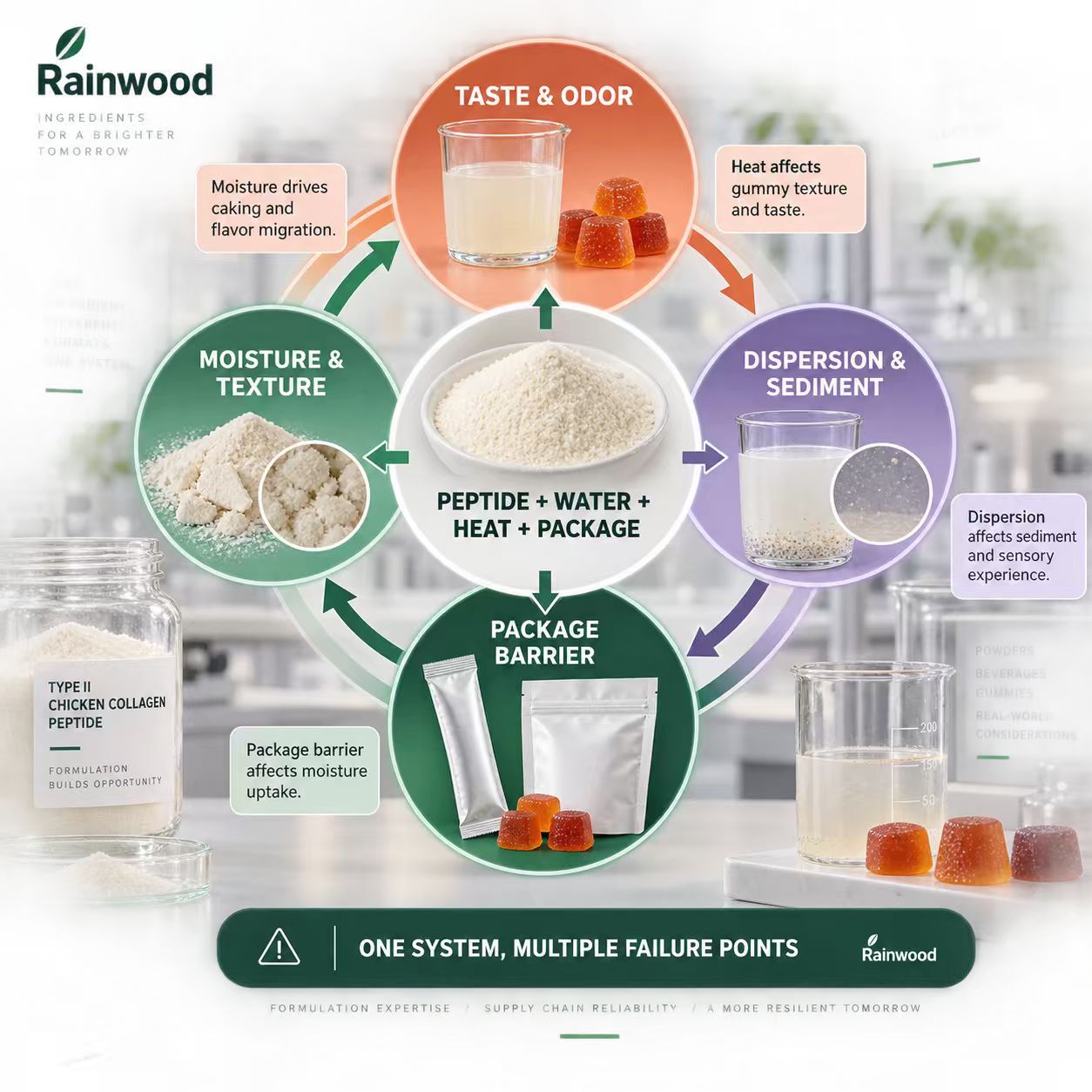
The powder passed the lab test. The gummy pilot did not. The drink leaves sediment, the sachet cakes after shipping, or the flavor system needs so much masking that the margin disappears. These failures are often treated as separate formulation surprises, but they can share one cause: the peptide, water, heat, and package were never evaluated as one system.
Type II chicken collagen peptide is a protein-derived material. Its hydrolysis level, accompanying cartilage compounds, moisture, particle size, and bulk density can influence taste and handling. A dry COA cannot tell you whether a consumer will accept the finished drink or whether a gummy will remain stable through a warm distribution route.
The format changes the risk profile
A powder sachet must disperse quickly and remain free-flowing during filling and shipping. A beverage must hydrate without excessive foam, sediment, or odor. A gummy must survive heating, solids adjustment, acidification, molding, and storage without texture or flavor failure. The same ingredient can work in one format and fail in another because the process exposes different weaknesses.
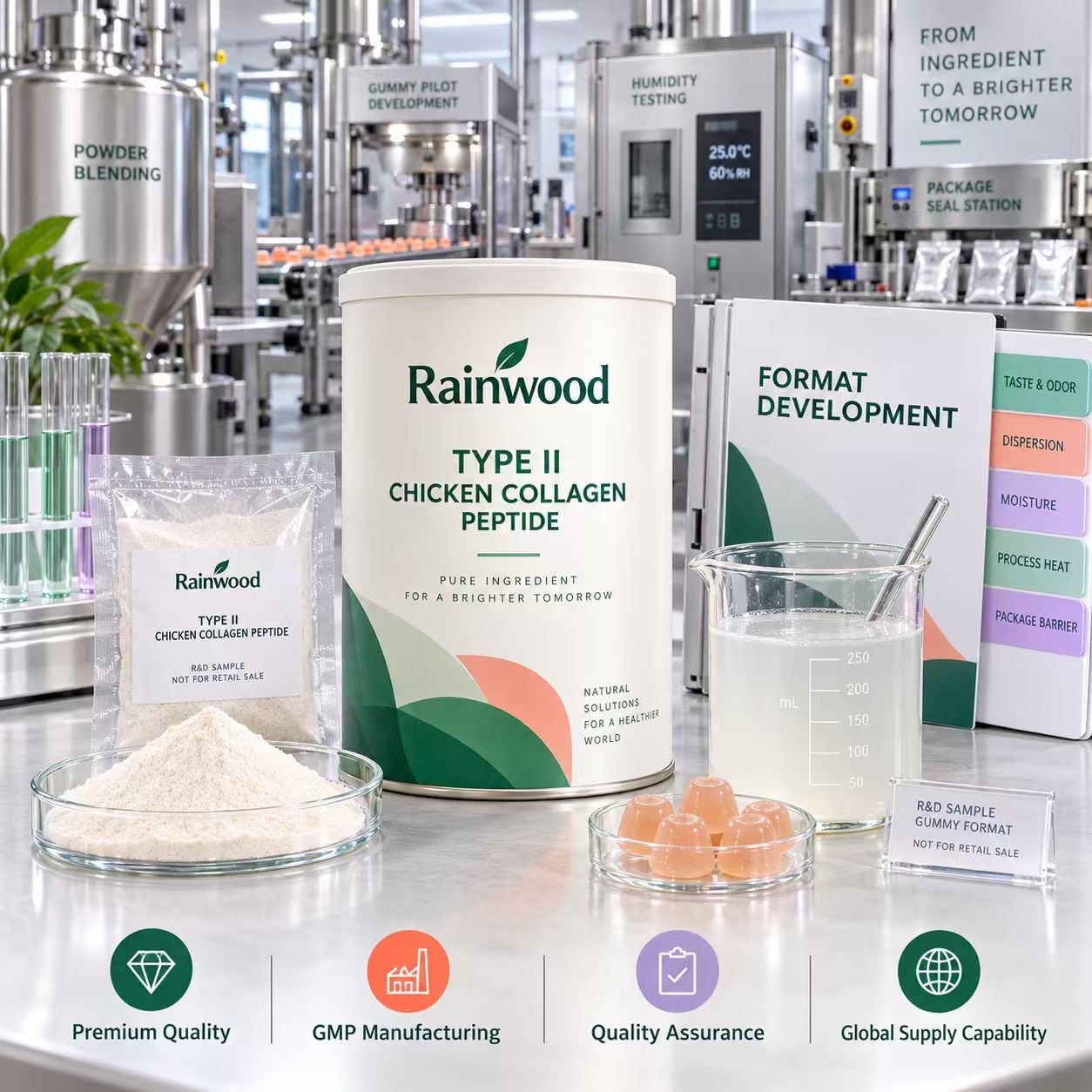
Use our type II collagen peptide format comparison to set format-specific acceptance criteria rather than asking whether the raw powder is simply “soluble.”
Taste is a sourcing and process question, not only a flavor question
Chicken cartilage-derived ingredients can contribute savory, animal, or sulfur-like notes depending on source, hydrolysis, concentration, filtration, drying, and accompanying components. A strong masking system may cover the first sample but fail after storage, when moisture and flavor migration change the perception. If the supplier changes the source or process, your flavor balance can move even when the protein assay does not.
The buyer loss is obvious in a DTC product: poor first-use experience can increase refunds and reviews, while an overly aggressive flavor system increases cost and may create its own stability problem. In a private-label project, a failed pilot can delay artwork, launch inventory, and seasonal commitments.
Ask the supplier for a retained sample and evaluate it after hydration in the same base you plan to sell. Record odor before mixing, during mixing, and after the product stands. Do not rely on a dry powder sniff test alone.
Read the composition risks beyond collagen protein when taste or color changes appear between lots.
Solubility is a timed performance test
“Soluble” should have a definition. Specify the water volume, temperature, mixing method, powder-to-liquid ratio, hydration time, acceptable sediment, foam, and visual standard. A peptide can disperse quickly in a laboratory beaker but form a persistent layer in a cold shaker bottle or leave particles after a consumer waits ten minutes.
For gummies, the relevant question may be dispersion into the hot syrup or aqueous phase, not a glass of water. If the powder is added after the mass has cooled, the process may create a different risk from adding it before cooking. The specification should state the addition point and the maximum exposure to heat.
Moisture links powder handling, texture, and shelf life
Peptide powders can absorb moisture during blending, filling, transport, or opening by the end user. The result can be caking, poor flow, altered dissolution, and microbial or stability concerns. In a gummy, the peptide may change water activity, texture, or the balance between a soft bite and a sticky surface.
Check moisture and water activity under the actual package conditions. Evaluate the powder after accelerated handling or a practical shipping simulation if the destination climate is humid. For sachets, test seal integrity and barrier performance. For gummies, check texture and moisture migration between the gummy and the package.
A format trial that produces useful evidence
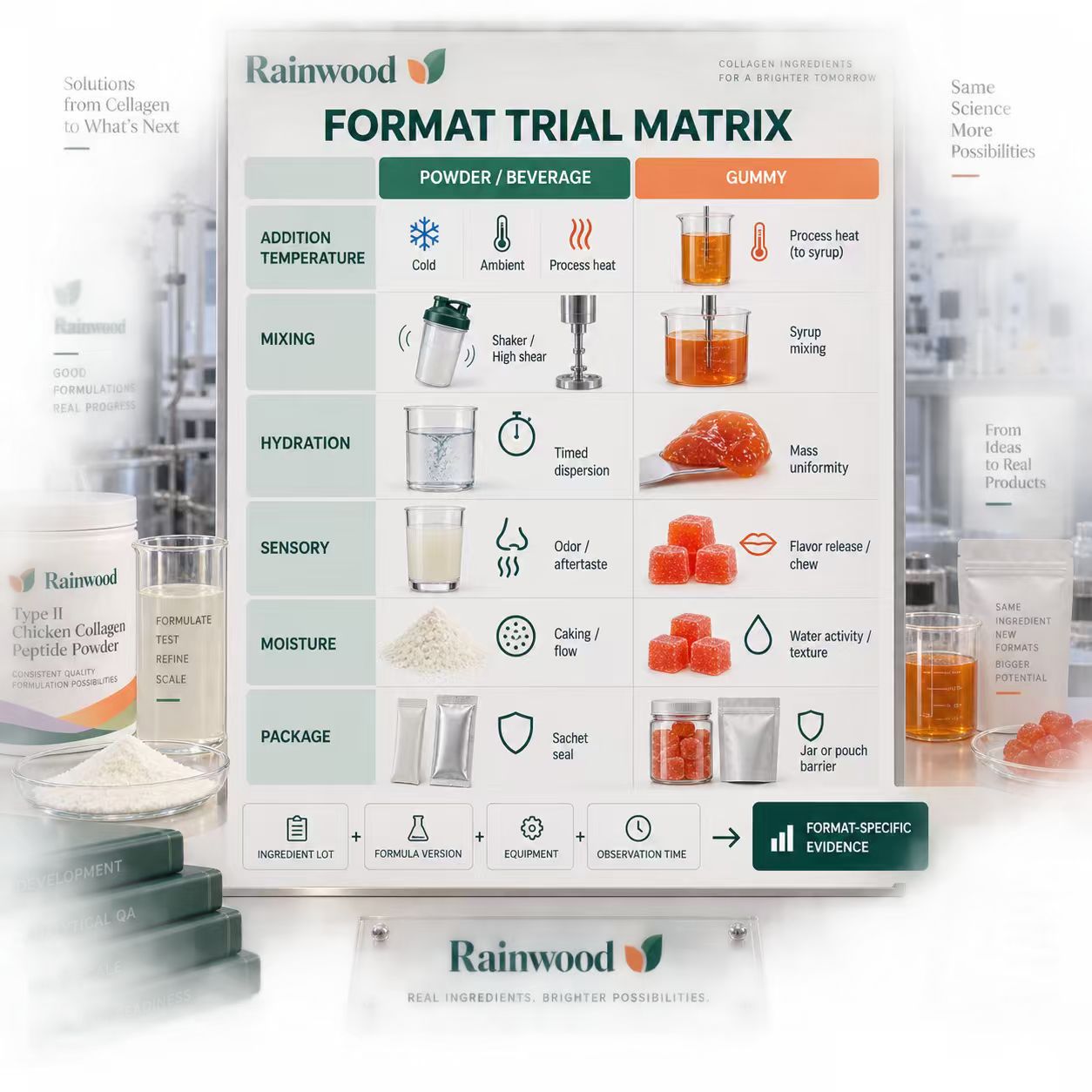
Run a small design matrix instead of one pass-or-fail batch:
| Variable | Powder or beverage test | Gummy test |
|---|---|---|
| Addition temperature | Cold, ambient, and intended process temperature | Before and after cooking window |
| Mixing | Shaker, high shear, or line process | Syrup mixing and hold time |
| Hydration | Timed dispersion and sediment | Uniform distribution in the mass |
| Sensory | Odor, flavor, aftertaste | Flavor release, chew, and surface |
| Moisture | Caking and flow after storage | Water activity and texture drift |
| Package | Sachet barrier and seal | Jar or pouch migration and seal |
Record the ingredient lot, formula version, equipment, and observation time. A good pilot is an evidence bridge between the raw-material COA and the customer experience.
How RainwoodBio can move the peptide from sample to sellable format
RainwoodBio describes support for powders and sachets, gummies, hard capsules, tablets, softgels, requirement confirmation, sample development, testing and release documentation, packaging, and traceability. For a sensory-sensitive peptide, the useful capability is format comparison before the final label and package are locked.
Request a gummy or powder pilot feasibility review with your target dose, flavor profile, package, market, and shipping conditions.
Approval checklist for a consumer-ready format
Before approving production, confirm:
- The raw material source and process are locked for the pilot and commercial lot.
- Taste and odor are evaluated after hydration or processing, not only as dry powder.
- Solubility or dispersion has a defined time and visual limit.
- Moisture and water activity fit the package and climate.
- The flavor system has been checked after stability exposure.
- The format trial uses the actual serving mass and realistic equipment.
- Lot changes trigger a sensory and physical requalification decision.
Send your draft formula, flavor system, target dose, package, and intended shipping market for a type II collagen format-risk review. RainwoodBio can help identify whether the problem belongs to the peptide, the process, the package, or the combination.
Do not approve sensory performance from a single day
Run the product through the use conditions your customer will experience. Test a sachet after transport simulation, a powder after repeated opening, and a gummy after the intended storage window. Record whether odor becomes stronger, whether particles settle, whether the seal remains intact, and whether the texture changes. If the formula is sold in multiple climates, compare a dry warehouse condition with a humid route. These checks do not replace formal stability work, but they expose obvious format risks before you order a full print run and a large quantity of packaging.
When a sensory issue appears, identify whether it originates in the collagen lot, flavor system, water activity, processing temperature, or package. Changing flavor alone can hide the symptom without removing the cause.
Frequently asked questions
1.Can flavoring solve every chicken collagen taste problem?
No. Flavoring can mask some notes, but source, process, concentration, moisture, and storage can change the underlying profile. Confirm the raw material and test the complete formula.
2.Is a clear drink always the best format for collagen peptides?
Not necessarily. A clear drink may require tighter control of dispersion, sediment, and visual appearance. A powder, capsule, or flavored suspension may be more forgiving depending on the product promise.
3.Should I specify a maximum moisture value?
Usually the specification should include a moisture limit and, where relevant, water activity or packaging controls. The exact limit must be validated for the grade and format.
References
- TGA, Hydrolysed Chicken Cartilage Extract compositional guideline: https://www.tga.gov.au/resources/resources/compositional-guidelines/hydrolysed-chicken-cartilage-extract
- Preparation of Type II Collagen Short Peptides: https://pubmed.ncbi.nlm.nih.gov/34046790/
- RainwoodBio OEM information: https://www.rainwoodbio.com/oem
This article is for B2B procurement and educational purposes. Sensory, stability, safety, labeling, and regulatory requirements must be confirmed for the exact ingredient, formula, package, processing line, and destination market.