 EN
EN

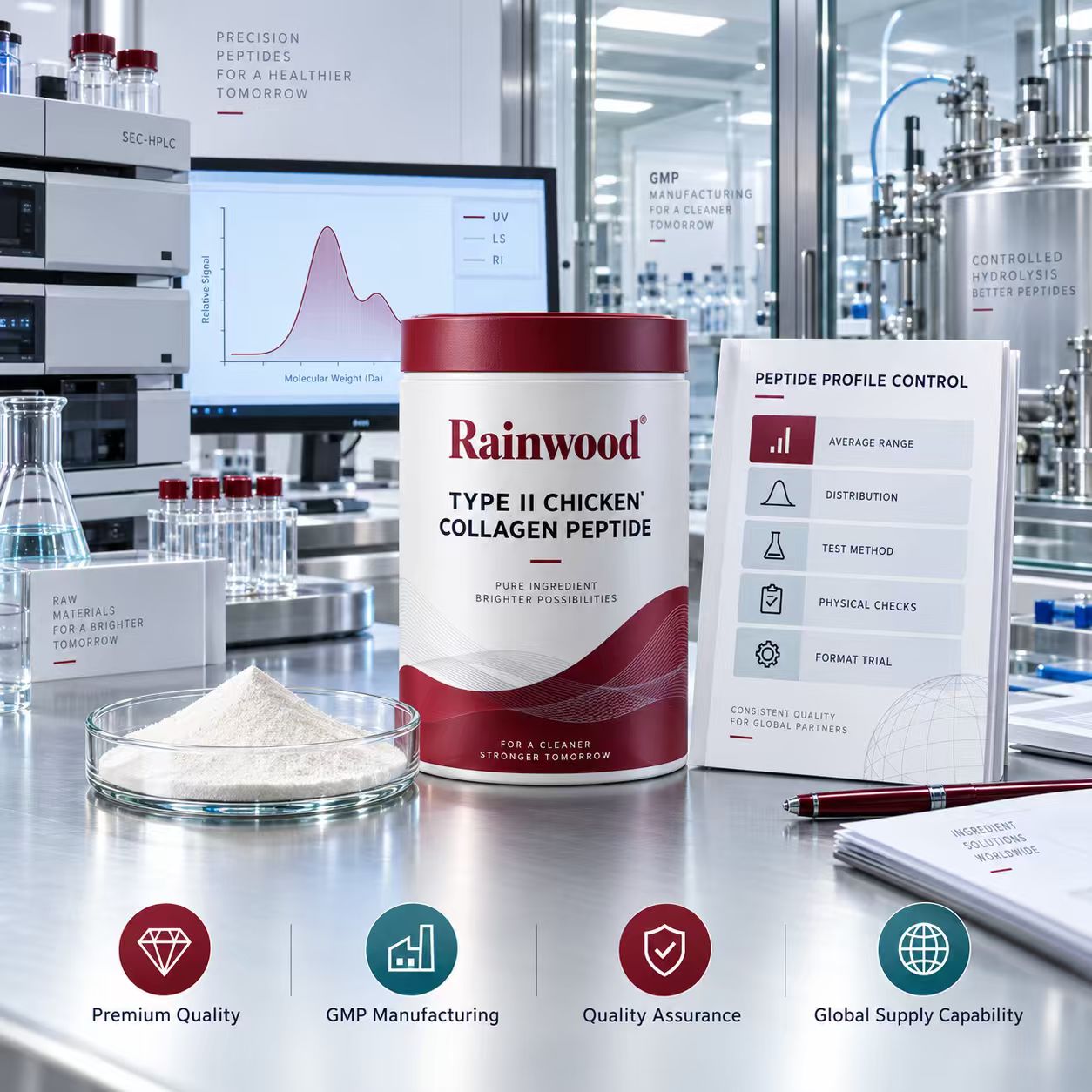
Meta title: Type II Collagen Peptide Molecular Weight Guide
Meta description: Average molecular weight is not the whole peptide profile. Learn how distribution, hydrolysis, solubility, taste, and lot control affect your formula.
Your supplier highlights one number: average molecular weight. It looks precise, easy to compare, and reassuringly technical. But an average can hide a wide population of peptides, and that population is what your production line actually handles.
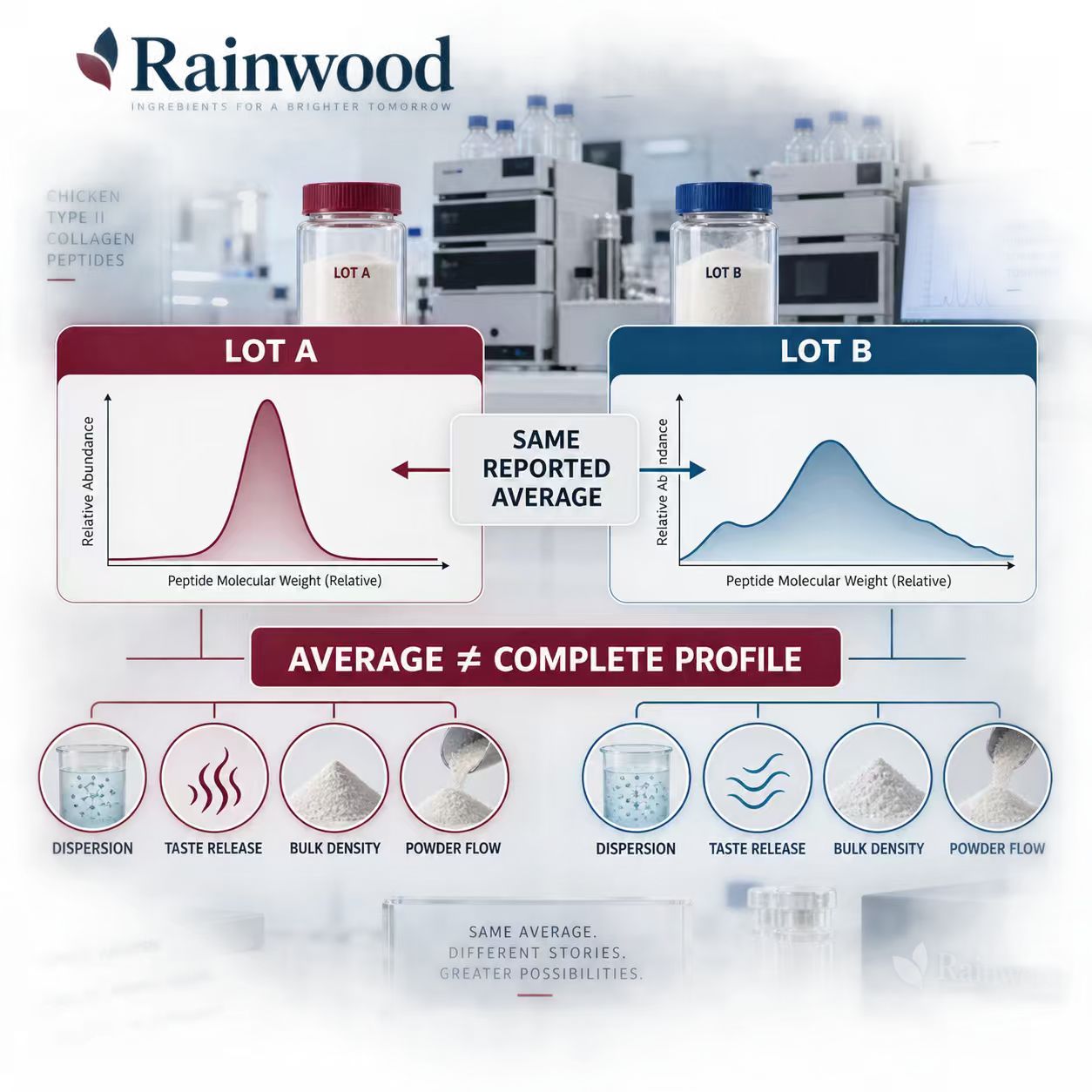
For a type II chicken collagen peptide buyer, molecular weight is not a decoration on the specification sheet. It can affect solubility, viscosity, taste release, hygroscopicity, bulk density, capsule fill, powder flow, and the consistency of every blend. A supplier can report the same average for two lots whose distributions behave differently in your formula. Approving the average without defining the method and range is how a clean sample becomes an expensive production problem.
Average molecular weight is a summary, not a complete identity
Hydrolysis breaks larger collagen molecules into peptide fragments. Enzyme selection, temperature, pH, reaction time, filtration, concentration, and drying determine how much of the starting material is converted and how the peptide population is distributed. Two suppliers may both report an average of roughly the same size while one lot contains a longer tail of larger peptides and the other contains mainly short fragments.
That difference can show up in the factory. One powder may disperse quickly but develop a stronger savory note. Another may dissolve slowly, foam, or create a different mouthfeel. In a capsule, the apparent bulk density and flow may shift the number of capsules required. In a gummy, the peptide may interfere with texture or create a flavor that cannot be masked at the intended dose.
Use our molecular-weight and peptide-profile specification before you compare quotations on average value alone.
Why the test method belongs beside the number
“Molecular weight: 2,000 Da” is incomplete unless the report explains how the result was obtained. Ask whether the method is SEC-HPLC, another chromatographic approach, or a calculation based on a reference standard. Ask whether the value is number-average, weight-average, a peak value, or a distribution estimate. Ask what calibration materials and sample preparation were used.
The result is only comparable when the methods are comparable. A method that dissolves the sample differently, uses a different column range, or reports a different average can make two suppliers appear equivalent when they are not. The TGA guidance for hydrolysed chicken cartilage extract gives an example of a defined average molecular-weight range, but your specification still needs to state the exact method and acceptance basis for the purchased grade.
Read how the source and assay affect type II identity because molecular weight supports process and performance decisions; it does not replace source or type evidence.
The hidden manufacturing incentive
Hydrolysis is a cost and performance lever. More intensive processing can change reaction time, enzyme demand, filtration load, concentration energy, and drying behavior. A supplier may optimize for throughput or a headline average rather than the distribution your formula needs. If the specification only controls average molecular weight, a process change can remain invisible until the material reaches your line.
The buyer loss is easy to calculate. A powder that flows poorly may need extra labor, slower filling, or a new excipient. A formula that develops stronger taste may require a flavor system, increasing cost and extending stability work. If the blend segregates, a finished product can fail uniformity even though every raw-material assay passes.
Define the business consequence before defining the test. For a drink, prioritize dispersion time, sediment, viscosity, and sensory behavior. For a capsule, prioritize bulk density, flow, fill-weight variation, and capsule count. For a tablet, add compressibility, ejection behavior, hardness, and disintegration.
Turn peptide distribution into a release decision
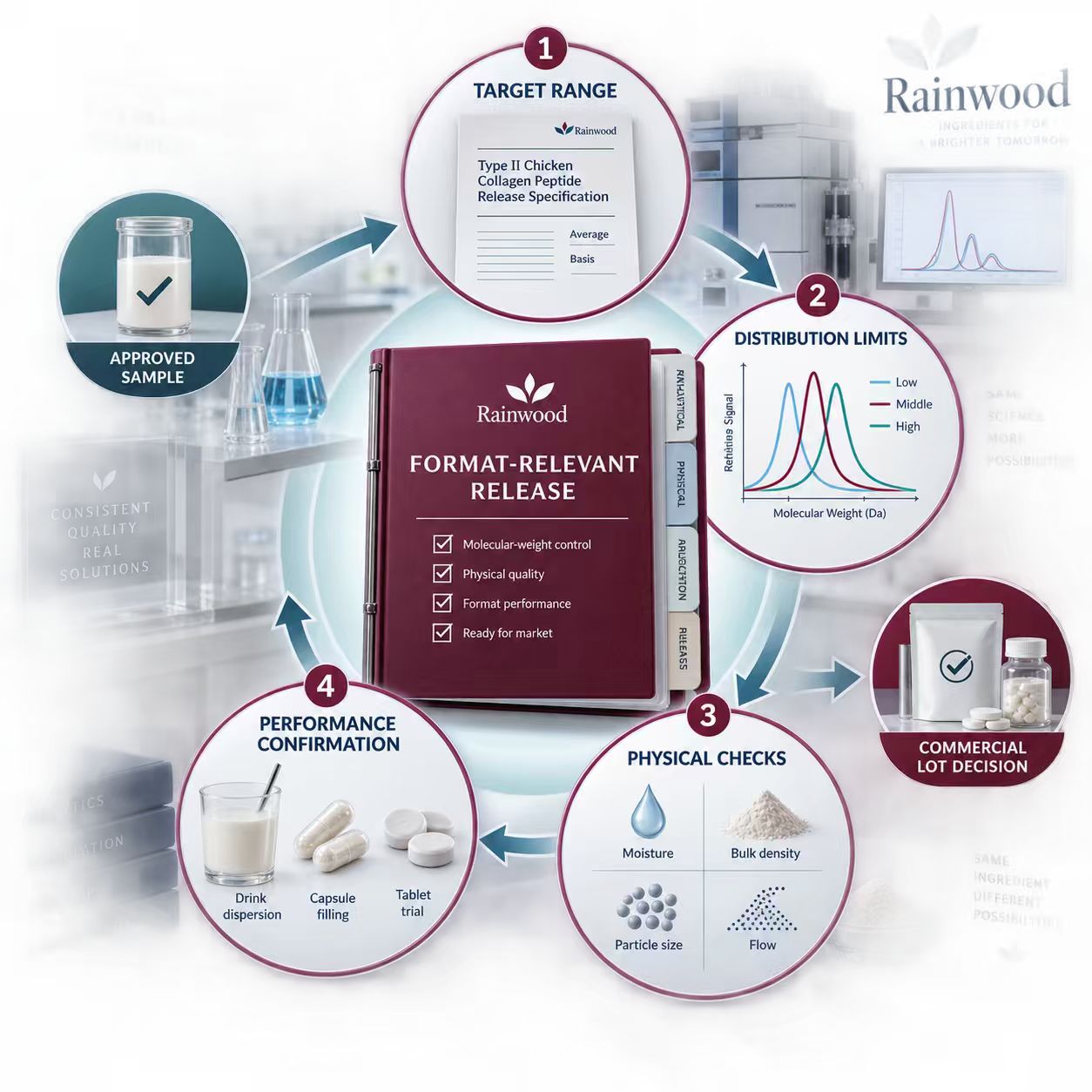
Create a four-part specification:
1. Average or target range. State the value and calculation basis.
2. Distribution limits. Where possible, define the acceptable proportion in lower, middle, and higher molecular-weight bands.
3. Physical checks. Include moisture, bulk density, particle size, flow, color, odor, and dispersibility when the format depends on them.
4. Performance confirmation. Test the approved sample in the actual formula or a representative base before the lot is released.
Do not make every performance limit universal. A powder intended for a hard capsule does not need the same sensory gate as a clear beverage. The specification should be strict about the risk that can cause your particular buyer loss.
Sample-to-bulk comparison that catches the drift
When the commercial lot arrives, compare it with the approved sample under the same conditions. Use the same solvent or formula base, mixing speed, temperature, hydration time, and observation window. Record not only whether the material dissolves, but how long it takes, whether it foams, whether sediment remains, and whether the odor changes after hydration.
For a high-risk format, retain a reference sample and repeat the molecular-weight analysis with the agreed method. If the result moves outside the range, do not accept a supplier explanation based only on “normal variation.” Ask which process step changed, whether the source changed, and how the supplier will prevent recurrence.
RainwoodBio can make molecular weight relevant to the finished format
RainwoodBio publishes support for requirement confirmation, sample development, production control, testing and release documentation, and multiple finished formats. The useful project control is to connect the peptide specification to the formula trial instead of approving a raw-material number in isolation.
Ask for a powder, capsule, or tablet feasibility comparison with your target dose, serving size, flavor system, packaging, and annual volume.
Molecular-weight approval checklist
Before you accept a specification, confirm:
- What does the reported molecular-weight number mathematically represent?
- Which method, column, calibration, and sample preparation were used?
- Is the distribution controlled or only the average?
- Does the range match the formula format and sensory target?
- Are moisture, bulk density, particle size, and flow included where needed?
- Is the approved sample tested in the same base as the commercial formula?
- What process or raw-material changes require requalification?
- Will the supplier provide a lot-specific result rather than a generic product sheet?
Send the current COA, molecular-weight report, formula target, and planned format for a peptide-profile feasibility review. RainwoodBio can help identify whether the number you are buying controls the performance you actually need.
Frequently asked questions
1.Is a lower molecular weight always better?
No. “Better” depends on the formula, sensory profile, solubility target, dose, evidence, and manufacturing process. A lower number without a controlled distribution can still create inconsistency.
2.Can two lots with the same average behave differently?
Yes. Different distributions, moisture levels, particle properties, and accompanying cartilage components can produce different handling and sensory results.
3.Should every buyer require the same molecular-weight range?
No. The range should be linked to the intended application and validated under the buyer’s process conditions.
References
- TGA, Hydrolysed Chicken Cartilage Extract compositional guideline: https://www.tga.gov.au/resources/resources/compositional-guidelines/hydrolysed-chicken-cartilage-extract
- Preparation of Type II Collagen Short Peptides: https://pubmed.ncbi.nlm.nih.gov/34046790/
- Low molecular weight type II collagenous polypeptide study: https://pmc.ncbi.nlm.nih.gov/articles/PMC4573174/
- RainwoodBio OEM information: https://www.rainwoodbio.com/oem
This article is for B2B procurement and educational purposes. Molecular-weight methods, product specifications, safety, labeling, and format performance must be confirmed for the exact ingredient, formula, process, and destination market.