 EN
EN

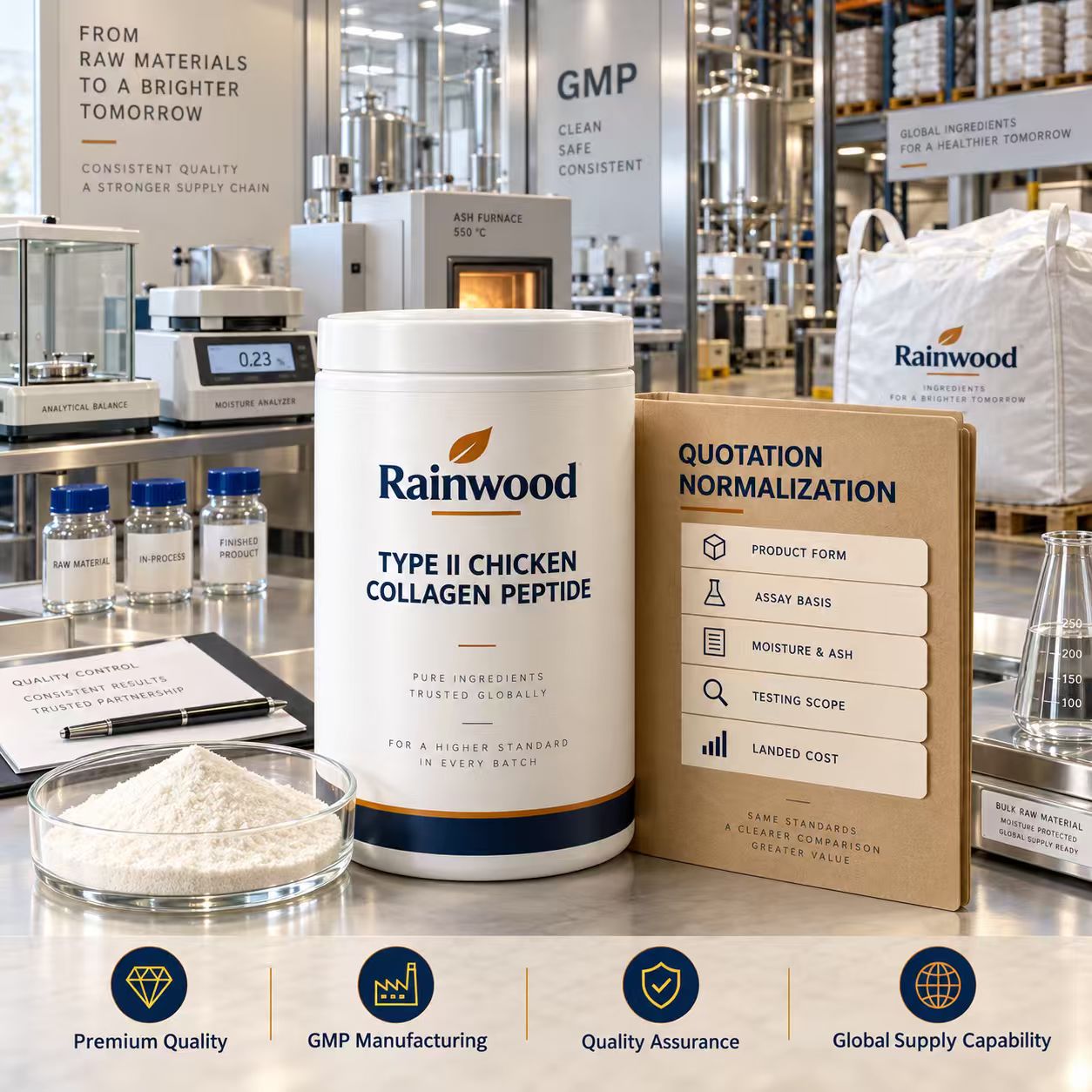
Meta title: Cheap Type II Chicken Collagen Quote Risk Guide
Meta description: A low type II collagen peptide quote may shift cost into moisture, ash, hidden cartilage components, weaker testing, or finished-product rework.
The quotation is 12% below your current supplier. The protein number looks close, so purchasing asks why you are waiting. But a raw-material price is only comparable when the material, basis, test panel, package, Incoterm, and risk allocation are comparable.
For type II chicken collagen peptide, a low quote can reflect a real efficiency. It can also reflect more moisture, higher ash, a broader cartilage extract, weaker peptide control, fewer lot tests, different packaging, or a trader margin that disappears only after the deposit is paid. The buyer mistake is not choosing the cheaper supplier. It is comparing unlike materials as if they were the same grade.
Normalize the quote before celebrating the saving
Put every quotation into the same template:
- exact product form: hydrolyzed peptide or undenatured collagen;
- chicken tissue and source statement;
- collagen or protein assay and calculation basis;
- molecular-weight or peptide-profile requirement;
- moisture, ash, microbiology, and heavy-metal limits;
- accompanying cartilage components if relevant;
- packaging, net weight, and overage;
- testing included in the price;
- MOQ, lead time, Incoterm, freight, and payment terms;
- change-control and replacement policy.
Use our type II collagen quotation normalization checklist before ranking the lowest price.
How composition can create a false discount
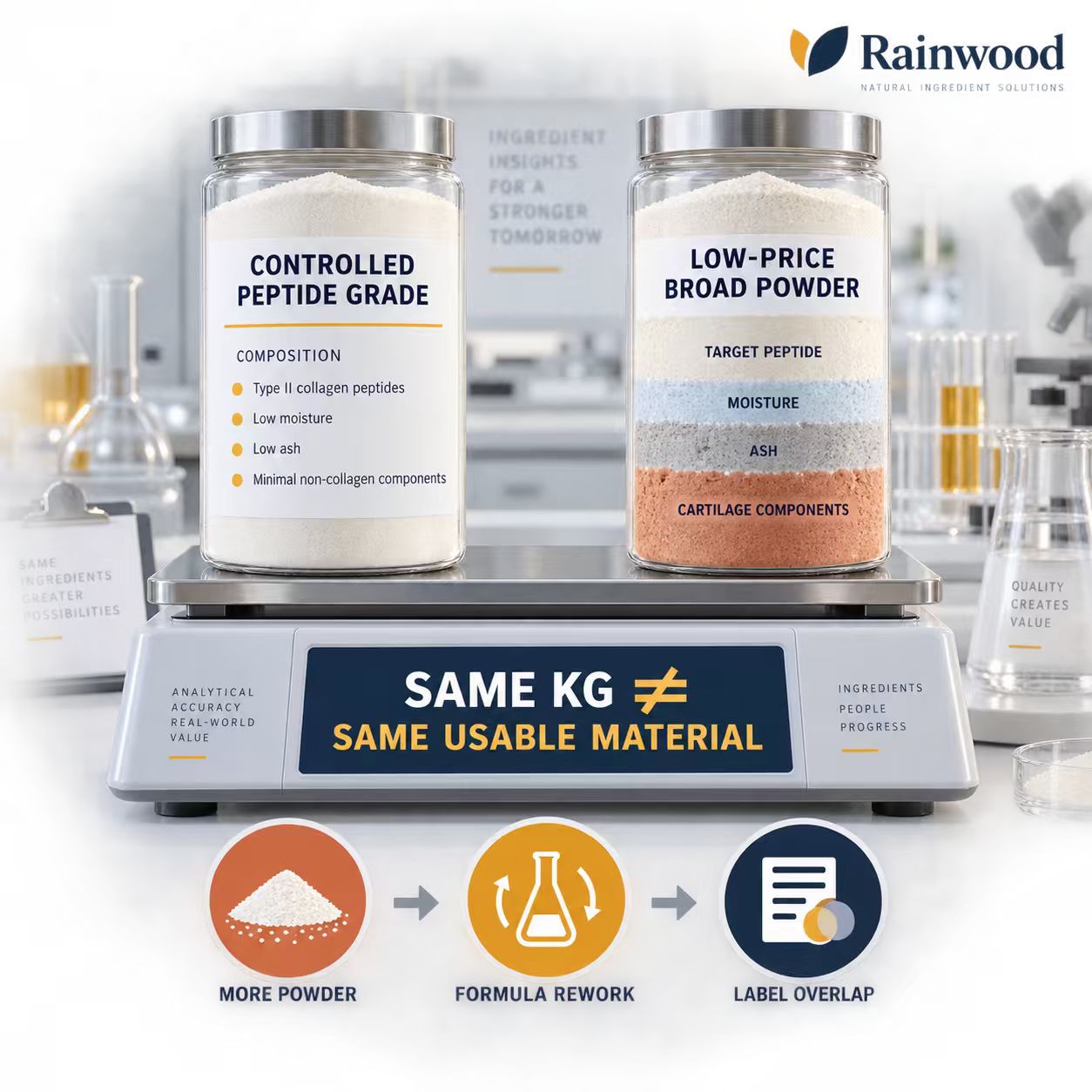
Suppose Supplier A quotes a peptide grade on a dry-basis specification with controlled moisture and molecular-weight distribution. Supplier B quotes a broader cartilage-derived powder with a similar protein headline but no limit for ash or accompanying components. The second price can be lower because more of the material is not the property you are actually paying to deliver.
Higher moisture increases the mass you must ship to deliver the same dry material. Higher ash can change sensory behavior and finished-product calculations. Uncontrolled chondroitin sulfate or hyaluronic acid can create label overlap or a formula contribution you did not plan. A broad powder can also behave differently in capsules, drinks, gummies, or tablets.
The loss appears after production: more capsules, extra masking, a failed pilot, or a label correction. The “saving” then becomes rework and inventory risk.
Read what a collagen composition COA can leave unverified before accepting a one-number comparison.
Testing scope is part of the price
A cheap quote may include only a generic COA. Your project may require lot-specific identity, molecular-weight distribution, moisture, ash, heavy metals, microbiology, source documentation, and finished-format testing. Add those costs to the comparison.
Ask whether the quoted test is performed by the manufacturer, a qualified external laboratory, or a document supplier. Confirm which method and lot the report covers. Do not pay a premium for a named instrument without knowing whether the method answers your identity or contaminant question.
The same logic applies to packaging. A peptide that is hygroscopic may need a better moisture barrier, liner, desiccant, or smaller pack size. If the supplier uses a cheaper bag that allows moisture uptake during transit, the delivered powder may fail flow or caking checks even though it passed at release.
The hidden cost calculation
Use a delivered-cost model:
Adjusted cost per usable kilogram = total landed cost ÷ accepted usable kilograms.
Subtract moisture or non-target components only when your specification and calculation support that treatment. Add testing, rework, rejected lots, extra excipients, packaging, storage, and delay exposure. Then compare the cost per finished serving, not only the cost per raw kilogram.
If the cheaper supplier requires 10% more powder per serving because of a lower assay basis or higher moisture, the apparent discount may disappear. If the powder creates a two-week pilot delay, the opportunity cost can exceed the invoice saving.
Questions that expose a weak low-price offer
Ask directly:
- Is the quoted grade hydrolyzed peptide or a broader cartilage extract?
- Is the price based on as-is or dry-basis values?
- What are the minimum and maximum moisture and ash limits?
- Which cartilage components are expected and reported?
- What molecular-weight range is guaranteed?
- Which tests are performed on every lot?
- Are packaging and desiccant included?
- What happens if the commercial lot fails the approved sample comparison?
- Which source, site, enzyme, or process changes require notice?
The goal is not to force the supplier to reveal proprietary details. It is to make the commercial offer measurable.
How RainwoodBio can compare price with project risk
RainwoodBio publishes requirement confirmation, supplier management, testing and release documentation, packaging, logistics, and traceability within its OEM workflow. For a peptide ingredient, the relevant capability is turning the quotation into a normalized technical and commercial comparison before production is scheduled.
Request a two-quotation type II collagen cost and risk comparison with both supplier COAs, specifications, Incoterms, target dose, format, and annual volume.
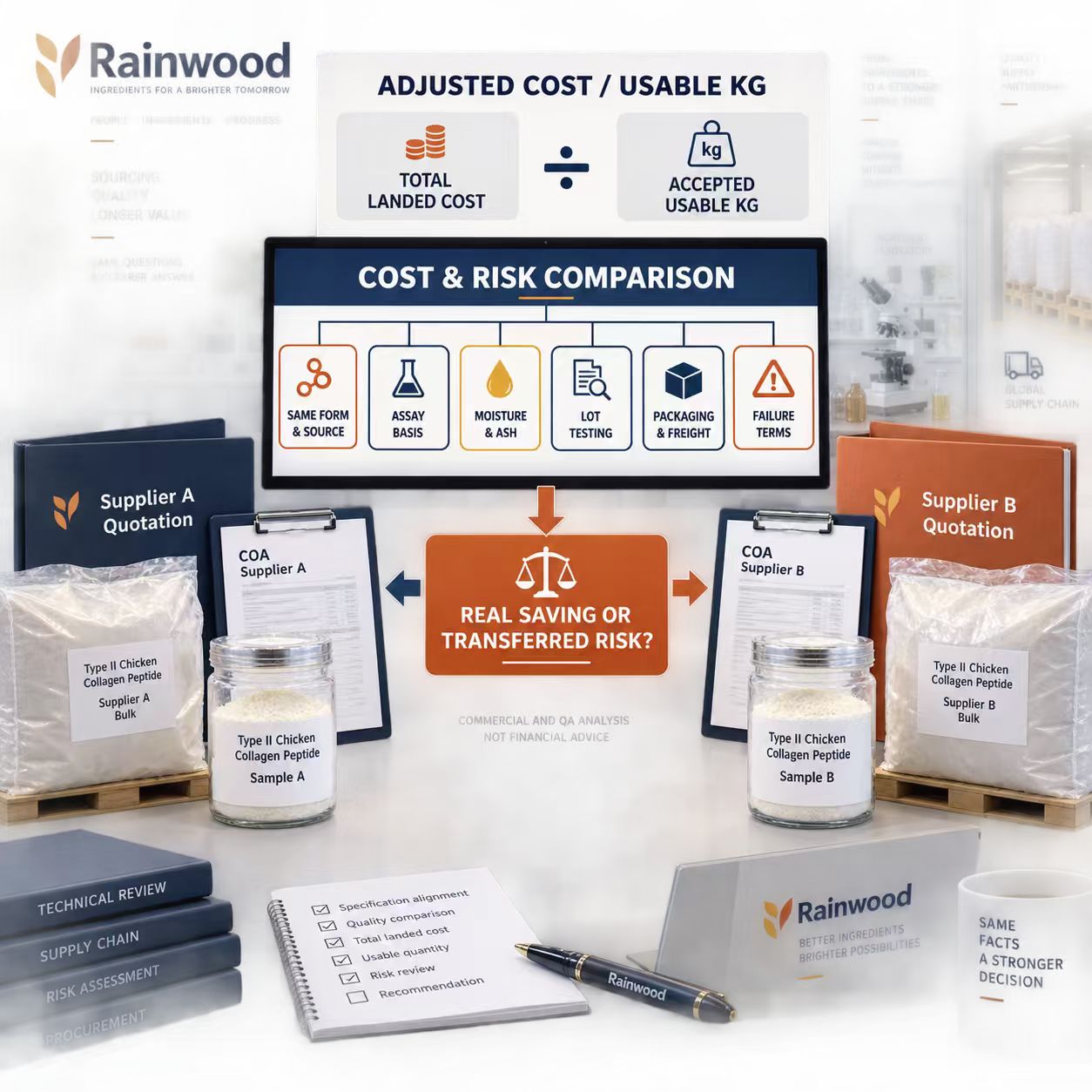
The procurement decision gate
Do not approve the cheapest offer until:
- both materials are the same form and source category;
- assay bases and acceptance limits are normalized;
- hidden composition and moisture risks are visible;
- the test panel and lot coverage are comparable;
- package and landed-cost assumptions are included;
- sample-to-bulk acceptance and replacement terms are written;
- change-control obligations are documented.
Send the quotations, COAs, target specification, formula, and delivery terms for a type II collagen quotation review. RainwoodBio can help show whether the saving is real or simply a transfer of risk into your warehouse and production line.
Quote comparison should include failure handling
Ask what happens if the first commercial lot cannot be released. Will the supplier replace the material, pay for additional testing, cover a pilot delay, or only refund the invoice? These terms have a measurable value when the ingredient is tied to a launch date or seasonal promotion. Also check whether the quote is valid for a defined period and whether a raw-material or freight change can move the price before shipment. A transparent offer explains both the normal cost and the conditions that can change it. That transparency is often more useful than a headline discount that cannot be defended after purchase.
Keep the normalized comparison on file with the approved specification so purchasing does not reopen the same ambiguity at every reorder.
Frequently asked questions
1.Is a higher price proof of a better collagen peptide?
No. Price is not identity or quality proof. Compare the exact form, specification, test scope, documentation, service, and landed cost.
2.Should I reject a quote with higher ash?
Not automatically. First determine whether the grade permits it and whether it fits your formula, label, market, and sensory requirements. If it is uncontrolled, treat it as a specification gap.
3.Can a trader provide a valid COA?
A trader can provide documents, but the buyer should verify the actual manufacturer, site, lot, method, and traceability chain behind the report.
References
- TGA, Hydrolysed Chicken Cartilage Extract compositional guideline: https://www.tga.gov.au/resources/resources/compositional-guidelines/hydrolysed-chicken-cartilage-extract
- U.S. FDA, Exploring the Scope of Dietary Supplement Ingredients: https://www.fda.gov/media/191964/download
- Comparative analysis of chicken cartilage compounds and type II collagen peptides: https://pmc.ncbi.nlm.nih.gov/articles/PMC9005812/
- RainwoodBio OEM information: https://www.rainwoodbio.com/oem
This article is for B2B procurement and educational purposes. Price, composition, analytical, safety, labeling, logistics, and regulatory requirements must be confirmed for the exact grade, lot, formula, and destination market.