 EN
EN

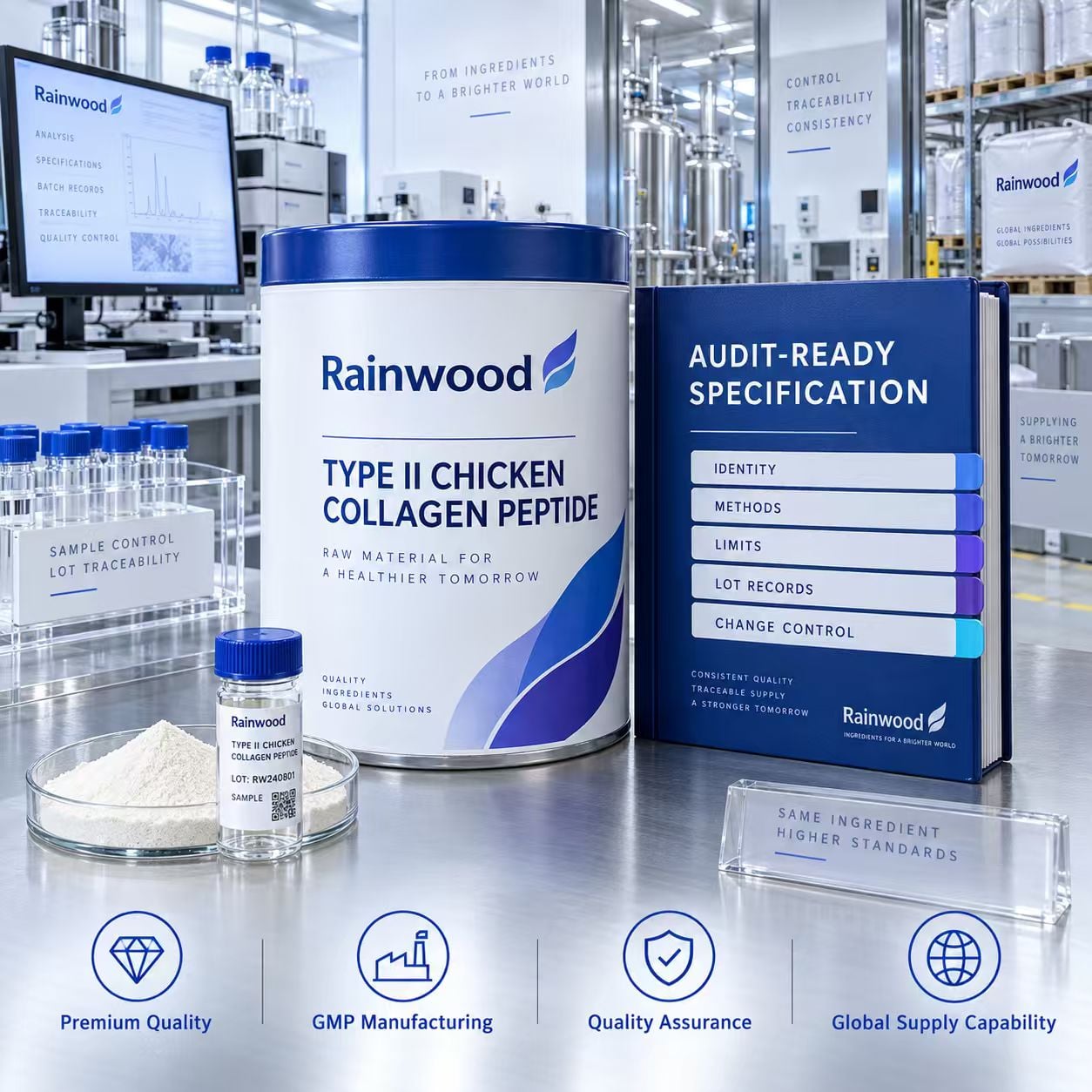
Meta title: Audit Ready Type II Chicken Collagen Specification
Meta description: Build an audit-ready type II chicken collagen peptide specification covering identity, molecular weight, contaminants, format, traceability, and change control.
An auditor does not ask whether the supplier has a nice brochure. They ask what you bought, what you required, which lot was tested, which method was used, who released it, and what happened when something changed. A one-page COA rarely answers all of those questions.
For type II chicken collagen peptide, an audit-ready specification is a commercial control system. It connects source, form, assay, peptide profile, contaminants, physical behavior, packaging, sampling, traceability, and change management. The goal is not to make the document look complicated. The goal is to prevent a vague ingredient name from carrying decisions it cannot support.
Define the material before defining the limits
Start with the identity statement. Is the material hydrolyzed type II chicken collagen peptide, partially hydrolyzed collagen, an undenatured type II collagen ingredient, or a broader chicken cartilage extract? State the chicken tissue source, the intended format, and any excluded forms.
Use our audit-ready type II collagen specification framework to establish the scope before you add numbers copied from another product.
The TGA guideline for hydrolysed chicken cartilage extract offers a useful example of why a defined material can include molecular weight, chondroitin sulfate, hyaluronic acid, bulk density, particle size, and heavy-metal expectations. Those values should not be copied blindly. They should prompt your team to decide which properties are relevant to your grade and market.
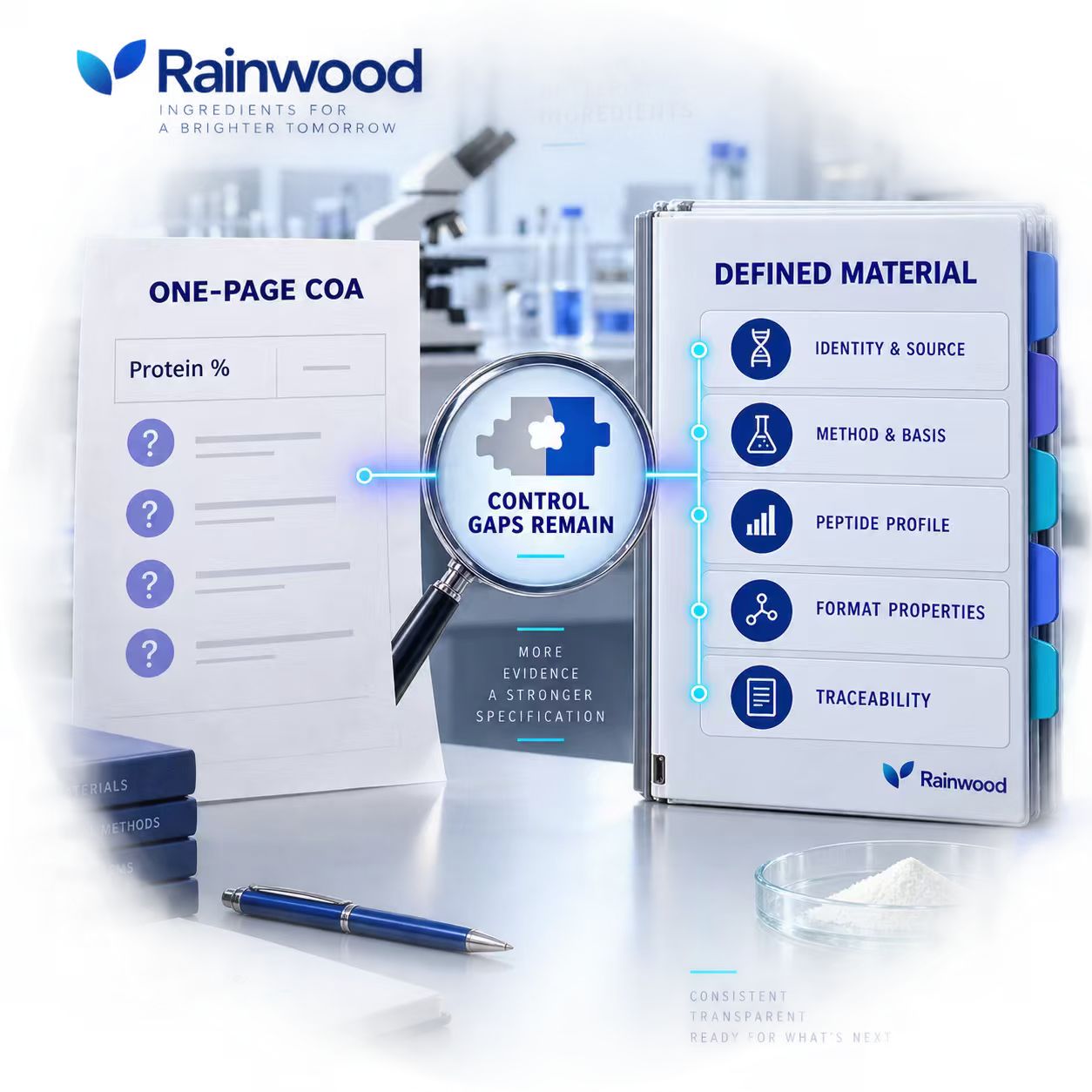
Section one: identity and source
Include:
- product name and acceptable synonyms;
- hydrolyzed or undenatured form;
- chicken species and anatomical source;
- manufacturing entity and site;
- source and animal-origin declarations;
- traceability code and lot definition;
- prohibited substitutions or mixed sources;
- reference to the identity method and its limitations.
Do not state that a total protein result proves type II identity. Explain which evidence supports source, collagen character, type, and form. If the proof is incomplete, mark it as an evidence request rather than a finished claim.
Read the COA identity gap for type II collagen peptides before approving the identity section.
Section two: composition and peptide profile
Define the assay basis for collagen or protein, moisture, ash, and any relevant accompanying cartilage components. If the grade is controlled by molecular weight, specify the method, calculation, calibration, average type, distribution, and acceptance range.
The specification should state whether chondroitin sulfate or hyaluronic acid are expected, limited, or excluded. If the ingredient contributes to a finished formula that already contains those compounds, calculate the overlap. If the finished label does not declare the contribution, create an internal control so the formula team knows what is being delivered.
Section three: contaminants and safety
Set microbiological and heavy-metal limits based on the destination market, product category, and risk assessment. The TGA example includes explicit limits for lead, cadmium, and mercury for a defined hydrolysed chicken cartilage extract. It is a reference point, not permission to use those exact limits for every market.
Add requirements for sampling, laboratory method, reporting units, detection limits, and out-of-specification handling. If animal-origin or allergen documentation is important to your customers, place it in the release package rather than leaving it as a sales promise.
Section four: physical and format properties
Include color, odor, particle size, bulk density, flow or dispersibility, moisture, and package condition when they influence the finished format. Set the test conditions. “Soluble” without water volume, temperature, time, and observation criteria is not a usable release limit.
For capsules, add practical fill behavior and blend uniformity. For tablets, add compression and disintegration or dissolution requirements. For powders and gummies, add sensory, moisture migration, and packaging checks. The raw-material specification should explain which tests are release requirements and which are periodic qualification checks.
Section five: documentation and change control
Require a complete lot package:
- COA with lot, date, basis, method, and result;
- source and animal-origin declaration;
- manufacturing and packaging traceability;
- process summary and change status;
- sampling and laboratory record;
- deviation, investigation, and corrective-action record when relevant;
- storage and transport conditions;
- certificate or audit evidence with correct entity and scope.
Define changes that require prior notice and impact assessment: species, tissue, upstream supplier, site, enzyme, hydrolysis window, filtration, drying, carrier, package, analytical method, and specification limit. A change-control clause is useful only if it names the events that trigger it.
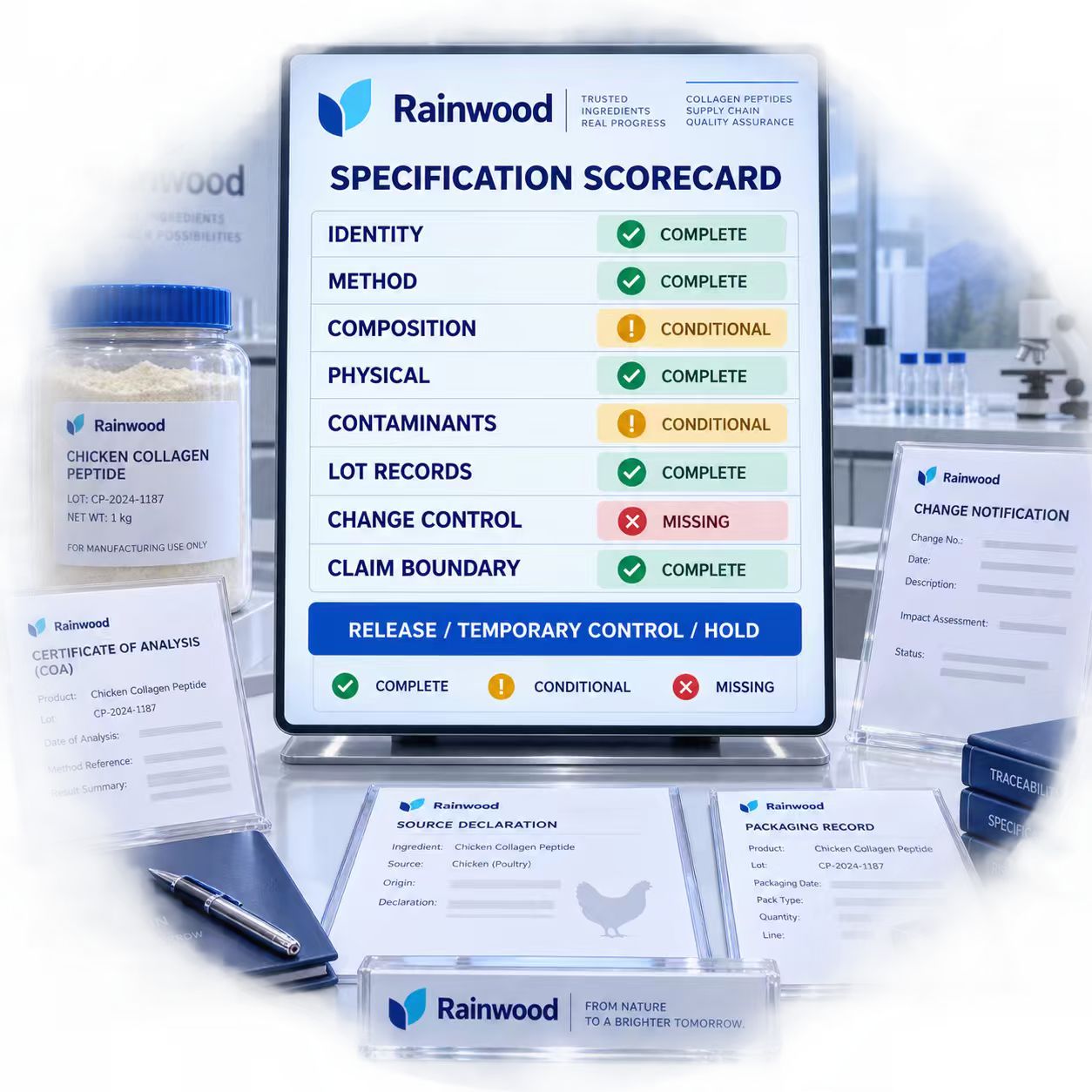
A specification scorecard for release meetings
| Section | Minimum decision |
|---|---|
| Identity | Form and source are defined |
| Method | Each test answers a stated question |
| Composition | Basis and limits are clear |
| Physical | Format risks are controlled |
| Contaminants | Market and risk limits are documented |
| Lot records | COA and traceability match the shipment |
| Change control | Requalification triggers are written |
| Claim boundary | Studies and labels match the material |
Mark every row complete, conditional, or missing. A specification with unresolved “conditional” items should not be used to release a large commercial lot without an agreed temporary control.
How RainwoodBio can use the specification in an OEM project
RainwoodBio publishes requirement confirmation, supplier management, sample development, testing and release documentation, packaging, logistics, and traceability. The relevant capability is using the agreed specification as the project spine from quotation through sample, production, release, and reorder.
Request a type II collagen specification and supplier-qualification review with your target market, format, annual volume, current COA, and supplier questionnaire.
The audit-ready approval gate
Do not close supplier qualification until:
- the product form and source are unambiguous;
- identity and composition methods are fit for purpose;
- molecular-weight or peptide-profile expectations are written where relevant;
- contaminants, physical properties, and packaging controls fit the format;
- lot traceability and sampling are documented;
- change-control and deviation responsibilities are signed;
- the finished label and evidence file use the same material identity.
Send the draft specification, supplier COA, source documents, formula, target market, and packaging plan for an audit-ready type II collagen specification review. RainwoodBio can help identify missing controls before the auditor, distributor, or customer finds them.
Frequently asked questions
1.Should every specification include a molecular-weight distribution?
Not every product needs the same test, but a hydrolyzed peptide buyer should assess whether molecular weight affects identity, performance, or claims. If it matters, define the method and range rather than listing an unexplained average.
2.Can a company certificate replace lot documentation?
No. A company or facility certificate describes a scope at a particular level. It does not automatically prove that a named lot meets your product specification.
3.Is a detailed specification enough to prove regulatory compliance?
No. It is a procurement and quality-control tool. Market classification, labeling, safety, and legal requirements still need qualified review for the exact product and destination.
References
- TGA, Hydrolysed Chicken Cartilage Extract compositional guideline: https://www.tga.gov.au/resources/resources/compositional-guidelines/hydrolysed-chicken-cartilage-extract
- U.S. FDA, Exploring the Scope of Dietary Supplement Ingredients: https://www.fda.gov/media/191964/download
- EFSA, Novel Food applications and guidance: https://www.efsa.europa.eu/en/applications/novel-food
- RainwoodBio About Us: https://www.rainwoodbio.com/about-us
This article is for B2B procurement and educational purposes. Product identity, analytical, safety, labeling, certification scope, and regulatory requirements must be confirmed for the exact grade, batch, finished formula, and destination market.