 EN
EN

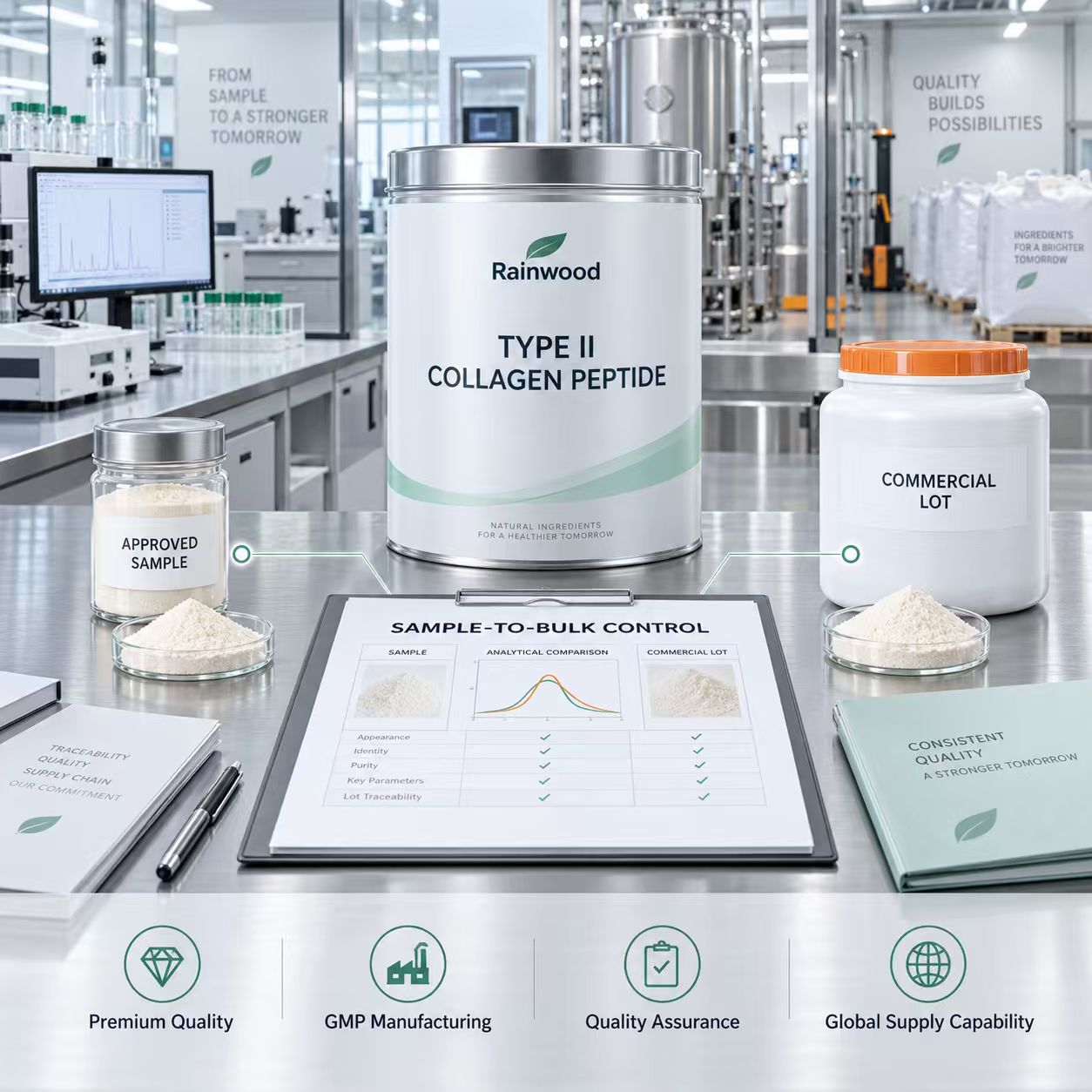
Meta title: Type II Collagen Peptide Sample to Bulk Control Guide
Meta description: A perfect type II collagen peptide sample does not guarantee matching bulk. Use lot comparisons, process controls, and release gates to protect launch inventory.
The sample dissolves, tastes acceptable, and fills cleanly. You approve the supplier. The first bulk shipment arrives with a stronger odor, more clumping, different density, and a slower blend. The COA still shows the required protein percentage.
This is the sample-to-bulk problem in its most frustrating form: the document passes, but the production behavior moves. Type II chicken collagen peptide is sensitive to source, hydrolysis, filtration, concentration, drying, moisture, particle size, and packaging. If the approval process covers only a small sample and a headline assay, it leaves too much room for lot drift.
A sample is evidence of one material at one moment
The supplier sample may come from a selected lot, a laboratory batch, or a retained production sample. It can be representative, but representation must be defined. Ask for the lot number, production date, sample size, sampling location, package, and storage history. If the commercial specification is not written before approval, the sample becomes a taste test rather than a release standard.
Use our sample-to-bulk qualification checklist to turn approval into a controlled gate.
The TGA guidance for hydrolysed chicken cartilage extract illustrates why physical and compositional properties belong in the specification. Molecular weight, bulk density, particle size, moisture-related behavior, and contaminant limits can all matter to the delivered grade, not only the protein headline.
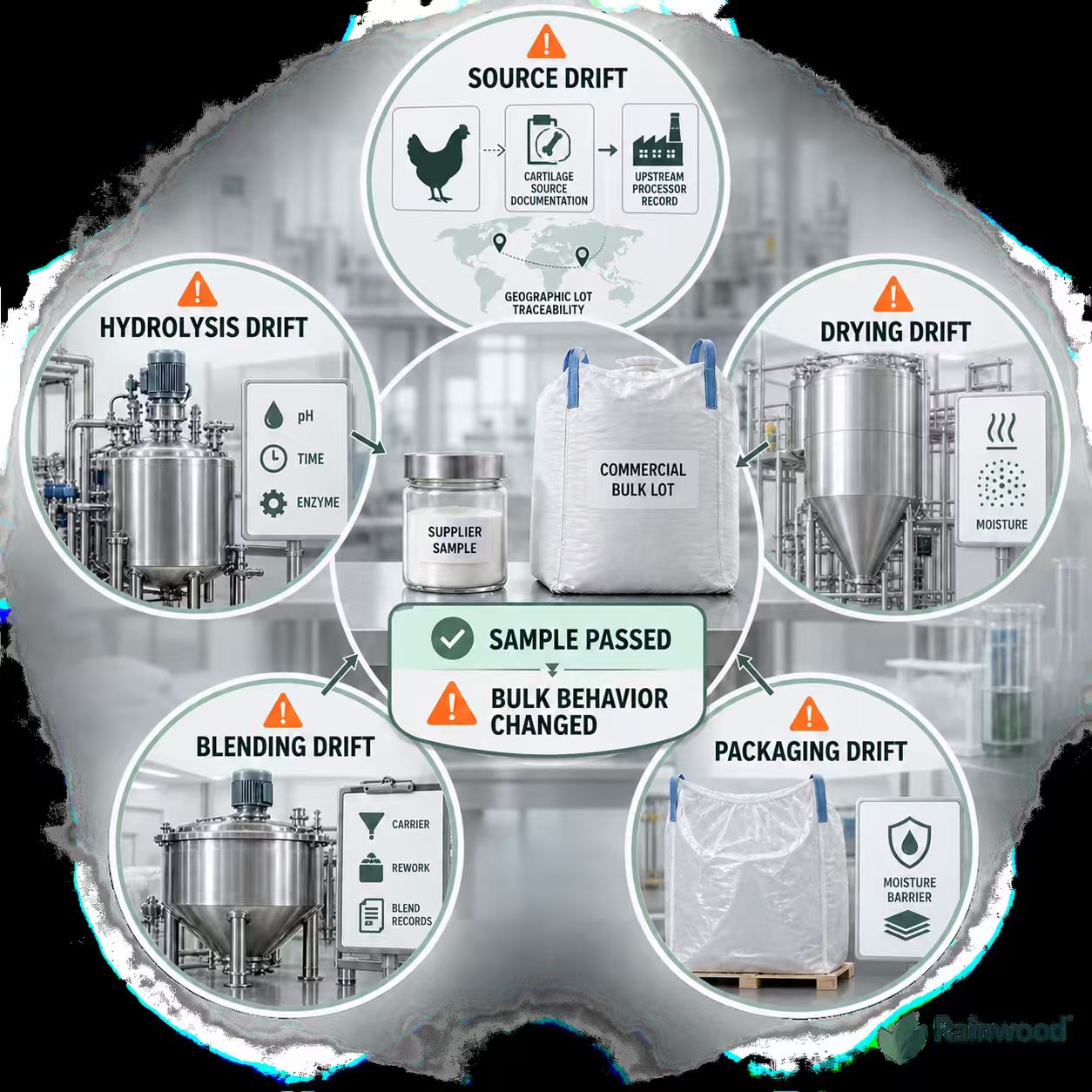
The five drift points to investigate
Source drift
The supplier changes chicken tissue, upstream processor, or geographic source. The material remains “chicken collagen” but its accompanying components and odor move.
Hydrolysis drift
Enzyme, temperature, pH, or time changes alter peptide distribution. The average may remain close while solubility or taste changes.
Drying drift
Different inlet conditions, residence time, or powder recovery can affect moisture, particle size, density, and flow.
Blending drift
A carrier, rework, or multiple lots are combined. The final lot may be within a broad assay range but not match the approved sample.
Packaging drift
A different liner, bag, seal, or desiccant allows moisture uptake during transport or storage. The powder changes before it reaches your factory.
Read the process choices that change type II collagen peptide properties when the supplier calls a drift “normal variation.”
Compare more than the COA headline
At minimum, compare the approved sample and commercial lot for:
- identity and source documentation;
- collagen or protein assay and calculation basis;
- molecular-weight distribution or average, using the same method;
- moisture and, where relevant, water activity;
- ash and significant accompanying cartilage components;
- color, odor, particle size, and bulk density;
- dispersibility or hydration time in the intended base;
- microbiology and heavy metals;
- package integrity, lot number, and storage conditions.
The exact panel should reflect the format. A powder drink needs a stronger sensory and dispersion check. A capsule needs flow, density, and fill-weight confirmation. A tablet needs compression and release testing.
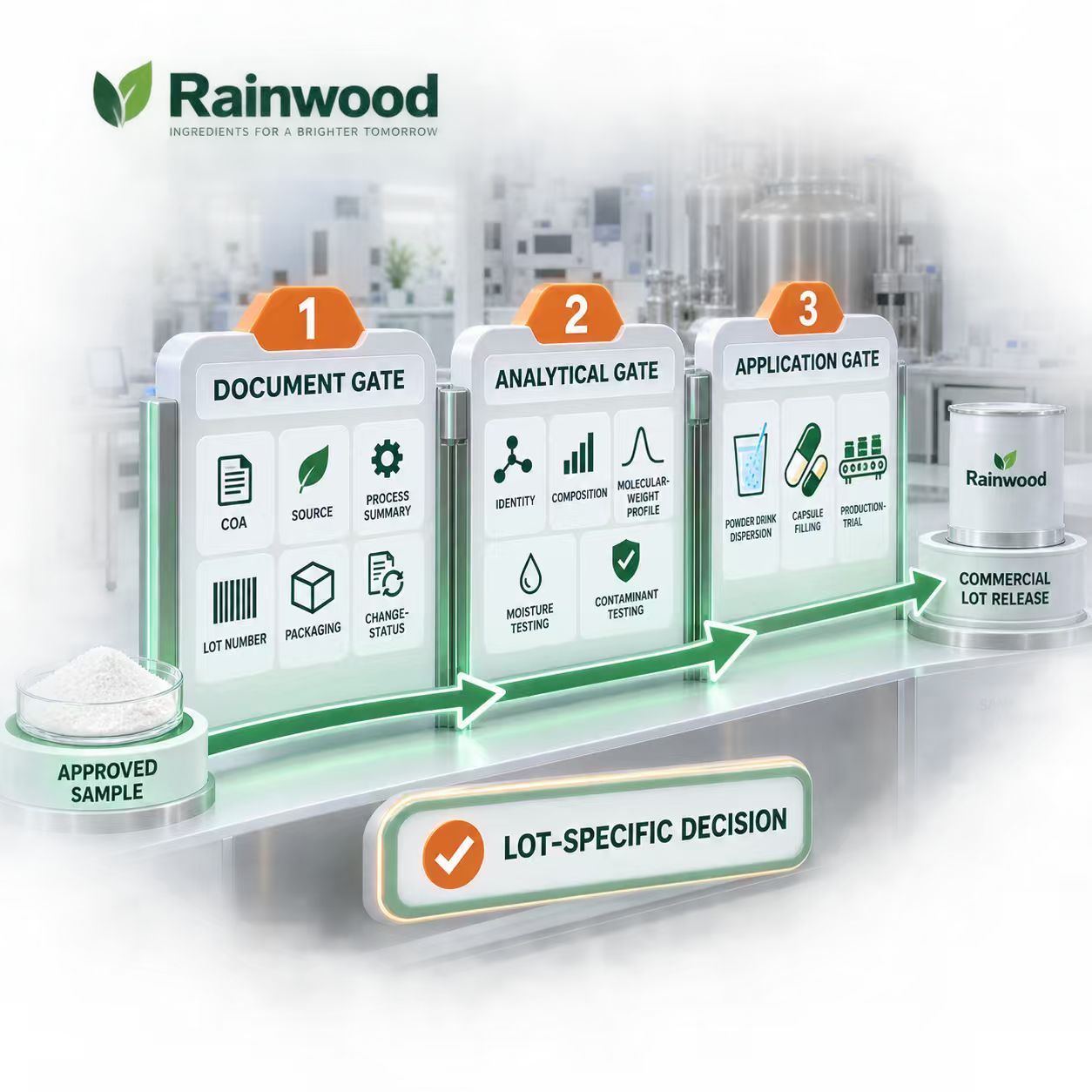
The commercial-lot release gate
Use a three-stage decision:
1. Document gate: COA, source, process summary, lot number, packaging, and change status are complete.
2. Analytical gate: agreed identity, composition, molecular-weight, contaminants, and physical limits pass.
3. Application gate: the lot performs in a representative formula or production trial.
Do not allow a supplier to replace a failed application gate with a new generic COA. Ask for root cause, corrective action, replacement terms, and a prevention plan.
Contract language that protects the buyer
Add a sample-to-bulk clause covering:
- reference sample retention and storage;
- lot-specific testing and sampling procedure;
- acceptable differences for physical and chemical properties;
- notice period for source, process, site, or packaging changes;
- buyer right to reject or requalify a materially different lot;
- replacement, credit, and investigation responsibilities;
- document retention and traceability expectations.
The clause should not promise absolute identity if the material is naturally variable. It should define what variation is acceptable and what happens when the range is exceeded.
How RainwoodBio can build the sample-to-bulk handoff
RainwoodBio publishes sample development, supplier management, testing and release documentation, packaging, logistics, and traceability within its OEM and private-label workflow. For this product, the relevant control is keeping the approved sample, commercial lot, format trial, and release decision connected in one record.
Request a type II collagen sample-to-bulk qualification plan with the target format, lot size, package, and production timeline.
Bulk acceptance checklist
Before releasing the first commercial lot, confirm:
- the sample and bulk are linked to documented lots;
- source and process statements are unchanged or requalified;
- the agreed analytical panel passes on the actual lot;
- physical and sensory behavior matches the format trial;
- package integrity protected the powder in transit;
- deviations have a written disposition;
- the supplier has acknowledged change-control obligations.
Send the approved sample record, bulk COA, specification, production date, and trial results for a sample-to-bulk drift review. RainwoodBio can help structure a release decision before the lot enters finished-product inventory.
What to do when the bulk lot is borderline
Do not mix a questionable lot into finished production simply to protect the schedule. Place it on hold, preserve a representative sample, and compare the result with the approved reference under the same method and conditions. If the difference is physical rather than chemical, run a small application trial before deciding whether the lot can be used in a different format or with a revised process. If the difference is outside the agreed specification, use the contract remedy and document the supplier investigation. A written disposition protects both the current launch and the next reorder because it turns a one-time surprise into a trend record.
Trend review is especially valuable for moisture, odor, density, and molecular-weight distribution. A gradual movement can warn you before a dramatic failure occurs.
Frequently asked questions
1.Is sample-to-bulk variation proof of supplier misconduct?
No. It can result from source, process, sampling, packaging, or natural variation. Investigate the mechanism and contract controls instead of assigning intent without evidence.
2.Should the commercial lot be tested by an outside laboratory?
That may be appropriate for high-risk identity or contaminant questions, but the method, laboratory scope, sample chain, and acceptance criteria should be defined first.
3.Can one retained sample represent every future lot?
It can serve as a reference, but each lot still needs lot-specific release evidence and a change-control review.
References
- TGA, Hydrolysed Chicken Cartilage Extract compositional guideline: https://www.tga.gov.au/resources/resources/compositional-guidelines/hydrolysed-chicken-cartilage-extract
- Preparation of Type II Collagen Short Peptides: https://pubmed.ncbi.nlm.nih.gov/34046790/
- Comparative analysis of chicken cartilage compounds and type II collagen peptides: https://pmc.ncbi.nlm.nih.gov/articles/PMC9005812/
- RainwoodBio About Us: https://www.rainwoodbio.com/about-us
This article is for B2B procurement and educational purposes. Lot consistency, analytical, safety, labeling, packaging, and regulatory requirements must be confirmed for the exact ingredient, finished product, and destination market.