 EN

Executive Summary & B2B Formulation Guidance
Synthetic and fermentation-derived CoQ10 quotes are not automatically equivalent. Verify source, identity, purity, carrier, traceability, and market documents.
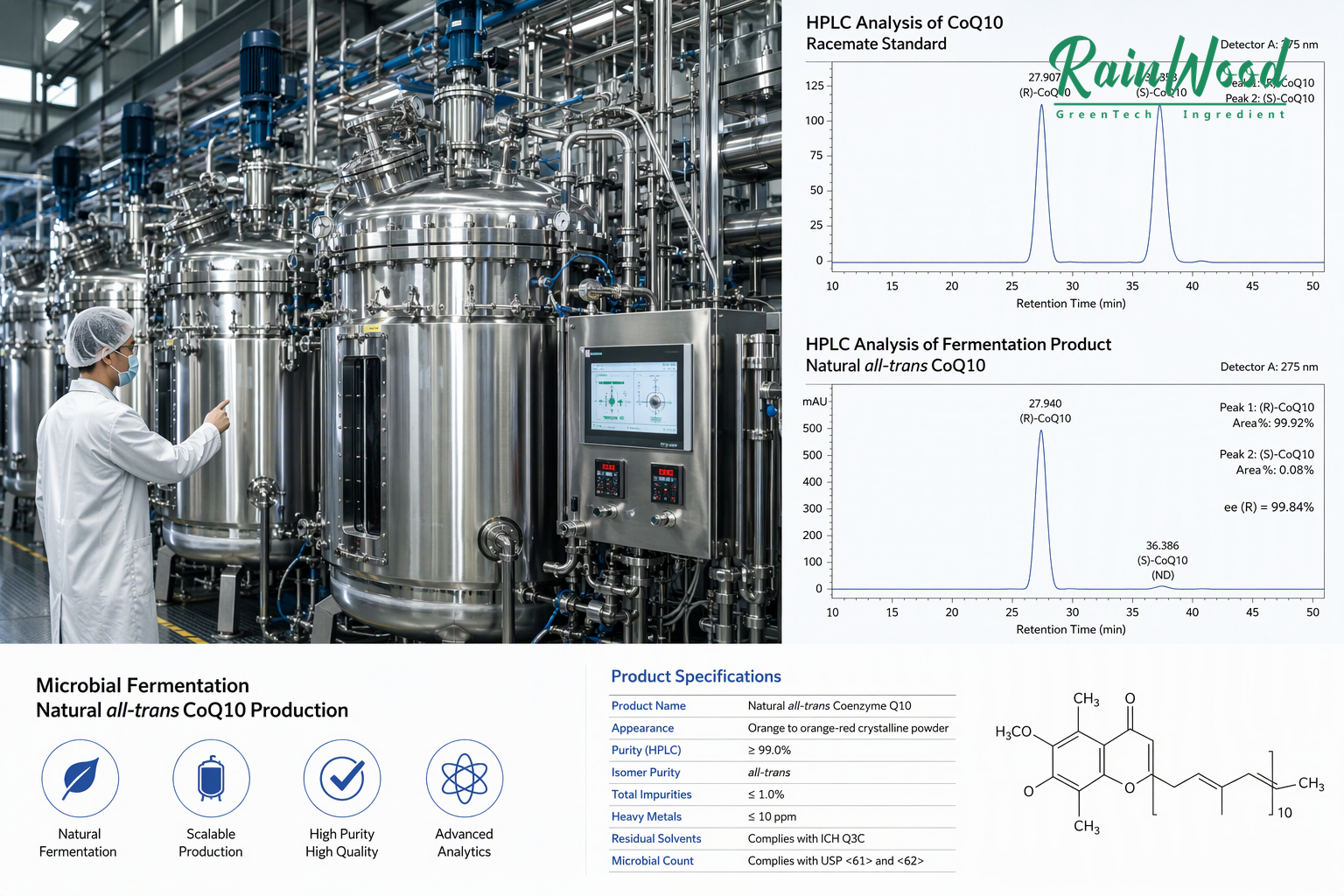
Figure 1: Industrial Microbial Fermentation Bioreactors Producing All-Trans CoQ10 with Chiral HPLC Analysis
Two suppliers quote the same CoQ10 price. One says “synthetic,” the other says “fermentation-derived.” A third says “natural source.” The buyer may assume the more appealing story is automatically better, but the source description alone does not establish identity, purity, redox form, stability, or regulatory suitability. Before you pay for the story, define what the source must prove.
Source is a procurement field, not a marketing adjective
CoQ10 can be produced through different manufacturing routes and sold in different forms. The route may affect residuals, carriers, color, crystal properties, redox profile, documentation, and cost. It does not automatically prove superior absorption or a better finished-product outcome.
Write the requested source clearly in the specification. If the source is not a customer-facing requirement, decide whether it is a qualification preference or a mandatory attribute. The [INTERNAL LINK -> CoQ10 Ingredient Identity Review] can separate identity, source, process, and claim fields so a supplier cannot answer one question with a different story.
Ask who actually made the material
Many buyers receive a trader's COA, a distributor's brochure, and a manufacturer name that appears only in a separate PDF. The key question is whether the lot on the COA is traceable to the stated manufacturer and site. Ask for the legal entity, manufacturing site, lot number, source statement, and chain of custody.
Request the change-notification policy for site, process, source, carrier, and packaging changes. If a supplier cannot explain how a source change is communicated, the buyer may discover a new grade only after the label, formula, and customer expectation are fixed.
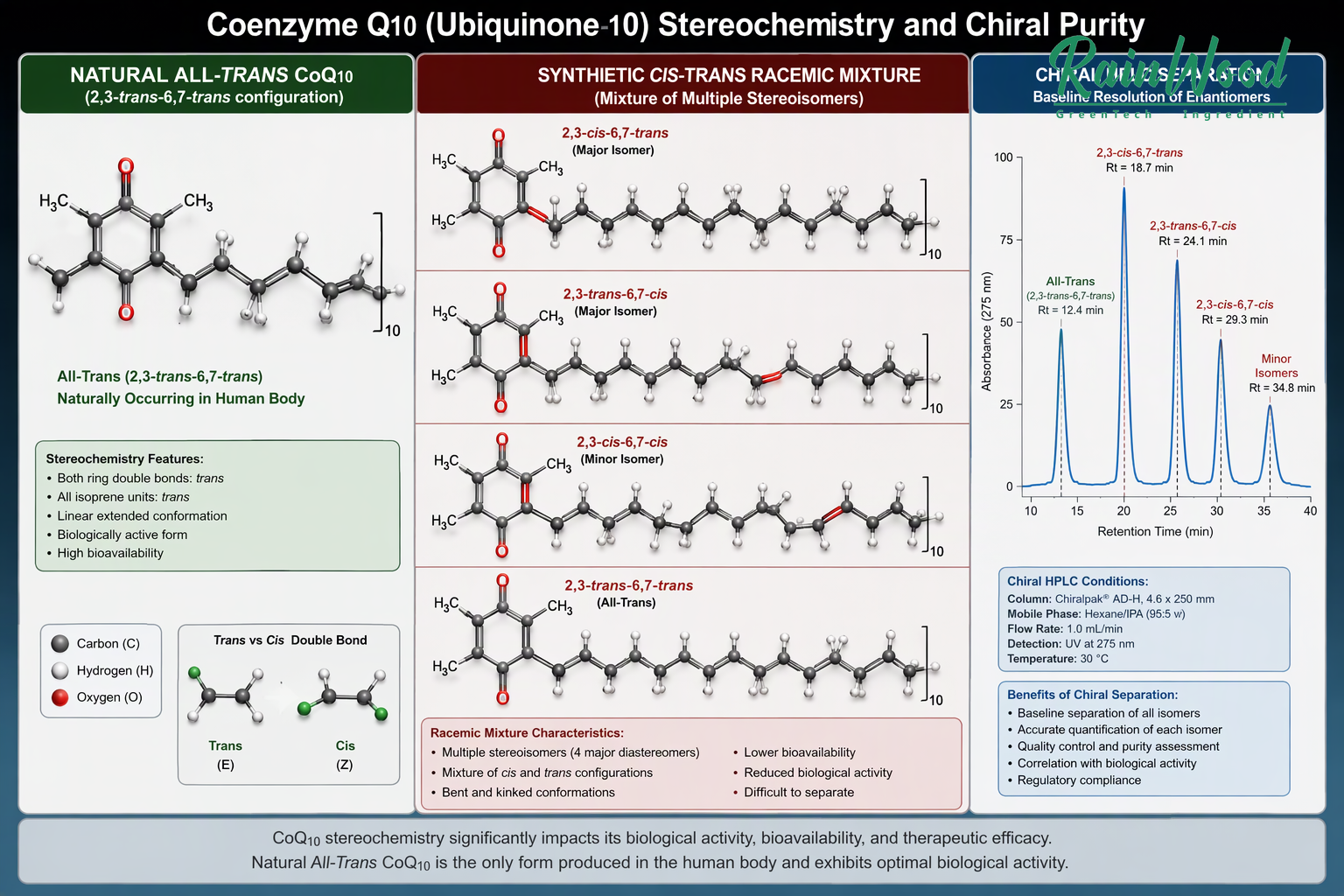
Figure 2: 3D Stereochemical Visualization: Natural All-Trans Isomer vs Synthetic Cis/Trans Racemic Mixture
“Natural” does not answer the active-form question
A source description does not tell you whether the commercial material is ubiquinone, ubiquinol, a derivative, or a premix. It also does not tell you whether the material is crystalline, oil-dispersed, solubilized, or water-dispersible. Ask for the exact form and how the form is measured.
If a brand plans to use a “naturally sourced” message, review the supporting evidence and market rules before artwork. A source claim may require documentation that is different from the evidence needed for a CoQ10 assay. Avoid turning a sourcing preference into an unsupported superiority claim.
Source changes can alter the manufacturing process
Different sources may have different particle size, bulk density, flow, color, odor, crystallinity, solvent residues, or carrier requirements. A formula that fills well with one powder may bridge or segregate with another. A softgel may require a different oil or antioxidant system. A tablet may show a different compression and disintegration profile.
Run a pilot with the proposed commercial source and intended package. Compare raw-material assay, form, moisture, particle distribution, bulk density, flow, color, carrier, finished-unit content, and stability. The [INTERNAL LINK -> CoQ10 Sample to Bulk Control Blog] should be used before a source switch is treated as equivalent.
Documentation should match the claim level
For a basic ingredient purchase, the buyer may need source statement, specification, COA, contaminants, microbiology, storage, and change control. For a “fermentation-derived” or “natural” label claim, the buyer may need process or origin evidence and a market-specific review. For a finished softgel expiry, the buyer needs finished-product stability, not only a raw-material brochure.
Make an evidence ladder: website description, supplier document, product-specific document, batch evidence, finished-product evidence, and independent evidence. Do not let a lower level silently become a higher claim. The [INTERNAL LINK -> CoQ10 Compliance Dossier Blog] can help organize the file.
Source economics can hide risk transfer
A low source price may exclude extra purification, testing, package, documentation, or replacement terms. A premium price may include a stronger specification but still require the buyer to validate the finished format. Compare cost per released active unit, not only kilogram price.
Ask who pays for method bridging, independent testing, failed-lot retesting, replacement freight, rework, and disposal. Include lead time and minimum order quantity. A source that requires a much larger purchase may create more cash and expiry risk even if the raw price is lower.
How RainwoodBio can support source qualification
RainwoodBio publishes raw-material procurement and supplier management, requirement confirmation, production control, testing and release, compliance documentation, and traceability management. For a CoQ10 project, those capabilities should be converted into a source-qualification checklist tied to the exact form and format. The buyer should request the lot documents and confirm which items are still pending.
RainwoodBio lists multiple private-label formats, including hard capsules, softgels, tablets, and powder sachets. Compare the source against the intended product using the [INTERNAL LINK -> CoQ10 OEM Format Comparison] and [INTERNAL LINK -> RainwoodBio Quality and Release Process].
Source approval gate
Do not approve a source until you can answer:
- Who made the lot and where?
- What exact CoQ10 form is supplied?
- Is the source route mandatory, preferred, or only a marketing option?
- Which impurities, residues, carriers, and allergens are controlled?
- Does the source behave correctly in the selected format?
- What documents support the target market?
- How are source and site changes communicated?
- What happens if the next lot is not equivalent?
Send the supplier quote, source statement, COA, target market, format, and customer claim for a [INTERNAL LINK -> CoQ10 Source Qualification Review]. RainwoodBio can use those inputs to distinguish a verifiable source requirement from a story that cannot protect your launch.
Separate source preference from source approval
Some brands need a particular source for customer positioning, retailer requirements, or internal sourcing policy. Other brands care primarily about identity, purity, stability, and cost. Write that priority before requesting quotes. A source preference should not prevent the team from asking for the same technical evidence for every offer.
Review the source again after the first commercial lot. Confirm that the actual source, site, carrier, and process match the approved record. If the supplier changes the route, decide whether the change affects label language, market documents, activity, redox form, particle properties, or finished-product stability.
Send the source statement, COA, specification, target claim, format, market, and quotation for a [INTERNAL LINK -> CoQ10 Source Contact Us Page] review. Include whether the source must appear on the consumer label or is only a procurement preference.
Frequently asked questions
Is fermentation-derived CoQ10 automatically better?
No. The route may be relevant to a buyer, but identity, assay, contaminants, stability, and finished-product performance still require evidence.
Can “natural CoQ10” replace a specific form on the purchase order?
No. Use exact form, active basis, source, and carrier language so the material is unambiguous.
Does a source change always require a new product launch?
Not always, but it should trigger a documented equivalence review and possibly a pilot, stability pull, or label review.

Figure 3: Industrial Stainless Steel Bio-Fermentation Plant with Automated Process Control Monitors
References
- NCBI LiverTox, Coenzyme Q10: https://www.ncbi.nlm.nih.gov/books/NBK603562/
- CoQ10 Quality Control Assessment: https://pmc.ncbi.nlm.nih.gov/articles/PMC2170950/
- RainwoodBio homepage: https://www.rainwoodbio.com/
- RainwoodBio contact page: https://www.rainwoodbio.com/contact-us
*This article is for B2B procurement and educational purposes. Product identity, source, analytical, safety, labeling, and regulatory requirements must be confirmed for the exact ingredient, finished product, and destination market.*
Explore RainwoodBio CoQ10 & Custom Formulation Capabilities
- Custom CoQ10 Hard Capsules & High-Potency Blends – Precision cGMP encapsulation for CoQ10 with PQQ, L-Carnitine, and Vitamin E co-factors.
- High-Absorption CoQ10 Softgels & Lipid Suspensions – MCT/Olive oil carrier systems with natural tocopherol stabilization.
- Water-Soluble CoQ10 Micro-Encapsulated Powders & Stick Packs – Enhanced bioavailability single-serve sachets and beverage-grade premixes.
- OEM / ODM Contract Manufacturing Services – End-to-end formulation development, pilot batch scaling, and US/EU regulatory compliance dossiers.
- Contact RainwoodBio Technical Sales – Request CoA, HPLC analytical protocols, pilot stability samples, or commercial quotation.
Table of Contents
- Source is a procurement field, not a marketing adjective
- Ask who actually made the material
- “Natural” does not answer the active-form question
- Source changes can alter the manufacturing process
- Documentation should match the claim level
- Source economics can hide risk transfer
- How RainwoodBio can support source qualification
- Source approval gate
- Separate source preference from source approval
- Frequently asked questions
- References