 EN
EN

Meta title: The 1% vs 99% Biotin Price Trap for Bulk Import Buyers
Meta description: Compare 1% premix and 99% biotin by active cost, carrier, testing, freight, and manufacturing risk—not by a misleading supplier price per kilogram.
One supplier quotes biotin at a price that looks almost impossible to beat. Another quote is many times higher. Your purchasing team circles the cheaper number, asks for a final discount, and prepares the order.
Stop. Are both suppliers pricing the same concentration?
A kilogram of 1% biotin premix and a kilogram of 99% biotin powder are not interchangeable commercial units. One theoretically contains 10 grams of biotin; the other contains 990 grams before specification tolerances are considered. A price-per-kilogram comparison can therefore make the apparently cheap quote the most expensive option on your desk.
For importers and ingredient distributors, the real buying unit is not a kilogram of powder. It is a released gram of usable biotin delivered under an agreed specification.
The headline price hides the active-cost calculation
Use this first-pass calculation:
`active cost per gram = material price per kg / biotin grams per kg`
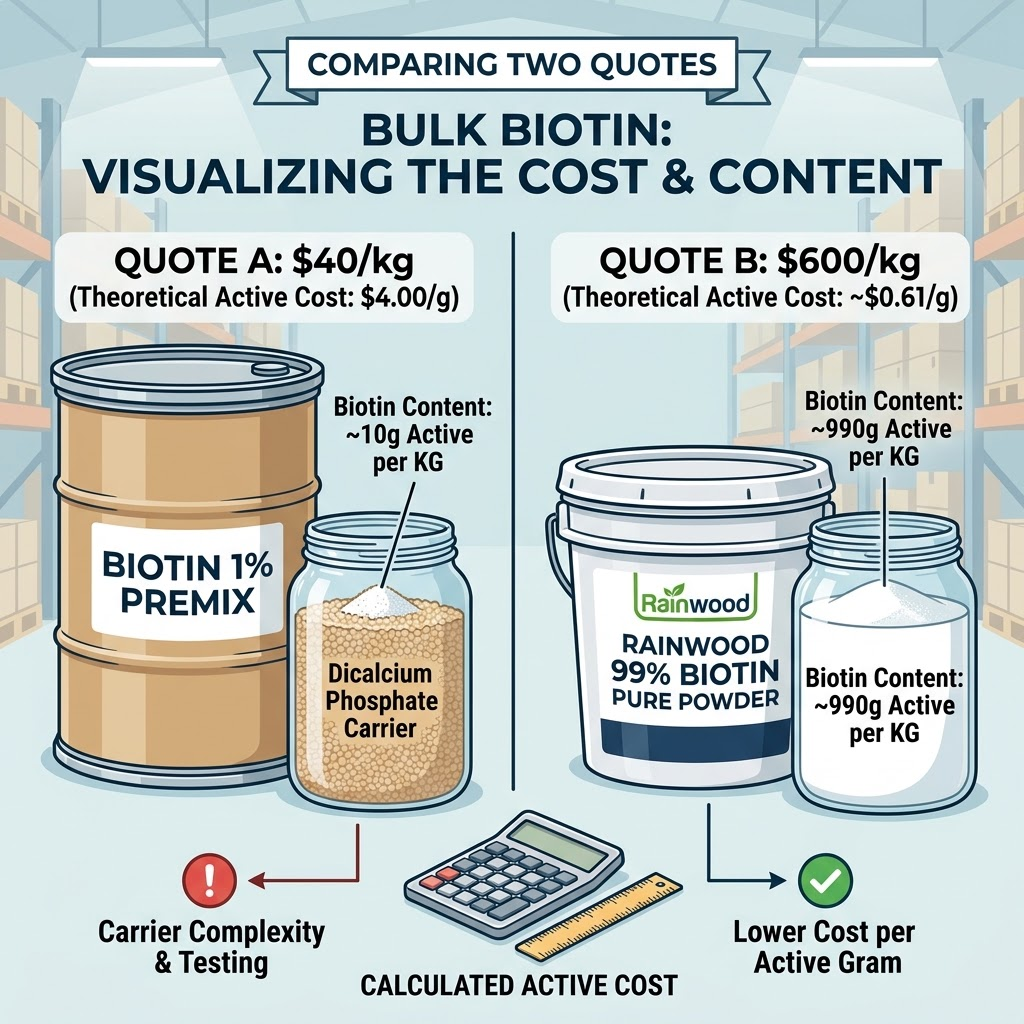
Assume Quote A is a 1% premix at $40/kg and Quote B is a 99% material at $600/kg. Ignore freight and testing for one minute:
- Quote A: $40 / 10 g = $4.00 per gram of theoretical biotin.
- Quote B: $600 / 990 g = about $0.61 per gram of theoretical biotin.
The $40 material is cheaper by powder weight but more than six times as expensive by theoretical active weight. These numbers are examples, not market prices. Replace them with the actual price, guaranteed concentration, and calculation basis from each quotation.
The calculation also works in the other direction. A well-designed 1% premix may reduce weighing and blending risk enough to justify a higher active cost in a micro-dose formula. The point is not that 99% is always better. The point is that concentration changes what you are buying.
Review RainwoodBio's published 99 percent biotin powder option, then require a project-specific specification before comparing it with any diluted grade.
A premix is not only diluted biotin
If a quotation says “biotin 1%,” ask what makes up the other 99%.
The carrier affects more than the ingredient list. It can affect flow, density, color, moisture behavior, allergen review, label declarations, dietary-positioning claims, and compatibility with the finished formula. The premix may also contain processing aids or use a particular particle-size strategy. None of those details should be inferred from the concentration alone.
Request:
- exact biotin concentration and acceptable range;
- carrier identity and percentage;
- all other ingredients or processing aids;
- calculation basis, such as as-is or dried basis where relevant;
- particle-size, bulk-density, moisture, and flow information needed for the use;
- storage, packaging, and retest or expiry information;
- change-notification terms for the biotin source and carrier.
If one quote is for pure input and the other is for a formulated premix, label them as different products in your comparison sheet. Otherwise, a purchasing decision can silently become a formulation change.
Purity does not remove manufacturing cost
High-concentration material wins the active-cost calculation easily in many scenarios. It can still lose at the factory if the formula needs only micrograms per serving.
The U.S. Daily Value for biotin is 30 mcg. At that target, a 99% input contributes only about 0.0303 mg of material per serving before any justified manufacturing adjustment. A commercial batch cannot be built by trying to distribute that amount one serving at a time. It needs an appropriate weighing and dilution strategy, controlled mixing, sampling, and finished-product verification.
A declared premix can make the input mass easier to handle. It also adds carrier mass, freight, storage, and sometimes a higher active cost. Your contract manufacturer should compare both routes using the real batch size, equipment, dosage form, and release plan.
Normalize the landed and released cost
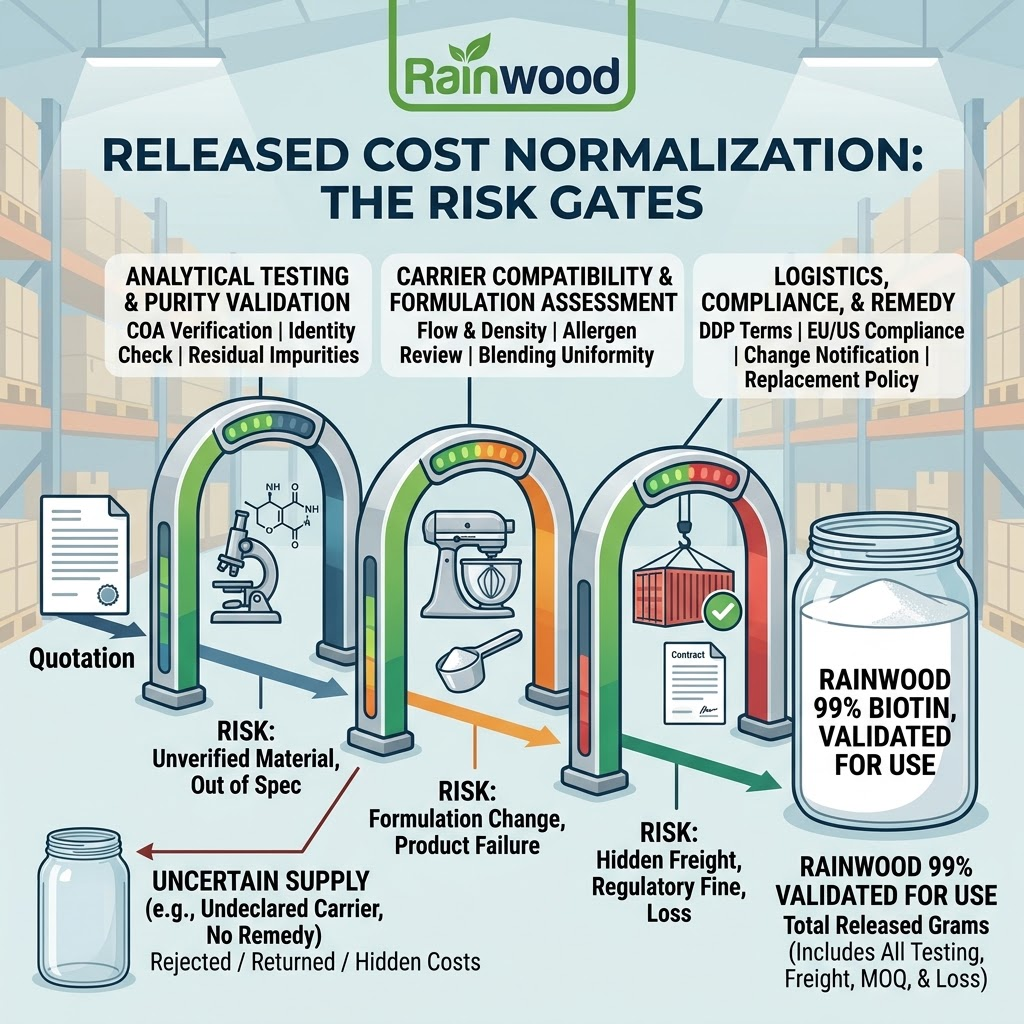
Price per active gram is the start, not the finish. Build a second calculation:
`released active cost = total landed and release cost / grams of accepted biotin active`
The numerator should include the commercial costs that differ between the offers:
1. Material price and minimum order quantity.
2. Packaging size and usable yield after handling loss.
3. Freight, insurance, duty, and Incoterm responsibilities.
4. Sampling and independent testing where required.
5. Premixing, extra processing, or special containment cost.
6. Warehouse space and inventory financing.
7. Rejected-lot, replacement, return, and disposal responsibility.
The denominator should use the guaranteed and accepted concentration—not a marketing headline or an unverified theoretical number. If the specification permits a range, model the lower release limit as a conservative scenario.
For example, a cheap quotation that excludes required testing, uses a large MOQ, and shifts rejected-lot disposal to the buyer may create a worse landed outcome than a higher quote with a more complete evidence package. That does not prove the supplier is dishonest. It proves the quotations allocate cost and risk differently.
Use the seven-gate biotin COA release scorecard to compare the evidence included behind each price.
Use a two-quotation normalization sheet
Do not approve either offer until every row has an answer.
| Comparison field | Quote A | Quote B | Decision question |
|---|---|---|---|
| Product definition | | | Pure material or premix? |
| Guaranteed biotin concentration | | | Same basis and acceptable range? |
| Carrier and other ingredients | | | Compatible and declarable? |
| Active cost per gram | | | Calculated from guaranteed concentration? |
| MOQ and packaging | | | How much cash and storage are required? |
| Test package | | | Which results are included and lot-linked? |
| Freight and Incoterm | | | Where does cost and risk transfer? |
| Manufacturing impact | | | Premix, weighing, or blending work required? |
| Rejection remedy | | | Who pays for retest, return, or replacement? |
| Change notification | | | Can source or carrier change without approval? |
Then calculate three outcomes: quoted price per kilogram, theoretical cost per gram of active, and expected cost per gram of released active. The difference between those columns is where the hidden cost usually appears.
Explore RainwoodBio's published OEM formula and dosage-form workflow when the concentration decision also affects capsules, tablets, gummies, or powder products.
How RainwoodBio can support a clean comparison
RainwoodBio currently publishes a 99% biotin powder and describes requirement confirmation, supplier management, sample development, production control, testing and release, documentation, packaging, and traceability on its website. Those statements provide a project framework; they do not by themselves prove a specific batch, test, premix composition, or finished-product result.
Use that framework to request three concrete deliverables for your order:
- a signed material definition and specification before price approval;
- a quotation that identifies concentration, carrier, MOQ, packaging, trade terms, and included evidence;
- a formula review that determines whether pure biotin or a declared premix is more controllable at the intended scale.
Review the company's published sourcing and documentation context, then ask for the records applicable to the exact grade and lot.
The decision gate before you choose the cheaper quote
Approve the quotation only if you can answer yes to all five questions:
- Are both product definitions and concentrations explicit?
- Has cost been normalized per gram of accepted biotin active?
- Are the carrier and manufacturing consequences included?
- Are testing, freight, MOQ, loss, and rejection costs allocated?
- Is the chosen grade feasible for the real batch and dosage form?
If any answer is no, you do not yet have a price comparison. You have two unrelated numbers.
Request a two-quotation biotin cost normalization. Send RainwoodBio both quotations, specifications or COAs, target formula, serving dose, dosage form, annual quantity, destination, and preferred Incoterm; the team can return a line-by-line comparison and a list of missing commercial inputs.
Frequently asked questions
1.Is 99% biotin always the cheapest choice?
No. It often has a lower cost per gram of active, but micro-dose weighing, premixing, blending, testing, MOQ, and handling can change the finished-product economics. Compare total released cost for the actual formula.
2.Is a 1% biotin premix lower quality?
Not automatically. It is a different material. Its suitability depends on the biotin concentration, carrier, uniformity, specification, documentation, stability, and compatibility with the finished product.
3.Can two 99% biotin quotations be compared directly?
Only after confirming the same identity, grade, assay basis, specification, test package, packaging, MOQ, trade terms, and remedies. The same headline concentration does not make the commercial offers equivalent.
4.What information should an importer send for a price review?
Send the quotations, product definitions, specifications or COAs, required tests, target market, quantity, packaging, Incoterm, dosage form, and planned daily dose. Missing fields can then be priced as risk instead of ignored.
References
- FDA Daily Value on Nutrition and Supplement Facts Labels: https://www.fda.gov/food/nutrition-facts-label/daily-value-nutrition-and-supplement-facts-labels
- NIH Office of Dietary Supplements, Biotin Fact Sheet for Health Professionals: https://ods.od.nih.gov/factsheets/Biotin-HealthProfessional/
- USP-NF Biotin monograph: https://doi.usp.org/USPNF/USPNF_M9515_02_01.html
- 21 CFR 111.70, dietary supplement specifications: https://www.ecfr.gov/current/title-21/chapter-I/subchapter-B/part-111/subpart-E/section-111.70
- RainwoodBio biotin powder page: https://www.rainwoodbio.com/-private-label-biotin-vitamin-h-powder-food-grade-biotin-vitamin-h
- RainwoodBio OEM page: https://www.rainwoodbio.com/oem
*This article is for international B2B procurement and educational purposes. Identity, concentration, carrier, testing, cost, labeling, formulation, and regulatory requirements must be confirmed for the exact material, batch, finished product, and destination market.*