 EN
EN
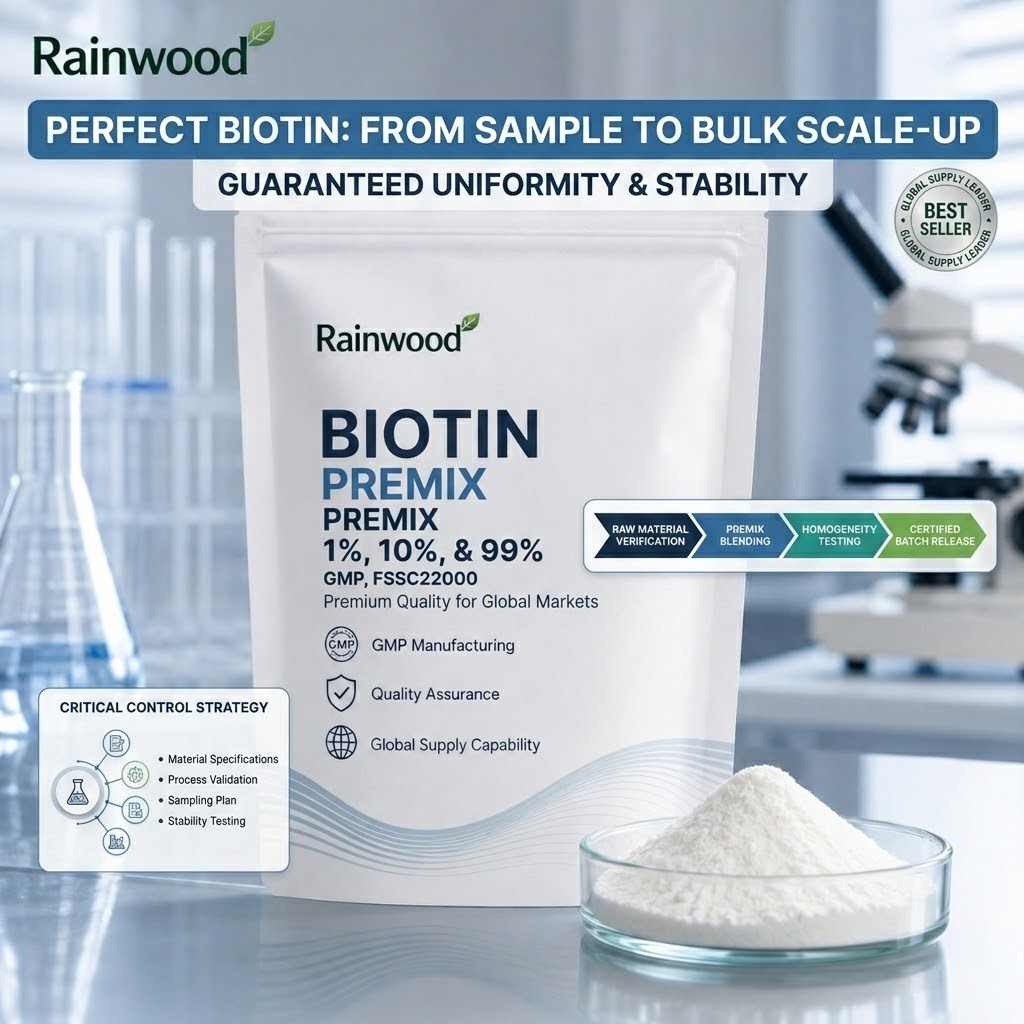
Meta title: Perfect Biotin Sample Failed Bulk How to Lock Scale Up
Meta description: A passing biotin sample does not control commercial production. Lock premix, process, sampling, packaging, stability, and change control first.
The biotin gummy sample tastes right. The capsule prototype passes its single test. The color is approved, and the sales team books the launch.
Three months later, the commercial batch creates a potency investigation.
The supplier says the formula never changed. Procurement points to the approved sample. Production says the batch was made on different equipment at a much larger scale. Everyone is technically correct—and the brand still cannot release inventory.
For an OEM buyer, an approved sample is evidence that one sample was acceptable. It is not a commercial control strategy.
A sample and a production batch are different systems
A bench sample may use hand weighing, a small premix, short transfers, and immediate packaging. Commercial production can introduce:
- a different raw-material lot or premix batch;
- larger equipment and a different fill level;
- longer blending, transfer, and hold times;
- multiple bins, hoppers, or packaging lines;
- different temperature and humidity exposure;
- a new excipient or flavor lot;
- start-up, shutdown, and line-clearance losses;
- wider sampling locations and more analytical variability.
Biotin magnifies these differences because the active amount may be extremely small relative to the whole formula. A process can preserve taste and appearance while distributing the micro-ingredient poorly.
The commercial question is not “Can you copy this sample?” It is “Which material and process attributes created the approved result, and how will each one be controlled at scale?”
Explore RainwoodBio's published biotin powder product context, then require exact lot and grade information for the commercial input.
Lock the premix before you lock the artwork
The phrase “contains biotin” leaves too much freedom. Your master formula should identify the commercial input precisely:
- high-concentration biotin or declared premix;
- guaranteed concentration and basis;
- carrier and all other ingredients;
- supplier and manufacturer information required by your qualification system;
- approved product code and specification version;
- critical physical attributes for processing;
- packaging, storage, retest or expiry conditions;
- substitution and change-notification rules.
If a sample used a 1% premix but the bulk batch uses 99% biotin diluted on site, the formula may contain the same theoretical active amount while using a completely different manufacturing route. That change can affect weighing, dilution, blend uniformity, carrier mass, labels, and test strategy.
Likewise, changing from one 1% premix to another is not automatically equivalent. Carrier, particle distribution, moisture, and premix homogeneity can differ. “Same concentration” is not a complete equivalence assessment.
Convert the golden sample into measurable requirements
An approved sample is most useful when it is accompanied by records. Build a golden-sample package containing:
1. Formula and material codes, concentrations, carriers, and actual weighed quantities.
2. Batch size, equipment, order of addition, mixing steps, and processing conditions.
3. In-process observations and measurable checks.
4. Finished-product specifications and test results.
5. Appearance, dimensions, weight, taste, odor, and packaging references where relevant.
6. Retained samples stored under controlled conditions.
7. Approved label, serving, claim, and market version.
8. Known differences expected at commercial scale and the plan to evaluate them.
Do not define “matches sample” only by visual comparison. A gummy can match color and flavor while potency differs. A capsule can match fill weight while biotin distribution is nonuniform. A powder can look homogeneous while segregation occurs during packing.
The approved reference should support—but never replace—quantitative specifications and process records.
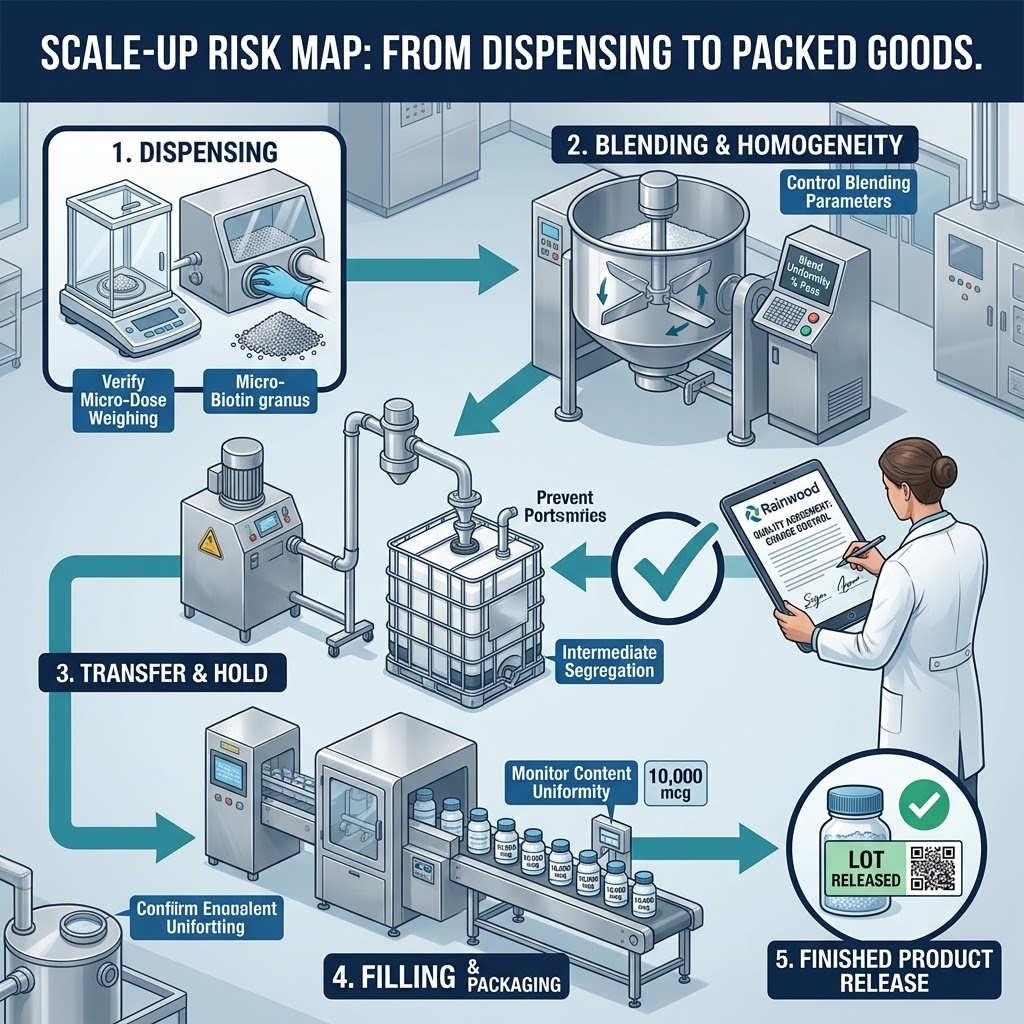
Scale-up needs a risk map, not a promise
Build the process map from dispensing to packed goods and ask what can change at each step.
| Stage | Scale-up risk | Evidence or control |
|---|---|---|
| Dispensing | Micro-ingredient weighing error or loss | Suitable balance, independent check, reconciliation |
| Premixing | Local concentration or incomplete dilution | Defined ratio, sequence, time, equipment, sample plan |
| Main blending | Nonuniform distribution | Qualified parameters and risk-based in-process checks |
| Transfer and holding | Segregation, adhesion, or loss | Controlled transfer, hold conditions, start-middle-end review |
| Forming or filling | Weight and content variation | In-process weight controls plus appropriate content verification |
| Packaging | Moisture, light, oxygen, or mix-up exposure | Suitable pack, line clearance, seal and label checks |
| Storage and shelf life | Potency or product-quality change | Product- and package-specific stability rationale and data plan |
“We use the same formula” addresses only one row. Commercial consistency depends on the interaction of material, method, equipment, sampling, test, package, and time.
Do not let one composite result hide the batch
If several samples are combined before testing, the average can look acceptable while individual locations differ. For a micro-dose ingredient, sampling should be designed around plausible failure modes.
Consider:
- blender locations and discharge sequence;
- separate containers or intermediate bulk bins;
- start, middle, and end of encapsulation, compression, or filling;
- different gummy deposit times or lines where relevant;
- packed units across the run;
- analytical method variability and sample preparation.
Not every project needs every sample listed above. The plan should be risk-based and created by qualified technical personnel. The key is to know what the result represents. A single number must not be asked to prove more than the sampling and method can support.
Low-dose and segregation literature demonstrates why powder systems can lose uniformity during blending and downstream handling. U.S. dietary-supplement CGMP requirements also emphasize established component, in-process, and finished-product specifications and verification that the finished batch meets them.
Explore RainwoodBio's published multi-format OEM development process when comparing capsules, tablets, gummies, or powders for scale-up risk.
Stability starts before the batch enters the warehouse
A passing release result is a time-zero decision. It does not automatically support the labeled shelf life.
The stability plan should reflect the actual formula, process, packaging, storage statement, markets, and meaningful attributes. For a biotin product, that can include potency and relevant physical or sensory properties, depending on the dosage form. Gummies add matrix and moisture questions; powders add caking and segregation concerns; capsules and tablets add shell, excipient, and packaging interactions.
Avoid three shortcuts:
- borrowing shelf life from the raw material;
- applying data from a different formula or package without a justified bridge;
- adding unexplained overage instead of understanding process recovery and stability.
Any overage should have a documented rationale, defined limit, safety and label review, and evidence that it addresses a real loss mechanism. It should not be a hidden correction for poor uniformity.
Change control prevents the second batch surprise
The first commercial batch can pass and the second can still fail if changes are not controlled.
Your quality agreement should identify changes that require notification, assessment, or approval, including:
- biotin source, manufacturer, grade, concentration, or carrier;
- premix process or specification;
- particle or physical-property limits;
- excipient source and formula;
- batch size, equipment, site, sequence, or key processing parameters;
- test method, laboratory, sampling, or acceptance criteria;
- packaging material, configuration, or supplier;
- storage, transport, and shelf-life assumptions.
The agreement should also define deviations, out-of-specification or atypical results, investigation access, retained samples, disposition, replacement, and corrective action. Commercial trust grows from knowing what happens after something goes wrong.
How RainwoodBio can support a controlled scale-up
RainwoodBio's website describes requirement confirmation, sample development, production control, testing and release, documentation, packaging, logistics, and traceability. These are published workflow statements. Buyers should ask which specific records, specifications, tests, and responsibilities apply to their product.
Turn the workflow into a commercial gate:
- signed formula, commercial input specification, and label version;
- approved sample plus measurable reference attributes;
- documented scale-up risks and pilot acceptance criteria;
- commercial-batch sampling and finished-product release plan;
- packaging and stability protocol appropriate to the formula and market;
- deviation, change-notification, and traceability records.
Review RainwoodBio's published production and traceability context and verify project-level evidence before making customer-facing quality claims.
The commercial purchase-order gate
Do not authorize bulk production until:
- the sample and commercial formulas use the same approved material definitions;
- every intentional difference from the sample is documented and assessed;
- dispensing, premixing, blending, transfer, forming, and packaging controls are named;
- sampling can detect the most plausible nonuniformity;
- methods and acceptance criteria are agreed before testing;
- the package and shelf-life rationale match the actual product;
- changes, deviations, rejected batches, and replacement responsibility are covered.
A perfect sample can sell the project. Only a controlled system can supply the reorder.
Request a biotin sample-to-bulk control plan. Send RainwoodBio the approved sample formula, proposed commercial formula, biotin specification or COA, target dose, batch quantity, dosage form, packaging, destination market, release tests, and launch date; the team can map the open scale-up decisions before production.
Frequently asked questions
1.Does an approved sample guarantee the bulk batch will match?
No. A sample demonstrates one result under one set of materials and conditions. Commercial consistency requires specifications, process controls, sampling, testing, packaging, stability, and change control.
2.Can the OEM change from a 1% premix to 99% biotin if the active dose stays the same?
Not without assessment and approval under the agreed change process. The switch changes input mass, carrier, weighing, dilution, blending, labeling considerations, and potentially the test and sampling strategy.
3.Is a passing finished-product assay enough?
It answers an important question, but interpretation depends on sampling, method, acceptance criteria, and whether the result represents individual-unit or batch-wide uniformity. Other quality attributes and process records may also matter.
4.Can raw-material shelf life be used for the finished product?
Not automatically. The finished formula, process, matrix, package, storage, and relevant product attributes differ. Establish a product-specific stability rationale and data plan.
References
- 21 CFR 111.70, dietary supplement specifications: https://www.ecfr.gov/current/title-21/chapter-I/subchapter-B/part-111/subpart-E/section-111.70
- 21 CFR 111.75, determining whether specifications are met: https://www.ecfr.gov/current/title-21/chapter-I/subchapter-B/part-111/subpart-E/section-111.75
- Low-dose blend homogeneity study: https://pubmed.ncbi.nlm.nih.gov/28609454/
- Blend segregation review: https://pubmed.ncbi.nlm.nih.gov/34834324/
- Blend and content uniformity industry position paper: https://pubmed.ncbi.nlm.nih.gov/40011408/
- RainwoodBio biotin powder page: https://www.rainwoodbio.com/-private-label-biotin-vitamin-h-powder-food-grade-biotin-vitamin-h
- RainwoodBio OEM page: https://www.rainwoodbio.com/oem
- RainwoodBio About Us page: https://www.rainwoodbio.com/about-us
*This article is for international B2B procurement, manufacturing, and educational purposes. Formulas, specifications, process controls, methods, sampling, packaging, stability, claims, and regulatory requirements must be confirmed for the exact material, site, batch, finished product, and destination market.*