 EN
EN
Meta title: Biotin Hair Skin and Nails Claims Need Better Evidence
Meta description: Turn biotin beauty marketing into a defensible claim file by matching the exact formula, consumer, dose, endpoint, wording, and total evidence.
Your designer has the before-and-after layout ready. The product page promises stronger hair and nails. An influencer script says biotin “fixes” hair loss. The evidence folder contains a general article explaining that biotin deficiency can involve hair loss and brittle nails.
That is not a claim file. It is a chain of assumptions.
Biotin has an essential biological role, and deficiency signs can include changes involving hair, skin, and nails. But the existence of a deficiency symptom does not prove that adding high-dose biotin improves the same outcome in healthy, biotin-sufficient consumers.
For a DTC beauty brand, the sale is won by a compelling promise. The business is protected by knowing exactly how far the evidence allows that promise to go.
The evidence gap begins with the target consumer
NIH's Office of Dietary Supplements states that biotin deficiency is rare and that claims for hair, skin, and nail health are supported, at best, by only a few case reports and small studies. It notes important limitations, including studies without placebo groups and case reports in people with particular conditions.
That distinction changes the marketing decision.
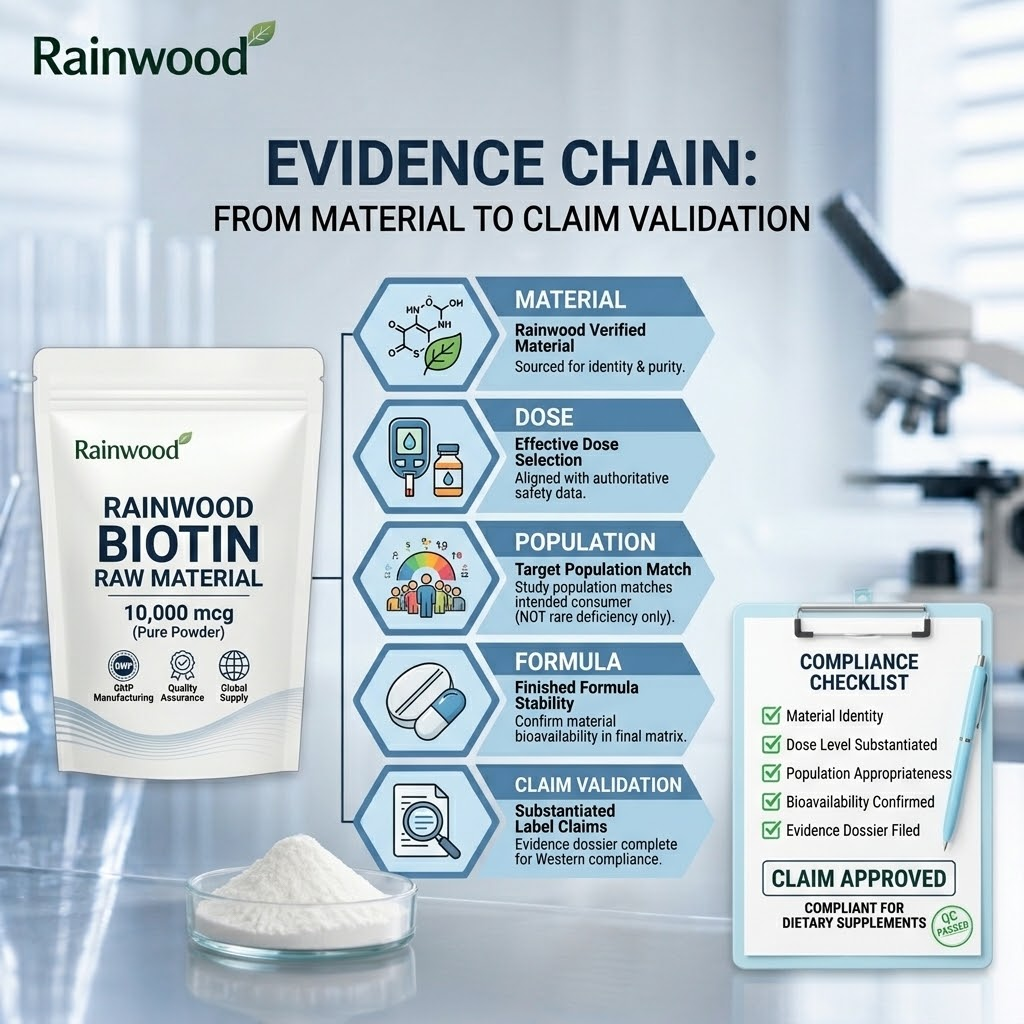
A report involving a person with a deficiency or a rare hair disorder does not automatically substantiate a broad promise for healthy marketplace shoppers. Evidence should be matched through the whole chain:
`study material -> dose -> population -> duration -> endpoint -> commercial ingredient -> finished formula -> exact claim`
If one link changes, the brand must explain why the evidence still applies. “Biotin is known for hair” is not an explanation.
Review RainwoodBio's published biotin powder ingredient option as raw-material context; do not treat a raw-material specification as proof of a finished-product beauty outcome.
Three common claim jumps that create risk
Jump 1: From biological role to guaranteed consumer result
“Biotin contributes to normal nutrient metabolism” and “this product regrows thinning hair” do not make the same promise. The second statement can imply treatment of a condition and a predictable personal outcome.
The stronger the express or implied promise, the stronger and more product-matched the evidence must be. Images, product names, testimonials, hashtags, and page structure all contribute to the overall message. A cautious sentence in the footer cannot neutralize a dramatic transformation story at the top.
Jump 2: From ingredient evidence to a multi-ingredient formula
Hair, skin, and nail products often combine biotin with collagen, minerals, botanical extracts, or other vitamins. Evidence on one ingredient does not automatically prove the effect of the combination, and a study on a combination does not isolate biotin's contribution.
The finished formula can also change dose, exposure, interactions, consumer instructions, and the plausibility of the claim. Keep the ingredient rationale separate from finished-product substantiation.
Jump 3: From testimonial to scientific support
Reviews and before-and-after images can reveal customer language, but they do not control confounding factors, natural change, concurrent products, camera conditions, or selection bias. FDA's claim-substantiation guidance and FTC's health-products guidance emphasize evidence quality, relevance, and the totality of the evidence.
A sincere testimonial can still communicate an unsupported objective claim. Influencer enthusiasm does not transfer legal or reputational responsibility away from the brand.
Build a claim-to-evidence matrix before copy approval
Create one row for every meaningful express or implied claim—not only the sentences your legal team notices first.
| Claim element | Evidence question | Decision |
|---|---|---|
| Product name | Does the name imply growth, repair, reversal, or treatment? | Keep, qualify, or change |
| Front-label benefit | Is the outcome supported for the exact formula and user? | Approve only with matched support |
| Ingredient callout | Does it describe a role or promise a finished outcome? | Separate rationale from proof |
| Image | What result will a reasonable consumer infer? | Test the implied message |
| Testimonial | Is the conveyed result typical and substantiated? | Verify, qualify, or remove |
| Dose statement | Is “high potency” meaningful and responsibly contextualized? | Document the rationale |
| FAQ | Does it drift into disease or diagnostic advice? | Rewrite and escalate |
| Influencer script | Does spoken language exceed approved copy? | Train, monitor, and retain records |
For each row, record the exact wording, target market, audience, evidence, reviewer, approval date, and version. A live listing should never contain a claim that exists nowhere in the approved matrix.
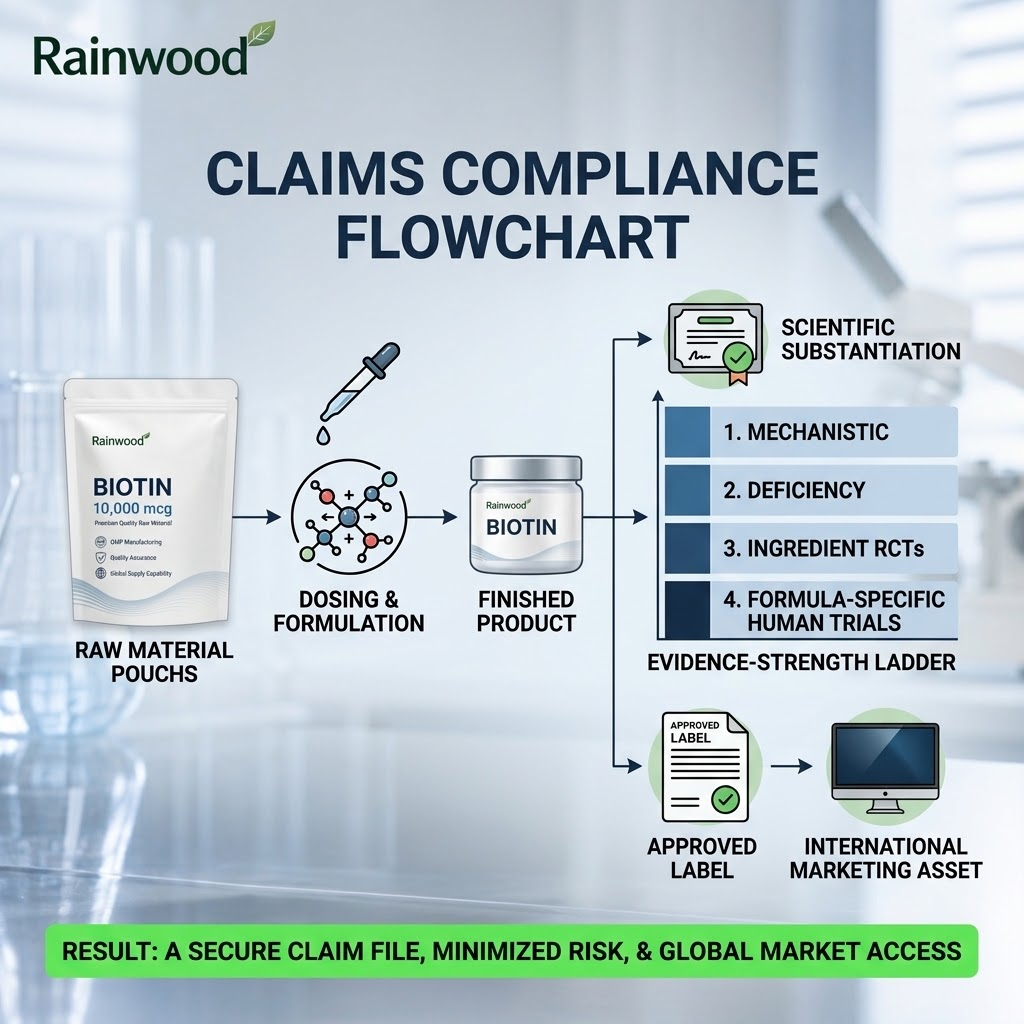
Use an evidence-strength ladder
Not all support deserves equal marketing weight. Organize evidence by relevance and quality:
1. Finished-product human evidence on the intended population and outcome.
2. Human evidence on an adequately matched ingredient, dose, population, and endpoint.
3. Authoritative scientific assessment of the ingredient and claim area.
4. Mechanistic, in-vitro, animal, or deficiency evidence used only for bounded scientific context.
5. Testimonials, traditions, and competitor language used for market insight—not as the scientific foundation.
This is not a universal legal ranking. It is a practical discipline that prevents a weak source from carrying a strong promise. Qualified reviewers must decide what evidence is sufficient for the exact jurisdiction and claim.
Explore RainwoodBio's published OEM formula development workflow when the claim decision may require changing the formula, dose, or dosage form.
The disclaimer does not rescue the headline
In the United States, permitted structure/function claims have specific requirements, including substantiation and notification, and dietary-supplement labels carrying such claims use the statutory disclaimer. FDA also distinguishes structure/function claims from disease claims.
The presence of a disclaimer does not grant permission to make an unsupported statement. FDA's substantiation guidance explains that firms should consider the meaning of the claim, relationship of evidence to the claim, evidence quality, and totality of evidence. FTC guidance similarly evaluates the overall advertising message.
International brands must repeat the analysis market by market. A phrase accepted in one jurisdiction or category may not be accepted in another. Translate only after the approved meaning is locked; otherwise, translation can quietly strengthen the promise.
How RainwoodBio can support a claim-aware project
RainwoodBio's website describes requirement confirmation, formula and sample development, documentation, multiple dosage forms, production control, and testing and release. These are useful project capabilities, but they do not prove clinical efficacy or approve customer-facing claims.
Use the process to create a controlled handoff:
- the brand supplies its target market, exact claims, audience, formula, dose, and evidence requirements;
- formula and material documents use consistent ingredient names and units;
- the approved label version matches the manufacturing specification;
- changes to the ingredient, dose, format, or supplier trigger claim reassessment;
- the final brand obtains qualified regulatory and legal approval.
Review RainwoodBio's published development and documentation context, then request the project records needed for the actual formula.
The pre-launch claims gate
Do not release artwork or ads until every answer is documented:
- Who is the exact consumer described by the evidence?
- Is the evidence about deficiency, a special condition, or healthy consumers?
- Does the study material match the commercial ingredient and dose?
- Does the finished multi-ingredient formula have separate support?
- What express and implied message do the name, images, testimonials, and copy create together?
- Could any phrase imply diagnosis, treatment, cure, prevention, or a guaranteed result?
- Has the exact market and final language been reviewed by qualified advisers?
- Will formula or supplier changes trigger a new review?
If the file contains only general biotin articles, supplier slides, and testimonials, the claim is not ready for an aggressive campaign.
Request a biotin label and claim evidence-gap review. Send RainwoodBio your draft label, product page, influencer brief, complete formula, daily dose, target consumer, destination market, and evidence file; the team can map the claims to formula documents and identify questions requiring qualified market review.
Frequently asked questions
1.Does biotin deficiency cause hair or nail changes?
Deficiency can involve hair loss, skin rash, and brittle nails. However, NIH states that deficiency is rare and that evidence supporting biotin promotion for hair, skin, and nails is limited. Deficiency biology should not be converted into a broad guaranteed benefit for healthy consumers.
2.Can a brand say that biotin supports healthy hair?
The answer depends on the exact wording, overall message, formula, evidence, target market, and applicable rules. Obtain qualified review rather than copying a competitor claim.
3.Are customer reviews enough to substantiate a claim?
No. Testimonials can communicate objective express or implied claims, but personal experience is not a substitute for competent and reliable scientific evidence matched to the product and message.
4.Does raw-material purity prove the finished product works?
No. Raw-material identity and assay are quality decisions. They do not establish finished-product dose uniformity, stability, exposure, or clinical benefit.
References
- NIH Office of Dietary Supplements, Biotin Fact Sheet for Health Professionals: https://ods.od.nih.gov/factsheets/Biotin-HealthProfessional/
- FDA, Structure/Function Claims: https://www.fda.gov/food/nutrition-food-labeling-and-critical-foods/structurefunction-claims
- FDA, Substantiation for Dietary Supplement Claims Guidance: https://www.fda.gov/regulatory-information/search-fda-guidance-documents/guidance-industry-substantiation-dietary-supplement-claims-made-under-section-403r-6-federal-food
- FTC Health Products Compliance Guidance: https://www.ftc.gov/business-guidance/resources/health-products-compliance-guidance
- Biotin for Hair Loss Evidence Review: https://pmc.ncbi.nlm.nih.gov/articles/PMC11324195/
- RainwoodBio biotin powder page: https://www.rainwoodbio.com/-private-label-biotin-vitamin-h-powder-food-grade-biotin-vitamin-h
- RainwoodBio OEM page: https://www.rainwoodbio.com/oem
This article is for international B2B marketing, product-development, and educational purposes and is not medical or legal advice. Claims, evidence, labels, advertising, influencer content, safety communication, and regulatory requirements must be reviewed for the exact formula, audience, channel, and destination market.