 EN
EN

Meta title: 10,000 mcg Biotin and the Lab Test Warning Brands Miss
Meta description: Before launching high-dose biotin, review FDA laboratory-test interference, dose communication, label copy, and customer-support controls.
“10,000 mcg” looks powerful on the front label. It is easy to photograph, easy to compare, and easy for a marketplace shopper to interpret as premium.
It is also 10 mg—about 33,333% of the U.S. Daily Value of 30 mcg.
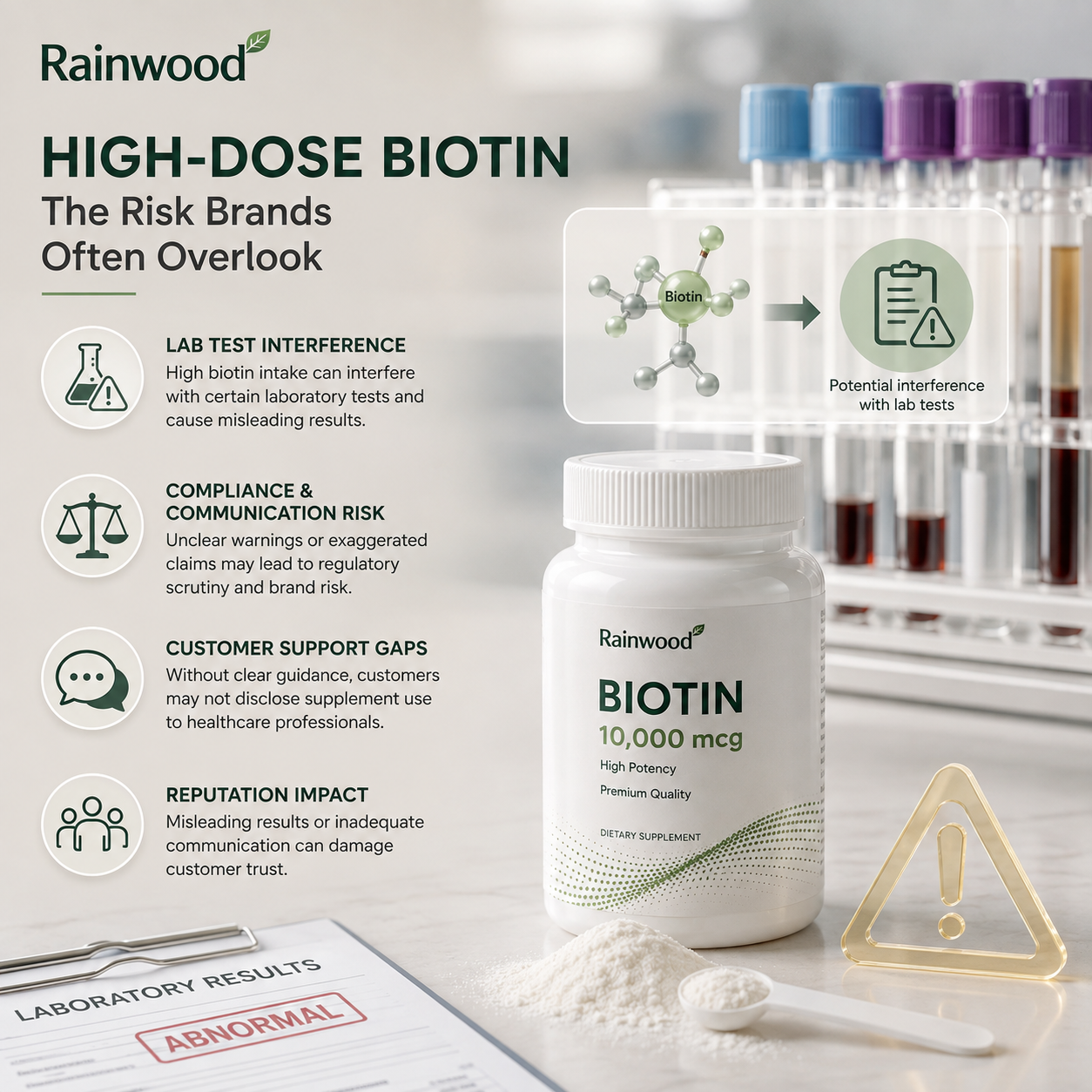
That percentage does not automatically make the product unsafe, and the U.S. Food and Nutrition Board has not established a Tolerable Upper Intake Level for biotin. But it creates a different risk that many beauty-supplement launches underplay: high biotin intake can interfere with certain laboratory tests and produce misleading results.
For an Amazon or DTC brand, dose is therefore not only a formulation choice. It is a customer-communication, label-review, support, and reputation decision.
The risk is not ordinary toxicity
Biotin is often defended with a simple statement: it is water-soluble and no UL has been established. That answer misses the commercial issue.
NIH's Office of Dietary Supplements explains that supplemental biotin above recommended intakes can cause clinically significant falsely high or falsely low laboratory results, depending on the test. FDA has repeatedly communicated concern about biotin interference and reports continued adverse events related to falsely low troponin results in certain assays.
The mechanism involves laboratory systems that use biotin-streptavidin interactions. Excess circulating biotin can disrupt the test design. The direction and magnitude of the error depend on the assay, dose, timing, and other factors. A normal-looking consumer may not connect a beauty supplement with a blood-test result unless the brand gives a clear reason to disclose supplement use to a healthcare professional.
This does not mean your Blog, label, or customer-service team should tell people how to prepare for a medical test. It means the brand should obtain qualified, market-specific advice and communicate responsibly.
Review RainwoodBio's published biotin powder product information as an ingredient starting point, not as a finished-product safety assessment.
“More” is a marketing strategy, not a scientific conclusion
The U.S. adult Adequate Intake and Daily Value are 30 mcg. A 10,000 mcg serving is more than 300 times that amount. Why do brands choose it?
Often, the answer is visual differentiation. A five-digit number can dominate a search-result image. Competitors may appear weaker even when a consumer has no demonstrated need for the larger dose. The number becomes the value proposition.
But a premium position should survive four questions:
1. Why was this exact dose selected for the exact target consumer?
2. What evidence supports the intended benefit and wording at that dose?
3. How will laboratory-test interference be addressed in label and support materials?
4. Does the formula contain overlapping biotin from other ingredients or daily products?
If the answer is “because the market sells 10,000 mcg,” your formula brief is incomplete. Market convention can inform positioning; it cannot replace a dose rationale.
The hidden exposure is the brand's overall message
Risk does not live only in the Supplement Facts panel. It can be created by the full consumer journey:
- the front label celebrates the number without context;
- the product page calls the dose “maximum strength” or implies a guaranteed outcome;
- an FAQ dismisses all risk because biotin is water-soluble;
- customer service has no script for questions about laboratory tests;
- subscription customers use the product continuously without seeing updated information;
- influencers repeat disease or diagnostic language the brand never formally approved.
FDA's structure/function framework and the FTC's health-products guidance make the overall express and implied message important. A required disclaimer does not cure an unsupported or misleading claim.
Read the biotin beauty-claim evidence test before building a larger dose around a larger promise.
Build a high-dose biotin decision brief
Before formula lock, create a one-page decision document with six sections.
| Decision field | Required answer |
|---|---|
| Target consumer | Who is expected to use the product, and who requires extra caution or exclusion advice? |
| Dose rationale | Why this daily amount and serving pattern were selected |
| Evidence match | Which ingredient, formula, population, duration, and endpoint support each claim |
| Laboratory-test communication | Qualified wording and placement for the target market |
| Support process | How questions, complaints, medical-test concerns, and adverse events are escalated |
| Change control | Who reassesses the brief when dose, formula, label, market, or official advice changes |
The brief should name its reviewers and version. Regulatory, medical, and legal input may be needed depending on the market and claim. Do not copy a competitor's warning as if it were automatically correct for your product.
Do not invent a universal stop-use interval
One of the easiest ways to turn a responsible article into unsafe advice is to state that every consumer should stop biotin for a fixed number of hours before testing.
There is no responsible universal rule for a brand Blog. Biotin dose, duration, individual factors, assay design, laboratory threshold, and medical urgency can vary. Some tests may not be affected; others can be. A consumer should inform the relevant healthcare professional and laboratory about supplement use and follow qualified instructions for the actual test.
Your brand's role is to make disclosure more likely, not to replace medical judgment.
Useful controls include:
- clear supplement-use disclosure language reviewed for the destination market;
- a customer-service knowledge article that mirrors approved wording;
- escalation paths for medical, complaint, and adverse-event questions;
- training that prevents staff from giving individualized medical advice;
- periodic review of FDA and other relevant official communications;
- version control across bottle, carton, insert, listing, email, and social copy.
Explore RainwoodBio's published OEM requirement and formula review process when dose and format are still open decisions.
How RainwoodBio can support the pre-launch decision
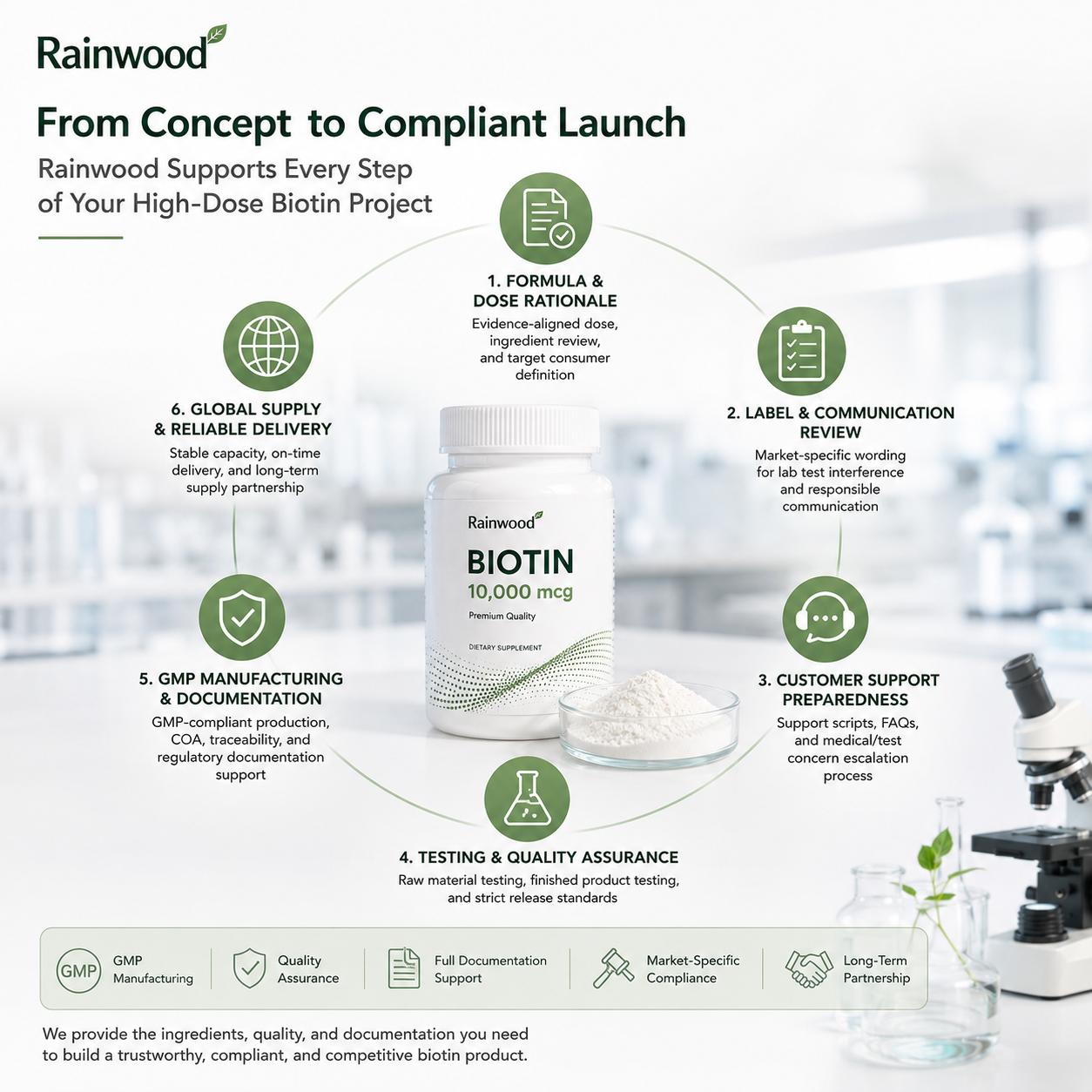
RainwoodBio's website describes requirement confirmation, formula and sample development, multiple dosage forms, production control, testing and release, documentation, and packaging support. These are company-published service statements, not proof that a particular high-dose formula is clinically appropriate or market compliant.
Use the project process to lock three items before artwork:
- target market, daily serving, dose, and all biotin sources in the formula;
- written label and customer-communication requirements supplied or approved by qualified reviewers;
- test and release specifications for the exact finished product.
Format also matters. A high-dose single-ingredient capsule, a beauty gummy, and a multivitamin create different serving, consumer-expectation, stability, and communication questions. Select the format after the dose and claim strategy are coherent.
Review RainwoodBio's published supplement development context and request product-specific records rather than relying on broad website claims.
The five-question launch gate
Do not approve a high-dose biotin product until the team can answer:
- Is the dose based on a documented product strategy rather than a bigger-number race?
- Do the claims match the exact evidence and formula?
- Has laboratory-test interference been reviewed by qualified market advisers?
- Are label, listing, influencer, and customer-service messages aligned?
- Is there an owner for updates, complaints, and adverse-event escalation?
A five-digit dose may still be the selected commercial strategy. If so, it should be a controlled decision—not an inherited marketplace habit.
Request a biotin dose and warning decision review. Send RainwoodBio your target market, proposed daily dose, full formula, format, draft label, intended claims, sales channels, and launch date; the team can identify the formulation and documentation questions that must be closed before production.
Frequently asked questions
1.Is 10,000 mcg of biotin the same as 10 mg?
Yes. One milligram equals 1,000 micrograms, so 10,000 mcg equals 10 mg. Keep units consistent across formula, specification, manufacturing record, test report, and label review.
2.Does the absence of a biotin UL mean there is no risk?
No. NIH notes that a UL was not established because evidence of toxicity at high intakes was insufficient, but high supplemental intake can still create clinically significant laboratory-test interference.
3.Which laboratory tests can biotin affect?
Certain tests that use biotin-streptavidin technology can be affected. FDA has highlighted concern about some troponin assays, and NIH discusses hormone and other assays. Consumers should disclose supplement use and follow healthcare and laboratory instructions for the actual test.
4.Should every biotin product use the same warning?
No. Dose, formula, market, channel, target user, current official guidance, and local requirements differ. Obtain qualified advice and document why the selected wording and placement are appropriate.
References
- FDA, Biotin Interference with Troponin Lab Tests: https://www.fda.gov/medical-devices/in-vitro-diagnostics/biotin-interference-troponin-lab-tests-assays-subject-biotin-interference
- FDA, Testing for Biotin Interference in In Vitro Diagnostic Devices: https://www.fda.gov/regulatory-information/search-fda-guidance-documents/testing-biotin-interference-in-vitro-diagnostic-devices
- NIH Office of Dietary Supplements, Biotin Fact Sheet for Health Professionals: https://ods.od.nih.gov/factsheets/Biotin-HealthProfessional/
- FDA Daily Value on Nutrition and Supplement Facts Labels: https://www.fda.gov/food/nutrition-facts-label/daily-value-nutrition-and-supplement-facts-labels
- FTC Health Products Compliance Guidance: https://www.ftc.gov/business-guidance/resources/health-products-compliance-guidance
- RainwoodBio OEM page: https://www.rainwoodbio.com/oem
This article is for international B2B product-development and educational purposes and is not medical or legal advice. Dose, safety communication, testing, claims, labeling, adverse-event processes, and regulatory requirements must be reviewed for the exact formula, consumer, channel, and destination market.