 EN
EN
Meta title: Curcumin 95% COA: What Importers Must Verify Before Release
Meta description: A 95% curcuminoids result can hide source, profile, lot, and testing gaps. Use this importer checklist before releasing a curcumin shipment.
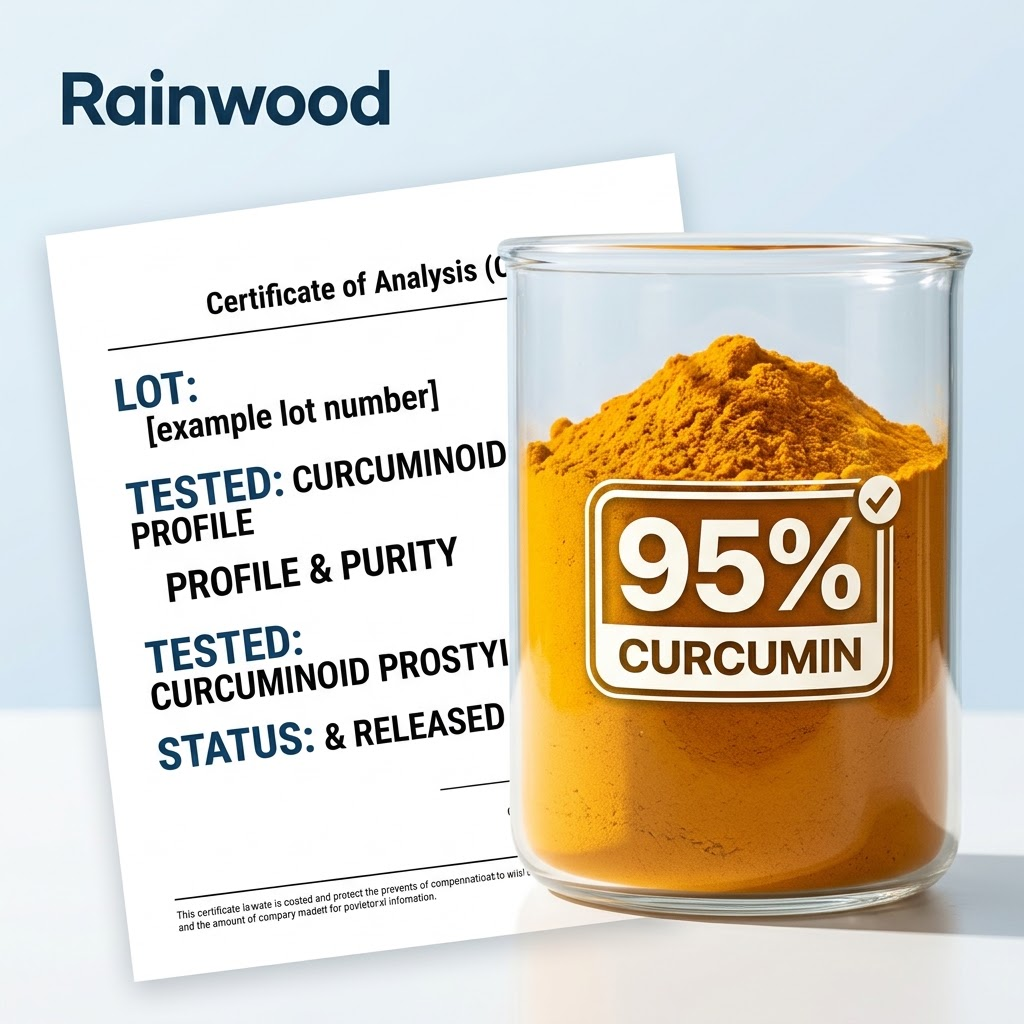
The shipment is at your warehouse. The COA says 95% curcuminoids. The number matches your purchase order, so the lot should be ready to release.
Not so fast.
That single result may answer one narrow question while leaving the expensive questions unanswered: Is the material the agreed botanical extract? Does the curcuminoid profile match the specification? Is the COA connected to the drum you received? Were the contamination limits chosen for your destination market and customer? If the answer to any one of these is unclear, “95%” can become the most expensive number on the page.
For a raw-material importer or distributor, the commercial risk is not that every curcumin supplier is dishonest. The risk is that a familiar headline specification can create false confidence. A persuasive COA is not the same as a complete release package.
What 95 percent actually tells you
The USP monograph defines Curcuminoids as a partially purified natural complex isolated from *Curcuma longa*. It requires not less than 95.0% total curcuminoids on a dried basis, calculated as the sum of curcumin, desmethoxycurcumin, and bisdesmethoxycurcumin. It also provides ranges for the three components.
That is far more specific than a loose phrase such as “95% pure curcumin.” It tells a buyer that total content and component profile are separate ideas.
But even a result that meets a 95% target does not, by itself, establish every fact needed for release. You still need to know which method was used, whether it was fit for the agreed specification, which sample was tested, which laboratory generated the result, and whether the document belongs to the received lot.
Start with RainwoodBio's published 95% curcumin powder product context, then request the project-specific specification and batch evidence rather than relying on the web-page headline.
Trap 1: total assay can hide the component profile
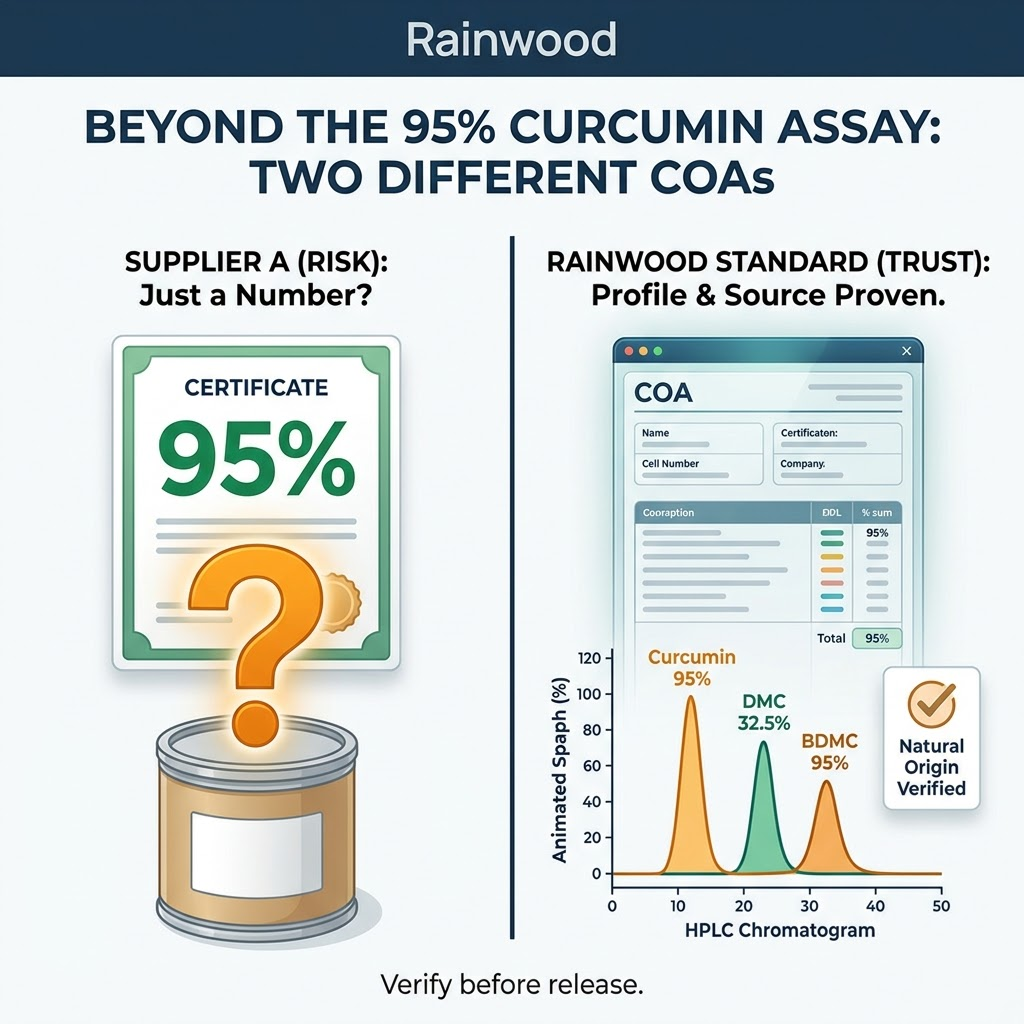
Imagine two powders that both report 95% total curcuminoids. One report shows only the total. The other reports curcumin, desmethoxycurcumin, and bisdesmethoxycurcumin separately, plus the calculation basis and method.
Those documents are not equally useful.
A total can meet the purchase-order headline while the detailed profile remains unknown. The profile matters because a buyer may be purchasing material against a pharmacopoeial, customer, or internally approved specification. If your contract expects defined component ranges, a total alone cannot demonstrate that those ranges were met.
Ask for:
- the exact product and grade name;
- the botanical name and plant part;
- total curcuminoids and the three-component profile;
- whether results are reported as-is or on a dried basis;
- the analytical method, acceptance criteria, and actual results;
- a representative chromatogram when technically and contractually appropriate.
Downstream rejection, retesting, storage, replacement, and delayed delivery can erase a small price advantage many times over.
Trap 2: assay does not automatically prove natural origin
Natural and synthetic curcuminoids can be analytically difficult to distinguish when a test is focused only on content. A peer-reviewed authentication study reported that synthetic material can present the three curcuminoid forms in ratios that resemble natural extracts. The researchers evaluated carbon and hydrogen stable-isotope ratios and discussed carbon-14 analysis as an effective, though more expensive, authentication approach.
This does not prove that synthetic substitution is present in every low-priced lot. It proves something more useful for procurement: if natural origin is commercially material, “95% by HPLC” may not close that question.
Your specification should therefore distinguish three decisions:
1. Does the material contain the expected curcuminoids?
2. Does it meet the agreed quantitative profile?
3. Does the evidence support the claimed botanical and natural origin?
The appropriate authentication package depends on risk, supplier history, market claims, and customer requirements. It may include supply-chain documents, manufacturer and origin records, botanical-source controls, and targeted independent testing. Do not demand an expensive isotope method automatically. Do require the supplier to explain how the natural-origin claim is supported.
Read the paired guide on locking natural curcumin source before import.
Trap 3: a COA can be technically correct but commercially disconnected
Check whether the COA identifies:
- the legal supplier and actual manufacturer where relevant;
- product code and grade;
- batch or lot number matching labels and shipping documents;
- manufacture, test, and retest or expiry dates;
- sample identity and sampling responsibility;
- test laboratory and report authorization;
- methods, limits, and actual numerical results;
- page count, revision control, and attachments.
For U.S. dietary supplement manufacturing, 21 CFR 111.75 is a useful reality check. It requires at least one appropriate identity test or examination for each dietary ingredient before use, subject to a narrow petition route. It also states conditions for relying on a supplier COA for other specifications, including supplier qualification, method and actual-result information, documentation, periodic reconfirmation, and quality-control review.
In plain procurement language: receiving a COA is not the same as qualifying the COA.
Trap 4: the missing tests may cost more than the included tests
Curcumin import decisions are not made on curcuminoid content alone. The relevant contamination and physical specifications depend on the material, manufacturing route, finished use, customer agreement, and destination market.
A risk-based package may need to address:
- elemental impurities;
- residual solvents from the extraction and purification route;
- pesticide residues;
- microbiological limits;
- moisture or loss on drying;
- particle size and bulk properties for the intended formulation;
- undeclared carriers or excipients;
- market- or customer-specific requirements.
Turmeric supply chains have documented contamination and adulteration concerns, including peer-reviewed evidence involving lead chromate in turmeric in Bangladesh. That evidence should not be stretched into a claim that every purified curcumin extract carries the same problem. It should prompt a better question: what hazards are reasonably foreseeable for this exact source and process, and where are the agreed limits and results?
Compare available grades through RainwoodBio's botanical extract sourcing range, but release only against the exact project specification.
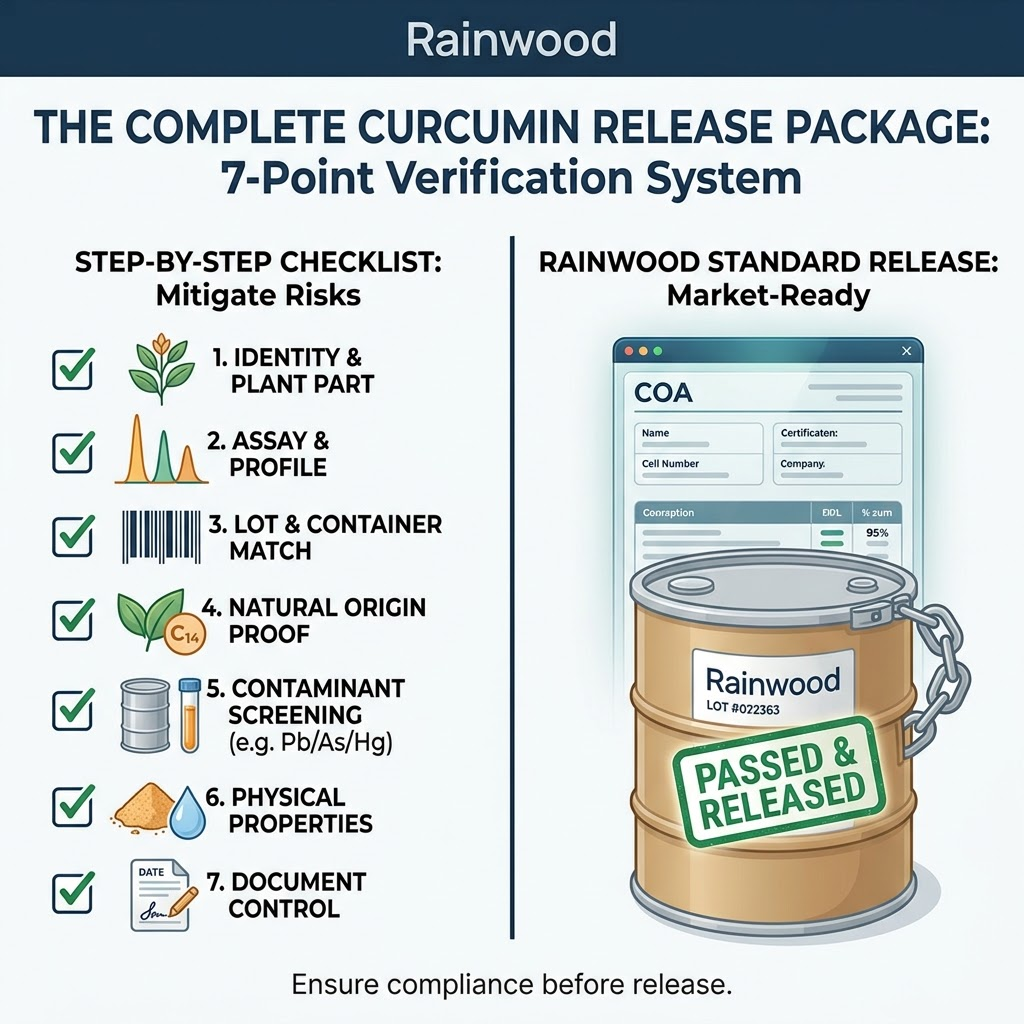
The seven-point COA release scorecard
Score each area as 0 for missing, 1 for incomplete, or 2 for clear and project-matched.
| Release area | What earns a full score |
|---|---|
| Identity | Exact ingredient, botanical source, plant part, grade, and appropriate identity evidence |
| Assay and profile | Total curcuminoids, individual profile where required, basis, method, limits, and actual results |
| Lot connection | COA, container labels, shipping records, and sample all match |
| Natural-origin support | Source records and a risk-appropriate authentication strategy |
| Contaminants | Limits and results reflect source, process, use, customer, and destination market |
| Physical performance | Relevant moisture, particle, density, flow, or other format-critical data |
| Document control | Authorized report, dates, laboratory, version, and attachments are clear |
A low score is not automatic proof of bad material. It is proof that your release decision is carrying undocumented risk. Put the missing items on hold before the drums move into production or a customer shipment.
How RainwoodBio can support a document-first purchase
RainwoodBio's website publishes a 95% curcumin powder and describes source qualification, lot-release documentation, and traceability. These statements provide a useful project framework, not batch-level proof.
For a curcumin order, convert that framework into named deliverables:
- an approved product specification before quotation acceptance;
- a lot-linked document list before shipment;
- an agreed identity, assay, profile, and contamination plan;
- a procedure for deviations, rejection, and change notification.
Review RainwoodBio's published sourcing and release workflow and ask which records apply to the exact curcumin grade and lot. Certificate validity, scope, entity, site, and product coverage should be confirmed separately.
Do not release the shipment until these questions are answered
- What exactly does “95%” mean in the signed specification?
- Are the three curcuminoids reported individually where required?
- How is botanical and natural origin supported?
- Does the COA match the product code, lot, labels, and shipping records?
- Which laboratory performed each test, and which methods were used?
- Which foreseeable contaminants are controlled for this source and process?
- What evidence is independently confirmed rather than supplier-declared?
- What happens contractually if the destination test disagrees?
If your current COA cannot answer these questions, do not solve the uncertainty with another slogan. Solve it with a documented release plan.
Request a curcumin COA and specification gap review. Send RainwoodBio the supplier COA, proposed specification, target market, annual volume, and intended use; the team can identify missing release fields and prepare a question list for your next supplier discussion.
Frequently asked questions
1.Does 95 percent curcuminoids mean 95 percent curcumin?
Not necessarily. A total-curcuminoids result may be the sum of curcumin, desmethoxycurcumin, and bisdesmethoxycurcumin. The exact definition, component ranges, calculation basis, and method should be stated in the specification.
2.Is HPLC enough to prove that curcumin is natural?
An HPLC method can be valuable for identity and quantitative profiling, but an instrument name alone does not define a complete method or automatically prove natural origin. Natural-origin authentication may require supply-chain evidence and targeted analytical techniques selected for the identified risk.
3.Can an importer rely on the supplier COA?
That depends on the market, use, quality agreement, and supplier-qualification system. In the U.S. dietary supplement context, 21 CFR 111.75 sets conditions for relying on a supplier COA for specifications other than the required dietary-ingredient identity test. Importers should obtain market-specific legal and quality advice.
4.What should be tested on every curcumin lot?
There is no responsible universal list for every product and market. Establish a risk-based specification for the exact grade, process, finished use, customer, and destination, then define sampling, methods, frequency, and acceptance criteria in writing.
References
- USP-NF, Curcuminoids monograph: https://doi.usp.org/USPNF/USPNF_M2499_04_01.html
- Electronic Code of Federal Regulations, 21 CFR 111.70: https://www.ecfr.gov/current/title-21/chapter-I/subchapter-B/part-111/subpart-E/section-111.70
- Electronic Code of Federal Regulations, 21 CFR 111.75: https://www.ecfr.gov/current/title-21/chapter-I/subchapter-B/part-111/subpart-E/section-111.75
- Stable Isotope Ratio Analysis for the Authentication of Natural Antioxidant Curcuminoids: https://pmc.ncbi.nlm.nih.gov/articles/PMC9952763/
- Food safety policy enforcement and lead chromate adulteration in turmeric: https://pubmed.ncbi.nlm.nih.gov/37286126/
- RainwoodBio curcumin powder page: https://www.rainwoodbio.com/best-selling-curcumin-powder-good-quality-95-curcumin-powder-for-bulk-buyers
- RainwoodBio About Us page: https://www.rainwoodbio.com/about-us
This article is for international B2B procurement and educational purposes. Product identity, analytical methods, sampling, safety, labeling, import, and regulatory requirements must be confirmed for the exact ingredient, lot, finished product, customer, and destination market.