 EN
EN

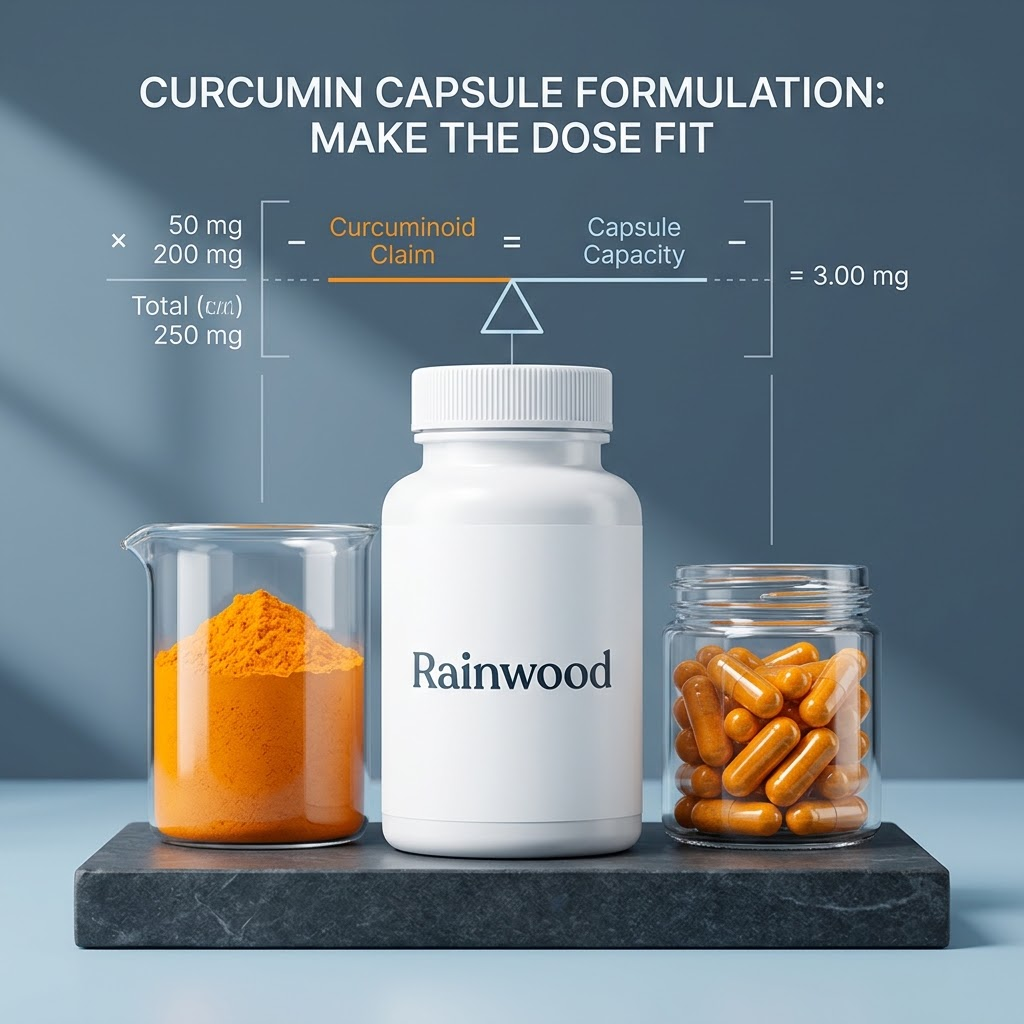
Meta title: Curcumin Capsule Formulation: Make the Dose Fit Before Launch
Meta description: Your curcumin label claim may exceed the capsule's real capacity. Calculate extract input, excipient space, serving count, and pilot requirements first.
The front label says “1,000 mg curcuminoids.” The design uses two capsules per day. Marketing approves the concept, artwork starts, and the launch calendar begins.
Then formulation performs the first real calculation.
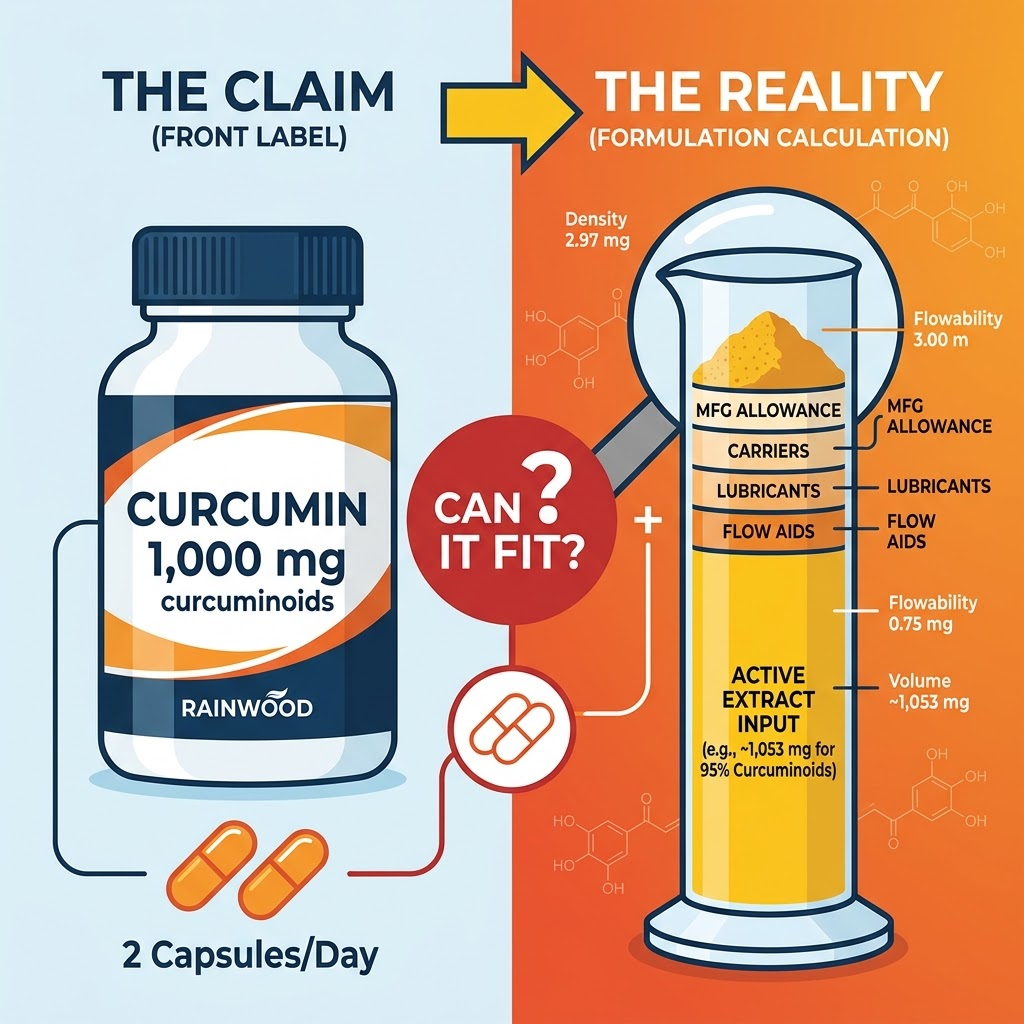
At a guaranteed 95% total-curcuminoid assay, delivering 1,000 mg of curcuminoids requires about 1,053 mg of extract before any glidant, lubricant, flow aid, carrier, or manufacturing allowance. Split across two capsules, that is about 526 mg of extract in each shell before the formula has room to run on the machine.
Can it fit? The label cannot answer. Only the actual material, density, flow, shell, equipment, excipient system, and pilot can.
For an OEM product developer, this is where an exciting curcumin concept becomes either a manufacturable product or an expensive artwork revision.
Start with the active-to-input calculation
Do not use “curcumin dose” as if it had one meaning. It can refer to turmeric powder, turmeric extract, total curcuminoids, curcumin as one component, or a formulated curcumin complex that includes carriers.
Define the label target first, then calculate the input:
`Required ingredient input = target defined active / guaranteed active fraction`
Examples:
- To deliver 500 mg total curcuminoids from a 95% extract: 500 / 0.95 = about 526 mg extract.
- To deliver 1,000 mg total curcuminoids from a 95% extract: 1,000 / 0.95 = about 1,053 mg extract.
- If a delivery-system ingredient contains 40% curcuminoids, 500 mg total curcuminoids would require 1,250 mg of that ingredient, unless the label and evidence are based on a different defined serving.
These examples are formula math, not manufacturing approval. The commercial specification, calculation basis, actual batch assay, overage rationale, and local labeling rules still need confirmation.
Review RainwoodBio's published 95% curcumin powder grade, then obtain the current specification and physical data for the exact lot or grade selected.
The assay solves mass but density decides volume
Two powders can have the same assay and very different capsule behavior.
A light, fluffy powder occupies more volume per gram than a denser powder. Tapped density can differ from loose bulk density. Particle-size distribution, electrostatic behavior, moisture, shape, and agglomeration affect flow and packing. Blending in low-density excipients can make a theoretically possible fill impractical at production speed.
That is why a capsule-size chart is not a formulation guarantee. Those charts use assumed densities or provide volume only. Your fill weight must be measured with the actual blend.
Request:
- loose bulk density and tapped density methods and results;
- particle-size distribution;
- moisture or loss on drying;
- flow observations or relevant flow measurements;
- blend composition and excipient percentages;
- target capsule shell and closure;
- pilot fill weights and weight variation;
- machine speed and observed stoppages or defects.
If the supplier cannot provide format-relevant data, budget for development work before approving the serving claim.
The excipient space buyers forget
A formula is not simply active powder poured into a shell.
Depending on the material and process, a capsule blend may need ingredients to improve flow, reduce sticking, support uniformity, or make filling repeatable. A delivery-system curcumin may already include carriers. Combining curcumin with piperine, boswellia, ginger, vitamins, minerals, or other actives adds more mass and can create new blending and testing questions.
Every extra milligram competes for the same internal volume.
Create a mass budget before quotation:
| Formula component | mg per daily serving | mg per capsule | Evidence or function |
|---|---:|---:|---|
| Curcumin ingredient | | | Assay and ingredient definition |
| Other actives | | | Formula and claim purpose |
| Delivery-system carrier | | | Included in ingredient or added separately |
| Flow and processing aids | | | Pilot-confirmed need |
| Planned manufacturing allowance | | | Written rationale and regulatory review |
| Total target fill | | | Must pass actual fill trial |
Do not hide a failed mass budget by switching from “curcuminoids” to “turmeric complex” late in the artwork process. Fix the product promise or change the format.
See why bioavailability claims must be compared at formula level.
More capsules can rescue the formula and damage the product
Increasing the daily serving from two capsules to four may solve a physical problem. It can create a commercial one.
More capsules can mean:
- a larger bottle and higher packaging cost;
- higher fulfillment weight and storage volume;
- lower consumer convenience;
- more visible mismatch with the front-label promise;
- different directions and serving count;
- lower days of supply per bottle;
- new price-positioning pressure.
Calculate these effects before treating serving count as a free variable. A formula that fits only after doubling the number of capsules may need a powder, softgel, lower-dose positioning, or a different evidence-supported delivery system.
Capsule, softgel, tablet, gummy, or powder
The best format is the one that can deliver the chosen formula consistently and sellably.
Hard capsule
Useful for dry powders and flexible formulas, but limited by blend volume, flow, serving count, and curcumin's strong color transfer. Shell compatibility and line cleaning also need consideration.
Softgel
Potentially useful for lipid-based systems, but the ingredient must remain compatible and stable in the fill matrix and shell. Solubility, suspension, sedimentation, leakage, and active uniformity require development.
Tablet
Can carry more mass in some designs, but compression behavior, hardness, friability, disintegration, coating, and size affect feasibility and consumer experience.
Gummy
Curcumin's intense color, low aqueous solubility, taste, dispersion, heat exposure, and active load can make a high-dose claim difficult. A visually attractive prototype is not proof of shelf-life potency or dose uniformity.
Powder or sachet
Provides more mass capacity but raises dispersion, sediment, taste, staining, packaging, and serving-measure questions.
RainwoodBio's hard-capsule development service and multi-format supplement options provide project routes to compare. The website's format list is company-published context; feasibility must be confirmed with the exact curcumin material and formula.
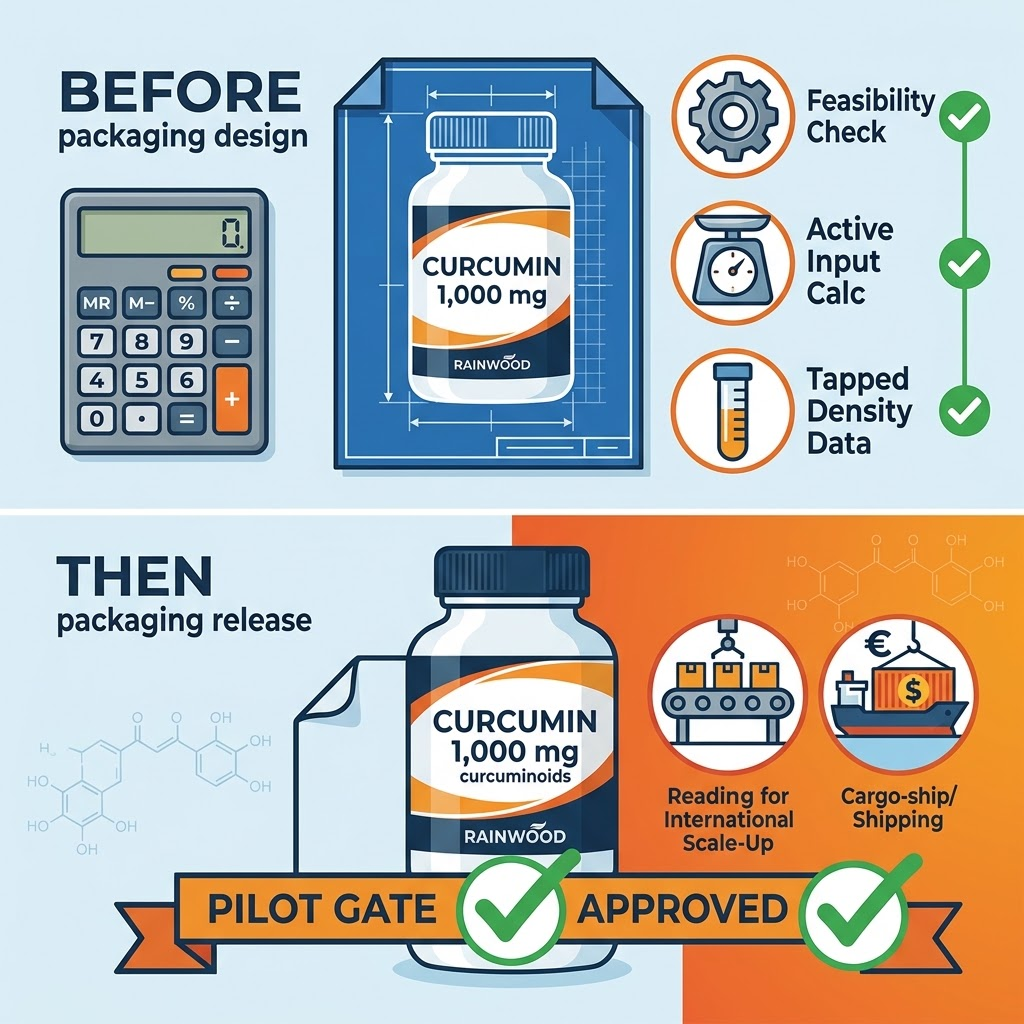
Build a pilot gate before approving packaging
The pilot should answer the questions that spreadsheet math cannot:
1. Does the actual blend fit the selected unit at the target weight?
2. Does it flow and fill consistently at a meaningful operating condition?
3. Are weight variation and finished active results acceptable?
4. Does curcumin stain shells, tooling, seals, or packaging in a commercially unacceptable way?
5. Does the unit disintegrate, disperse, or release as required for the project?
6. Can the serving and directions remain consumer-friendly?
7. Does the package protect the product through the proposed shelf life?
Record the exact raw-material lot, formula version, equipment, process settings, sample size, results, deviations, and acceptance decision. Without those records, “the sample worked” is not a scalable conclusion.
How RainwoodBio can turn the label into a manufacturable brief
RainwoodBio's website describes requirement confirmation, sample development, and multiple dosage forms. Use those published capabilities to demand a concrete feasibility package:
- exact ingredient and active definitions;
- daily target and serving count;
- active-to-input mass calculation;
- physical-property data for the chosen grade;
- formula mass and volume budget;
- prototype and pilot acceptance criteria;
- finished-product specification and test plan;
- packaging and stability proposal;
- change triggers that require revalidation.
Do not ask only, “Can you make this?” Ask, “What evidence will show that this formula, dose, format, and serving can be made repeatedly?”
The pre-artwork formula release gate
Release the label only when all boxes are checked:
- The ingredient name and active definition are unambiguous.
- The guaranteed assay, not a best-case result, drives the input calculation.
- Carriers, co-actives, and processing aids are included in the mass budget.
- Actual bulk/tapped density and pilot data support the unit fill.
- Serving count, bottle count, and consumer directions remain commercially acceptable.
- Finished-product assay, uniformity, physical tests, and contaminant limits are defined.
- The target market's label, safety, and claim requirements have been reviewed.
- Source, formula, process, or packaging changes trigger reassessment.
If one item is still an assumption, your artwork is not ready.
Request a curcumin dose and format feasibility calculation. Send RainwoodBio your target active amount, ingredient specification, proposed formula, daily serving, preferred capsule or alternative format, market, quantity, and packaging concept; the team can prepare the input-mass budget and identify the pilot data required before final quotation.
Frequently asked questions
1.How much 95 percent curcumin extract is needed for 500 mg curcuminoids?
The theoretical input is about 526 mg because 500 divided by 0.95 equals 526.3. The commercial formula must still account for the specification basis, actual quality target, other ingredients, manufacturing rationale, finished testing, and local labeling rules.
2.Can a capsule manufacturer guarantee fill weight from a powder specification?
Not responsibly from assay alone. Actual fill depends on bulk and tapped density, flow, particle properties, excipients, shell volume, equipment, operating conditions, and pilot results.
3.Is a larger capsule always the best fix?
No. It can affect swallowing, bottle size, serving experience, packaging cost, and market positioning. Compare serving count and alternative formats before committing.
4.Why does a formulated curcumin ingredient sometimes have a lower assay?
The product may include carriers or a delivery matrix intended to change dispersion, stability, or absorption. Evaluate the exact composition, evidence, active dose, total input mass, and format fit rather than comparing assay alone.
References
- USP-NF, Curcuminoids monograph: https://doi.usp.org/USPNF/USPNF_M2499_04_01.html
- Electronic Code of Federal Regulations, 21 CFR 111.70: https://www.ecfr.gov/current/title-21/chapter-I/subchapter-B/part-111/subpart-E/section-111.70
- Pharmacokinetics of a Single Dose of Turmeric Curcuminoids Depends on Formulation: https://pubmed.ncbi.nlm.nih.gov/33877323/
- Stabilization and stability evaluation of curcumin: https://pmc.ncbi.nlm.nih.gov/articles/PMC2904446/
- RainwoodBio curcumin powder page: https://www.rainwoodbio.com/best-selling-curcumin-powder-good-quality-95-curcumin-powder-for-bulk-buyers
- RainwoodBio OEM page: https://www.rainwoodbio.com/oem
*This article is for international B2B formulation and educational purposes. Ingredient calculations, manufacturing allowances, specifications, analytical methods, safety, labeling, packaging, stability, and regulatory requirements must be confirmed for the exact commercial formula and destination market.*