 EN
EN
Meta title: Curcumin Sample to Bulk: Lock Commercial Production
Meta description: A perfect curcumin sample does not lock the source lot, blend, process, tests, or packaging. Use this OEM release gate before mass production.
The sample is exactly what your team wanted: bright color, clean capsules, acceptable fill, and a finished bottle ready for photography. You approve it and pay for mass production.
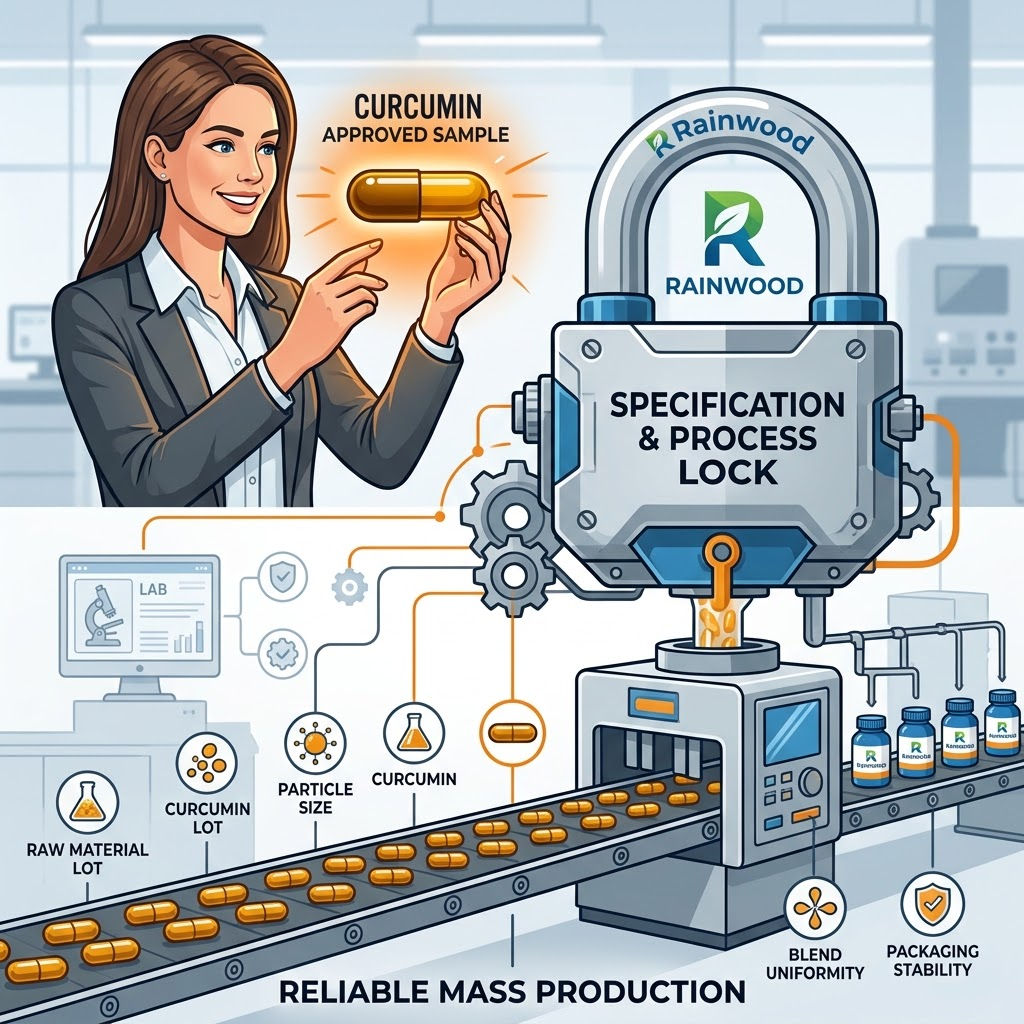
Six weeks later, the commercial batch looks darker, fills less consistently, and needs a longer investigation before release. The supplier says both products used “the same formula.”
That phrase is not enough.
A formula can remain unchanged while the raw-material lot, particle distribution, bulk density, blend scale, equipment, process settings, or packaging changes. The buyer approved an attractive sample without locking the commercial control system behind it.
For an OEM/ODM buyer, the objective is repeatable commercial release.
A development sample answers only one question
A sample shows what happened under the conditions used to make that sample. It may demonstrate early feasibility, appearance, taste, fill, or packaging presentation. It does not automatically demonstrate what will happen at production scale or through shelf life.
Ask how the sample was made:
- Was it hand-filled, made on pilot equipment, or produced on the intended commercial line?
- Which curcumin lot and grade were used?
- Which process settings were recorded?
- Which tests were performed on the raw material, in-process blend, and finished units?
- Was the sample exposed to accelerated or real-time stability conditions?
If answers are missing, treat the sample as a design reference, not a production guarantee.
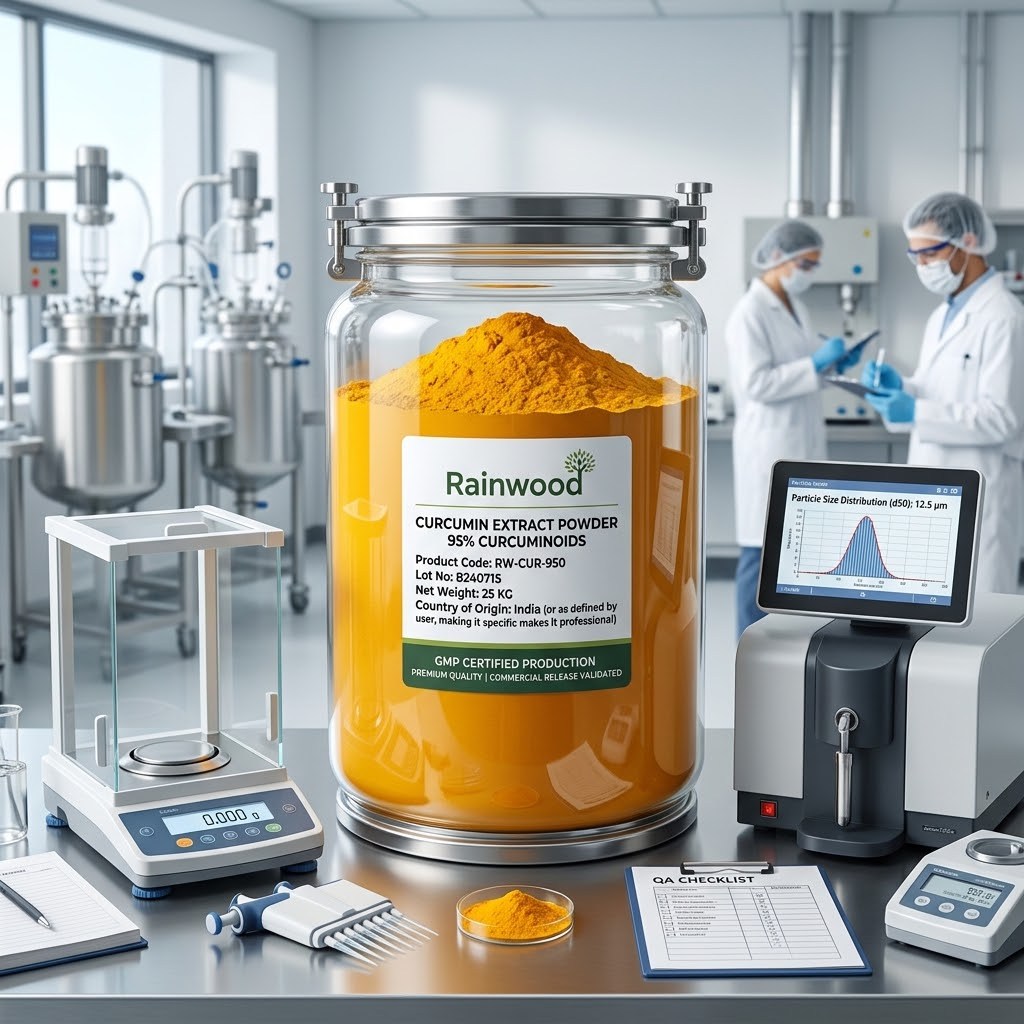
RainwoodBio publishes a 95% curcumin powder product option. A commercial project still needs to identify the exact approved grade, supplier or manufacturer, specification, and lot controls.
The curcumin lot can change the process without changing the label
Standardized assay does not standardize every physical property.
Two lots can both meet total-curcuminoid content while differing in:
- particle-size distribution;
- loose and tapped density;
- flow and compressibility;
- moisture;
- color tone;
- agglomeration;
- electrostatic behavior;
- residual carrier or process-related composition within the agreed limits.
Those differences can affect blending, capsule fill, tablet compression, gummy dispersion, softgel suspension, powder sediment, cleaning, and visual consistency. The issue is not automatically a defective lot. It may be a specification that controls chemistry but ignores format-critical behavior.
The solution is to add physical and performance attributes that matter to the actual product, with methods and limits justified by development data.
Use the curcumin dose and capsule feasibility calculation before setting the commercial fill target.
Scale changes what “well blended” means
A small sample may mix easily. Commercial production changes blend geometry, mixing time, transfer, vibration, and holding time. Powders with different particle size or density may segregate after they initially appear uniform.
Visual uniformity can reveal gross problems, but color cannot replace quantitative uniformity testing. A blend can look even and still fail active-content criteria.
Define:
- the order of addition;
- pre-blending or geometric dilution steps where appropriate;
- blend size and equipment;
- mixing time and speed range;
- sampling locations and plan;
- hold and transfer limits;
- in-process acceptance criteria;
- actions after an out-of-limit or atypical result.
The master record must make “same formula” operational, not rhetorical.
Color is commercially important but analytically dangerous
Buyers and consumers associate curcumin with an intense yellow-orange color. That makes shade a legitimate product attribute when appearance matters. It also creates a trap: a vivid color can persuade teams that identity and potency are correct.
Color can be affected by source, processing, particle characteristics, light, pH, surrounding ingredients, and storage. Research documents curcumin's sensitivity to light and degradation in certain aqueous and pH conditions. A color check cannot replace identity, assay, or stability testing.
Set separate decisions:
- Visual standard: acceptable shade range under defined lighting or an instrumental color range where justified.
- Chemical standard: identity, curcuminoid content/profile, and relevant degradation or stability indicators.
- Finished-product performance: uniformity, disintegration or dispersion, appearance, and active retention.
Do not reject a safe, conforming batch only because it differs from an uncontrolled phone photograph. Do not release a nonconforming batch because it “looks like curcumin.”
Packaging is part of the curcumin process
If development ends when the capsule leaves the machine, the project is unfinished.
Light, moisture, oxygen exposure, container material, closure, and storage temperature can affect a finished product. Gummies and aqueous powders add stability and dispersion questions. Curcumin can also stain contact surfaces and packaging.
The approved sample should therefore be tied to an approved packaging configuration and stability protocol. A change from opaque to clear packaging, a different bottle size, or a new desiccant is not merely a purchasing substitution when it can affect performance.
Explore RainwoodBio's published OEM format and packaging context, then confirm the exact materials, compatibility work, and stability evidence planned for the product.
Build a golden-sample package, not a golden bottle
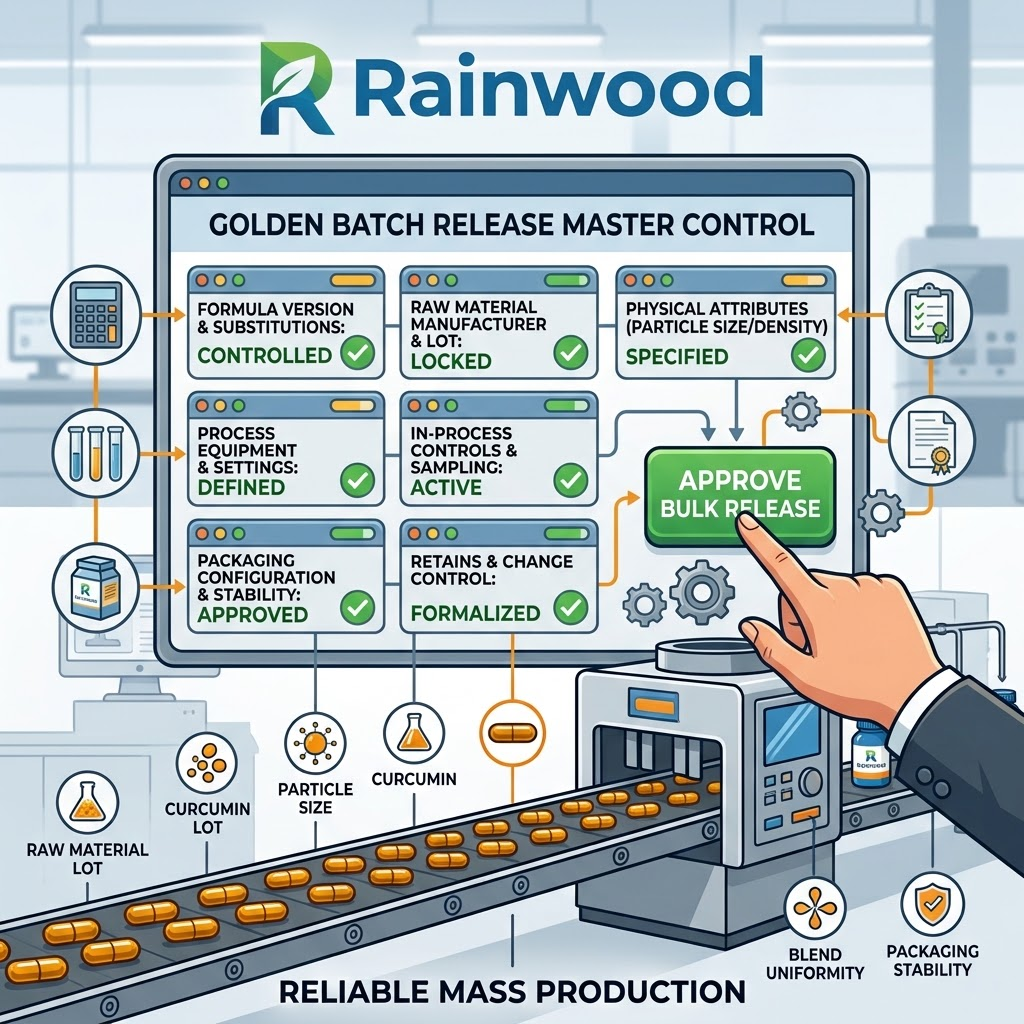
The approved sample should sit inside a controlled package:
| Control item | What must be locked |
|---|---|
| Formula | Version, ingredient quantities, active definitions, and authorized substitutions |
| Raw material | Manufacturer/source, grade, specification, and approved lot used in development |
| Physical attributes | Particle size, density, moisture, color, flow, or format-critical limits |
| Process | Equipment, batch scale, order of addition, settings, hold, and transfer conditions |
| In-process controls | Sampling locations, frequency, limits, and response to deviations |
| Finished specification | Identity, strength, composition, relevant contaminants, and physical tests |
| Packaging | Exact container, closure, liner, desiccant, label, and storage conditions |
| Stability | Protocol, conditions, tests, time points, and shelf-life decision |
| Retains | Raw-material, blend, bulk, and finished-product retains with custody rules |
| Change control | Changes requiring notification, review, sample, testing, or reapproval |
This is the difference between approving an object and approving a reproducible product.
Commercial-batch sampling must be designed before the batch exists
A composite or convenient grab sample can hide location or time-based variation. The plan must reflect the process and risk.
For the first commercial batch, consider:
- incoming sampling for the curcumin lot;
- blend sampling justified for the mixer and segregation risk;
- start, middle, and end checks during filling or packaging;
- finished-product samples selected under a defined plan;
- retains sufficient for investigation and agreed reconfirmation;
- independent or customer testing rights where needed.
In the U.S. dietary supplement context, 21 CFR 111.70 requires component, in-process, finished-product, packaging, and label specifications where applicable. Section 111.75 requires monitoring at necessary in-process points, scientifically valid tests or examinations, and corrective action plans for unmet specifications. Use these requirements as a discipline, then confirm the exact obligations for your product and market.
Change control is your defense against invisible substitutions
Your quality agreement should state which changes require prior notification and approval, including:
- curcumin manufacturer, source, country, or grade;
- extraction, purification, drying, milling, or blending process;
- analytical method or laboratory;
- excipient supplier or grade;
- equipment, site, batch scale, or critical process range;
- capsule shell, packaging, desiccant, or storage condition;
- formula, serving, label, or claimed shelf life.
Not every change requires a full redevelopment. Every material change requires a documented impact assessment. The buyer should know whether the evidence, label, stability, and commercial sample remain applicable.
How RainwoodBio can convert sample approval into release control
RainwoodBio's website describes sample development, production-and-release control, and traceability. These are relevant stages, but the website does not prove that a particular curcumin project has completed them.
Ask RainwoodBio to convert the project into:
- an approved formula and ingredient specification set;
- a recorded development and pilot history;
- commercial-batch process and sampling requirements;
- finished-product release criteria;
- packaging, stability, retain, deviation, and change-control responsibilities.
Review RainwoodBio's published production and traceability workflow and request the project records before treating the sample as evidence for commercial consistency.
The first-bulk release gate
Do not release the first commercial batch until you can answer:
1. Did production use the approved curcumin source, grade, lot status, formula, and packaging?
2. Are deviations from the approved sample process identified and assessed?
3. Do incoming, in-process, and finished results meet the signed specifications?
4. Does the sampling plan represent the batch and filling run appropriately?
5. Are color and appearance assessed separately from chemical identity and potency?
6. Are retains and complete batch records available for investigation?
7. Are stability commitments active for the final package?
8. Will future material or process changes require notification and review?
Absolute sample-to-bulk identity is not a credible promise. Controlled equivalence against agreed specifications and performance criteria is.
Request a curcumin sample-to-bulk release and change-control plan. Send RainwoodBio the approved sample specification, formula, target market, dosage form, packaging, quantity, launch date, and current concerns; the team can identify which raw-material, process, sampling, release, and change records should be locked before mass production.
Frequently asked questions
1.Does approving a curcumin sample guarantee identical mass production?
No. Development and commercial conditions can differ. The goal is not an absolute guarantee; it is controlled production that meets signed raw-material, process, finished-product, packaging, and performance criteria.
2.Which curcumin changes should require a new sample?
Changes to source, manufacturer, grade, particle properties, process, formula, key excipients, dosage form, or packaging may require a new sample or additional testing. The decision should follow a documented risk assessment.
3.Can color be used to release a curcumin batch?
Color can be an appearance specification, but it cannot replace appropriate identity, potency, contaminant, uniformity, and stability controls. Define visual and chemical decisions separately.
4.What should an OEM buyer retain from the first bulk batch?
The retain plan should cover relevant raw materials, in-process or bulk material where useful, and finished packaged product, with quantities, conditions, custody, and retention periods sufficient for the intended investigations and market obligations.
References
- Electronic Code of Federal Regulations, 21 CFR 111.70: https://www.ecfr.gov/current/title-21/chapter-I/subchapter-B/part-111/subpart-E/section-111.70
- Electronic Code of Federal Regulations, 21 CFR 111.75: https://www.ecfr.gov/current/title-21/chapter-I/subchapter-B/part-111/subpart-E/section-111.75
- USP-NF, Curcuminoids monograph: https://doi.usp.org/USPNF/USPNF_M2499_04_01.html
- Stabilization and stability evaluation of curcumin: https://pmc.ncbi.nlm.nih.gov/articles/PMC2904446/
- RainwoodBio curcumin powder page: https://www.rainwoodbio.com/best-selling-curcumin-powder-good-quality-95-curcumin-powder-for-bulk-buyers
- RainwoodBio OEM page: https://www.rainwoodbio.com/oem
- RainwoodBio About Us page: https://www.rainwoodbio.com/about-us
*This article is for international B2B procurement, manufacturing, and educational purposes. Specifications, sampling, process validation, testing, stability, packaging, quality agreements, and regulatory requirements must be confirmed for the exact ingredient, finished product, site, and destination market.*