 EN
EN
Meta title: Natural Curcumin Sourcing: Lock the Source Before Import
Meta description: Two 95% curcumin quotes can carry very different source, test, logistics, and rejection risks. Normalize the evidence before choosing a supplier.
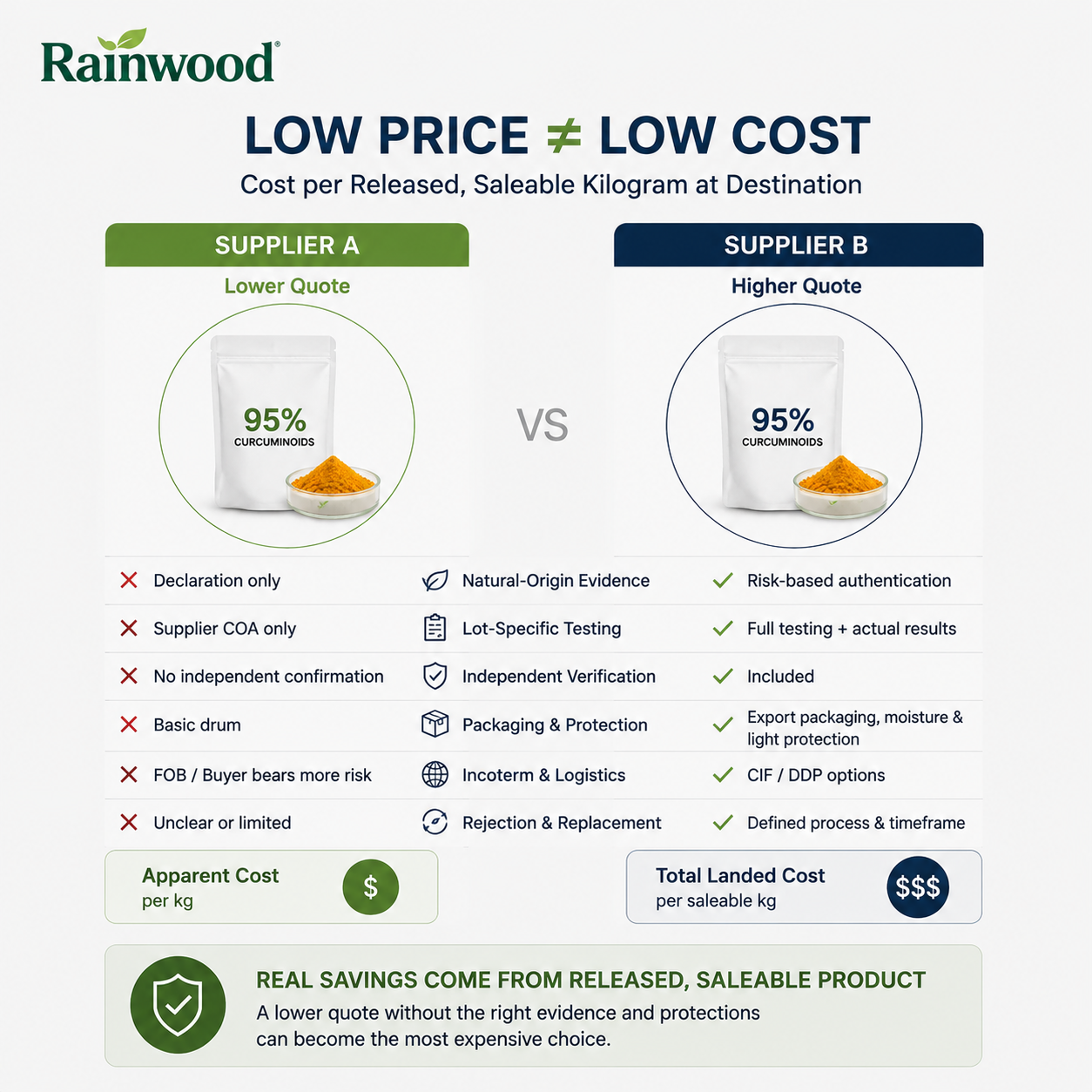
Supplier A protects your margin. Supplier B is 18% higher and includes more testing. Both quote 95% curcuminoids. By cost per kilogram, Supplier A wins.
But cost per kilogram is not your real purchasing unit. Your real unit is cost per released, saleable kilogram at destination.
If the lower quote excludes source authentication, independent confirmation, destination testing, protective packaging, or a workable rejection remedy, the apparent saving can disappear before the batch reaches your customer. The dangerous quote is not always the cheapest one. It is the one that leaves expensive responsibilities undefined.
This guide is for importers and distributors comparing natural curcumin suppliers. It turns “trust us, it is natural” into a qualification and quotation system you can use before paying a deposit.
Natural origin is a purchasing requirement, not a color judgment
Orange-yellow appearance does not authenticate botanical origin. A familiar chromatographic profile may also be insufficient when the commercial question is natural versus synthetic source.
A 2023 peer-reviewed study evaluated stable-isotope methods for authenticating natural curcuminoids and reported that synthetic forms used as adulterants can present curcumin, desmethoxycurcumin, and bisdesmethoxycurcumin in ratios that resemble a natural complex. The researchers discussed carbon-14 as an effective method and explored carbon and hydrogen isotope ratios as additional tools.
That finding gives importers a precise message: a normal-looking powder and a strong total assay do not automatically close the natural-origin claim.
It does not justify accusing a low-priced supplier of substitution. Instead, it justifies writing the requirement into the purchase system:
- What source is being claimed?
- Who manufactured the extract?
- Which records trace the material back to *Curcuma longa* rhizome?
- What process and origin declarations are available?
- What analytical strategy is used when natural authenticity is commercially material?
- Who pays for confirmation if the destination result is disputed?
First review why a 95% curcumin COA can leave critical gaps.
The cheap quote may be selling a smaller evidence package
When two quotes use the same grade name, buyers often assume the underlying deliverables are equal. They rarely are.
One price may include only a supplier COA and standard drum. Another may include lot-specific testing, origin documents, independent verification, export packaging, pre-shipment sample approval, and defined replacement terms. A third may use a different Incoterm that transfers freight, insurance, customs, and local handling risk earlier than expected.
Normalize each quote across these fields:
| Cost and evidence field | Quote A | Quote B | Buyer decision |
|---|---|---|---|
| Exact grade and total curcuminoid definition | | | Same specification or not? |
| Natural-origin evidence | | | Declaration only or risk-based authentication? |
| Lot-specific identity and profile | | | Method, limits, actual results, lot link? |
| Contaminant package | | | Matches source, process, customer, and market? |
| Independent confirmation | | | Included, optional, or buyer-paid? |
| Sample and inspection | | | Pre-shipment sample, retain, sampling responsibility? |
| Packaging and storage | | | Drum, liners, light/moisture protection, pallet terms? |
| Incoterm and destination costs | | | Which party carries which cost and risk? |
| Lead time and validity | | | Production time, document time, freight assumptions? |
| Rejection and replacement | | | Retest process, governing result, remedy, time limit? |
Do not choose until you can explain every blank. A quote with fewer included controls may still be commercially acceptable, but only when you deliberately price and manage the missing work.
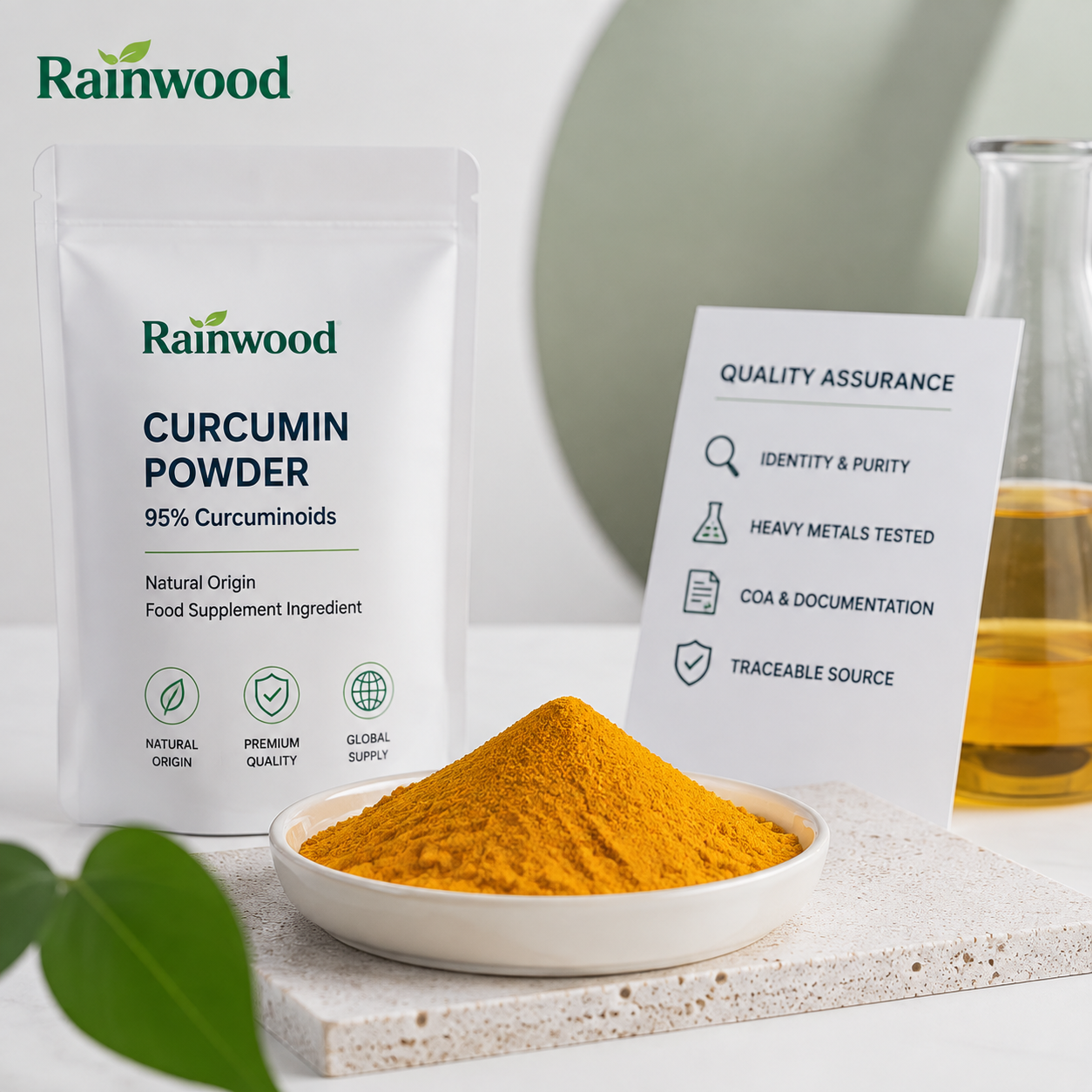
Compare RainwoodBio's published curcumin powder grade with your destination specification line by line. The web page currently presents a 95% product; the purchase decision still requires current product and lot documents.
Lock the actual manufacturer behind the trading document
An importer needs to know which entity is responsible for which fact.
The seller, extract manufacturer, laboratory, and logistics provider may be different entities. That is acceptable only when the chain is clear and the documents reconcile.
Build an entity map before approval:
1. Contracting seller and payment recipient.
2. Actual manufacturer of the commercial grade.
3. Botanical raw-material source and declared country of origin.
4. Sampling party and sampling location.
5. Testing laboratory for each reported result.
6. Exporter of record and shipping party.
7. Party responsible for complaints, retesting, replacement, and corrective action.
Then match legal names, addresses, product codes, lot numbers, and dates across the specification, COA, test reports, labels, packing list, invoice, and certificate package. A logo is not traceability. Matching records are.
RainwoodBio's website describes supplier management and traceability steps. For a curcumin project, ask for the documents that demonstrate how those steps apply to the exact source, manufacturer, and lot.
Do not let certification replace product qualification
Certificates can support confidence in a named management system, site, or activity. They do not automatically prove that a particular curcumin batch is natural, meets 95% total curcuminoids, or satisfies your customer's contaminant limits.
Before using a certificate in supplier approval, verify:
- issuer and current validity;
- exact legal entity and address;
- covered facility or site;
- scope and activities;
- product or category coverage where relevant;
- audit or certificate status;
- connection to the entity manufacturing your grade.
A certificate screenshot on a website is company-published context. It becomes useful evidence only after the current document and scope are checked. Keep this distinction visible in your supplier file so sales language does not outrun quality evidence.
Design the authentication plan around commercial risk
Testing everything with the most expensive method is not smart procurement. Testing nothing beyond the supplier's headline result is not smart either.
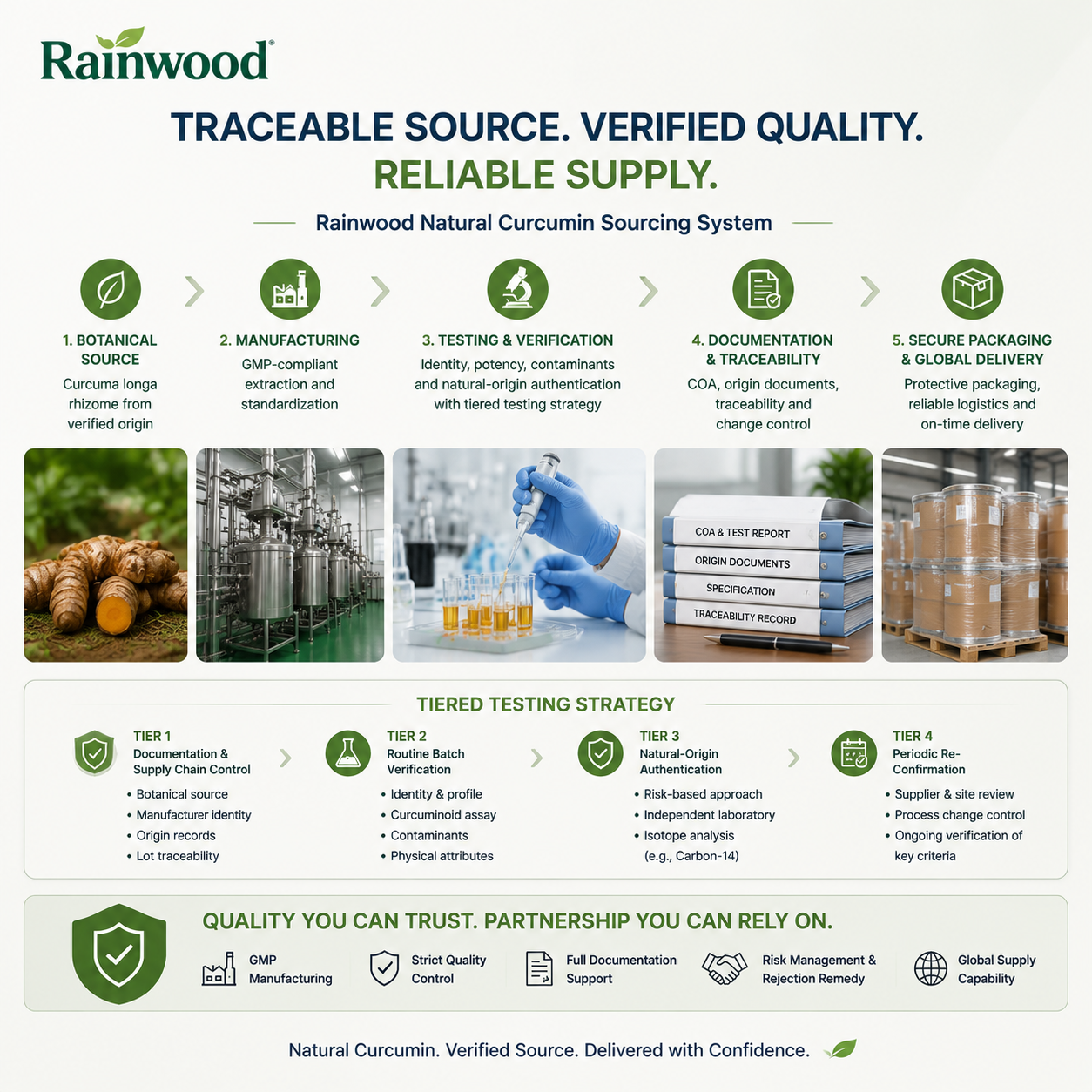
Use a tiered plan:
Tier 1: document and supply-chain control
Confirm botanical name, plant part, origin, actual manufacturer, extraction/purification description, product code, lot traceability, and change-notification obligations.
Tier 2: routine lot verification
Define fit-for-purpose identity, total curcuminoid assay, component profile where required, relevant contaminants, and physical attributes. State methods, laboratories, sampling, frequency, and acceptance criteria.
Tier 3: targeted natural-origin authentication
Use a qualified independent laboratory and an appropriate technique when the natural-origin claim, price gap, supplier history, market positioning, or anomaly makes additional authentication necessary. Agree in advance how results will be interpreted and what happens after a failure.
Tier 4: periodic reconfirmation
Reconfirm key results based on supplier performance, volume, changes, complaints, market intelligence, and risk. A supplier approved three years ago is not automatically qualified for a changed plant, process, or grade today.
This approach spends money where it changes the release decision.
Put failure handling into the purchase order
The weakest qualification plan is the one that discovers a problem but has no contractual path to resolve it.
Before the order, define:
- the controlling specification and version;
- approved manufacturer, origin, and grade;
- pre-shipment document deadline;
- sample and independent-test rights;
- agreed laboratory or referee-laboratory process;
- rules for discrepant results;
- quarantine, rejection, replacement, refund, and disposal responsibility;
- notification and approval requirements for changes;
- response times for investigations and corrective actions.
If these terms appear only after a failed result, you are negotiating from inside the loss.
Explore RainwoodBio's OEM and requirement-confirmation workflow when the purchase will feed a finished supplement project. Raw-material acceptance and finished-product feasibility should be connected before the commercial lot is committed.
The released-kilogram decision gate
Approve a supplier only when every answer is documented:
- Specification: Are both quotes based on the same grade, profile, basis, tests, and physical requirements?
- Source: Is the natural-origin claim supported at the level your risk requires?
- Entity: Can you identify the seller, manufacturer, sampler, laboratory, and responsible complaint party?
- Lot: Will every document and container be linked to the commercial batch?
- Testing: Are methods, limits, actual results, and independent confirmation responsibilities clear?
- Market: Does the package match the destination and downstream customer's requirements?
- Logistics: Are packaging, storage, Incoterms, insurance, and destination charges normalized?
- Remedy: Is there a practical path after a discrepant or failed result?
- Change control: Must the supplier notify you before changing source, plant, process, method, or specification?
Now recalculate the offer:
`Released cost per kg = purchase price + testing + freight + duties + handling + financing + expected delay/rejection cost`
The last term will be an estimate, but acknowledging it is better than pretending it is zero.
Request a two-quotation curcumin normalization and source check. Send RainwoodBio both quotations, COAs, specifications, target market, Incoterms, quantity, and required natural-origin position; the team can build a side-by-side gap list and identify the questions that must be answered before supplier approval.
Frequently asked questions
1.Does a 95 percent curcuminoid profile prove natural origin?
Not by itself. A profile can support identity and composition, but research shows that synthetic material can be difficult to distinguish when ratios resemble natural curcuminoids. Use supply-chain evidence and targeted authentication appropriate to the commercial risk.
2.Should every curcumin shipment receive carbon-14 testing?
Not automatically. The method can be valuable, but the testing plan should reflect supplier history, claim importance, price anomaly, volume, customer requirements, and available validated approaches. Agree the laboratory, interpretation, and action limits before testing.
3.Is the lowest curcumin quote always the highest risk?
No. Price alone does not establish quality or misconduct. The problem is an unnormalized quote. Compare the grade, evidence package, testing, logistics, lead time, and remedy before deciding which offer delivers the lowest released cost.
4. What supplier change should trigger requalification?
A change in manufacturer, botanical source, origin, extraction or purification process, grade, specification, analytical method, key subcontractor, or packaging may justify review. Define notification and approval thresholds in the quality agreement.
References
- USP-NF, Curcuminoids monograph: https://doi.usp.org/USPNF/USPNF_M2499_04_01.html
- Stable Isotope Ratio Analysis for the Authentication of Natural Antioxidant Curcuminoids: https://pmc.ncbi.nlm.nih.gov/articles/PMC9952763/
- Electronic Code of Federal Regulations, 21 CFR 111.70: https://www.ecfr.gov/current/title-21/chapter-I/subchapter-B/part-111/subpart-E/section-111.70
- Electronic Code of Federal Regulations, 21 CFR 111.75: https://www.ecfr.gov/current/title-21/chapter-I/subchapter-B/part-111/subpart-E/section-111.75
- RainwoodBio curcumin powder page: https://www.rainwoodbio.com/best-selling-curcumin-powder-good-quality-95-curcumin-powder-for-bulk-buyers
- RainwoodBio OEM page: https://www.rainwoodbio.com/oem
- RainwoodBio About Us page: https://www.rainwoodbio.com/about-us
*This article is for international B2B procurement and educational purposes. Authentication, sampling, testing, contract, customs, safety, and regulatory requirements must be confirmed for the exact ingredient, lot, customer, and destination market.*