 EN
EN
Meta title: Curcumin Bioavailability Claims: Compare the Formula
Meta description: Stop choosing curcumin by the biggest absorption multiplier. Compare study design, active dose, delivery system, safety, format, and claim fit.
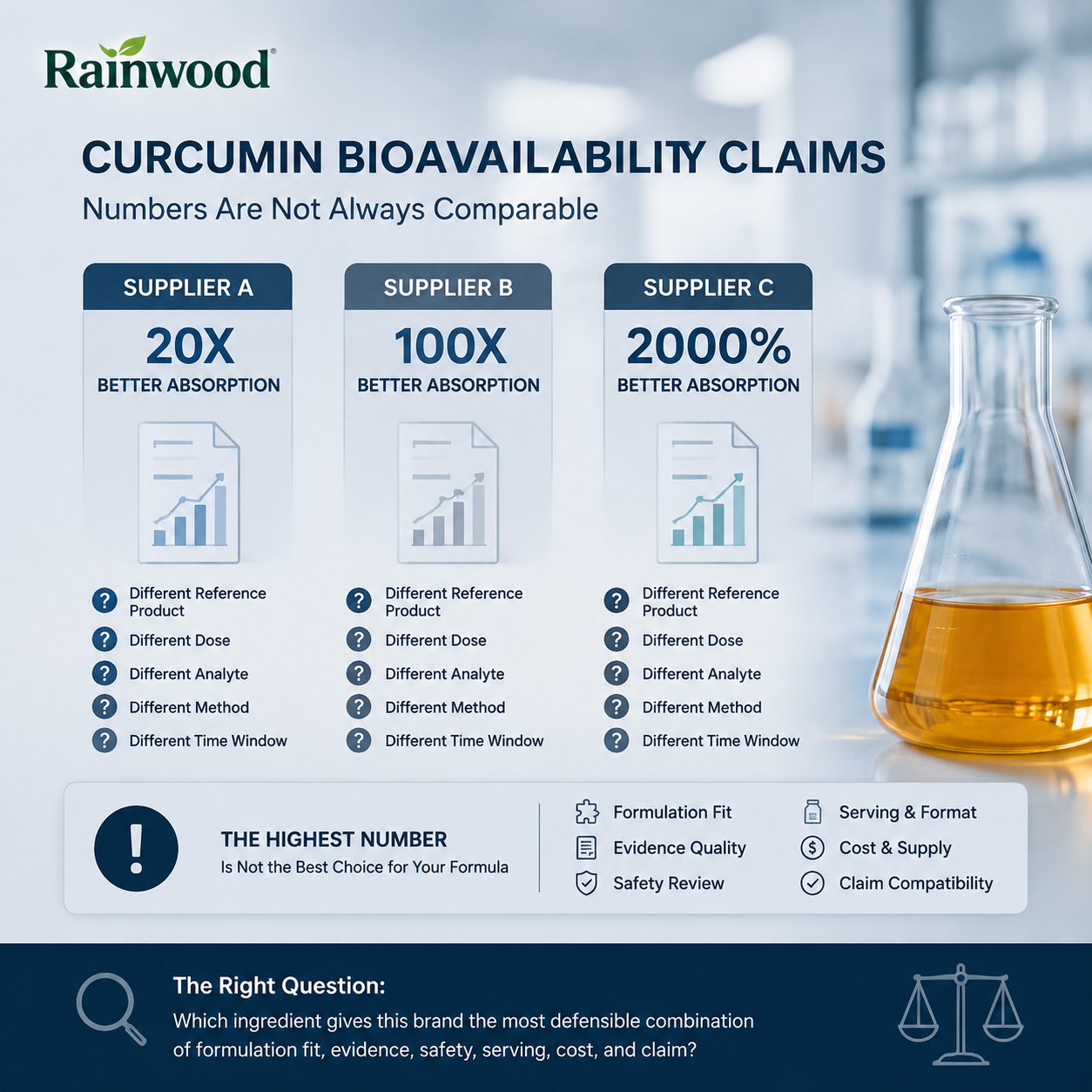
One supplier promises 20 times better absorption. Another says 100 times. A third leads with 2,000%.
The biggest number feels like the obvious winner—until you discover that the studies used different reference products, doses, analytes, blood-processing methods, and time windows. Then the multiplier stops being a product fact and becomes a comparison that may not survive contact with your formula.
For an Amazon or DTC product manager, the right question is not “Which curcumin has the highest multiplier?” It is “Which ingredient gives this brand the most defensible combination of formulation fit, evidence, safety review, serving, cost, and claim?”
That decision requires a scorecard, not a slogan.
Start by separating four different products called curcumin
The market uses one familiar word for materially different inputs:
1. Standardized extract: commonly sold by total curcuminoid content, often around a 95% specification.
2. Curcumin plus piperine: two ingredients combined with the intention of changing absorption or metabolism.
3. Lipid or phospholipid systems: curcuminoids associated with oils, phospholipids, or other lipid matrices.
4. Dispersible, colloidal, cyclodextrin, micellar, or other delivery systems: formulations designed to change solubility, dispersion, stability, or gastrointestinal behavior.
These categories can overlap, and products inside one category are not necessarily equivalent. The commercial ingredient may include carriers that reduce the percentage of curcuminoids per kilogram while improving another performance attribute. A lower assay is not automatically lower value; a higher assay is not automatically better absorbed.
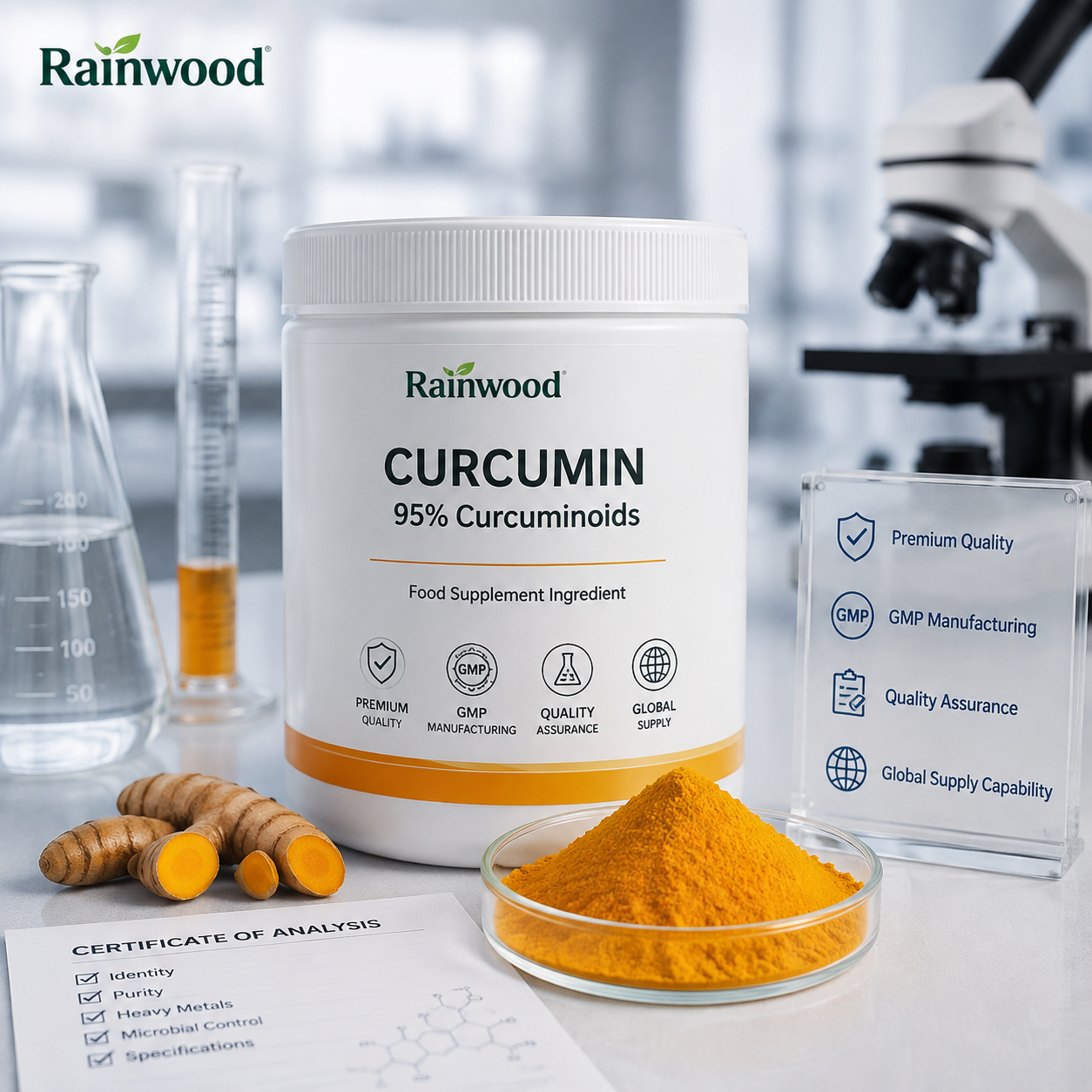
RainwoodBio currently publishes a 95% curcumin powder option. If a brand wants an enhanced-delivery formula, the purchased ingredients, process, and evidence must be defined separately rather than implied by the 95% raw-powder listing.
Why the multiplier can mislead you
A relative-bioavailability number needs a denominator. If Product X is compared with a poorly absorbed reference at a different dose, a large multiplier may appear. If Product Y is compared with another enhanced formulation under dose-normalized conditions, the number may shrink.
The measured analyte matters too. Curcumin is rapidly transformed in the body. Some studies report free curcumin; others report conjugated curcuminoids or total curcuminoids after enzymatic treatment. Those values do not answer the same biological question.
A 2021 human crossover study compared standard extract, a micellar preparation, a piperine-curcuminoid combination, a phytosome formulation, and a dried colloidal suspension. Results differed depending on dose normalization and whether unconjugated curcuminoids, parent compounds, metabolites, or totals were assessed. The piperine combination did not significantly outperform the standard extract for the evaluated measures in that trial.
A separate 2021 randomized crossover study comparing several strategies found significant increases for micellar and gamma-cyclodextrin formulations under its conditions and concluded that post-digestive stability and solubility were important. A 2025 independent pharmacokinetic study also reported minimal unconjugated curcumin in plasma for several products and no benefit from adding piperine in that experiment.
No study establishes a universal winner.
First complete the clinically studied curcumin evidence check.
The piperine decision deserves more than one famous number
The widely repeated 2,000% figure traces to a small human pharmacokinetic study published in 1998 that evaluated 2 grams of curcumin with 20 milligrams of piperine. It is a real study, but it is not a universal property of every curcumin-piperine supplement.
Later work has used different methods and produced different findings. Piperine can also affect metabolic enzymes and drug disposition, which makes safety and interaction review part of the formulation decision—not a footnote added after marketing approves the claim.
Ask:
- Does our exact curcumin-to-piperine ratio match the cited evidence?
- Are we measuring the same analyte and endpoint?
- Is the daily serving practical and accurately labeled?
- What safety, interaction, and warning review is required in the target market?
- Does piperine create taste, positioning, or consumer-fit issues?
- Is the claim about absorption, exposure, or a health outcome?
“Contains black pepper” is not an evidence file.
High bioavailability can change the safety question
Marketing often treats more exposure as unconditionally better. Risk assessment cannot.
The UK Committee on Toxicity's 2024 statement on turmeric and curcumin supplements concluded that rare individuals may experience idiosyncratic adverse liver effects and identified highly bioavailable micellar, nano, and micro formulations as an area needing further assessment. The statement also notes that substantial exposure above the relevant acceptable daily intake can present potential risk, particularly with concomitant medicines or altered hepatobiliary function.
This does not mean every enhanced curcumin product is unsafe. It means the safety assessment must match the actual ingredient, exposure, delivery system, intended consumer, and market. A brand cannot claim a superior absorption system and simultaneously treat it as identical to standard curcumin for every safety decision.
Build safety review into formula selection before purchasing premium material.
Compare cost per supported serving, not cost per kilogram
Assume two ingredients:
- Ingredient A: 95% total curcuminoids, lower cost per kilogram.
- Ingredient B: a delivery-system complex with lower curcuminoid percentage and higher cost per kilogram.
Ingredient A may require more raw-material mass to achieve the selected curcuminoid serving. Ingredient B may use less curcuminoid mass but add carrier mass, licensing conditions, or a different evidence package. Either could be the better commercial choice.
Use this calculation:
`Ingredient input per serving = target amount of defined active / guaranteed active fraction`
Then add:
- delivery-system or co-ingredient inputs;
- required excipients;
- capsule, softgel, gummy, or powder serving count;
- testing and documentation cost;
- branded-ingredient or evidence-use cost where applicable;
- packaging and stability requirements;
- cost of the claims you can actually substantiate.
The lowest raw-material price can create the highest serving count. The highest bioavailability price can buy a story your exact product cannot use. Both are avoidable.
Use this eight-part formulation scorecard
Score each option from 1 to 5, then require written evidence for any score above 3.
| Decision area | Question |
|---|---|
| Ingredient definition | Is composition, source, carrier system, and manufacturer clear? |
| Evidence match | Do human studies test the exact or scientifically bridged ingredient? |
| Analytical meaning | Are analytes, reference, dose normalization, and time window understood? |
| Finished dose | Can the selected serving deliver the intended ingredient and active amounts? |
| Format fit | Does the material work in the chosen capsule, softgel, gummy, or powder matrix? |
| Safety review | Are exposure, interactions, warnings, consumer group, and market requirements addressed? |
| Claim value | Can the brand make a clear, permitted, evidence-supported distinction? |
| Commercial cost | What is the cost per tested, supported, saleable daily serving? |
Do not average away a fatal weakness. A formulation that scores five on marketing but one on evidence match should not pass.
Test the actual format, not just the raw ingredient
Curcumin is poorly water-soluble and sensitive to formulation conditions. Research reports that light, pH, and the surrounding system can affect stability. A raw-material data sheet therefore cannot predict every finished-product outcome.
For the selected format, confirm:
- dispersion and sediment behavior where water is involved;
- color transfer and staining;
- taste and masking requirements;
- interaction with oils, emulsifiers, minerals, flavors, and other actives;
- processing temperature and hold time;
- packaging protection from light and moisture;
- active retention through the proposed shelf life;
- finished-product assay, uniformity, and release plan.
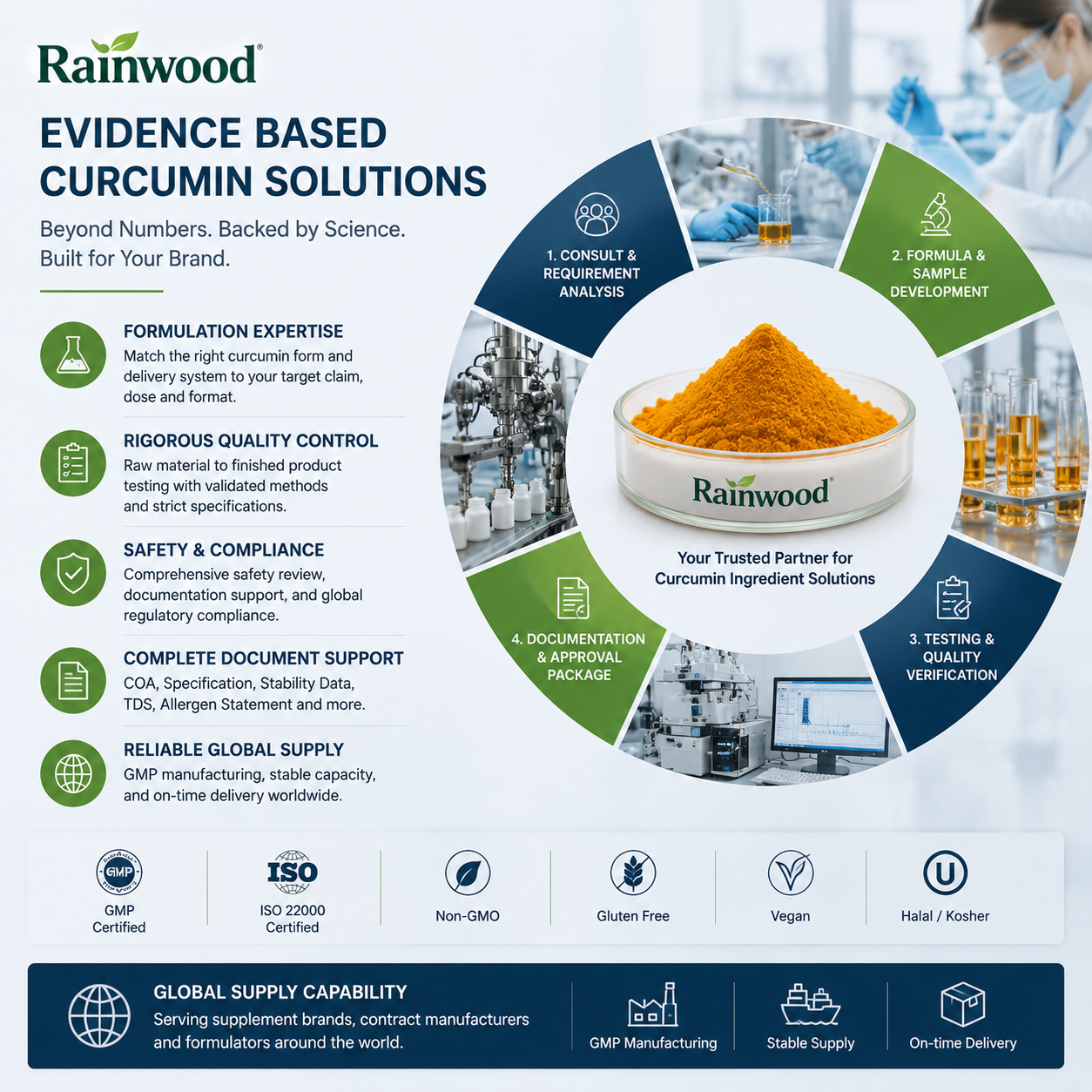
RainwoodBio's website describes multi-format OEM and sample development covering hard capsules, gummies, powder formats, tablets, and softgels. Treat that range as a reason to compare prototypes, not as proof that every curcumin system will perform in every format.
How RainwoodBio can structure the decision
A useful curcumin project should start with four inputs: target market, proposed claim, daily serving, and desired dosage form. Then the team can compare raw-material input, carrier load, serving count, prototype behavior, document availability, and required testing.
RainwoodBio's published requirement-confirmation and testing/release workflow can support this process when each step is converted into a project deliverable. Request the exact ingredient specification, formulation bill of materials, sample protocol, finished-product acceptance criteria, and change-control record.
Review RainwoodBio's published formulation and release process and confirm the product-level evidence before using an absorption or performance statement.
The decision your brand should be able to defend
Choose the formulation only when you can complete this sentence:
“We selected this curcumin ingredient because its exact composition and evidence support our proposed market, serving, format, safety assessment, and claim—and our commercial sample passed the agreed finished-product tests.”
If the sentence ends with “because it has the biggest multiplier,” the comparison is not finished.
Request a curcumin delivery-system and formula comparison. Send RainwoodBio the candidate ingredient specifications, studies, target market, proposed claims, daily serving, format, quantity, and target cost; the team can calculate input mass and serving implications, identify missing evidence, and recommend the next prototype questions.
Frequently asked questions
1.Is a higher curcumin bioavailability multiplier always better?
No. The number depends on the reference, dose, analyte, method, and study design. It also does not automatically establish clinical efficacy, safety, format suitability, or commercial value.
2.Does adding piperine always increase curcumin absorption by 2,000 percent?
No. The widely quoted result came from a specific small study with defined doses. Later studies using other designs have reported different outcomes. Evaluate the exact formula and full evidence rather than treating the figure as universal.
3.Can a brand compare two curcumin products using assay alone?
Assay is only one input. Compare composition, delivery system, evidence, active and ingredient dose, safety file, format behavior, claims, testing, and cost per supported serving.
4.Should enhanced-bioavailability curcumin receive a separate safety review?
Yes. Any formulation that materially changes exposure or contains additional delivery ingredients should be assessed as the actual commercial formula for the intended consumer and market.
References
- Pharmacokinetics of a Single Dose of Turmeric Curcuminoids Depends on Formulation: https://pubmed.ncbi.nlm.nih.gov/33877323/
- Increasing Post-Digestive Solubility of Curcumin: https://pubmed.ncbi.nlm.nih.gov/34665507/
- A Pharmacokinetic Study and Critical Reappraisal of Curcumin Formulations: https://pubmed.ncbi.nlm.nih.gov/40487425/
- Influence of Piperine on the Pharmacokinetics of Curcumin: https://pubmed.ncbi.nlm.nih.gov/9619120/
- UK Committee on Toxicity, Turmeric and Curcumin Supplements: https://cot.food.gov.uk/Turmeric%20and%20Curcumin%20Supplements%20-%20Summary%20and%20conclusions
- Stabilization and stability evaluation of curcumin: https://pmc.ncbi.nlm.nih.gov/articles/PMC2904446/
- RainwoodBio OEM page: https://www.rainwoodbio.com/oem
*This article is for international B2B formulation and educational purposes. Pharmacokinetic, clinical, safety, labeling, advertising, and regulatory conclusions must be confirmed for the exact ingredient, finished formula, dose, consumer group, claim, and destination market.*