 EN
EN
Meta title: Clinically Studied Curcumin: Can Your Brand Prove It?
Meta description: A curcumin study may not support your ingredient, dose, formula, or claim. Use this evidence chain before approving labels, listings, and ads.
“Clinically studied curcumin” looks powerful on a product page. It can also be dangerously incomplete.
The study may have tested a named micellar formula while your capsule contains generic 95% extract. It may have used a different daily dose, a different population, and a different endpoint. It may have measured blood levels after one dose while your copy implies a lasting health outcome. The research can be real and your claim can still outrun it.
For an Amazon or DTC supplement brand, that gap does not stay inside a scientific file. It reaches the label, advertising, customer questions, platform review, refunds, and reputation. The issue is not whether curcumin has been studied. The issue is whether your exact product claim is supported by evidence relevant to your exact product.
The study-to-product chain breaks more easily than brands expect
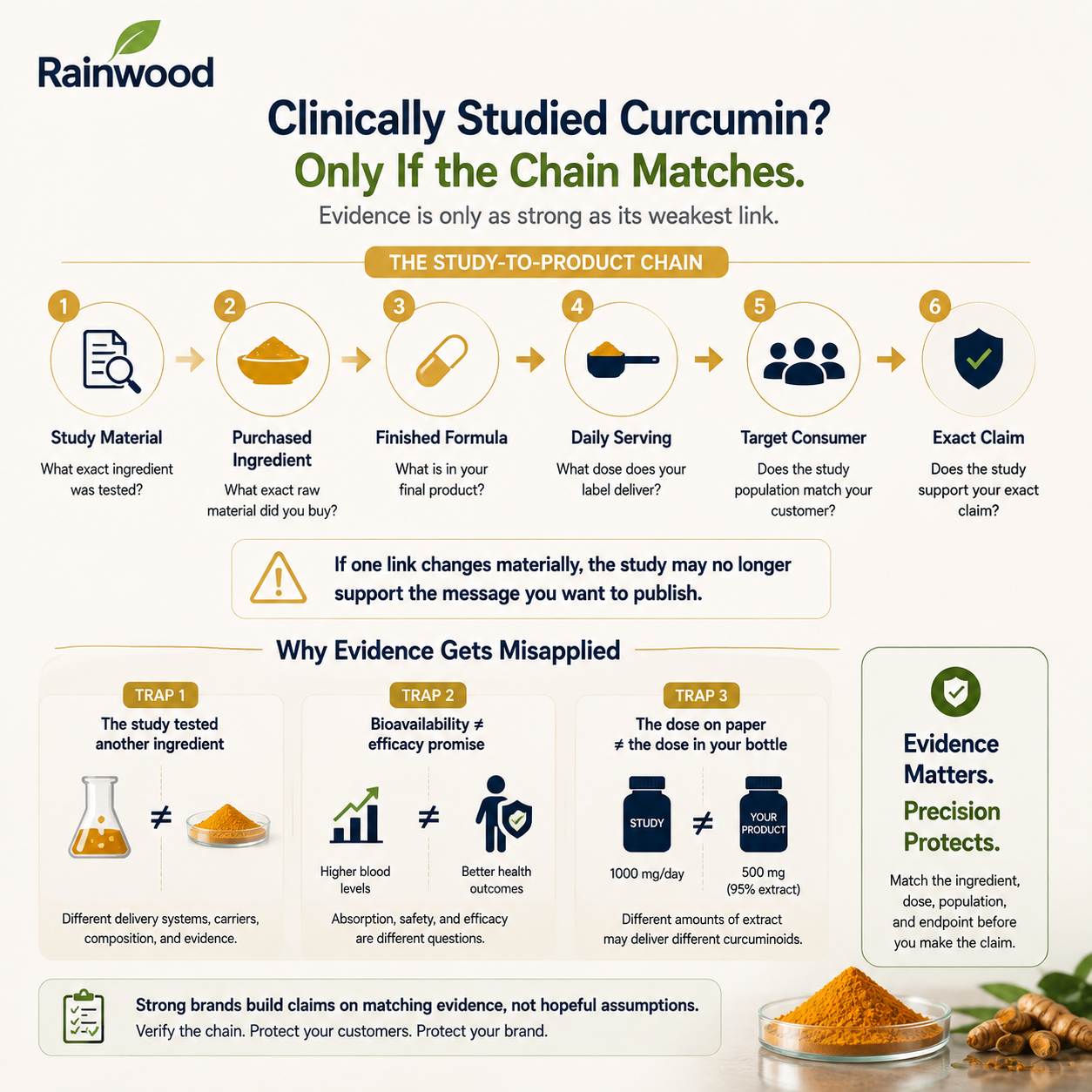
Every defensible claim must travel through a chain:
`study material -> purchased ingredient -> finished formula -> daily serving -> target consumer -> exact claim`
If one link changes materially, the study may no longer support the message you want to publish.
Check the ingredient first. “Curcumin,” “turmeric extract,” “95% curcuminoids,” “curcumin with piperine,” “phospholipid complex,” “micellar curcumin,” and “water-dispersible curcumin” are not interchangeable labels. They can differ in composition, carriers, delivery system, dose, pharmacokinetics, and evidence.
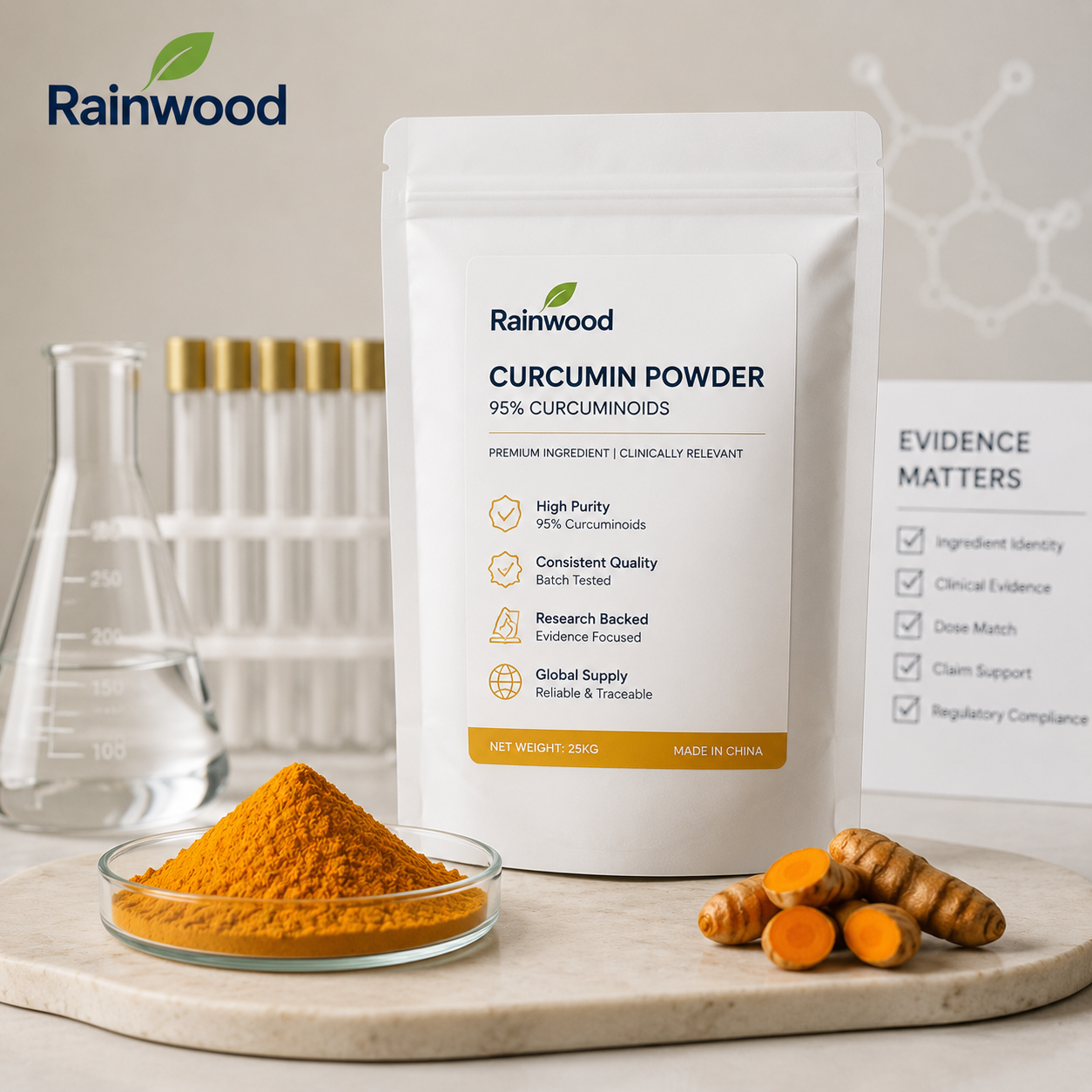
RainwoodBio currently publishes a 95% curcumin powder product. That page establishes company product context; a brand still needs current specifications and lot evidence, and it must not attach research from another delivery technology without a documented bridge.
Evidence borrowing trap 1: the study tested another ingredient
This is the most common conceptual error: the paper contains the word “curcumin,” so marketing treats it as evidence for every curcumin product.
Open the methods section and identify:
- the exact commercial or experimental material;
- manufacturer or formulation owner, if reported;
- curcuminoid composition and delivery technology;
- dose per administration and per day;
- excipients or co-ingredients;
- comparator;
- analytical method;
- study population, duration, and endpoint.
Then compare those fields with your raw-material specification and finished-product master formula. A match on the ingredient category is not enough.
If the study used a branded formulation, confirm that your purchased ingredient is that authorized formulation and that you have the right to use the trademark, study, and associated claims. Buying generic powder with a similar assay does not transfer identity or evidence rights.
The buyer loss is bigger than a compliance correction. Your brand may pay premium acquisition costs to build demand around a point of difference it cannot prove. When the evidence gap is discovered, you may need to rewrite ads, redesign packaging, change the formula, or abandon the differentiator after launch.
Evidence borrowing trap 2: bioavailability becomes an efficacy promise
Pharmacokinetic studies can compare what was measured in blood after specific formulations and doses. They do not automatically prove a clinical benefit.
Human crossover research has shown that reported curcuminoid exposure depends heavily on the formulation and analytical choices. Studies may measure free curcumin, conjugated curcuminoids, multiple metabolites, or totals after enzymatic deconjugation. A large exposure multiplier can also depend on the reference product and dose-normalization method.
Before writing “better absorbed,” ask:
1. Better than what exact reference?
2. At what dose?
3. Which analyte was measured?
4. Was the comparison dose-normalized?
5. Was the result statistically and practically meaningful?
6. Does your commercial formula match the tested formula?
7. What consumer-facing conclusion does the study actually support?
Do not turn “higher total plasma curcuminoids after a single dose” into “works better” without suitable outcome evidence. Absorption, safety, and efficacy are different questions.
Use the paired curcumin bioavailability formula comparison before selecting a premium delivery system.
Evidence borrowing trap 3: the dose on paper is not the dose in your bottle
Suppose a study administered 1,000 mg of a defined curcumin formulation per day. Your Supplement Facts panel lists 500 mg of turmeric extract, standardized to 95% curcuminoids. Those are not automatically equivalent quantities.
For a simple standardized extract, 500 mg at a guaranteed 95% assay corresponds to 475 mg of total curcuminoids before considering the exact basis, manufacturing variation, and finished-product verification. For a formulated ingredient, the labeled ingredient mass may include carriers or a delivery matrix, so the curcuminoid amount can be lower even when the research supports that particular complex.
Your evidence table should show all three:
- milligrams of the commercial ingredient;
- milligrams of total curcuminoids or other defined actives;
- daily serving and number of units required.
If the study and label use different definitions, marketing should not smooth over the difference.
Evidence borrowing trap 4: a safe-sounding disclaimer does not cure a bad claim
In the United States, FDA says structure/function claims must be truthful and not misleading, supported before use, notified to FDA within the required timeframe, and accompanied by the prescribed disclaimer. FDA also distinguishes these statements from disease claims, which can cause a supplement to be regulated as a drug unless another authorized pathway applies.
FTC guidance addresses advertising more broadly. It says health-related claims generally require competent and reliable scientific evidence and instructs marketers to examine both express and implied messages. A small disclaimer cannot neutralize a bold headline that conveys an unsupported outcome.
For international brands, do not assume the U.S. framework applies everywhere. Build a market column into the claims file and obtain jurisdiction-specific review. A phrase accepted in one channel or country may be restricted in another.
RainwoodBio's OEM requirement and formula confirmation service can be used as the project entry point, but legal claim approval remains market- and product-specific.
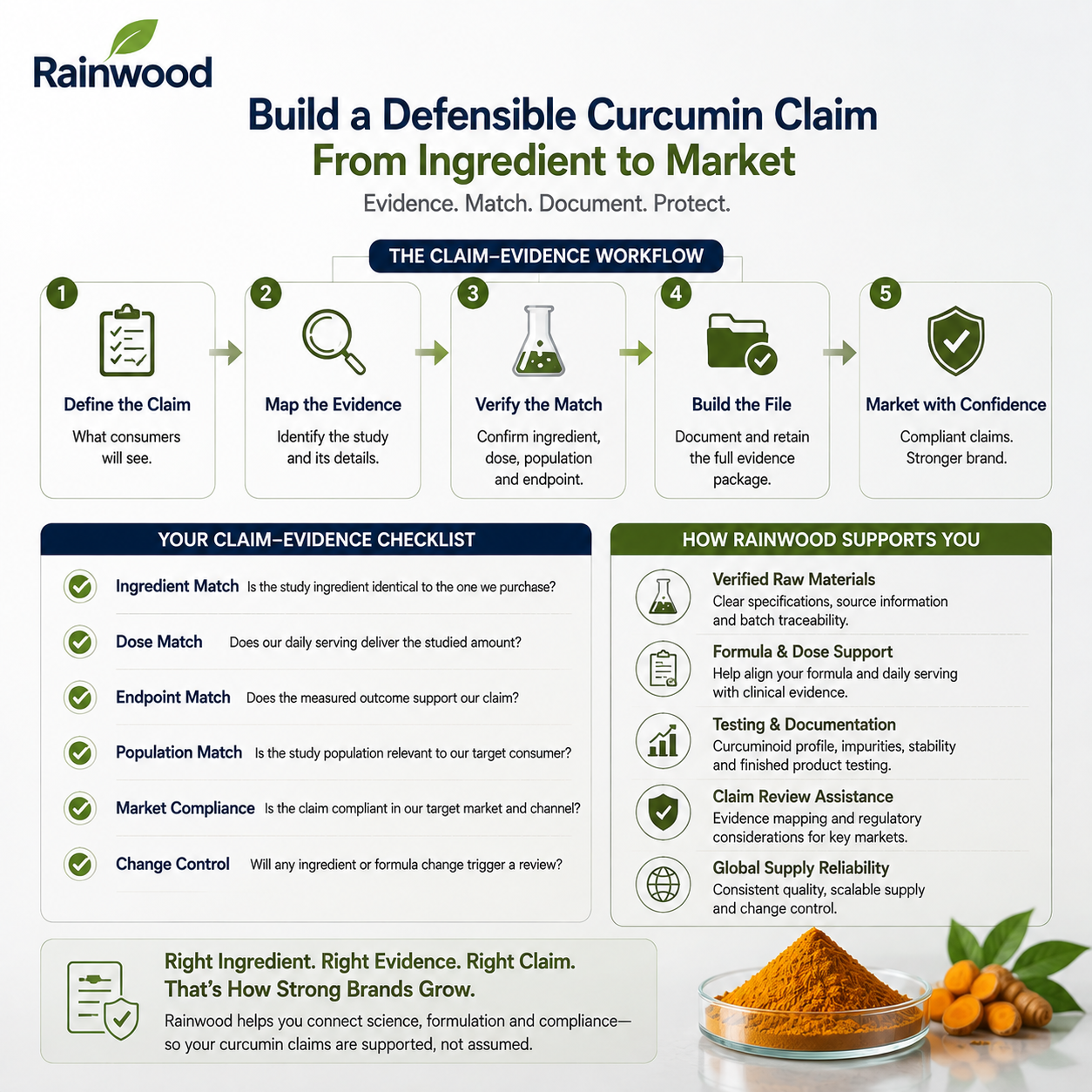
Build a claim-evidence file before approving artwork
For every proposed headline, bullet, image, testimonial, comparison, and FAQ answer, complete this table:
| Field | Required answer |
|---|---|
| Proposed claim | Exact words the consumer will see |
| Implied message | What a reasonable consumer may understand |
| Market and channel | Country, label, website, marketplace, social, or sales material |
| Evidence type | Human trial, systematic review, analytical data, or other support |
| Study material | Exact ingredient and delivery system tested |
| Commercial match | Supplier, grade, composition, and authorization link |
| Dose match | Study dose versus finished daily serving |
| Population match | Study subjects versus intended consumer |
| Endpoint match | What was actually measured and for how long |
| Limitations | Conflicts, sample size, duration, analyte, or generalizability |
| Decision | Approve, qualify, rewrite, request evidence, or reject |
This table forces marketing, regulatory, product development, and procurement to review the same sentence. It also reveals when a formula change silently invalidates previously approved copy.
How RainwoodBio can support an evidence-matched project
RainwoodBio's website describes formula confirmation, product documentation, and sample-to-release review. Those published steps can support a disciplined evidence process when translated into project records.
For a curcumin brand, request:
- the exact ingredient specification and composition;
- source and manufacturer information;
- formula input and daily serving calculation;
- authorization documents for any named or trademarked ingredient;
- finished-product test plan;
- a change-control rule that triggers claims-file review;
- market-specific label and advertising review responsibilities.
Review RainwoodBio's published company and documentation workflow, then confirm which records exist for the exact product. Website statements should not be presented as product-, batch-, or finished-formula evidence.
The five-question artwork release gate
Do not approve the claim until the owner of the evidence can answer yes to all five:
1. Is the study material the same as, or scientifically bridged to, the purchased ingredient?
2. Does the finished product deliver the relevant studied dose and serving pattern?
3. Does the evidence measure the outcome the claim communicates?
4. Is the statement permitted and properly qualified in the destination market and channel?
5. Will source, formula, or supplier changes trigger documented re-review?
If the answer is “we use curcumin too,” the claim is not ready.
Request a curcumin label and claim evidence-gap review. Send RainwoodBio your draft label, product-page copy, formula, ingredient specification, target market, and the studies you plan to cite; the team can map the missing product inputs and prepare a structured question list for your regulatory reviewer.
Frequently asked questions
1.Can a generic 95 percent curcumin extract use a study on a branded formulation?
Not automatically. The branded study may depend on a specific composition, delivery system, dose, and authorized material. Confirm ingredient identity, evidence relevance, and rights before using the study or trademark.
2.Does a bioavailability study prove that the product is clinically effective?
No. A pharmacokinetic study measures exposure under defined conditions. A clinical outcome claim requires evidence that directly and reliably supports that outcome for a relevant product, dose, population, and use.
3.Is the standard FDA disclaimer enough to protect an unsupported claim?
No. FDA guidance states that structure/function claims require substantiation and must be truthful and non-misleading. FTC guidance also evaluates the overall express and implied advertising message. A disclaimer does not repair a claim that lacks support.
4.When should a brand reopen its claims file?
Re-review after changes to supplier, ingredient, grade, delivery technology, formula, dose, serving, target population, market, advertising language, or relevant scientific evidence.
References
- FDA, Structure/Function Claims: https://www.fda.gov/food/nutrition-food-labeling-and-critical-foods/structurefunction-claims
- FDA, Substantiation for Dietary Supplement Claims: https://www.fda.gov/regulatory-information/search-fda-guidance-documents/guidance-industry-substantiation-dietary-supplement-claims-made-under-section-403r-6-federal-food
- FTC, Health Products Compliance Guidance: https://www.ftc.gov/business-guidance/resources/health-products-compliance-guidance
- Pharmacokinetics of a Single Dose of Turmeric Curcuminoids Depends on Formulation: https://pubmed.ncbi.nlm.nih.gov/33877323/
- A Pharmacokinetic Study and Critical Reappraisal of Curcumin Formulations: https://pubmed.ncbi.nlm.nih.gov/40487425/
- RainwoodBio curcumin powder page: https://www.rainwoodbio.com/best-selling-curcumin-powder-good-quality-95-curcumin-powder-for-bulk-buyers
- RainwoodBio OEM page: https://www.rainwoodbio.com/oem
This article is for international B2B procurement, formulation, and educational purposes. Scientific substantiation, safety, labeling, advertising, trademark, and regulatory requirements must be reviewed for the exact ingredient, finished product, claim, channel, and destination market.