 EN
EN
Meta title: The Zinc Oxide Plus Glycine Chelate Trap
Meta description: Some low-cost materials contain zinc and glycine without proving a completed zinc bisglycinate reaction. Learn how importers can expose the difference.
Zinc oxide is cheap. Glycine is cheap. Put them in the same bag, adjust the numbers and the powder may look suspiciously similar to a premium zinc glycinate quotation.
But proximity is not chelation.
The real commercial question is whether the supplier manufactured and controlled the intended zinc-glycine complex—or simply sold ingredients that could produce acceptable total-zinc and total-glycine results.
If your purchase decision relies only on those two assays, the substitute may pass every test you requested.
The dry-blend illusion
Imagine two samples:
- Sample A is produced through a controlled reaction, purification and drying process intended to create zinc bisglycinate.
- Sample B is a physical mixture of zinc oxide, glycine and perhaps a carrier.
Both can contain zinc. Both can contain glycine. Both may be white powders. Both can be adjusted to the same declared elemental percentage.
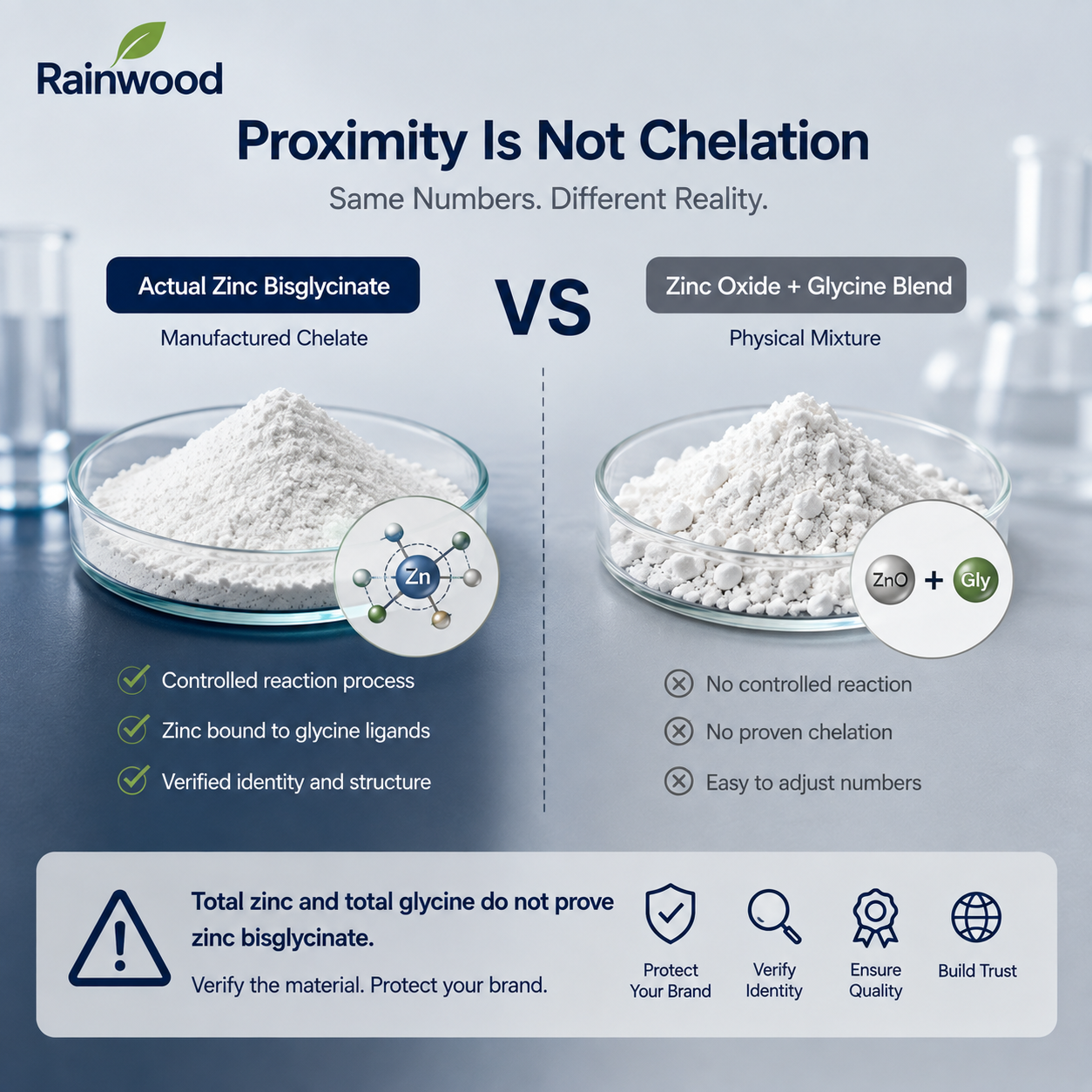
A weak specification therefore rewards the cheapest way to hit the numbers.
Use our raw-material identity checklist to define what must be proven beyond total assay.
Why “the raw materials react in the stomach” is not an acceptable answer
When challenged, a seller may argue that zinc and glycine are present together and will behave similarly after ingestion. That avoids the purchase specification.
If the product was sold as a manufactured chelate, the buyer paid for a defined raw material and may be using that form in labels, product pages and bioavailability messaging. A theory about later reaction does not prove the supplied ingredient matches the order.
It also ignores formulation variables such as pH, competing ligands, other minerals, excipients and processing. Do not let an unverified physiological story repair a raw-material identity failure.
Trap 1: input records are treated as finished-product proof
A batch record showing two moles of glycine added per mole of zinc is useful process evidence. It is not, by itself, proof of conversion.
The record should connect to:
- reaction conditions;
- pH and temperature controls;
- mixing or milling parameters;
- endpoint criteria;
- purification or washing steps;
- drying conditions;
- yield and mass balance;
- free-ligand or residual-starting-material controls; and
- identity results against a qualified reference.
Input quantity tells you what entered the vessel. It does not prove what left it.
Trap 2: solubility is used as the entire identity argument
Solubility can reveal useful differences, but it is affected by pH, temperature, particle size, carriers and ionic strength. A clear solution does not automatically prove chelation, and an insoluble fraction does not identify itself.
Use solubility as one part of a broader comparison—not as a substitute for compositional and structural evidence.
Ask the supplier to show the test conditions and explain what result would distinguish the approved material from zinc oxide plus glycine.
Trap 3: a generic spectrum is copied into every dossier
A spectrum without sample identity, batch number, preparation, instrument conditions, reference comparison and interpretation can be recycled across quotations.
Request the underlying batch-specific record. The technical reviewer should identify diagnostic features and relevant limitations. If the document shows only a pretty graph with no conclusion tied to the batch, it is marketing artwork.
Read why a zinc COA may prove only total zinc.
Trap 4: the carrier disappears from the specification
Some commercial mineral preparations are standardized with carriers or processing aids. That may be completely legitimate when transparent.
The problem begins when the quotation implies pure zinc bisglycinate while the material contains a significant undeclared carrier. The buyer then pays premium pricing, calculates the formula incorrectly and may create a label or allergen inconsistency.
Require component disclosure, quantitative ranges where necessary, and alignment across specification, SDS, allergen statement and formula record.
Trap 5: the source changes after sample approval
An agent can provide an excellent sample from one producer and ship bulk from another. The second material may hit the zinc number while differing in reaction process, carrier, moisture, particle size, taste and identity evidence.
Lock:
- actual manufacturer name and site;
- manufacturer product code;
- country of origin;
- approved grade;
- process description;
- unique document identifiers;
- packaging and lot coding; and
- written approval before change.
Compare our sample-to-bulk supplier control guide.
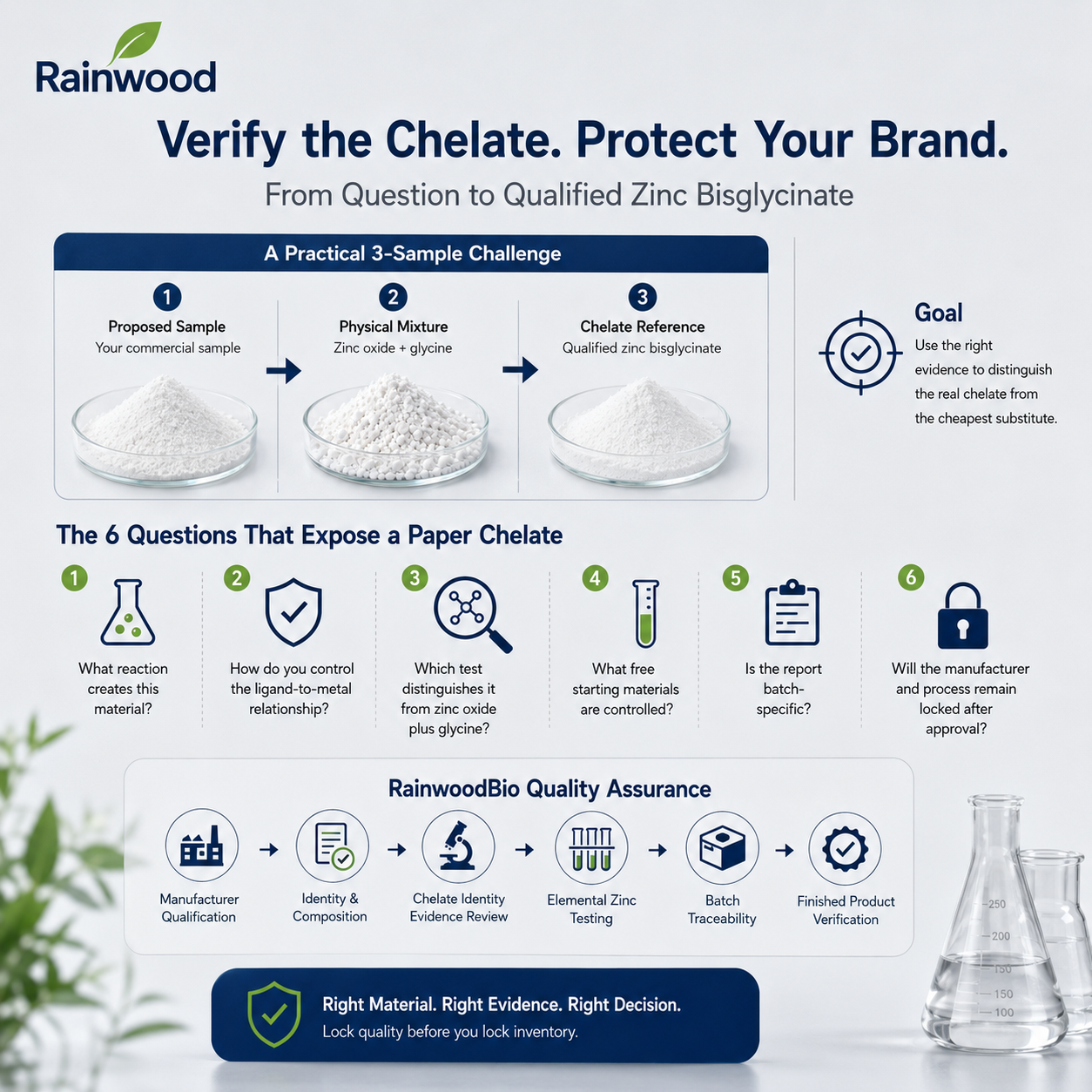
A practical three-sample challenge
Before a large order, ask the laboratory to compare:
1. the proposed commercial sample;
2. a known physical mixture of zinc oxide and glycine at similar composition; and
3. a qualified zinc bisglycinate reference or approved benchmark.
The goal is not to demand one universal test. It is to determine whether the selected evidence can actually distinguish the purchased grade from the most plausible cheap substitute.
If every method produces the same conclusion for all three samples, your test plan has little power against substitution.
Calculate the fraud economics
Suppose a premium chelate costs several dollars more per kilogram than a physical mixture. The saving per bottle may appear small, encouraging procurement teams to ignore the risk.
But the buyer’s exposure includes:
- rejected imported material;
- rework or destruction;
- corrected labels;
- lost marketplace listings;
- customer refunds;
- trademark or advertising disputes;
- failed distributor audits; and
- damage to the premium positioning.
The supplier captures the ingredient saving. The brand carries nearly every downstream loss.
How RainwoodBio can structure the evidence
RainwoodBio publishes experience in dietary ingredients, mineral supplements and private-label formats, supported by laboratory and production-control capabilities. For zinc glycinate, those capabilities should be used to build a question-specific file rather than repeat “strict quality control.”
The file can include:
- manufacturer qualification;
- approved identity and composition;
- batch traceability;
- elemental-zinc testing;
- review of suitable chelate-identity evidence;
- carrier and allergen disclosure;
- retained samples; and
- finished-product verification.
RainwoodBio’s private-label manufacturing workflow can connect the raw-material decision to capsules, tablets, powders or gummies without losing the approved source identity.
The six questions that expose a paper chelate
Ask the seller:
1. What reaction creates this material?
2. How do you control the ligand-to-metal relationship?
3. Which test distinguishes it from zinc oxide plus glycine?
4. What free starting materials are controlled?
5. Is the report batch-specific?
6. Will the manufacturer and process remain locked after approval?
Vague answers are valuable information. They tell you the premium exists in the sales language, not necessarily in the drum.
Send RainwoodBio your current specification for a zinc glycinate authenticity review. We can help convert the marketing name into a purchase specification, evidence list and sample-approval gate before you commit to bulk stock.
Frequently asked questions
1.Can zinc oxide and glycine form a chelate during manufacturing?
They can be starting materials in legitimate processes. The issue is whether controlled reaction and evidence demonstrate the intended conversion—not which starting material was selected.
2.Does a 2:1 glycine-to-zinc input ratio prove bisglycinate?
No. It supports stoichiometric intent but does not, by itself, prove conversion, purity or batch uniformity.
3.Is a physical blend necessarily unsafe?
That is not the central procurement question. A physical blend sold accurately may be evaluated on its own merits. A blend sold as a verified chelate creates identity, labeling and commercial-integrity risks.
4.What is the best authenticity test?
There is no universal one-line answer. Use a fit-for-purpose combination that can distinguish the approved material from plausible substitutes in the exact grade.
References
- U.S. Patent US11649252B2, *Energy-Efficient Solvent-Free Method for Producing Metal Chelates*: https://patents.google.com/patent/US11649252B2/en
- U.S. Patent US20060292698A1, *Spectroscopic Methods for Detecting and Identifying Chelates*: https://patents.google.com/patent/US20060292698A1/en
- U.S. Patent CN103922954A, *Method for Preparing Glycine Zinc Chelate*: https://patents.google.com/patent/CN103922954A/en
- RainwoodBio official website: https://www.rainwoodbio.com/
*This article is intended for B2B procurement education. Material identity and test suitability should be assessed by qualified technical and regulatory professionals.*